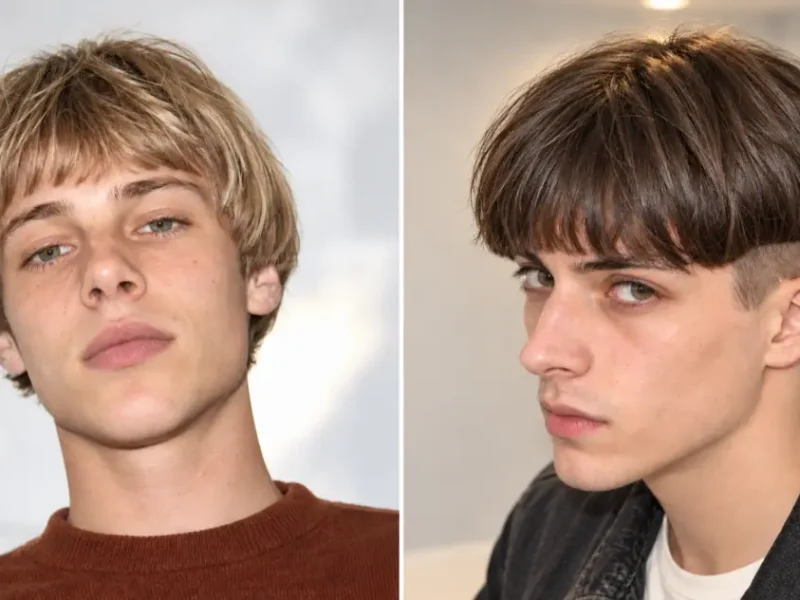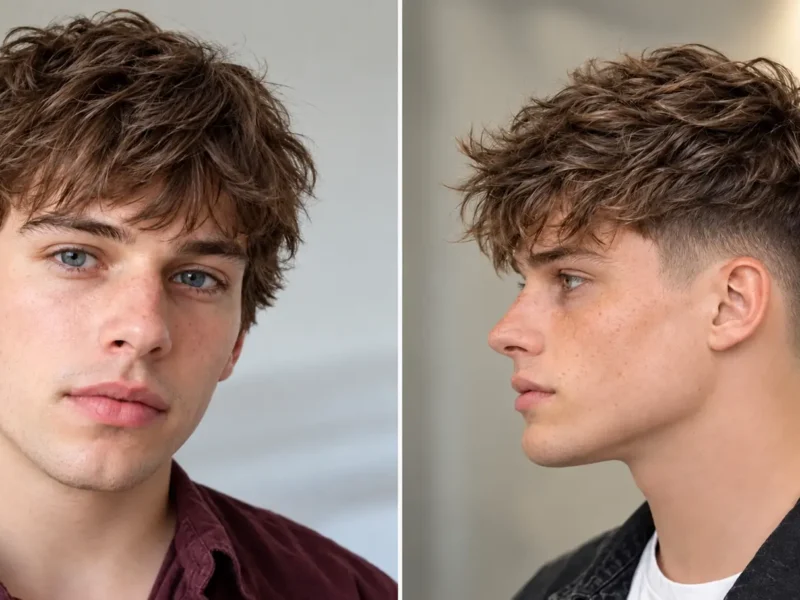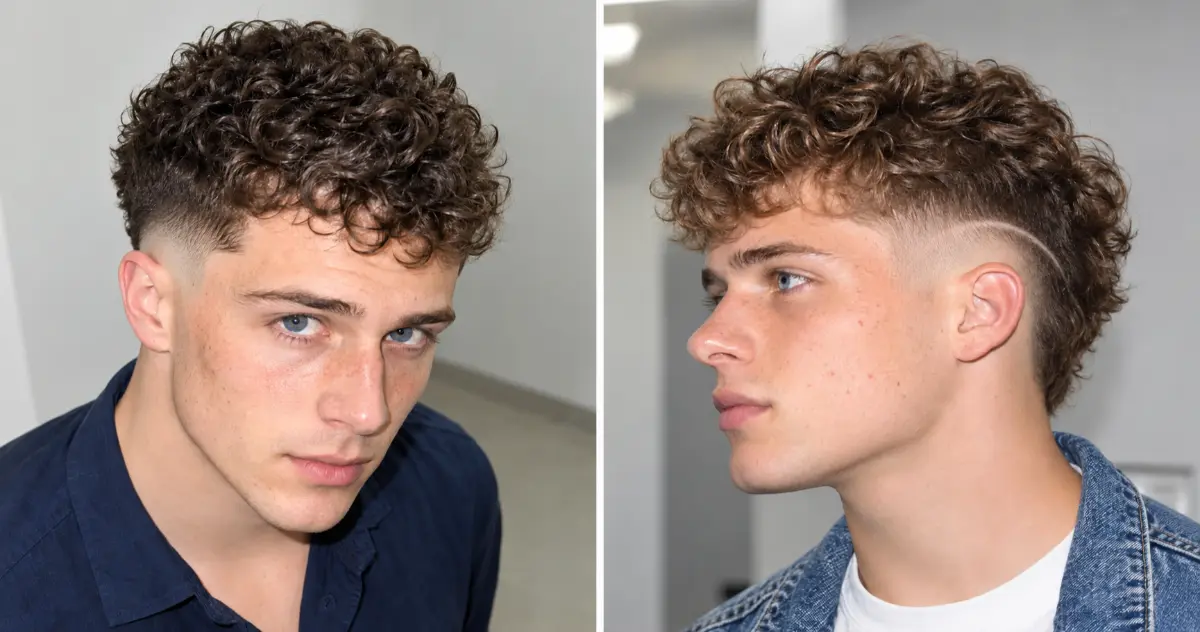
Burst fade haircuts for curly hair combine clean, curved fades around the ears with natural curls on top. When you sit down in the barber chair with your favorite reference photo, your barber will ask a few important questions: Do you prefer a low, mid, or high burst fade? Would you like a skin fade or a softer guard finish? And how much length should stay on top after your curls dry and spring back into their natural shape?
That is exactly where a burst fade on curly hair either turns out sharp or goes sideways. The cut looks simple in pictures, but it depends on a handful of decisions that rarely get explained: how high the curve sits, how close it cuts to the skin, what stays long at the nape, and how the curls behave after they dry. This guide covers all of it in plain language, from curl pattern and face shape to a word-for-word barber script, 25 real looks, styling, upkeep, cost and grow-out.
What Is a Burst Fade on Curly Hair?
A burst fade on curly hair is a half circle fade that curves around the ear and into the neckline, while the curls on top and at the back stay long. The sides look clean and sharp, the curl pattern becomes the star, and the cut works on loose waves, tight curls and coils as long as the top has enough length to show texture.
By default the neck stays long, but some men prefer a lightly tapered or rounded nape, or a guard length instead of bare skin. Tell your barber which version you want before the clippers come out.
Burst Fade for Curly Hair at a Glance
| Question | Quick answer |
|---|---|
| What is it? | A rounded fade around the ear, with curls left long on top and at the back |
| Other names | Radial fade, halo taper |
| Best heights | Low for subtle, mid for balanced (the most requested), high for strong contrast |
| Best curl types | 3A to 4C, from loose curls to tight coils |
| Barber visits | Fade every 2 to 4 weeks, sooner for high or skin finishes |
| Daily styling | Top only: leave-in, curl cream or gel, then air dry or diffuse |
| Typical US price | About $30 to $50 for a fade, higher in big cities, plus a 15 to 20 percent tip |
| Who may want to skip it | Men who cannot book regular visits, or whose skin reacts to close cuts at the nape |
| Biggest mistake | Skipping the conversation about curl shrinkage and how the barber cuts curls |
Table of Contents
What Makes a Burst Fade Different on Curly Hair?
A burst fade is a fade shaped like a half circle around the ear. The hair is shortest right behind the ear and gets gradually longer as the fade spreads outward, so the top and the back keep their length. Barbers sometimes call it a radial fade or a halo taper.
On curly hair, that shape does a little extra work. Curls tend to puff out around the ear and temple, which can make the head look wider and boxier than it really is. The curved fade clears that area, so the curls stack neatly above it instead of spilling sideways. The result is a clear contrast between sharp sides and full, textured curls, and that contrast is a big reason the cut looks so good in photos.
It also helps to know what a burst fade is not. It is a shape for the sides, not a complete haircut. The same burst can sit under a short curly crop, a fringe, a mohawk or a mullet, and the barber still needs a few more details to finish the job.
The Four Decisions Behind Every Curly Burst Fade
| Decision | Options | What it changes |
|---|---|---|
| Fade height | Low, mid or high | How far the curve climbs and how strong the contrast looks |
| Closeness | Bare skin or a guard number | How sharp the fade looks and how quickly it grows out |
| Back and nape | Natural, rounded or tapered | Whether the curls stay full at the back of the neck |
| Top length, measured dry | Short coils to long curls | How the curls read after they shrink and spring back |
Most guides stop at the first three. The fourth is the one curly hair adds, because curls shrink as they dry and the top can end up noticeably shorter than it looked in the chair.
Burst Fade vs Other Fades on Curly Hair
| Fade | Shape | What happens at the neck | Curly hair notes |
|---|---|---|---|
| Burst fade | Half circle around the ear | Left long | Keeps nape curls full and gives the strongest ear definition |
| Taper fade | Gradual trim along the sideburns and neckline | Cut shorter | Softer look that grows out more easily |
| Drop fade | Arcs lower behind the ear, more angular | Dips toward the nape | Good for a sharper, more angular outline |
| Low fade | Runs low and straight around the head | Cut short | Classic and subtle, easy for first timers |
| Skin fade | Fades down to bare skin | Depends on the shape | A finish, not a shape, and it needs the most upkeep |
In short, a taper shortens the sideburns and the neckline, while a burst cuts short behind the ear and leaves the neck long. A drop fade dips lower behind the ear and looks more angular, while a burst curves around the ear and into the neck.
Is a Burst Fade Right for Curly Hair? A Quick Fit Check
A burst fade works on most curl types, but the best version depends on curl pattern, density, face shape and how often a man realistically visits the barber. The checks below take a few minutes and can save a lot of regret.
Best Burst Fade by Curl Pattern
| Curl pattern | What it looks like | Why a burst works | Common top length to start with (dry) |
|---|---|---|---|
| Wavy to loose curls (2C to 3A) | S shaped waves and loose loops | Keeps the sides flat so the top does not widen | About 3 inches |
| Medium to tight curls (3B to 3C) | Springy corkscrews | Frames the curls and keeps the shape tidy | About 2 inches |
| Coily (4A to 4C) | Tight coils with strong shrinkage | Removes side bulk while the top stays full | About 1 to 2 inches for short styles, longer for an afro |
Those lengths are starting points taken from common barbershop requests, not rules. Even half an inch to an inch of curl can show contrast against the faded sides, so shorter tops still work. The barber should confirm the final length after seeing how the curls behave dry.
Why Shrinkage Decides Everything
Curly hair looks longer when it is wet and springs up as it dries. A cut that looks right while the hair is soaked can look surprisingly short later, especially on coily hair. Many curl-focused barbers cut dry or damp rather than soaking wet so they can see where each curl actually sits. That is worth asking about before the appointment, and it is one of the simplest ways to avoid a top that ends up shorter than planned.
Hair Density: Thick, Medium or Fine
- Thick curls: The fade takes weight off the sides and sends the volume upward, which tends to look more intentional than a wide, bushy outline. The barber may thin the top lightly with scissors only where needed.
- Medium density: The most flexible. Almost every look in this guide works.
- Fine curls: Slightly shorter tops usually look fuller, and a light mousse at the roots helps. Men with fine strands can also borrow ideas from the short haircuts for men with fine hair guide, since the curly crop and soft taper there pair well with a burst.
Face Shape Guide for Curly Burst Fades
| Face shape | What tends to work | Why |
|---|---|---|
| Oval | Almost any height and top length | Balanced proportions handle every version |
| Round | A mid to high burst with extra height on top | Vertical volume makes the face look longer |
| Square | A mid burst with soft curls on top | Curls soften a strong jaw and forehead |
| Oblong | A mid burst with fuller curls at the sides of the top | Adds balance without adding more height |
| Heart | A low to mid burst with a curly fringe | Keeps some width at the temples |
| Diamond | A low to mid burst with moderate volume | Keeps the sides tight so the cheekbones do not look wider |
A wider jaw with a narrower forehead is a separate case, and the triangle face shape hairstyles for men guide explains how to balance it. It is also worth remembering that barbers often say density, growth pattern and how often a man will rebook matter more than any face shape chart. Face shape narrows the options, but it never makes the final call.
Hairline, Crown and Back of the Head
A burst fade leaves length at the back, which adds volume where a flatter back of the head has little. A curly fringe can soften a high forehead or receding hairline, and a strong crown swirl usually needs a little extra length so the curls lie the right way. Anyone with a very uneven hairline should ask the barber to check it before choosing a skin finish.
Who May Want to Skip or Adjust a Burst Fade
- Men who cannot rebook every 2 to 4 weeks. Industry data from the booking platform SQUIRE, reported by American Salon in August 2026, shows the average barbershop client returns about every 48 days. A burst fade looks best at roughly half that interval, so a soft low burst taper is the safer pick for busy schedules.
- Men whose skin reacts to close cuts. Dermatologists note that people with tightly curled hair are at particular risk of razor bumps, and that the nape of the neck can be affected after haircuts. Henry Ford Health explains the condition in its razor bumps guide. A guard length instead of bare skin at the nape is a gentler option, and a dermatologist can advise on persistent bumps.
- Men in very strict dress codes. A low burst taper keeps the look polished with the least contrast.
25 Burst Fade Haircuts for Curly Hair
The looks below are grouped by top length, from short curls to long statement cuts. Each one lists who it suits, how much upkeep to expect and a ready-to-use barber script. Curl lengths in the scripts are measured dry, since curls shrink as they dry.
Short Curls
1. Low Burst Fade with a Short Curly Crop
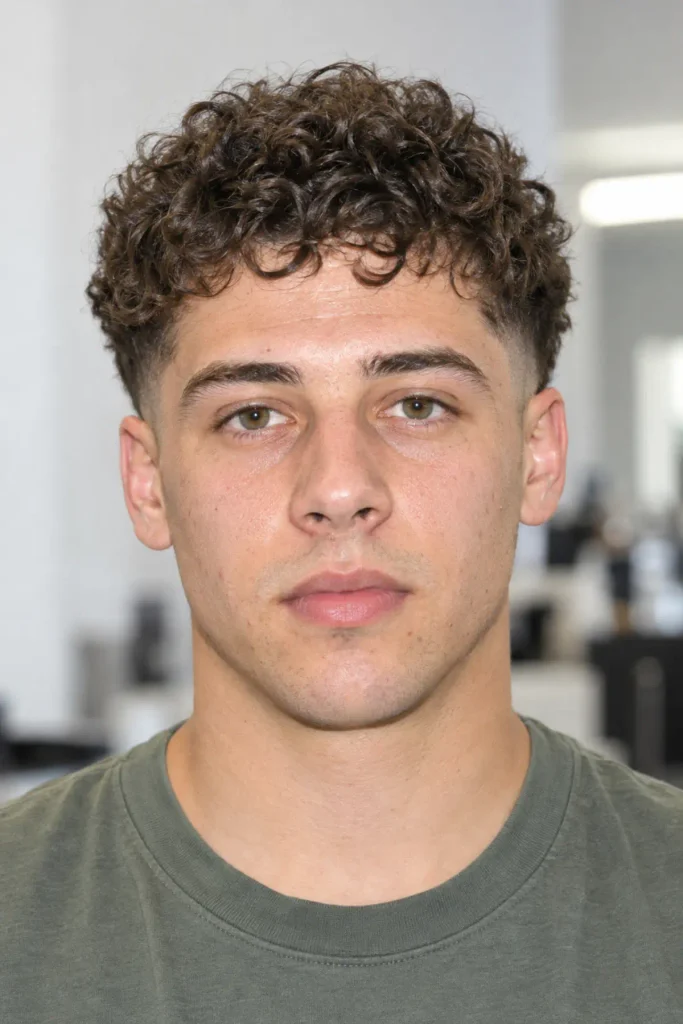
Curls stay short and neat on top while the fade hugs the ear, which makes this the softest way to try the cut. The sides stay close to natural, so it reads as tidy at work and relaxed everywhere else. A pea-sized amount of curl cream on damp hair, then air drying, covers the whole routine.
Best for: First timers, loose to medium curls, every face shape. Upkeep: Barber visit about every 3 to 4 weeks. Barber script: “Low burst fade with a taper finish, curls about 1 to 2 inches on top measured dry.”
2. Mid Burst Fade with Tight Curls
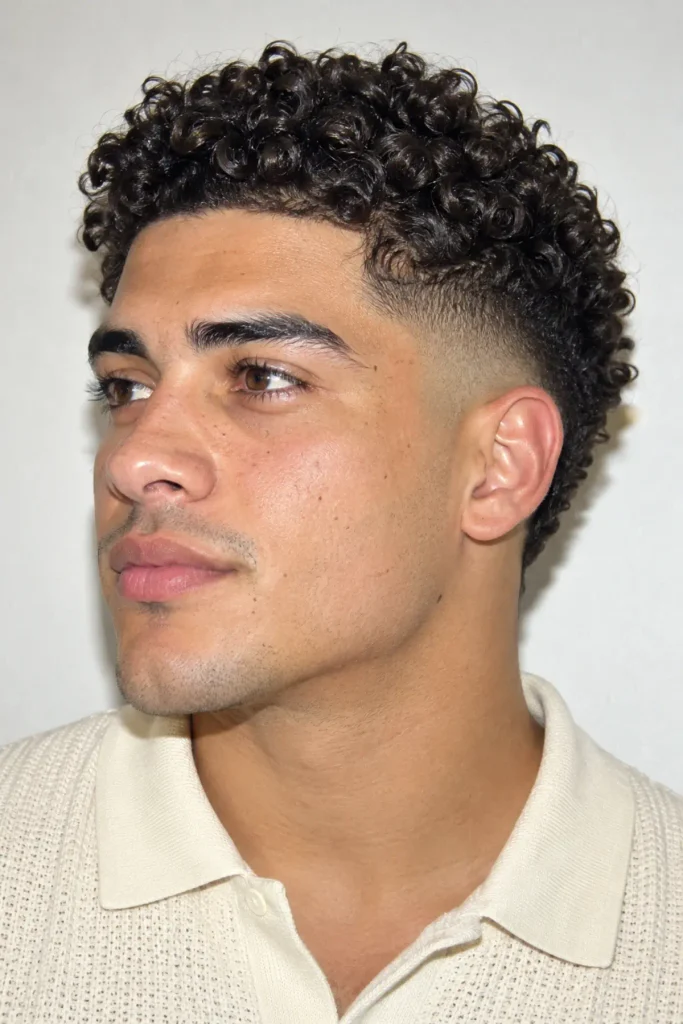
Dense, tight curls stay compact on top and the burst gives the round shape a clean edge. This look holds its form with very little help, so a curl sponge or a little cream after washing brings the pattern back up. It is a reliable everyday cut for medium to thick density.
Best for: Curl types 3B to 4A, round and square faces. Upkeep: Every 2 to 3 weeks. Barber script: “Mid burst fade, tight curls kept about 2 inches dry, with a soft line at the front.”
3. Short Coils with a Sharp Line-Up
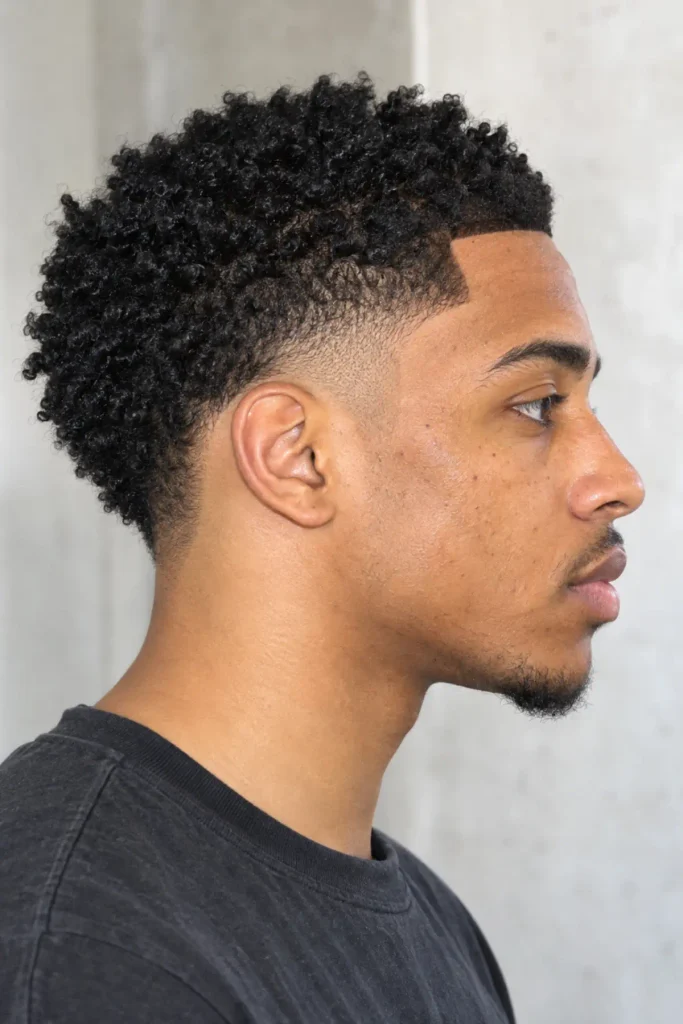
Short coils on top, a crisp line at the forehead and temples, and a burst cut around the ear. The short length still shows the coil pattern, and a leave-in conditioner keeps it soft between cuts. This is a favorite for men who like precise edges.
Best for: Curl types 4A to 4C. Upkeep: Line-up refreshed about every 2 weeks. Barber script: “Mid burst fade, coils about 1 inch on top, sharp line-up at the front and temples.”
4. Skin Burst Fade with a Short Curly Top
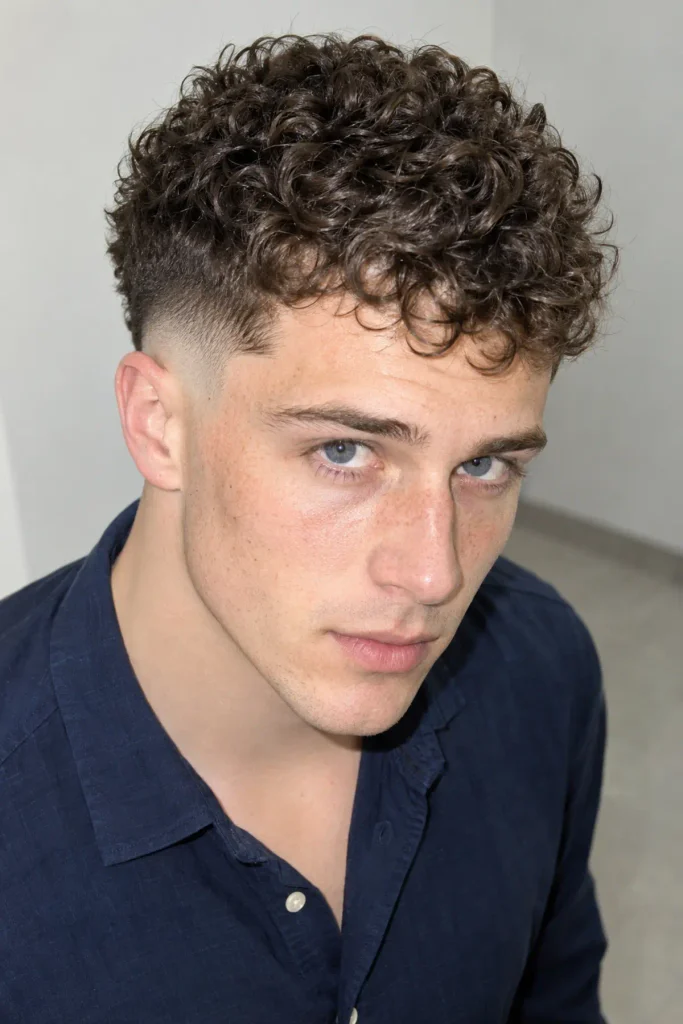
The fade drops to bare skin behind the ear, which creates the strongest contrast with the curls. It looks sharp and graphic, and it also shows regrowth first. Men who have had razor bumps at the nape may prefer a shadow finish instead of bare skin.
Best for: Tight, defined curls and men who love very clean lines. Upkeep: Every 1 to 2 weeks. Barber script: “Skin burst fade behind the ear, short curls on top, natural neckline.”
5. Burst Taper with Short Curls
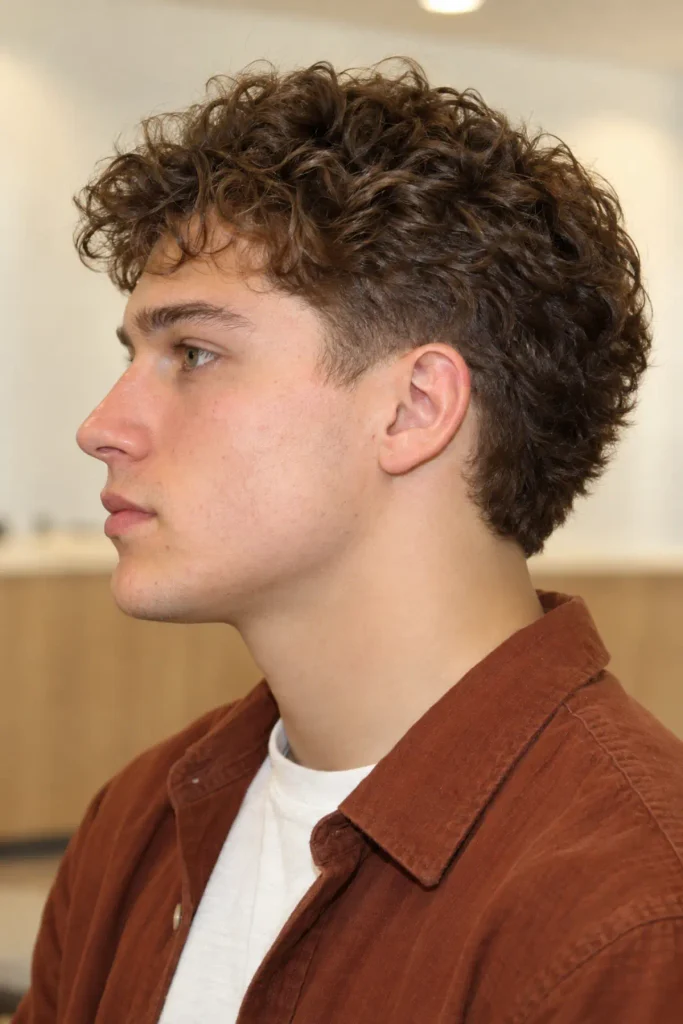
This is the quiet version. The taper blends gradually instead of dropping to skin, so there is no harsh line and the grow-out stays gentle. It suits busy schedules and conservative workplaces, and people notice the haircut more than the fade.
Best for: Wavy to medium curls, offices, longer gaps between visits. Upkeep: Every 3 to 4 weeks. Barber script: “Low burst taper, soft blend with no skin, curls kept full on top.”
6. Short Curls with a Hard Part
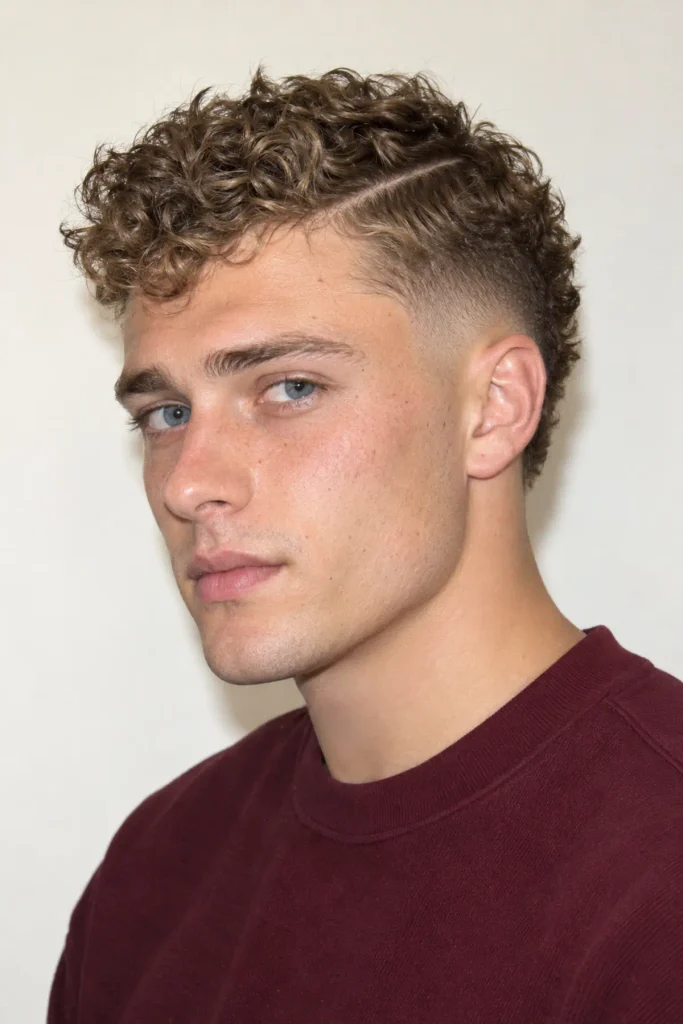
A shaved part line adds one more crisp edge to the burst and the curls. It looks sharp and deliberate, but the line blurs fast, so the barber visits come sooner. A light gel keeps the curls tidy beside the part.
Best for: Short to medium curls, men who enjoy a polished edge. Upkeep: Every 2 weeks. Barber script: “Mid burst fade with a hard part on the left, curls kept textured on top.”
Medium Curls
7. Curly Fringe with a Mid Burst Fade
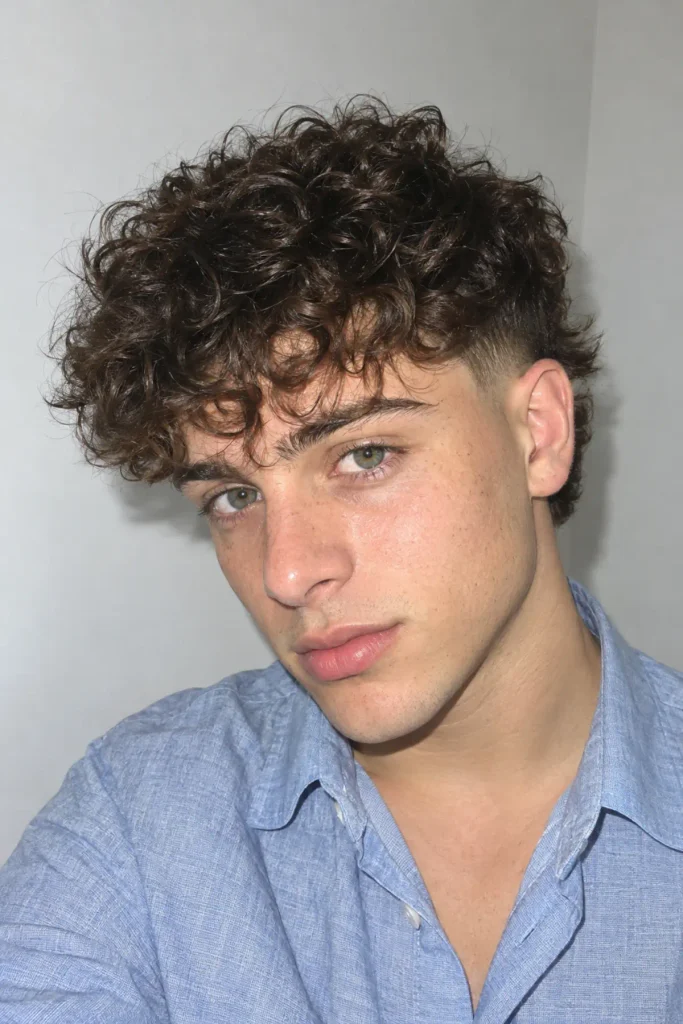
Curls fall forward over the forehead while the burst keeps the sides tight. It is a smart choice for men who are growing their curls out, because the fringe can keep lengthening while the barber tidies the sides. Scrunch the curls forward when they are damp and leave them alone while they dry. Men moving toward more length can browse the medium length haircuts for men guide for the next stage.
Best for: Loose to medium curls, oblong and heart faces. Upkeep: Every 2 to 3 weeks. Barber script: “Mid burst fade to a short guard, curls long enough to reach the eyebrows at the front, back left curly.”
8. Loose Curls or Waves with a Low Burst
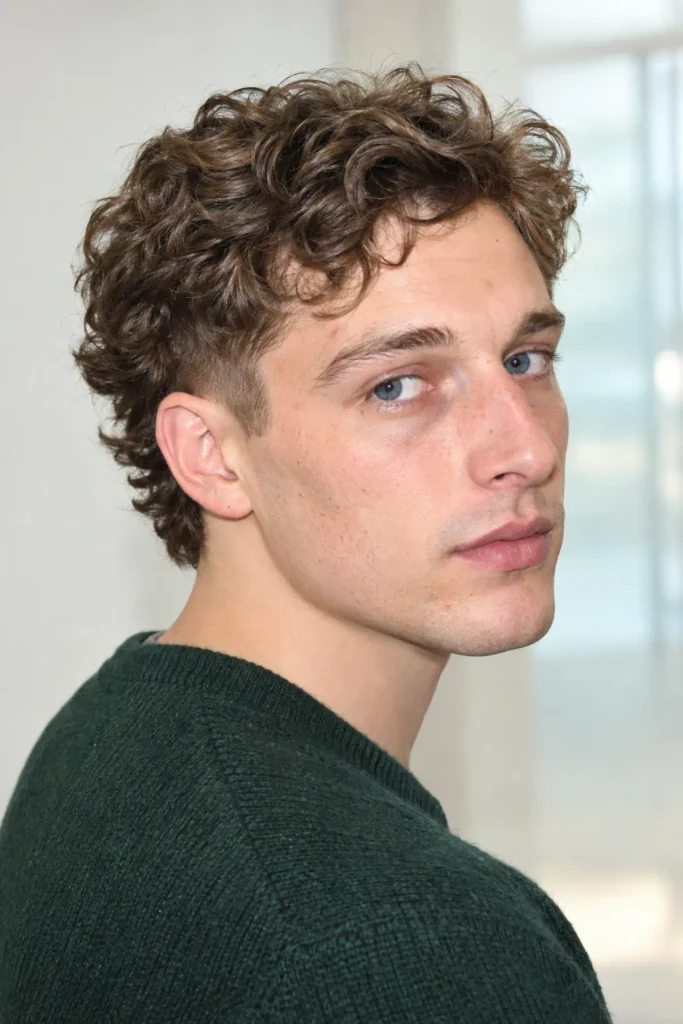
Open, loose curls stay fairly long on top, and the low burst keeps the sides flat so the cut does not go wide. A diffuser on low heat adds lift without frizz. Salt spray on damp waves gives extra grip.
Best for: Wavy to loose curly hair, relaxed and casual styles. Upkeep: Every 3 to 4 weeks. Barber script: “Low burst fade, loose curls about 3 inches on top, nape left curly.”
9. Curly Top with a Side Part
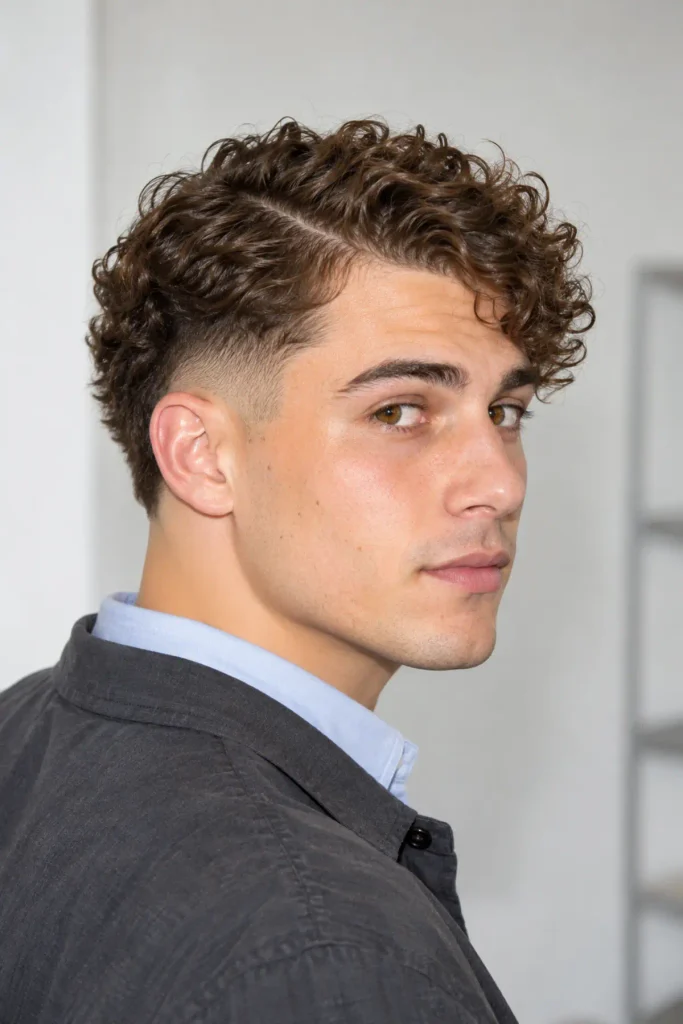
A soft or hard side part adds structure and a smarter feel, while the burst keeps the sides clean. The curls sweep to one side, so a small amount of cream or light gel keeps the shape without stiffness. It works well in professional settings.
Best for: Medium curls, offices, square and oval faces. Upkeep: Every 2 to 3 weeks. Barber script: “Mid burst fade, curls about 2 to 3 inches on top with a natural side part.”
10. Curly French Crop with a Burst Fade
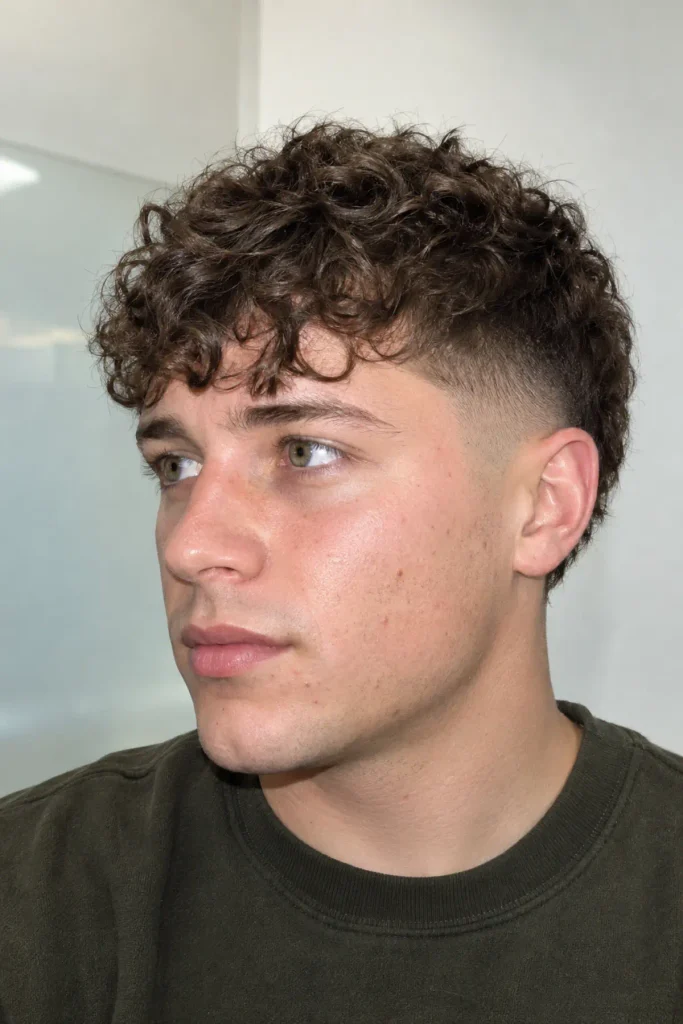
Short curls are cut forward into a cropped fringe, and the burst finishes the sides. It is neat, modern and easy, and the fringe helps soften a higher hairline. Curls replace the usual straight fringe, so the front has movement instead of a flat edge.
Best for: Fine to medium curls, oval and oblong faces. Upkeep: Every 2 to 3 weeks. Barber script: “Curly French crop with a low burst fade, short fringe at mid forehead.”
11. Curly Quiff with a Burst Fade
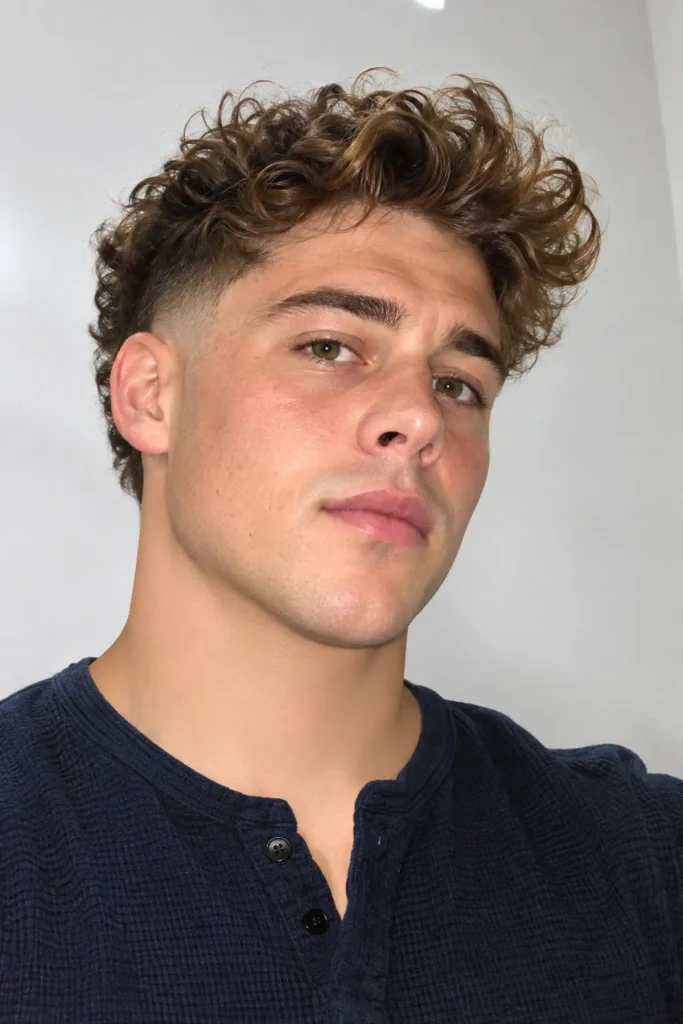
The front lifts and the curls build height, with the burst keeping the outline tidy. Blow-drying the front upward with a diffuser, then adding a light-hold cream, keeps the lift soft instead of stiff.
Best for: Medium to thick curls, round and square faces. Upkeep: Every 2 to 3 weeks. Barber script: “Mid burst fade, curls about 3 inches on top, shaped to lift at the front.”
12. Curly Blowout with a Burst Fade
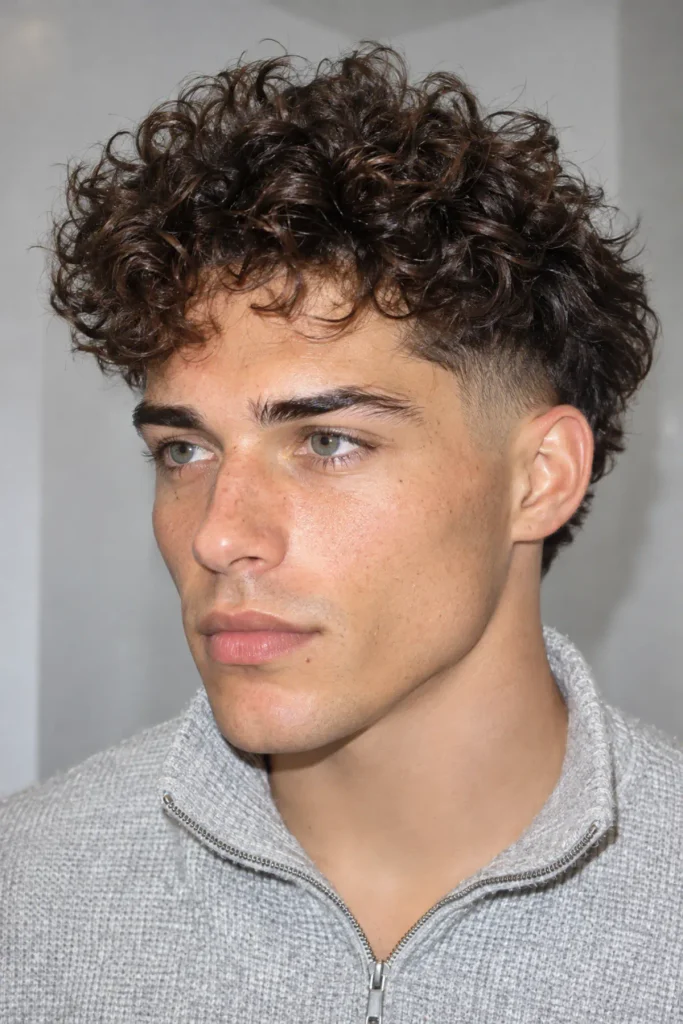
A full, airy top is dried upward for maximum volume, and the burst grounds the whole shape so it looks styled rather than wild. Mousse on damp curls and a diffuser create the lift. It suits men who enjoy a few extra minutes of styling.
Best for: Loose to medium curls, thick hair. Upkeep: Every 2 to 3 weeks. Barber script: “Mid burst fade with a full curly top I can blow out for volume.”
13. Curly Top with a Burst Fade and Beard
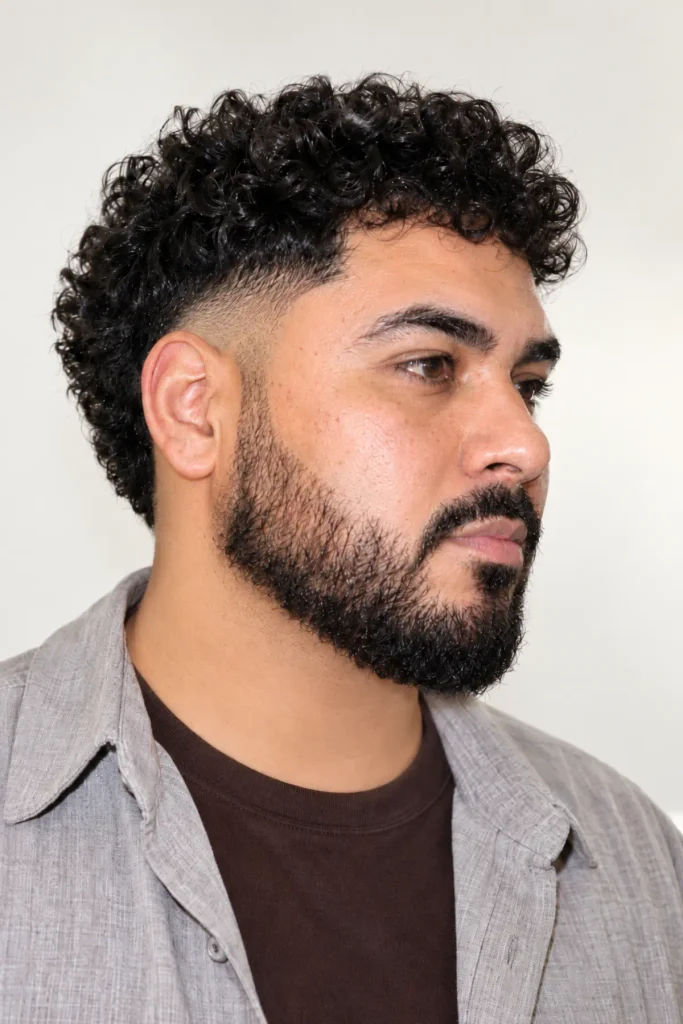
The burst runs down past the ear and joins the beard at the sideburn, so the head and the jaw read as one shape. The beard should be shaped during the same appointment so the fade and the beard line up. The buzz cut fade with beard guide explains how to plan that blend.
Best for: Men with medium or full beards, any curl type. Upkeep: Every 2 to 3 weeks. Barber script: “Mid burst fade with the sideburns blended into the beard, curls kept full on top.”
14. Curly Top with a Shaved Design
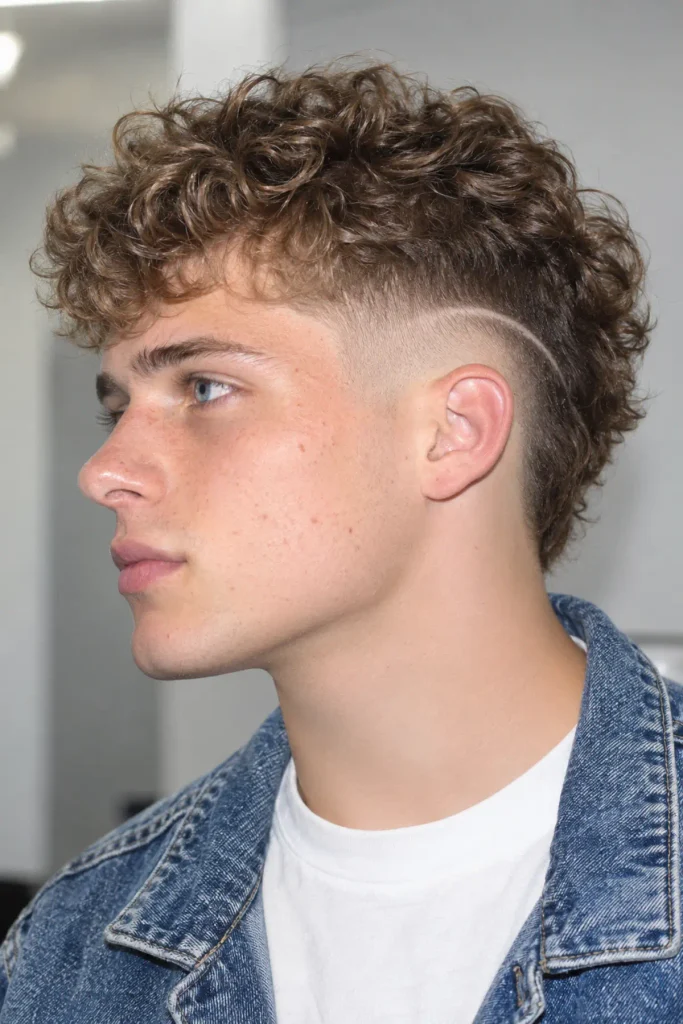
A barber can carve a thin line or a small shape into the faded area near the ear. Simple lines last longer than detailed patterns, because designs blur as the hair grows. It is a good detail for men who like a personal touch.
Best for: Short to medium curls, creative styles. Upkeep: Every 2 to 3 weeks to keep the design crisp. Barber script: “Mid burst fade with one thin curved line near the ear, curls kept natural on top.”
Long and Statement Curls
15. Curly Burst Fade Mullet
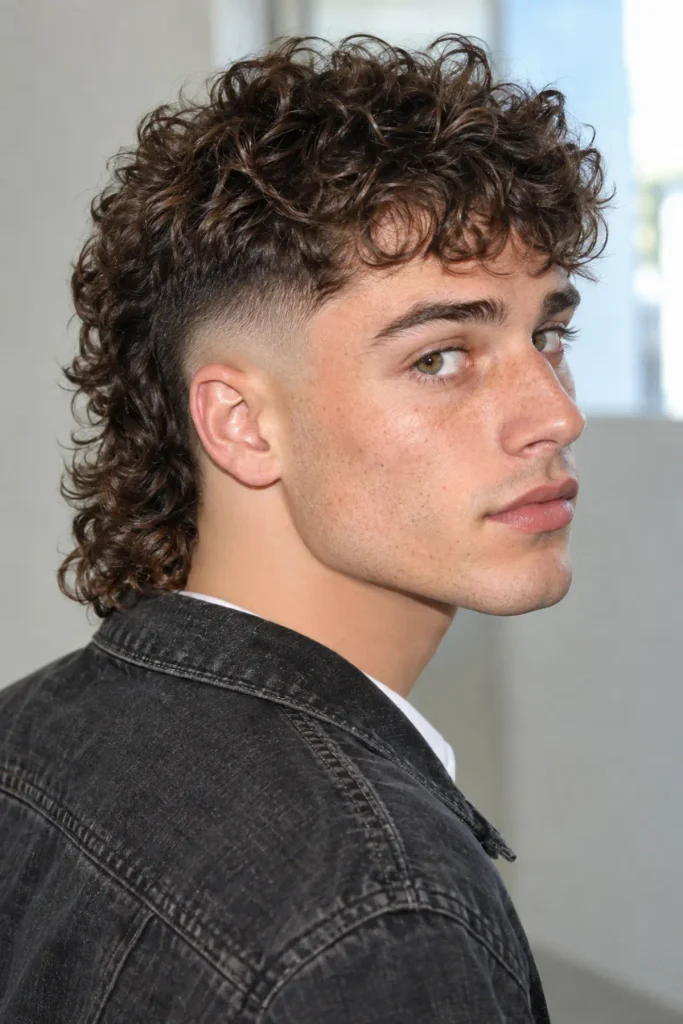
Curls on top, curls at the nape and bare skin carved around each ear. The curly back stays full while the sides fade out, which is exactly the contrast that makes this cut so popular. A curl cream scrunched in and then left alone does most of the work. The full breakdown of this look is in the burst fade mullet haircuts guide, which covers 20 versions in detail.
Best for: Curly hair, round and oval faces, confident dressers. Upkeep: Every 2 to 3 weeks. Barber script: “Curls about 2 inches on top and longer at the nape, burst fade to skin behind the ear, curl left uncut at the neckline.”
16. Curly Layers with a Burst Fade
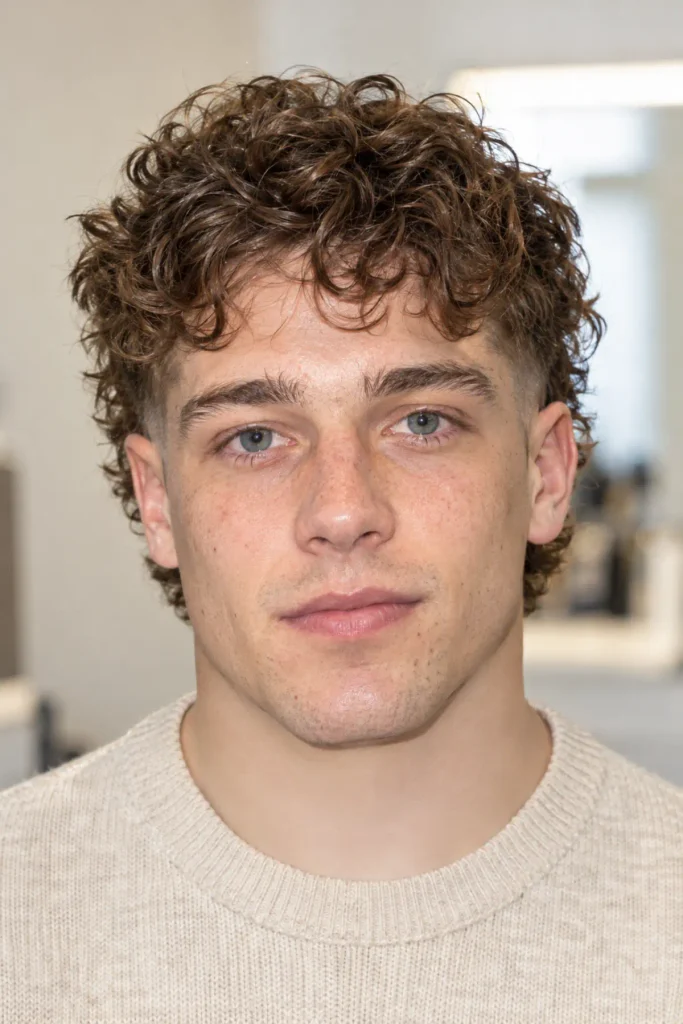
Shaggy, layered curls on top and at the back sit above clean faded sides. The layers remove weight so curls bounce instead of puffing into a triangle, and the burst keeps the cut looking planned. Men who prefer layers all around, without faded sides, can look at the curly wolf cut section in the wolf cut for men guide.
Best for: Medium to thick curls, creative styles. Upkeep: Fade every 2 to 3 weeks, layers reshaped every 6 to 8 weeks. Barber script: “Layered curls on top and back, cut dry, with a mid burst fade on the sides.”
17. Curly Mohawk with a Burst Fade
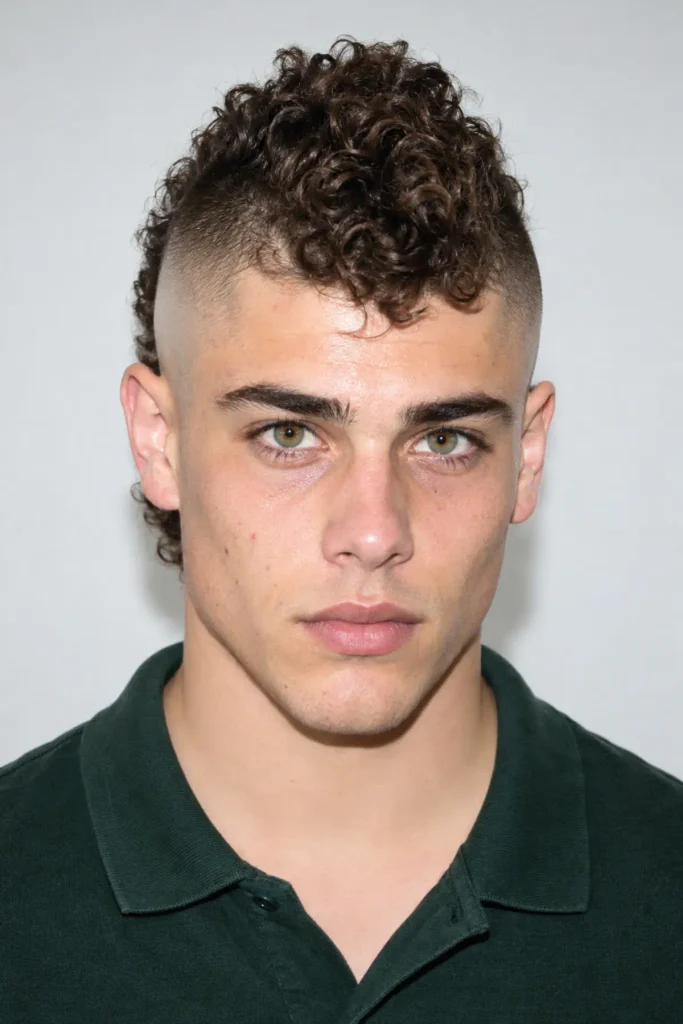
A strip of curls runs down the middle and the sides fade tightly around the ears. The shape comes from the curls themselves, so there is very little to do each morning. A leave-in conditioner keeps the strip defined, and a crisp line-up at the front frames it.
Best for: Tight curls and coils, bold personalities. Upkeep: Every 2 weeks. Barber script: “High burst fade to skin on both sides, a strip of curls about 3 inches wide left full, line-up at the front.”
18. Curly Faux Hawk with a Burst Fade
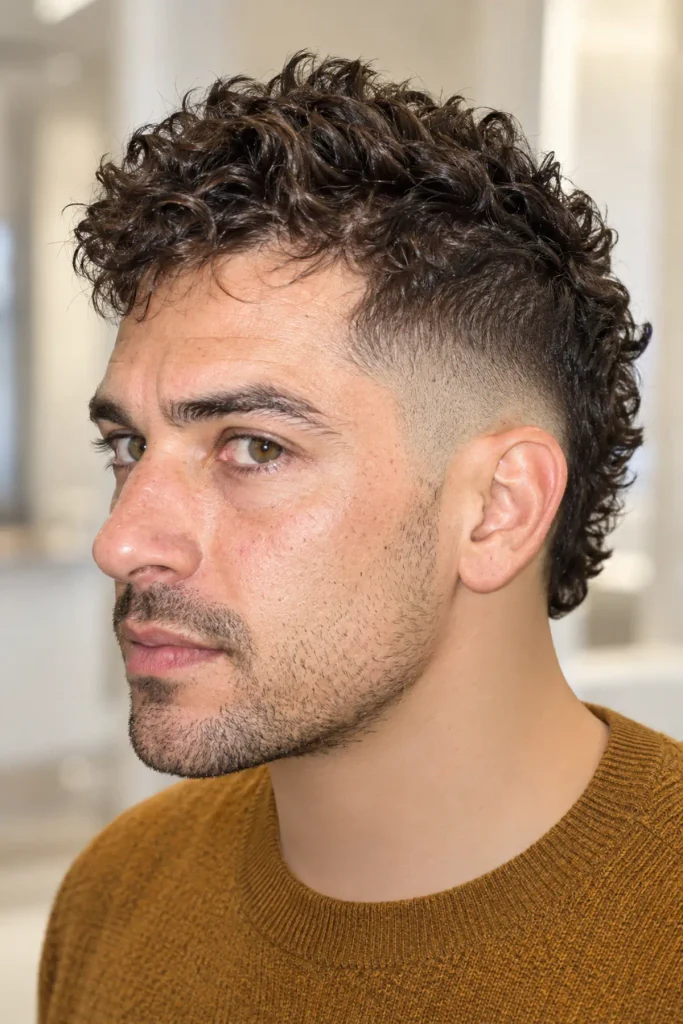
The curls form a central ridge from front to back, but the sides keep more hair than a true mohawk. That makes it easier to wear to work and easier to grow out. A medium-hold cream shapes the peak without a stiff finish.
Best for: Medium to thick curls, oval and heart faces. Upkeep: Every 2 to 3 weeks. Barber script: “Mid burst fade with the sides left longer than a mohawk, curls cut to peak in the middle.”
19. Long Curls on Top with a Burst Taper
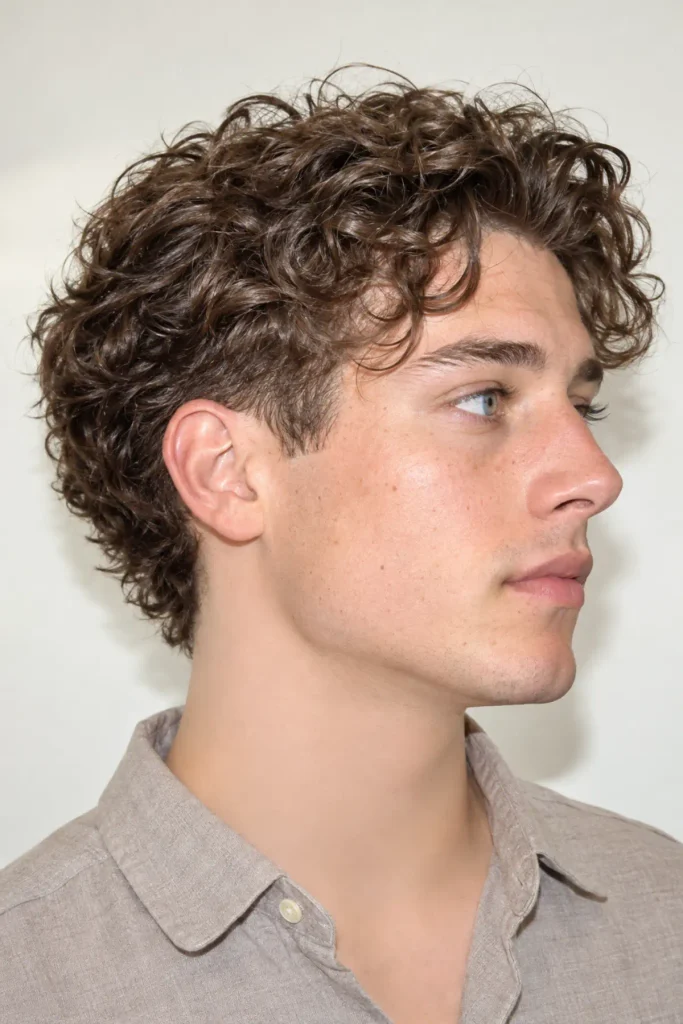
Long, full curls flow on top while the taper keeps the sides soft and neat. The curls need steady moisture, so a leave-in conditioner after every wash matters. Men heading toward longer lengths can pick up shaping ideas in the long layered hair for men guide.
Best for: Loose to medium curls, men growing their hair out. Upkeep: Fade every 3 to 4 weeks, curls trimmed every 8 to 12 weeks. Barber script: “Low burst taper, curls kept long on top with light layering, no thinning shears.”
20. Afro with a Burst Fade
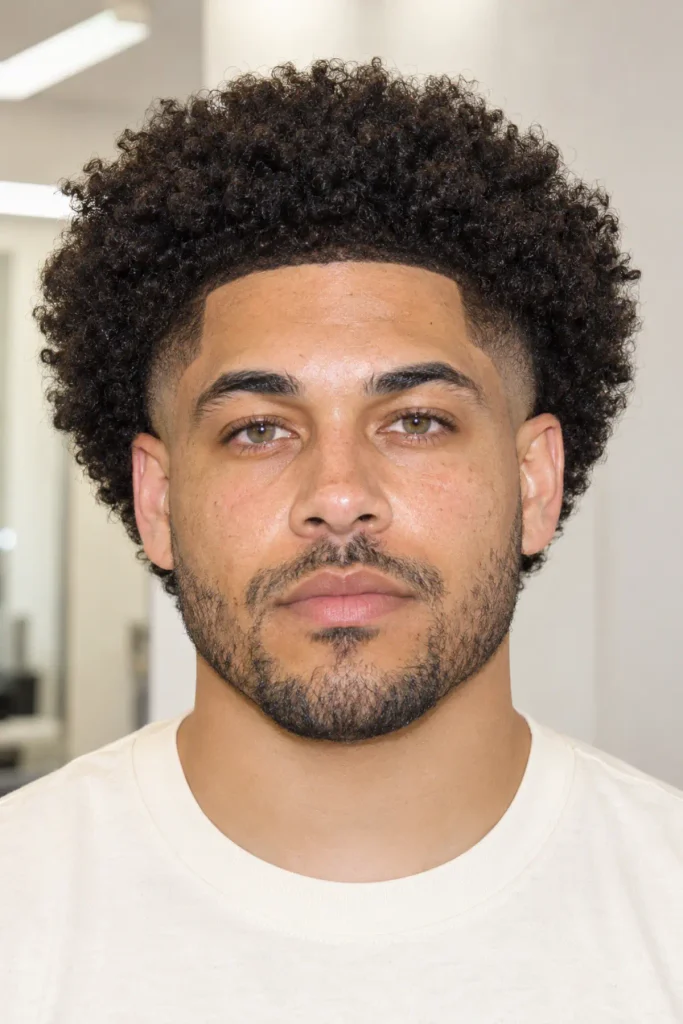
A full afro sits on top, the fade curves round the ear and the length stays at the back. The rounded fade echoes the rounded shape of the afro, so the whole head looks balanced. Picking the curls out from the roots after a wash keeps the height even.
Best for: Curl types 4B to 4C. Upkeep: Fade every 2 to 3 weeks. Barber script: “Afro kept full on top, burst fade around the ear, sharp line-up, length left at the back.”
21. Curly Undercut with a Burst Fade
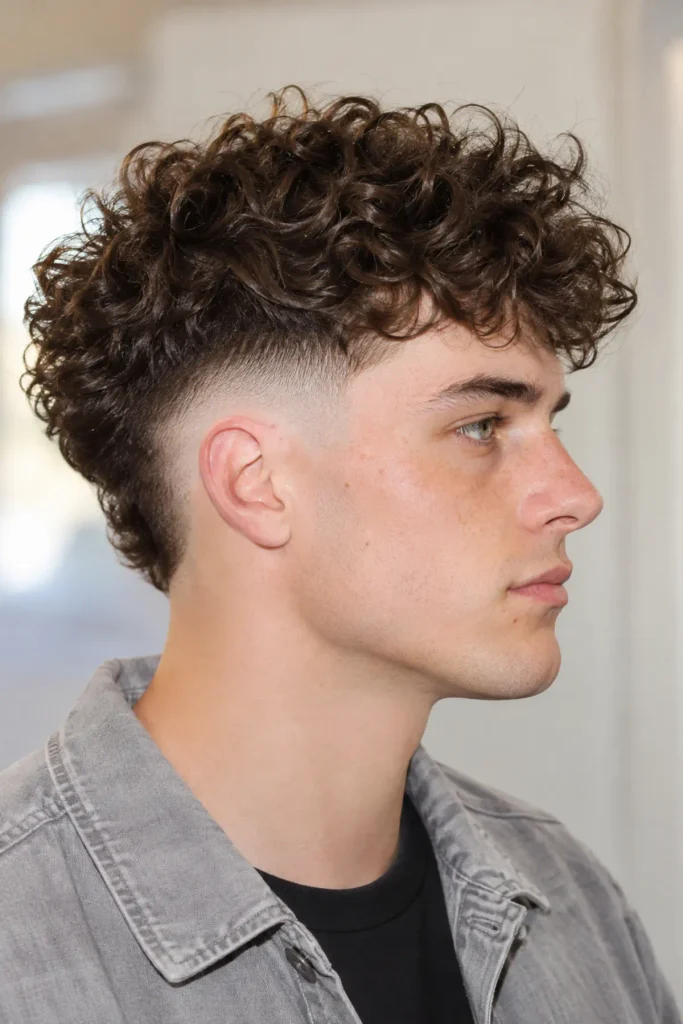
The top is disconnected from the faded sides with a clear, visible line, so the curls look like they float above the fade. It is bold and modern. Styling the curls forward or upward shows off the contrast best.
Best for: Thick curls, men who want strong contrast. Upkeep: Every 2 weeks, since the disconnection needs to stay crisp. Barber script: “Burst fade with a disconnected top, curls kept about 3 inches, no blending into the top.”
Color, Volume and Age-Friendly Looks
22. Bleached or Highlighted Curls with a Burst Fade
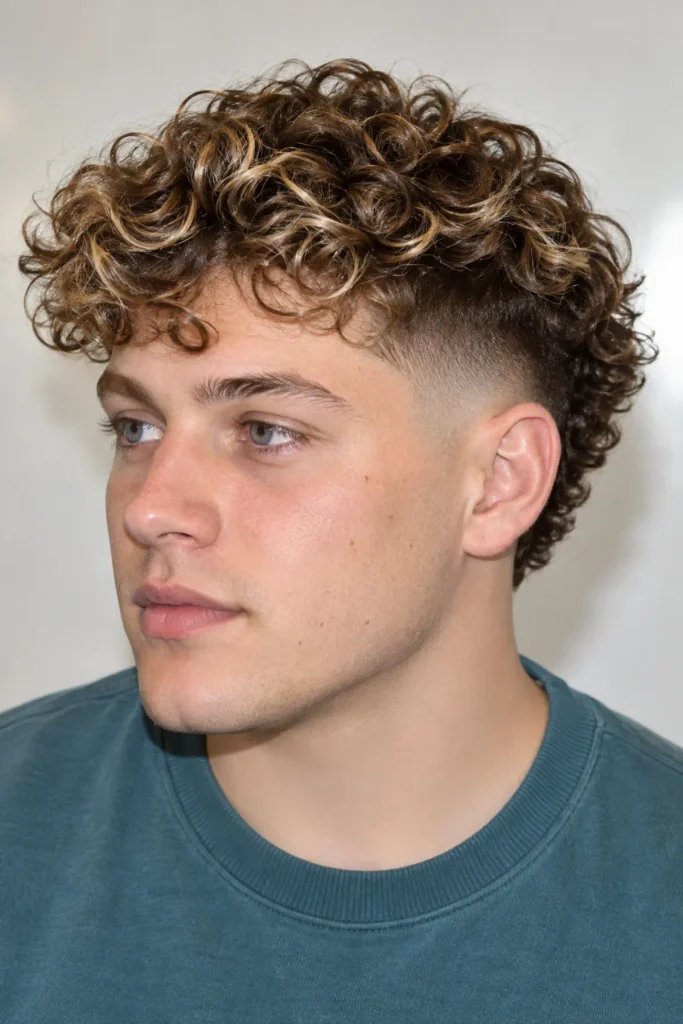
Blonde tips or soft highlights on the curls pop against the darker faded sides, which makes the texture look even fuller. Color adds dryness to hair that is already drier than most, so a deep conditioning treatment and color-safe products belong in the routine. It also adds a second kind of salon visit to the calendar.
Best for: Healthy, medium to thick curls and men who enjoy trying color. Upkeep: Fade every 2 to 3 weeks, color touch-ups on their own schedule. Barber script: “Mid burst fade with the curls lightened at the tips, and a plan for keeping them moisturized.”
23. High Burst Fade with Tall, Voluminous Curls
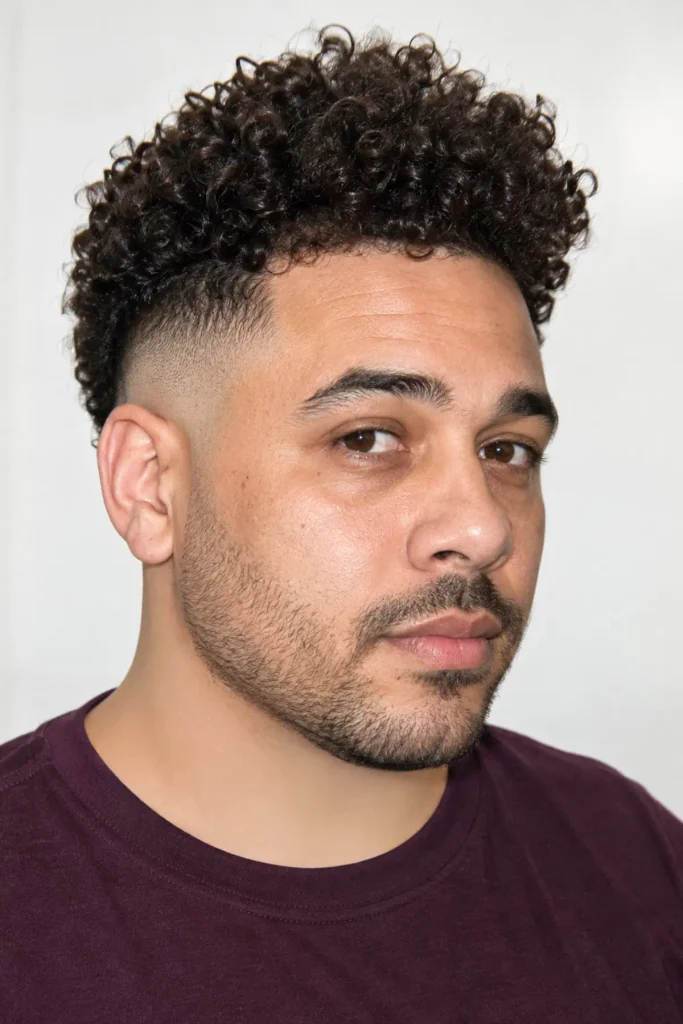
The fade climbs high, the curls stand tall and the contrast is dramatic. A diffuser and a light mousse build the volume, and the rounded top keeps the height from looking boxy. It is a strong choice for men with a rounder face who want extra length from the top.
Best for: Round faces, thick curls, bold dressers. Upkeep: Every 1 to 2 weeks. Barber script: “High burst fade with a defined curve, curls kept tall and full on top.”
24. Curly Perm with a Burst Fade
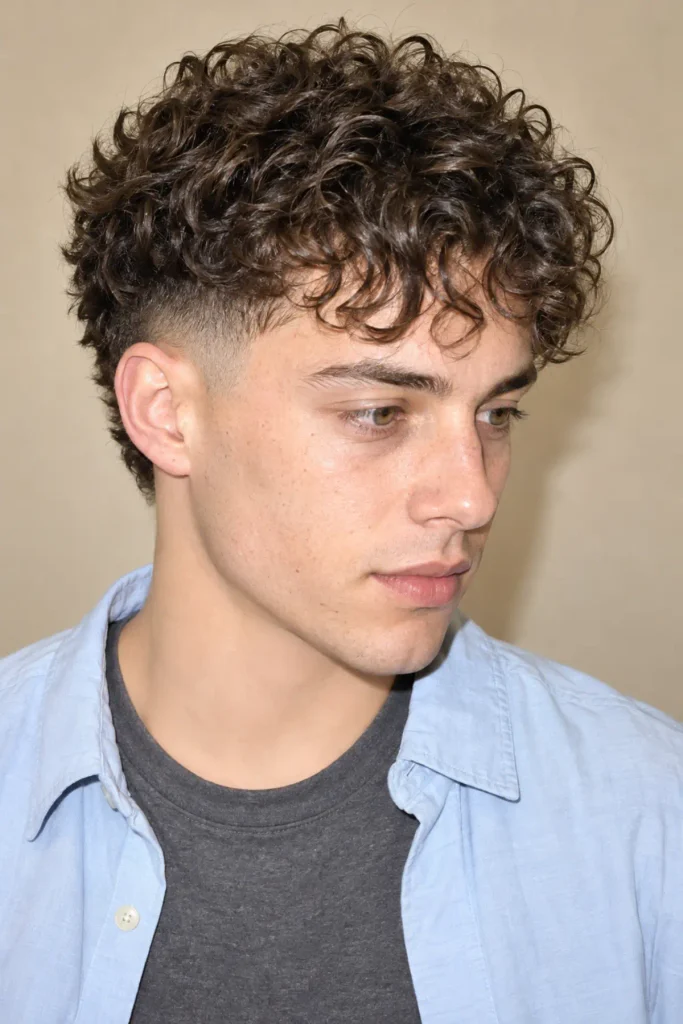
A perm adds bounce and body to straight or wavy hair, so the curly top can happen without waiting for natural curls. The fade and the perm are handled as separate services, and permed curls like gentle shampoo and a moisturizing conditioner. It is a fun route for men who love the look but have straighter hair.
Best for: Straight to wavy hair that wants curls. Upkeep: Fade every 2 to 3 weeks, with perm care and touch-ups on a separate schedule. Barber script: “Permed curls on top, mid burst fade, and advice on how to keep the curls defined.”
25. Salt-and-Pepper Curls with a Low Burst Fade
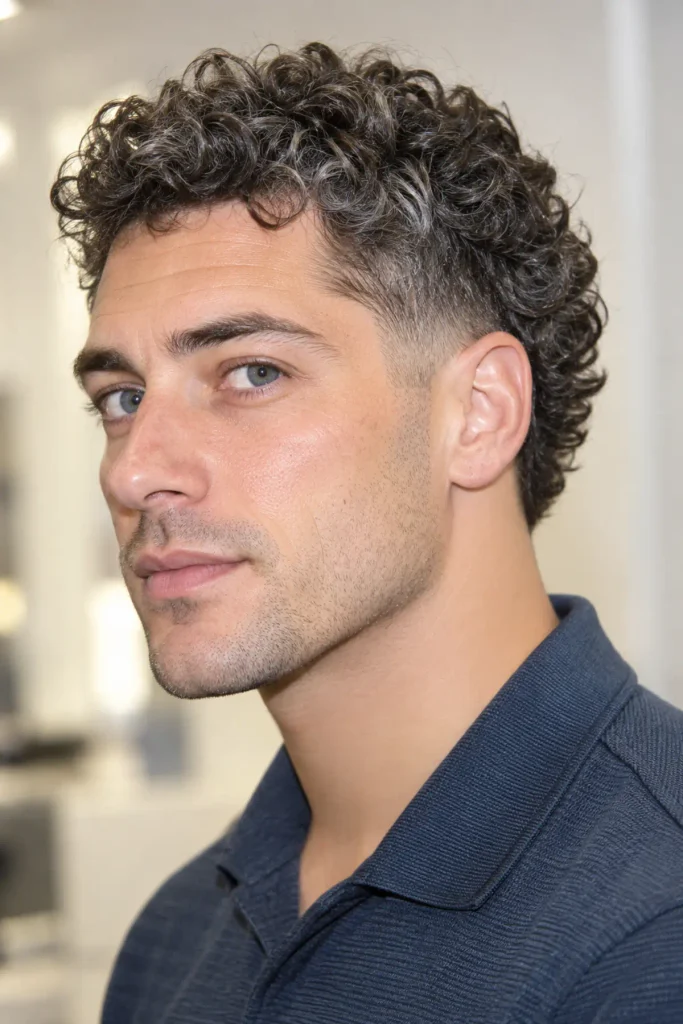
Gray and silver curls look especially good against a clean fade, and the low burst keeps the whole look polished and mature. It suits men over 40 who want a modern cut without a loud contrast. A moisturizing routine matters here as it does for every curl type, and a soft line-up adds a tidy finish.
Best for: Men over 40, offices, loose to medium curls. Upkeep: Every 3 to 4 weeks. Barber script: “Low burst taper, curls kept natural on top with a little shape, soft line-up at the front.”
Low, Mid or High? Burst Fade Heights and Finishes for Curly Hair
Fade height is the first thing any barber asks about, so it pays to know the options before sitting down.
| Height | Where the curve sits | Contrast | Typical barber visits | Best for |
|---|---|---|---|---|
| Low burst | Close to the ear and the hairline | Subtle | About every 3 to 4 weeks | First timers, offices, men with thick curls who want a softer look |
| Mid burst | About halfway up the side of the head | Balanced | About every 2 to 3 weeks | Most men, since it frames curls without looking extreme |
| High burst | Up toward the crown | Strong | About every 1 to 2 weeks | Bold looks, tall curls, men who enjoy frequent barber visits |
The mid burst is the height most barbers see requested, and it is the easiest answer for a man who feels unsure. Anyone curious about how a straight-across mid cut compares with the curved version can read the mid fade haircuts for men guide, which also covers prices and maintenance schedules.
Skin, Shadow or Taper: Choosing the Finish
Height is where the curve sits, and finish is how close it cuts. A barber can take the shortest point behind the ear all the way to bare skin or stop at a guard, and the choice changes both the look and the upkeep.
- Skin finish: The sharpest, most graphic result. It needs the most frequent visits and shows regrowth first.
- Shadow or guard finish: A very short guard instead of bare skin. It looks cleaner than a taper and grows out a little more gently than skin.
- Taper finish: A soft, gradual blend that keeps more hair at the sideburns and neckline. It is the easiest to live with and usually the best choice for a first burst fade.
Putting it together, a low burst with a taper finish is the quietest option, while a high burst taken to skin is the loudest. Most men land somewhere in the middle: a mid burst with a short guard at the shortest point.
How to Ask a Barber for a Burst Fade on Curly Hair
Clear words beat a vague photo every time. A burst fade request is easiest to follow when it covers five details.
- Name the shape. Say “burst fade” and mention that it should curve around the ear, with the neck left long.
- Pick the height. Low, mid or high.
- Pick the closeness. Bare skin, or a guard number. Barbers blend with guards in half steps, so a short guard is a fine answer for a softer look.
- Give the top length, measured dry. Inches work better than words like “a little shorter.”
- Say what happens at the nape and front. Natural, rounded or tapered at the back, plus whether a line-up is wanted.
A Script That Can Be Saved on a Phone
“I would like a [low, mid or high] burst fade that curves around the ear. Please take the shortest point to [skin or a #1 or #2 guard], keep the curls about [X] inches on top measured dry, and leave the nape [natural, rounded or tapered]. Please check both ears from the side so the curve matches.”
Photo Rules That Prevent Surprises
- Bring photos from more than one angle. A burst is easy to see from the side and easy to lose from the front, and the back view shows what the nape is doing.
- Choose reference photos with a similar curl pattern. A photo of straight hair does not show how curls will sit.
- Add one photo of the man’s own natural curls, ideally after a wash, so the barber can see the real pattern.
The Shrinkage Conversation
Before the clippers come out, one question is worth asking: “How do you usually cut curls, dry or damp?” A barber who cuts curls regularly will have a clear answer and will explain how much length the top can lose when it dries. If the barber seems unsure, that is useful information too.
Words That Get Mixed Up
| Phrase | What it can be mistaken for | Clearer wording |
|---|---|---|
| “Just a fade” | A straight-across fade | “Burst fade, curved around the ear” |
| “Taper” | A gradual trim at the sideburns and neckline | “Burst taper, soft blend, no skin” |
| “Drop fade” | A fade that dips lower behind the ear | “Burst, not a drop, with the neck left long” |
| “Short on the sides” | No set height at all | “Low, mid or high burst” |
What a Good Curly Burst Fade Looks Like in the Chair
A barber usually sets the curve around the ear first, picks the height, then blends upward so there are no harsh lines. After that, the curls on top get shaped with scissors, and the nape, sideburns and temples get a final check. Watching the process is a good way to learn what good work looks like.
Green flags:
- The arc looks the same on both sides when viewed from behind.
- The blend is smooth, with no visible steps.
- The barber checks the curls dry before finishing.
- The nape matches what was agreed.
Red flags:
- One side sits higher than the other.
- The curls were cut much shorter than the length that was agreed.
- A hard line shows where the fade meets the curls.
- The nape was cut shorter than planned.
How to Style and Care for a Curly Burst Fade
The fade stays sharp on its own, so daily styling is all about the top. The routine below follows the curly hair guidance from board-certified dermatologists at the American Academy of Dermatology, who note that curly hair is drier than other hair types and breaks more easily. Their full list is in the 6 curly hair care tips from dermatologists.
The Everyday Routine
- Start with wet or damp curls. Dry curls clump less evenly and frizz more.
- Apply a leave-in conditioner first. It adds moisture and makes detangling easier.
- Add curl cream or gel, section by section. Scrunch upward to form the curls.
- Air dry or diffuse on low heat. Heat dries curls out, so low and slow wins.
- Keep hands off while the curls dry. Touching them breaks up the clumps.
- Refresh on day two or three. A light mist of water and a small amount of cream wakes the curls up.
Dermatologists also advise against brushing curly hair while it is dry. Detangling is easier with a wide-toothed comb or fingers on wet, conditioned hair. On washing, they say curly hair does not need a wash daily or even weekly, though a minimum of every 2 to 3 weeks supports a healthy scalp and hair. A moisturizing shampoo made for curly hair and a conditioner applied to all of the hair, not only the ends, round out the routine. Short sides also expose more scalp, so a wide-brimmed hat helps in strong sun.
Product Cheat Sheet
| Product | What it does | Best for |
|---|---|---|
| Leave-in conditioner | Adds moisture and softness | All curls, especially coily |
| Curl cream | Defines curls and controls frizz | Medium to tight curls |
| Gel | Adds hold and definition | Loose to medium curls that need more hold |
| Mousse | Light hold and volume | Fine curls and waves |
| Sea salt spray | Adds grip and texture | Waves and loose curls |
| Texture powder | Lifts roots | Fine or flat curls |
| Edge control | Keeps the line-up crisp | Short coils and line-ups |
Heavy pomades and waxes made for straight hair tend to weigh curls down instead of defining them, so curl-specific products usually work better.
Maintenance Calendar
| Task | How often | Notes |
|---|---|---|
| Low burst touch-up | Every 3 to 4 weeks | Softer growth, gentler grow-out |
| Mid burst touch-up | Every 2 to 3 weeks | The most common rhythm |
| High or skin burst touch-up | Every 1 to 2 weeks | Regrowth shows fastest |
| Curly top reshape | Every 4 to 6 weeks | The top grows out more slowly than the fade |
| Deep conditioning | Weekly or every other week | Keeps curls from drying out |
| Wash | As needed, at least every 2 to 3 weeks | Dermatologist guidance for curly hair |
How Much Does a Burst Fade Cost?
In the United States, the average barbershop haircut costs about $43, ranging from roughly $35 in the Midwest to $45 in the West, according to booking platform SQUIRE’s 2026 industry report as covered by American Salon in August 2026. A StyleSeat pricing guide lists fades at about $30 to $40 and recommends a tip of 15 to 20 percent. Putting those together, a burst fade commonly lands somewhere between $30 and $50 at a typical barbershop. Prices run higher in expensive cities, and add-ons like shaved designs, color or a perm cost extra.
One more detail worth knowing: StyleSeat points out that some salons charge more for textured hair, and recommends choosing barbers who specialize in a client’s hair type without a surcharge. Some barbers also offer cheaper fade-only touch-ups between full cuts, so it is worth asking.
How a Burst Fade Grows Out
Hair grows about half an inch per month on average, according to the American Academy of Dermatology, so even a short fade changes quickly.
| Time after the cut | What to expect |
|---|---|
| Week 1 to 2 | The curve is sharp and clean |
| Week 2 to 3 | Regrowth shows behind the ear |
| Week 3 to 4 | The fade blurs and the arc softens |
| About 2 months | Roughly an inch of new growth where the hair was shortest |
| 3 months and beyond | The sides catch up, and the cut can turn into a taper, a mullet or longer curls |
Because the top and the back keep growing at the same pace, a burst fade is a handy starting point for anyone growing curls out. Men who eventually want to tie their curls back can explore these man bun hairstyles for the next step.
Common Burst Fade Mistakes on Curly Hair
- Skipping the shrinkage talk. A top that looks right when wet can look much shorter once it dries, especially on coily hair.
- Cutting the top too short. Once curls are cut too short, they stop looking curly, and the contrast with the fade disappears.
- Letting the fade grow out too long. The curve is the first thing to blur, so curly burst fades need tighter upkeep than a plain taper.
- Brushing dry curls. Dermatologists advise against it because it breaks up curl clumps and causes frizz and breakage.
- Using heavy straight-hair products. Waxes and heavy pomades weigh curls down. Curl cream, gel and mousse behave better.
- Over-thinning the top. Removing too much bulk can leave curls frizzy and patchy instead of full.
- Bringing only one photo. A single front view hides the curve, the nape and the back.
- Starting with a high skin burst. It is much easier to go higher later than to soften a fade that started too high.
- Forgetting moisture. Short sides make the top the whole show, and dry curls look dull and frizzy against sharp edges.
- Ignoring the nape. A skin finish at the back of the neck can irritate curly hair, so a guard length is the gentler place to start.
Special Situations: Thinning Hair, Gray Curls, Work and Gym
Thinning or receding hair. A burst fade can still work with a few adjustments. Keeping the curls slightly shorter on top, using a light mousse at the roots and choosing a low or mid burst usually looks fuller than a very high contrast cut. A curly fringe also softens a higher hairline. Men who notice increased shedding should check with a dermatologist rather than relying on a haircut.
Men over 40 and gray curls. The low burst taper or low burst fade with natural salt-and-pepper curls is a polished, modern choice. Gray curls need the same moisture routine as any curls, and a soft line-up keeps the look tidy.
Work and dress codes. A low burst taper with a short, neat top looks professional in most offices. Bolder versions, like mohawks and high bursts, fit casual and creative workplaces better.
Gym, hats and sweat. Short sides mean a cap sits right on the curls, which can flatten them. A light mist of water and a little cream, scrunched back in, brings them back after a workout.
Sensitive skin. Men prone to razor bumps at the nape can ask for a guard length instead of bare skin and keep to a gentle aftercare routine. Persistent or painful bumps are worth showing to a dermatologist.
Burst Fade Curly Hair FAQs
What is a burst fade on curly hair?
A burst fade on curly hair is a half circle fade that curves around the ear and into the neckline, with the curls on top and at the back left long. The hair is shortest right behind the ear. The sides look clean while the curl pattern stays the focus.
Is a burst fade good for curly hair?
Yes. The curved fade removes bulk around the ear and temple, so curls stack neatly on top instead of spreading sideways. It works on loose waves, medium curls and tight coils, as long as the top has enough length to show texture.
How do you ask a barber for a burst fade with curly hair?
A man should name the shape (burst fade, curved around the ear), the height (low, mid or high), the closeness (skin or a guard number), the top length in inches measured dry, and what happens at the nape. Photos from the side and back help the barber see the curve.
How long should curly hair be for a burst fade?
A common starting point is about 3 inches for loose curls, 2 inches for medium to tight curls and 1 to 2 inches for short coils, all measured dry. Even half an inch to an inch of curl can show contrast against faded sides. The barber should confirm the final length.
What is the difference between a burst fade and a taper fade?
A taper gradually shortens the hair at the sideburns and neckline, while a burst fade curves around the ear and leaves the neck long. A taper looks softer and grows out more easily. A burst has stronger contrast and needs more upkeep.
What is the difference between a burst fade and a drop fade?
A drop fade dips lower behind the ear and looks more angular, while a burst fade curves around the ear and into the neck. On curly hair, the burst keeps the nape curls fuller. A man can ask for a burst, not a drop, to avoid a mix-up.
Should curly hair get a low, mid or high burst fade?
A mid burst fade suits most men because it frames the curls without looking extreme. A low burst is the softest choice and works well for offices and first timers. A high burst gives the strongest contrast and needs the most frequent visits.
Does a burst fade work on 4C or coily hair?
Yes. The fade removes bulk at the sides while the coils on top stay full, which gives a balanced, rounded shape. Coily hair shrinks a lot when dry, so the barber should leave enough length and cut with that shrinkage in mind.
Should a barber cut curly hair wet or dry for a burst fade?
Many curl-focused barbers cut curls dry or damp rather than soaking wet, because wet curls stretch and spring back as they dry. It is worth asking the barber directly how curls are usually cut, since methods differ. Dry cutting makes it easier to judge the final length.
What face shape suits a curly burst fade?
Oval faces suit almost any version, round faces often look good with a mid to high burst and extra height on top, and square faces usually pair well with a mid burst and soft curls. Barbers often say density and upkeep habits matter as much as face shape.
How much does a burst fade cost?
A burst fade commonly costs about $30 to $50 at a typical U.S. barbershop. The 2026 SQUIRE industry report puts the average barbershop haircut near $43, and StyleSeat lists fades at about $30 to $40. Prices rise in big cities, and a tip of 15 to 20 percent is standard.
How long does a burst fade take to grow out?
Hair grows about half an inch a month, so regrowth shows around week two and the arc blurs by weeks three to four. After about two months, roughly an inch of new hair covers the area that was shortest. A low burst taper grows out the most gracefully.
Can curly hair get a burst fade mullet?
Yes. Curly hair suits a burst fade mullet because the full curls at the back contrast with the faded sides. The barber should leave the nape curls uncut and cut the top dry. The burst fade mullet haircuts guide covers 20 versions.
Does a burst fade cause razor bumps?
A burst fade does not cause razor bumps by itself, but close, bare-skin cuts can raise the risk for men with tightly curled hair, especially at the nape. A guard length instead of skin is a gentler option. Persistent or painful bumps are worth showing to a dermatologist.
Final Thoughts
A burst fade for curly hair combines clean, curved sides with natural curls and volume. Whether you choose a low, mid, or high burst fade, the best style depends on your curl pattern, face shape, and maintenance routine. Tell your barber your preferred fade height, top length, and nape shape, keeping curl shrinkage in mind. With regular trims and proper moisturizing, you can keep your curly burst fade looking sharp and stylish.