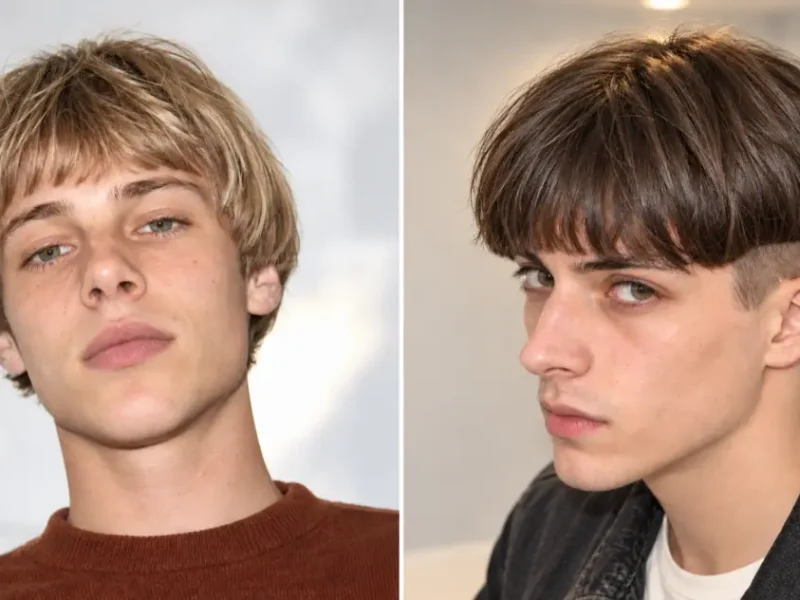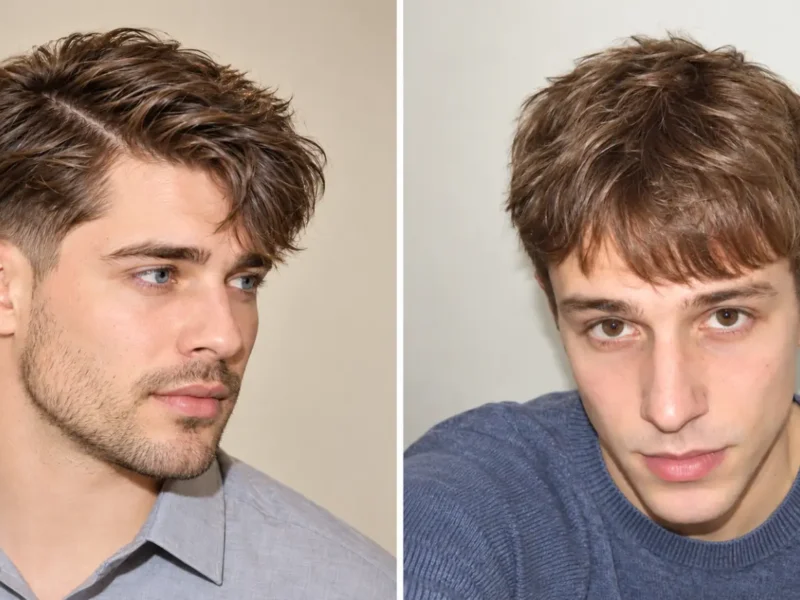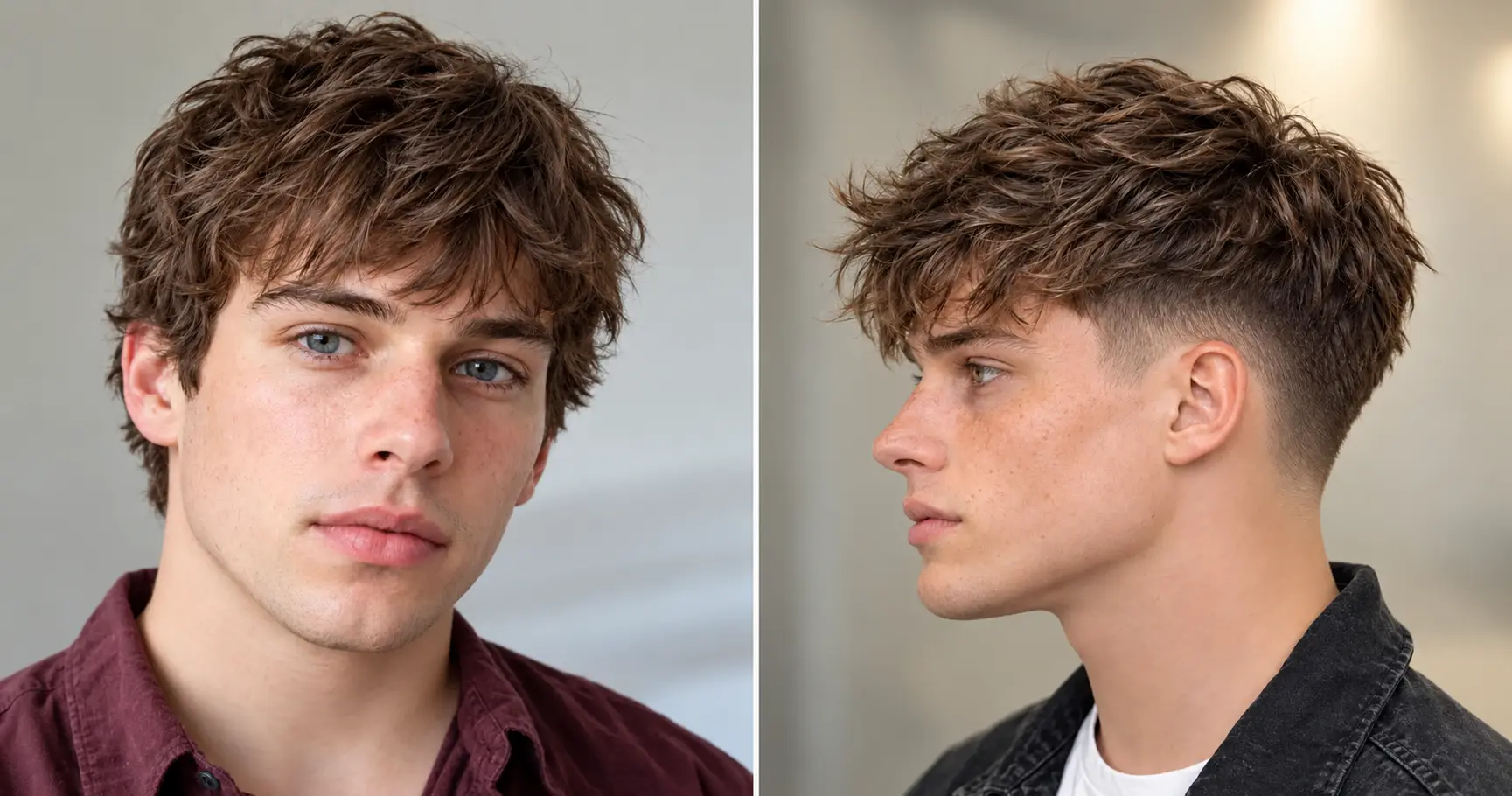
Shaggy haircuts for men are layered, textured cuts with shorter layers at the crown, a loose fringe, and feathered ends that give the hair built-in volume and movement. Most guys who ask for a shag want the same thing: hair that looks relaxed and a little undone, but still looks deliberate. That look comes from the cut itself, not from a pile of product.
The shag has been through a few revivals, and 2026 is one of the busy ones. Barbers now cut it short and tapered for the office, long and wavy for the weekend, and everything in between. This guide covers which version suits which hair texture, density, and face shape, what a guy can actually say in the chair, how to style it in a few minutes, and what the grow-out really looks like.
Find the Right Shag in 30 Seconds
What it is: a layered cut where hair is shorter at the crown and longer toward the edges, with textured (not blunt) ends and, usually, a fringe.
Length needed: about 2 to 3 inches on top for a short shag, and roughly 4 to 6 inches on top for a medium or classic version, according to Barber’s Take.
Upkeep: a trim every 4 to 8 weeks, depending on length, with only a few minutes of styling on most days.
| Hair type | Best shag to try | What the barber should do | Go-to product |
|---|---|---|---|
| Straight | Shaggy crop or razored medium shag | Point cutting or razor work to create separation | Texture spray at the roots, matte paste on the ends |
| Wavy | Classic or modern medium shag | Soft layers with light weight removal | Sea salt spray |
| Curly | Curly shag with rounded layers | Dry scissor cut, curl by curl, with room for shrinkage | Curl cream |
| Coily | Rounded, textured shag | Dry cut with scissors, extra allowance for shrinkage, little or no razor | Moisturizing curl cream |
| Fine or thin | Medium shag with longer, softer layers | Keep weight at the ends, skip heavy thinning | Mousse or a volumizing spray |
| Thick | Interior-layered shag | Remove bulk from inside the cut, not the surface | Lightweight cream |
The product pairings above follow the general guidance in Luxe Digital’s shag guide: salt spray for straight and wavy hair, curl cream for curls, mousse for finer hair, and creams or balms for coarser hair.
Table of Contents
What Is a Shaggy Haircut for Men?
A shaggy haircut, also called a shag, is built from layers cut at many different lengths. The shortest layers sit at the crown and around the face, and the hair gets longer toward the ends, so the cut stays full on top and lighter at the edges. The ends are textured instead of blunt, which is why the hair separates into loose pieces rather than falling in one solid sheet.
Three features usually define it:
- Crown volume: shorter layers on top create lift without much styling.
- A fringe: a heavy, broken-up front section that can sit at the brow, eye, or cheekbone.
- Feathered ends: point cutting or razor work softens the edges so the layers blend instead of stepping down in obvious shelves.
Because the shape is cut in, a good shag looks relaxed even when the hair is sitting still. A guy can wear it short with tapered sides, medium with a curtain fringe, or long with wavy ends. Hair type, length, and how much layering the barber builds in all change the final look.
Where the Shag Came From
The shag is usually credited to New York hairstylist Paul McGregor, who cut it for Jane Fonda around 1969. It became widely known through the 1971 film Klute, according to Wikipedia’s entry on the shag haircut. In the early 1970s, rock stars including David Bowie, Mick Jagger, and Rod Stewart wore versions of it, which is why the cut still carries a rock-and-roll reputation.
The men’s version returned to the spotlight in 2016, when hairstylist Martial Vivot told W Magazine that a fashion show without the shag was hard to find, pointing to the spring 2017 Gucci, Hermès, and Raf Simons runways. More recently, Timothée Chalamet’s tousled, mid-length layers sparked a wave of salon requests. Stylists quoted by Byrdie describe that look as shaggy around the hairline and ears with longer layers on top. The 2026 version tends to be shorter, more textured, and tidier at the edges than the 1970s original, often with a taper or fade on the sides.
Shag vs Wolf Cut vs Mullet vs Flow
These four cuts get mixed up constantly because all of them involve length and texture. The real difference is where the short layers sit and how sharply the length changes from front to back.
| Cut | Where the short layers sit | Back length | Overall feel |
|---|---|---|---|
| Shag | Crown and face, tapering gradually | Feathered ends, usually near the collar | Soft, blended, evenly layered all around |
| Wolf cut | Crown, with a sharper step to longer lengths | Long and layered | Wilder, with more crown volume |
| Mullet | Short on the front and sides | Long, with a clear break from the front | Strong front-to-back contrast |
| Flow | Little or no layering | Medium to long, swept back | Smooth and uniform rather than choppy |
In short, a wolf cut is a shag crossed with a mullet, while a shag keeps the length and layers more even around the head. That description matches how Luxe Digital separates the three. Guys who like the idea of a longer back can browse the wolf cut for men guide or the burst fade mullet ideas. Those who want shag layers without much back length usually land on a medium length haircut with added texture.
22 Best Shaggy Haircuts for Men
Each style below lists who it suits, how much upkeep it needs, how to style it, and what to say to the barber. Trim timing follows the usual range of about 4 to 6 weeks for short shags and 6 to 8 weeks for longer ones, with tapered edges needing a tidy-up sooner.
1. Classic Shag
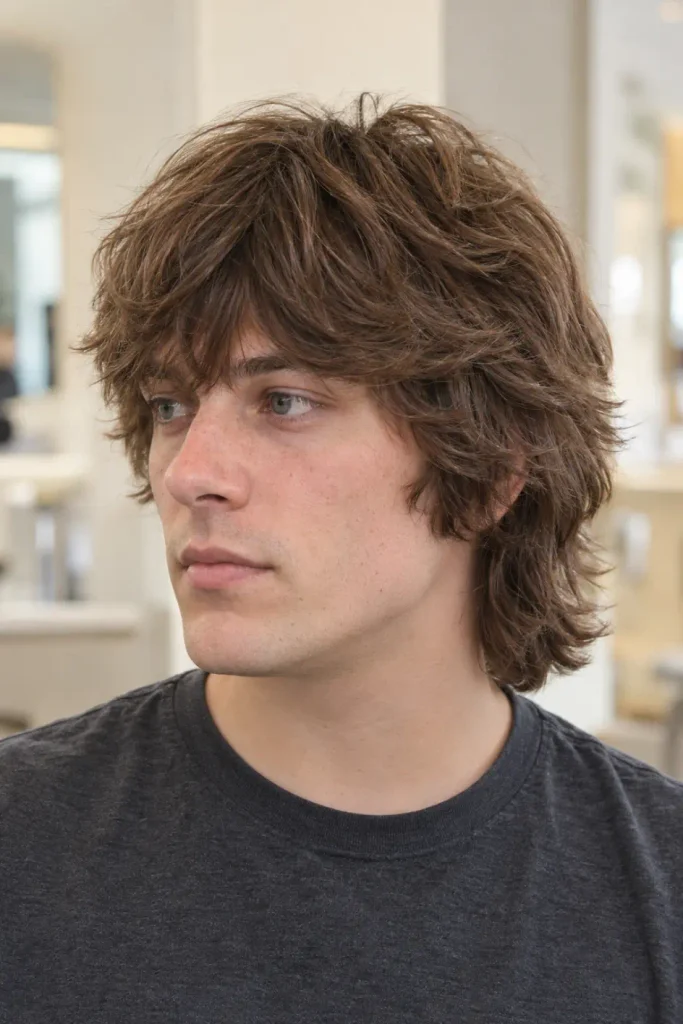
The classic shag follows the 1970s blueprint: heavy layering through the crown, feathered ends around the ears, a full fringe that brushes the brow, and length that settles near the collar.
- Best for: oval and oblong faces, wavy or thick hair, and guys who want the full rock-and-roll look.
- Upkeep: moderate. A trim every 6 to 8 weeks keeps the layers defined.
- Style it: rough-dry with the fingers instead of a brush, then work a light texture cream through the mid-lengths.
- Ask the barber for: soft, feathered layers with a heavy crown, a brow-length fringe, and length at the collar.
- Watch out for: a dated, costume-like look if the layers are too round and too dense. Keep it relaxed.
2. Modern Short Shag
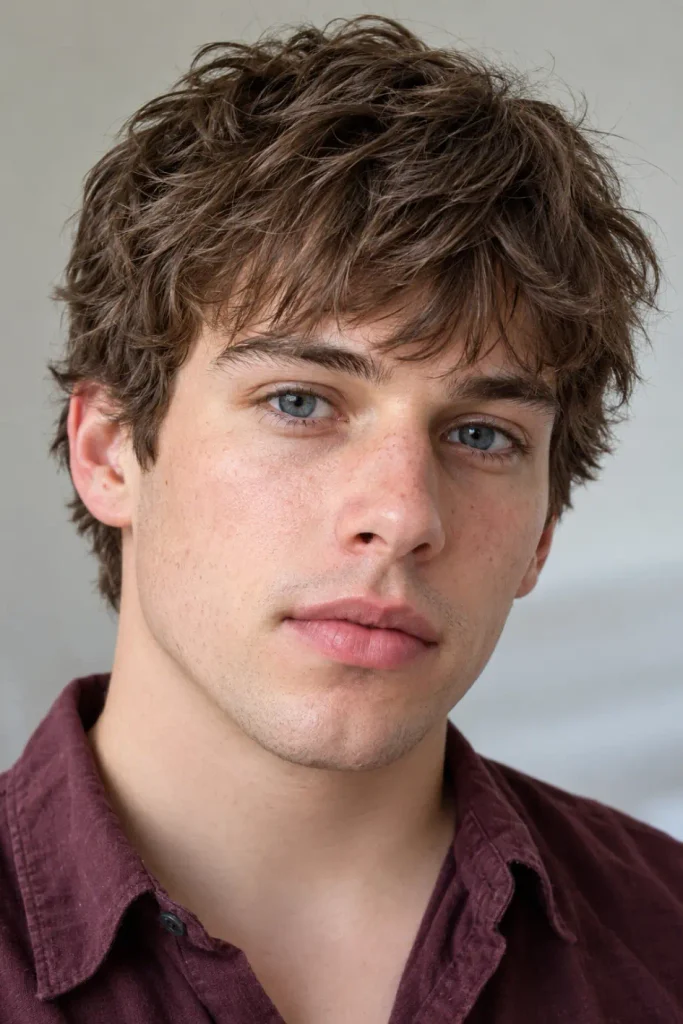
The modern version tightens the proportions, cleans up the ear line, and softens the fringe. Length stops above the collar, which makes it easy to wear from a weekend brunch to a Monday meeting.
- Best for: oval, square, and heart-shaped faces, plus straight or wavy hair of medium density.
- Upkeep: moderate. Every 4 to 6 weeks keeps the shape tight.
- Style it: blow-dry loosely with the head tipped forward, then finish with a matte paste through the ends.
- Ask the barber for: a modern shag with a cleaned-up ear line, a soft fringe, and length above the collar.
- Watch out for: over-trimming the fringe, which turns the cut into a generic layered style.
3. Shaggy Crop

The shaggy crop borrows the compact frame of a French crop and roughens it up. The blunt fringe becomes a broken, piece-y one, and choppy layers run through a short top. The sides stay neat but soft, usually scissor cut instead of faded.
- Best for: square and oval faces, straight or wavy hair, and guys testing the shag with minimal commitment.
- Upkeep: low styling effort, with trims every 4 to 5 weeks.
- Style it: towel dry, then work matte clay through the top in small pinches, pushing the fringe slightly off line.
- Ask the barber for: 2 to 3 inches on top, point cut layers, and a broken mini fringe.
- Watch out for: too much clay in one lump, which flattens the pieces into a single mass.
4. Shag with Taper
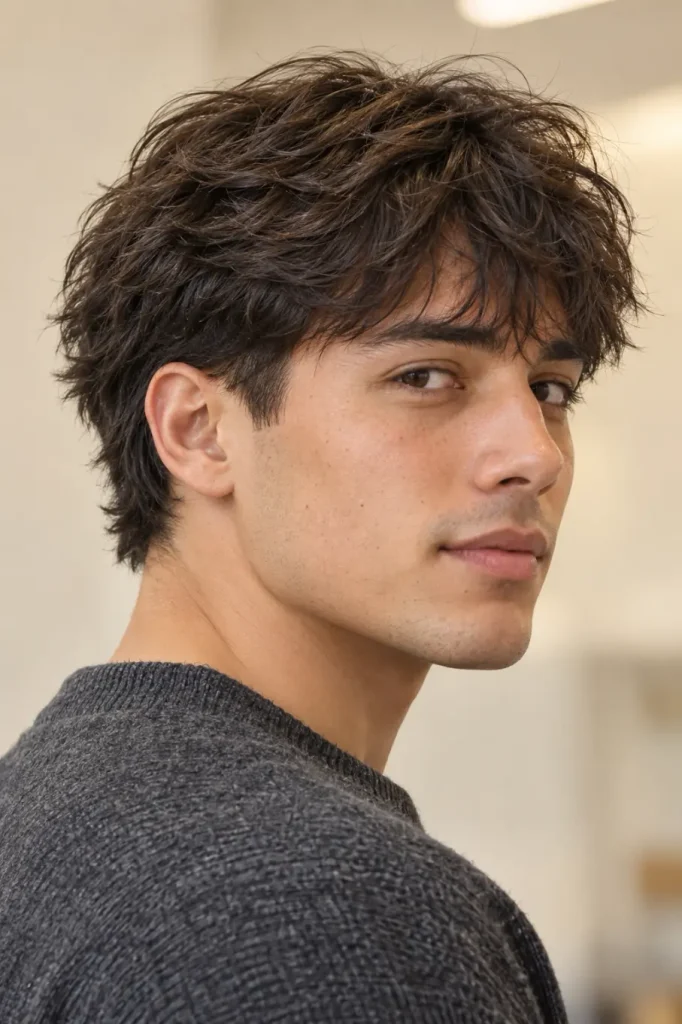
This version keeps the choppy layers on top and gradually tightens the hair around the ears and neckline. The taper cleans up the perimeter while the crown keeps its movement.
- Best for: professionals, anyone who wants a polished edge, most face shapes, and most textures.
- Upkeep: moderate to high. The layers can wait, but the tapered edges look best when cleaned up every 3 to 4 weeks.
- Style it: matte paste on the layers and let the taper provide the polish.
- Ask the barber for: a low taper at the sides and nape, with the shag layers left long on top.
- Watch out for: tapering too high, which can leave the top looking like a separate haircut.
5. Shaggy Fade or Undercut
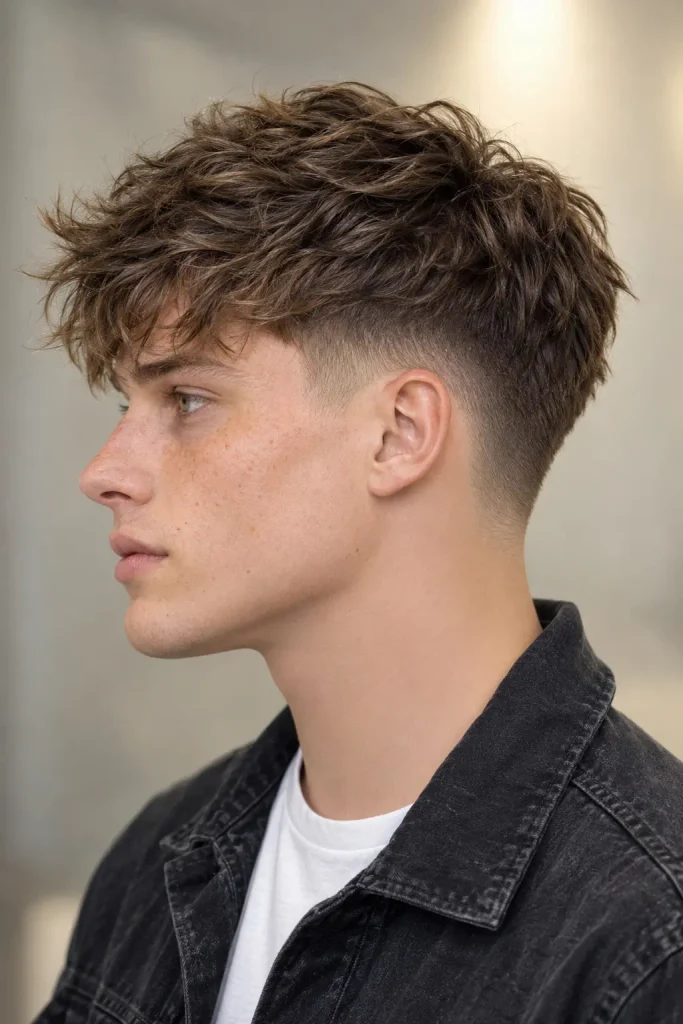
This hybrid pairs a textured shag top with faded or buzzed sides. The contrast creates a sharp silhouette that suits casual and semi-formal settings. Guys exploring this route can compare it with mid fade haircuts for men.
- Best for: oval, diamond, and square faces, and thick or wavy hair. It can also help thin hair look denser through contrast.
- Upkeep: high. Fades need refreshing every 2 to 4 weeks.
- Style it: towel dry, lift with the fingers, then pinch a small amount of clay through the layers.
- Ask the barber for: a mid or low fade with a gradual transition into the longer top.
- Watch out for: a hard disconnect between the sides and the top, and a fade that starts too high.
6. Curtain Shag
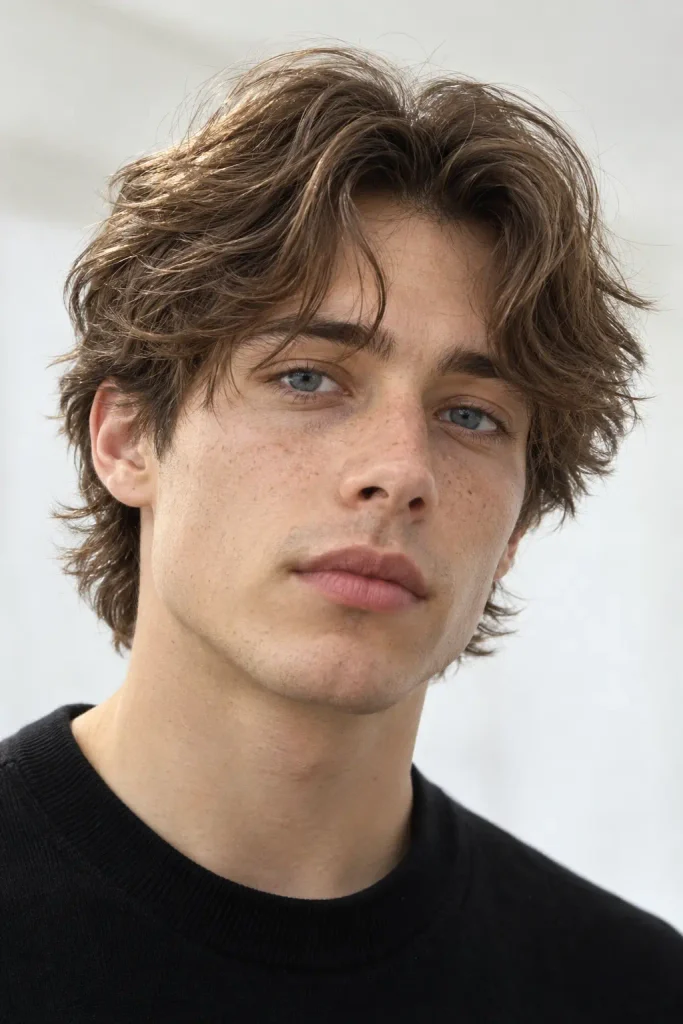
The curtain shag parts the layered front down the middle so the fringe falls to each side of the face. It blends the 1990s curtain look with shaggy movement through the rest of the cut. For more fringe ideas, see the fluffy fringe haircuts for men roundup.
- Best for: round and square faces, plus straight or wavy hair. The center split lengthens the face and softens the forehead.
- Upkeep: moderate. Fringe length matters, so trims every 4 to 6 weeks help.
- Style it: blow-dry the front away from the part with a round brush, then rake a light cream through the lengths.
- Ask the barber for: a center-parted, eyebrow-grazing fringe blended into shaggy layers.
- Watch out for: a cowlick at the part, which can make the fringe split in the wrong place.
7. Long Shag
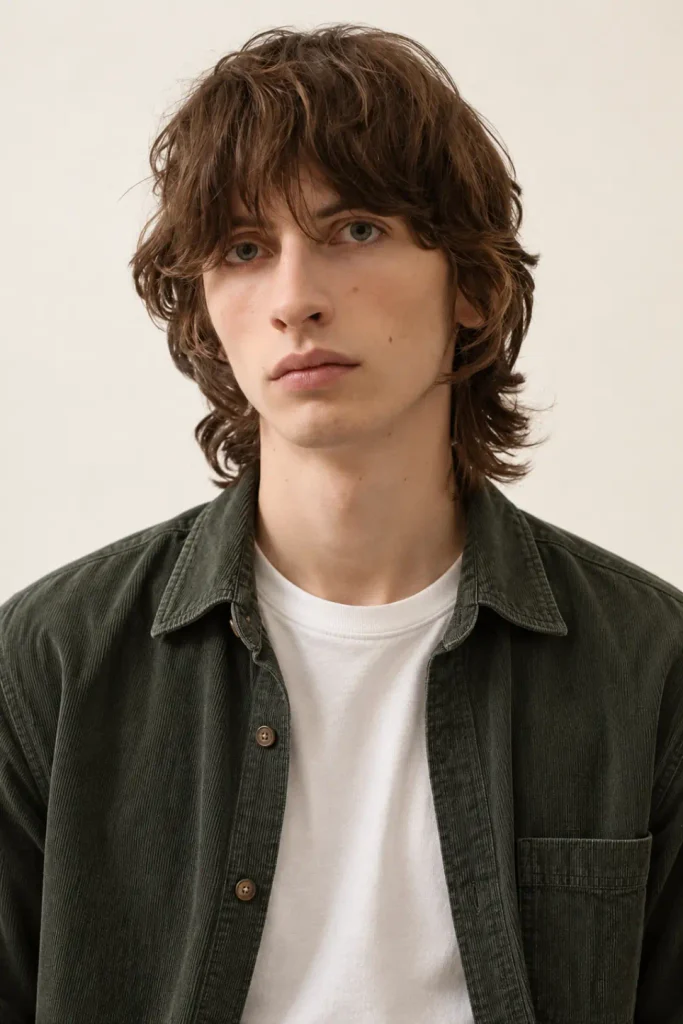
The long shag stretches the layered shape toward the shoulders, with feathered face-framing pieces and loose, lived-in ends. The layering stops long hair from sitting flat or triangular.
- Best for: oval and oblong faces, and medium to thick hair. Fine hair can look stringy past the collar.
- Upkeep: moderate. Trims can stretch to 8 or 10 weeks, but conditioner should be regular.
- Style it: air dry with a palmful of sea salt spray scrunched through, or pull it back. Guys who tie it up can pair it with man bun hairstyles.
- Ask the barber for: long layers with face-framing pieces and softly textured ends. The long layered hair for men guide has more detail.
- Watch out for: dry, split ends, which show up fast on feathered hair.
8. Curly Shag
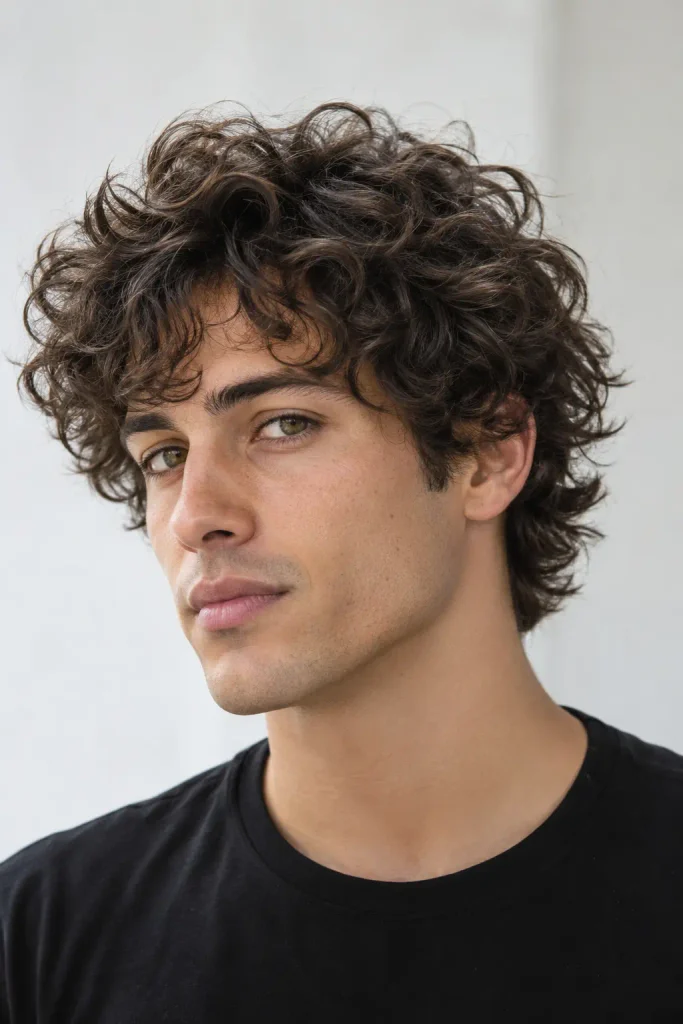
The curly shag shapes natural curls into rounded, graduated layers that stack without the pyramid effect that unlayered curls often create. Removing length from the interior lets the curls spring into their pattern with even volume from crown to nape.
- Best for: square and heart-shaped faces, and curly hair of medium to thick density.
- Upkeep: moderate. Deep conditioning keeps definition.
- Style it: apply curl cream to damp hair, then air dry or diffuse on low heat. Rough handling breaks curls into frizz. Similar texture-first ideas appear in the burst fade haircuts for curly hair guide.
- Ask the barber for: a dry cut with scissors, rounded layers, and room for shrinkage.
- Watch out for: a wet cut that lands shorter than planned once the curls spring back.
9. Wavy or Surfer Shag
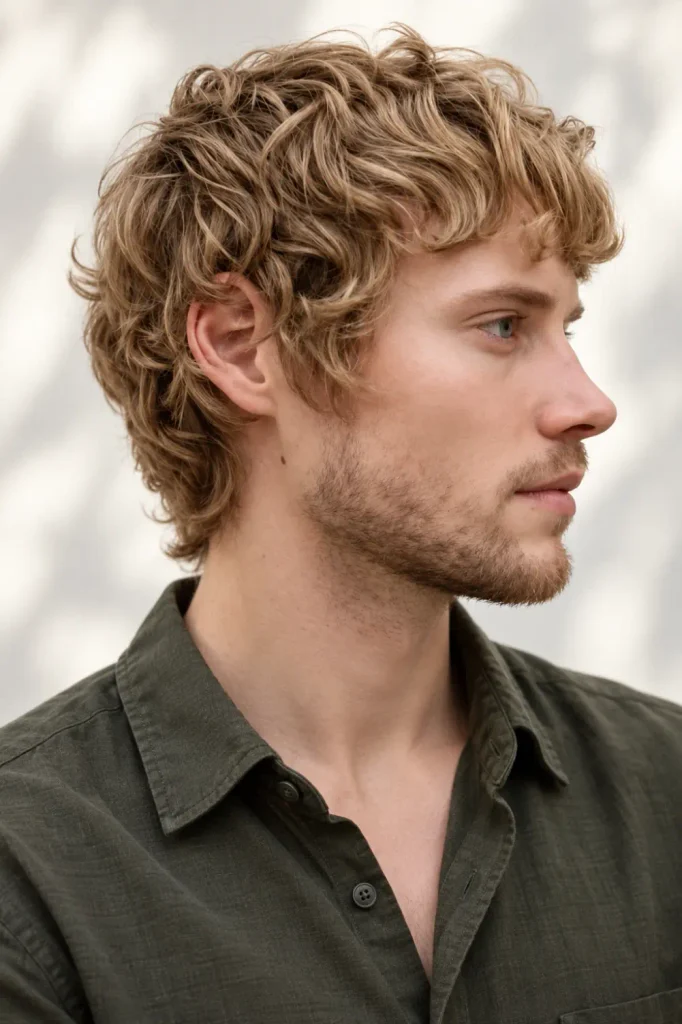
The wavy shag is considered the ideal match by many barbers. The surfer version adds tousled, beachy layers and a loose fringe pushed off the face.
- Best for: oval and heart-shaped faces, and wavy hair of any density.
- Upkeep: low styling effort, with trims every 6 to 8 weeks.
- Style it: mist damp hair with sea salt spray, scrunch upward, and let it air dry untouched, then rough it up once with the fingers.
- Ask the barber for: soft layers that follow the wave, with a medium length and a loose fringe.
- Watch out for: too much product, which weighs waves down and erases the separation.
10. Straight Hair Shag (Including the Korean Shag)
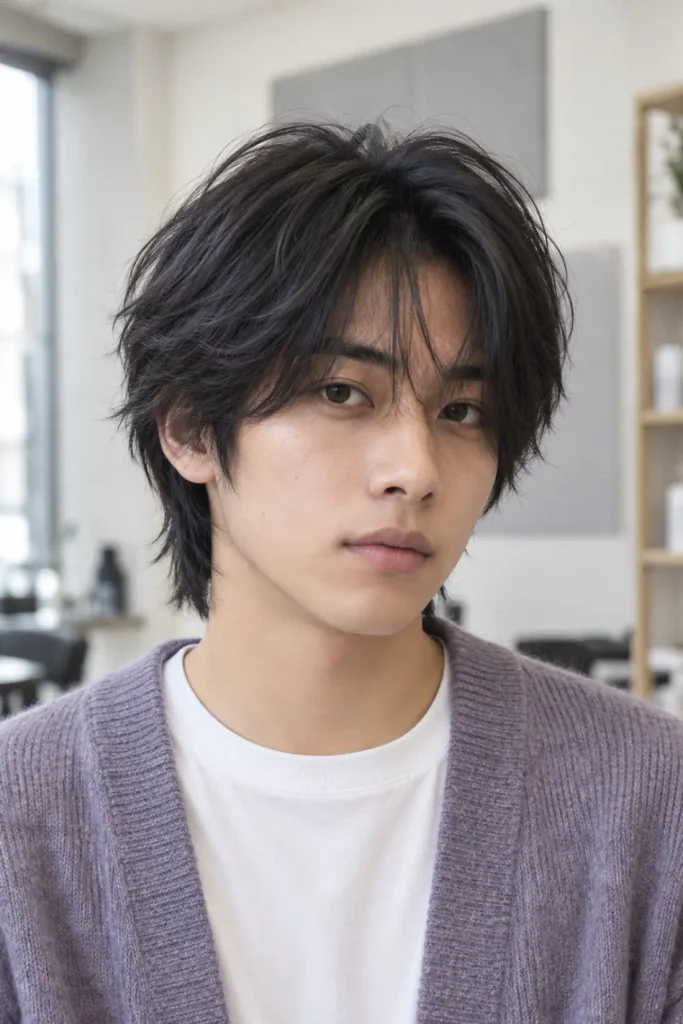
Straight hair has no natural bend, so the shag relies on cutting technique. Razor work and deep point cutting carve separation into the ends so the layers read clearly instead of collapsing into a flat curtain. The Korean shag builds soft waves into the layers, often with a light perm, for an airy, full look with a see-through fringe.
- Best for: oval, heart, and diamond faces, and straight hair of medium to thick density, including thick Asian hair.
- Upkeep: moderate. Texture spray or powder is needed most days.
- Style it: blow-dry with the fingers, tipping the head side to side, then break up the ends with a little texture powder at the roots and matte paste at the tips.
- Ask the barber for: razor or point cut layers, with the finish checked dry.
- Watch out for: blunt cutting, which leaves solid shelves instead of feathered movement. Those considering a perm should schedule it before the cut so the barber can layer around the new wave.
11. Coily Textured Shag
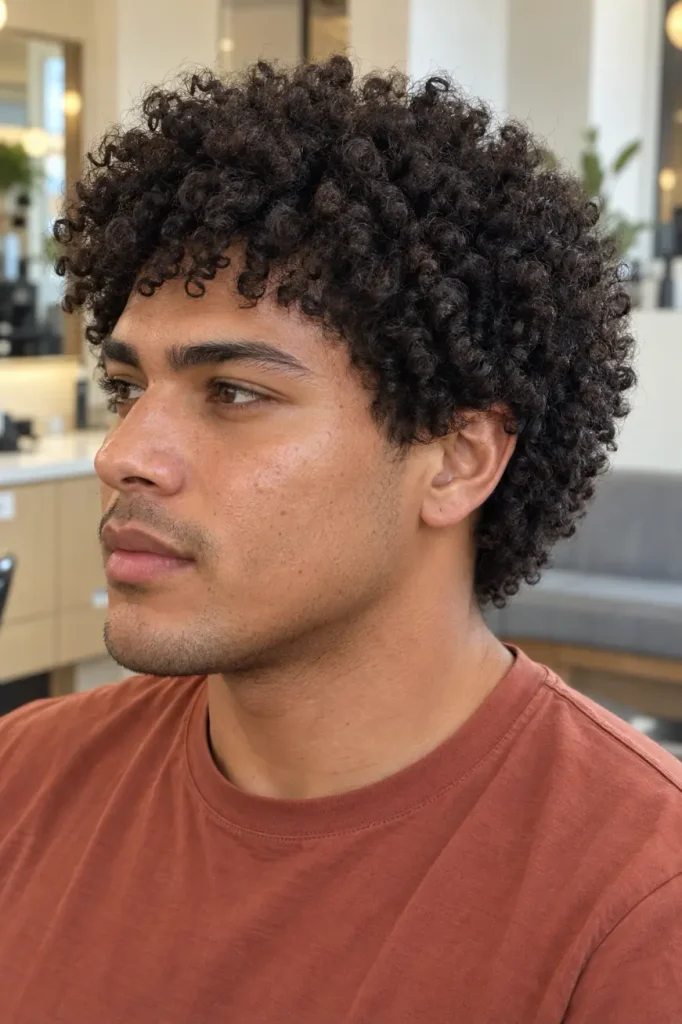
A shag on 3C to 4C hair is cut as a rounded, textured shape with controlled layers on top and a defined perimeter. It celebrates the natural pattern instead of fighting it.
- Best for: most face shapes, and medium to thick coily hair.
- Upkeep: moderate. Moisture matters more than hold.
- Style it: apply a moisturizing curl cream to damp hair, shape with the fingers, and air dry or diffuse.
- Ask the barber for: a dry cut with scissors, controlled layers, and extra allowance for shrinkage.
- Watch out for: heavy razoring, which can disturb the pattern and leave the ends dry and thin.
12. Shaggy Wolf Cut or Shaggy Mullet
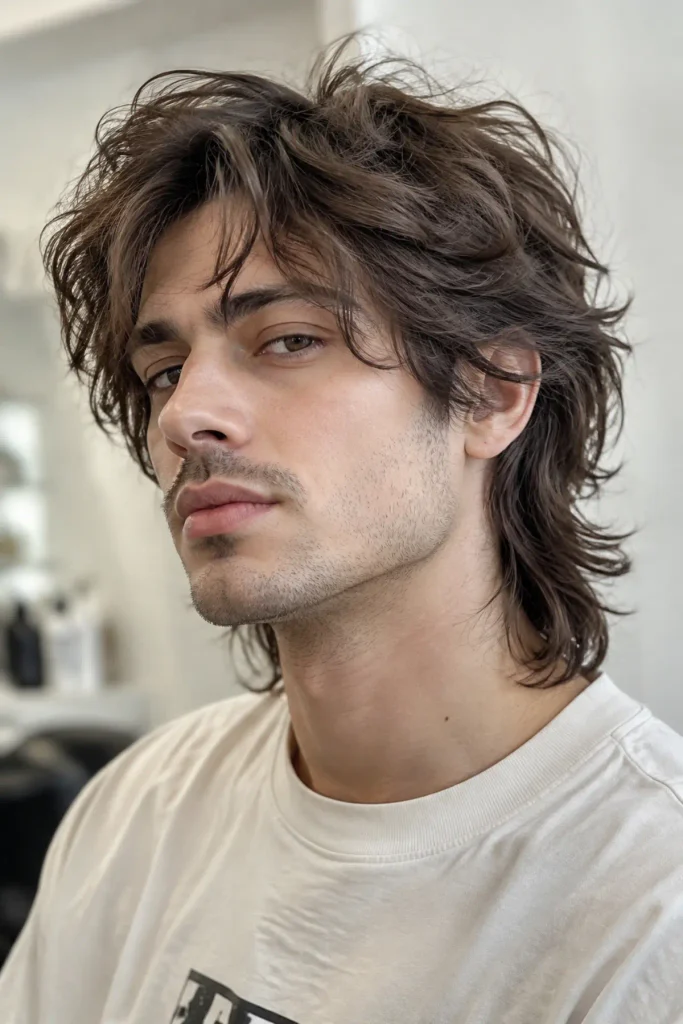
Both push the length toward the back. The shaggy wolf cut stacks short layers at the crown while the back runs noticeably longer. The shaggy mullet softens the classic mullet by running choppy layers through the whole cut so the back connects to the top.
- Best for: oval and square faces, and thick or wavy hair. It is a bold pick for younger guys.
- Upkeep: moderate. Trims every 6 to 8 weeks.
- Style it: blow-dry the crown upside down for lift, then define the back with a light salt spray.
- Ask the barber for: choppy crown layers with a longer, layered back. The wolf cut guide lists more options.
- Watch out for: a workplace that expects a conservative look.
13. Shaggy Flow
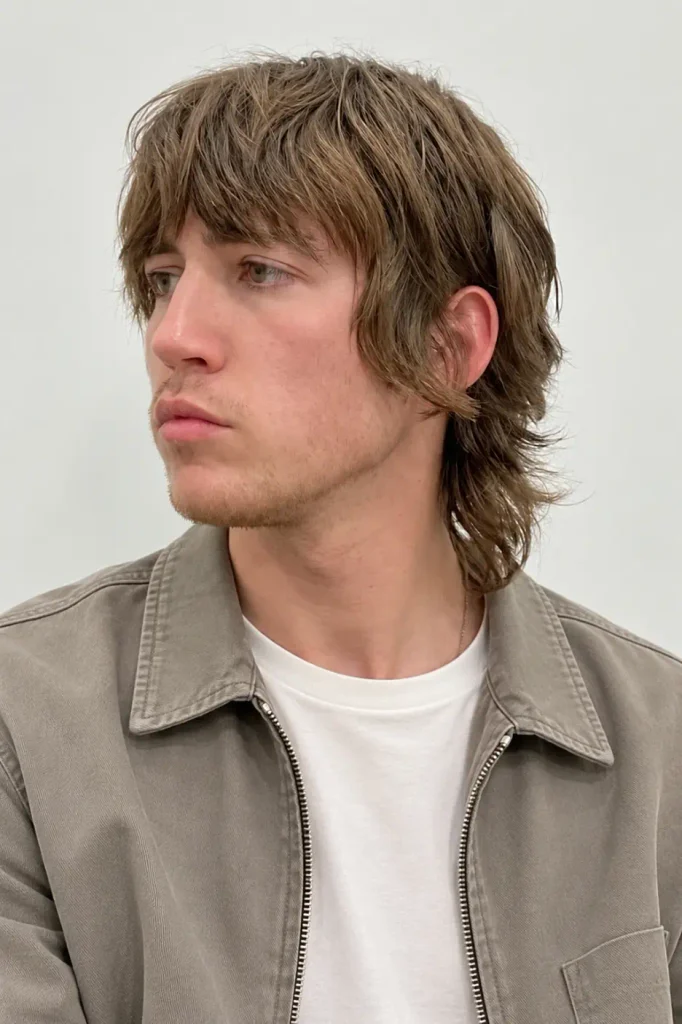
The shaggy flow directs layered length back and away from the face. The layers keep the swept shape full of movement instead of flat and slick, and the ends flip naturally at the collar.
- Best for: oval and square faces, and wavy or thick hair. It also suits men with less natural texture, because layers add shape.
- Upkeep: low. Trims every 8 weeks or so.
- Style it: push the hair back with the fingers while it dries, then add a touch of light cream.
- Ask the barber for: layered length swept back with soft ends at the collar.
- Watch out for: a receding hairline, which sweeping back can highlight. A fringe may flatter more.
14. Shag with a Beard
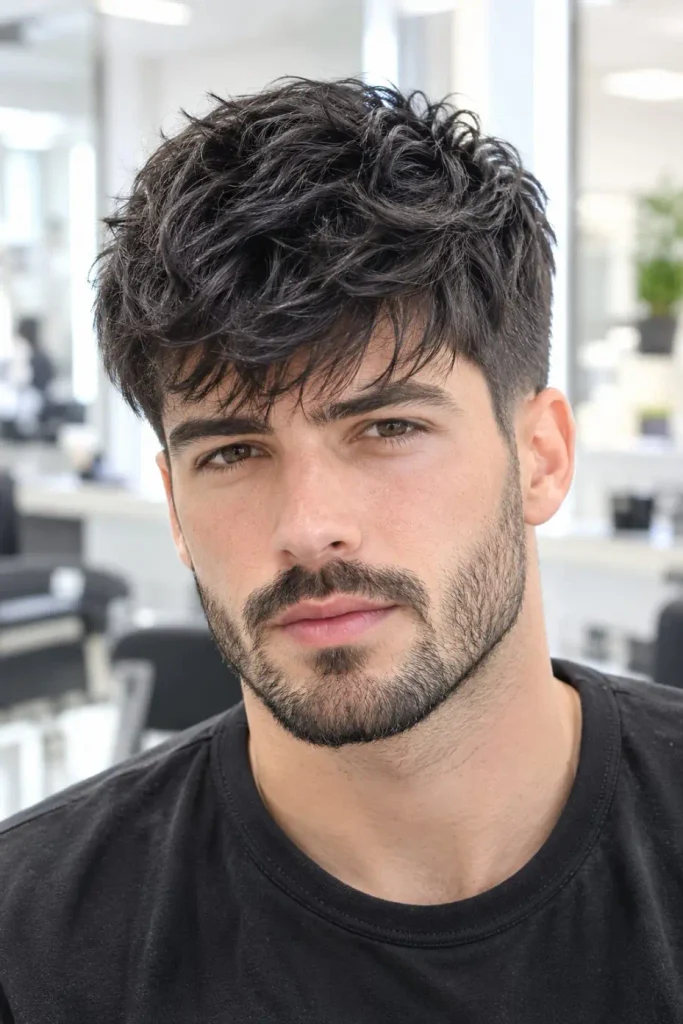
A loose, layered top paired with structured facial hair creates a rugged look. The beard anchors the softness of the shag and adds jawline definition.
- Best for: round and oval faces, where the beard adds structure that the shag softens.
- Upkeep: moderate. The beard needs trimming at the cheek lines, and a few drops of beard oil help.
- Style it: light texture cream in the hair, and keep the sideburn transition blended so the hair and beard connect. Guys planning a faded sides version can look at the buzz cut fade with beard ideas for how a faded beard pairs with short sides.
- Ask the barber for: a shag with blended sideburns that flow into the beard line.
- Watch out for: sideburns left bulky, which break the connection between hair and beard.
15. 70s Rock Shag
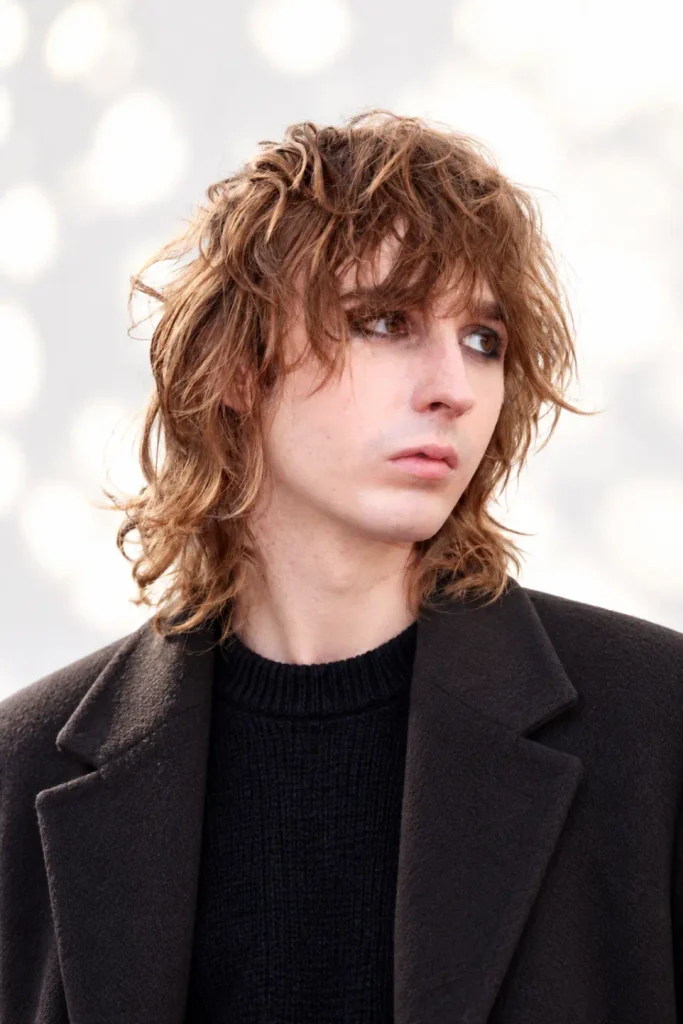
This is the full revival: dramatic feathering, a heavy brow-length fringe, and volume that channels the Jagger and Bowie era. The layers sit shorter and denser at the crown than in modern versions, which creates the rounded, rock-and-roll top.
- Best for: oval and oblong faces, and wavy or thick hair.
- Upkeep: moderate. Trims every 6 to 8 weeks.
- Style it: blow-dry upside down for height, shake everything into place, and skip the comb.
- Ask the barber for: heavy crown layering, feathered ends around the ears, and a brow-length fringe.
- Watch out for: a costume effect. A softer version reads more current.
16. Grunge Shag
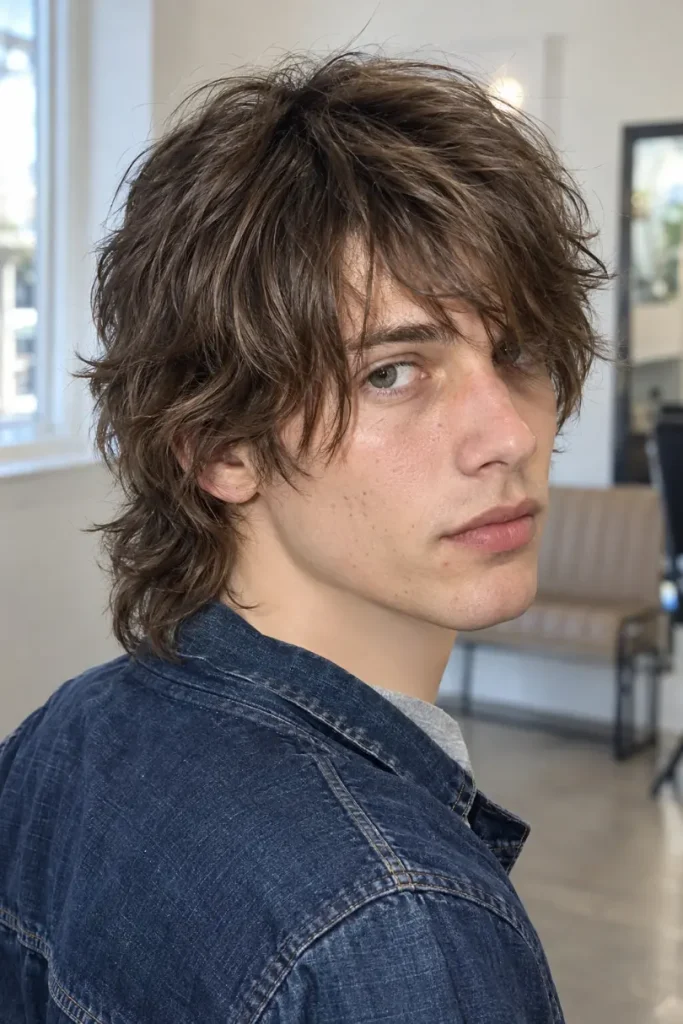
The grunge shag channels the 1990s alternative look: relaxed layers, a grown-out fringe, and a finish that does not try too hard. Length usually sits between the ears and the shoulders.
- Best for: oval and square faces, and straight or wavy hair.
- Upkeep: low styling effort. Fringe and ends still need trims every 8 weeks or so.
- Style it: air dry, run the fingers through once, and use a tiny amount of cream only where the ends look dry.
- Ask the barber for: loose, unsculpted layers with a longer, grown-out fringe.
- Watch out for: dry ends. Relaxed is attractive, but damaged is not.
17. Choppy or Punk Shag
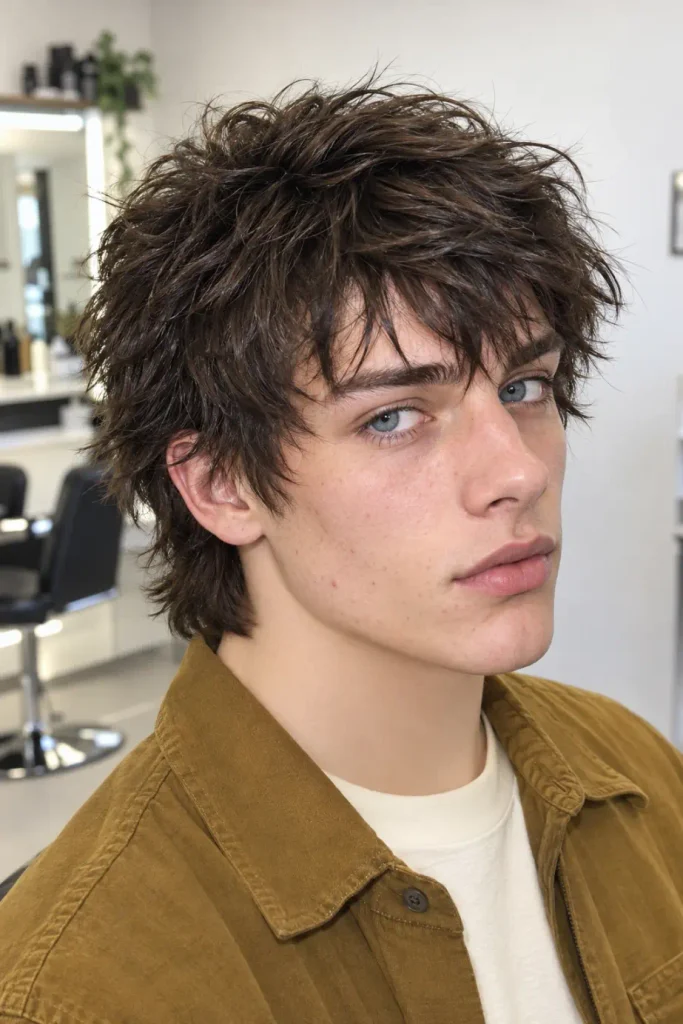
A choppy shag sharpens the layering into visible steps made with point cutting. The harder texture gives it an edgier feel than the soft, feathered versions.
- Best for: diamond and heart-shaped faces, and medium to thick hair.
- Upkeep: higher. The pieces lose definition as they grow, so trims every 4 to 6 weeks help.
- Style it: work medium-hold matte clay through dry hair piece by piece, pinching the ends to exaggerate the separation.
- Ask the barber for: deep point cutting with defined, stacked pieces.
- Watch out for: fine hair, which can look sparse with this much separation.
18. Messy Shag
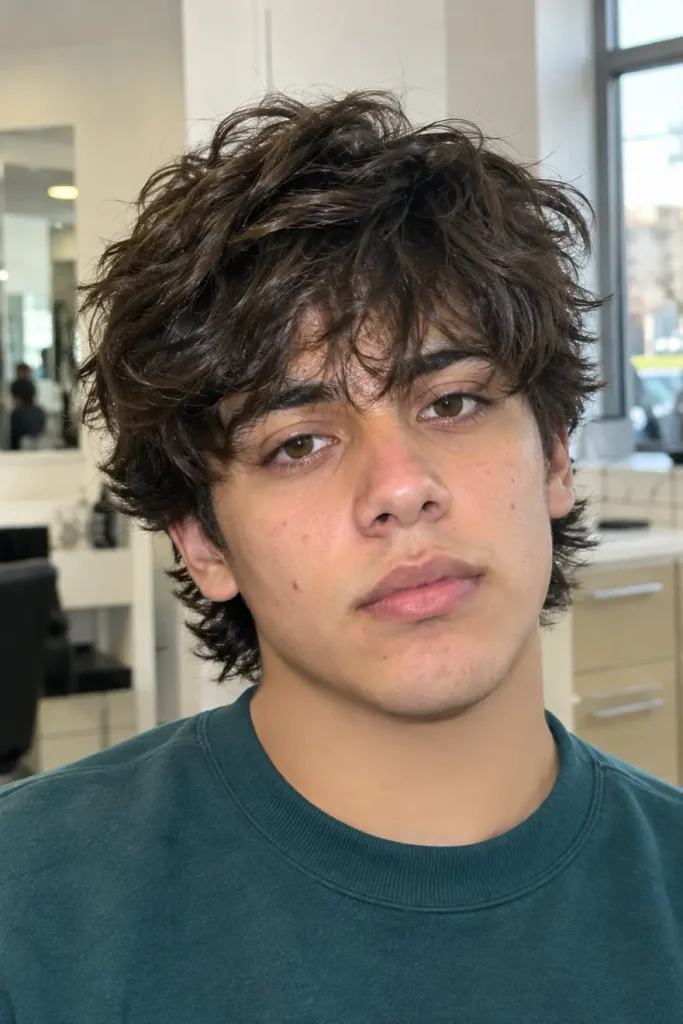
The messy shag pushes the undone quality to the front, with layers going in mixed directions and a slept-on finish. The cut underneath is precise, which is why the disorder still looks flattering.
- Best for: round and square faces, and medium to thick hair.
- Upkeep: minimal styling. Regular trims prevent matting and heavy sections.
- Style it: rough dry, shake it out with the fingers, and add a light dry texture spray only if the hair needs grip.
- Ask the barber for: a layered shag with a flexible, tousle-friendly fringe.
- Watch out for: over-styling, which ruins the point.
19. Thick Hair Shag
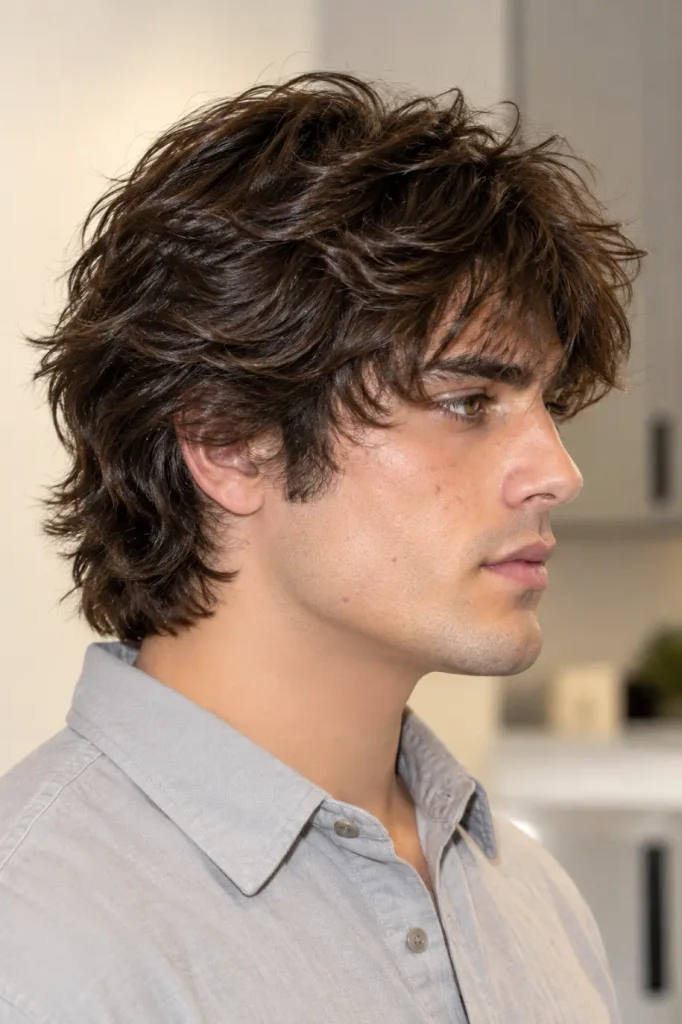
Deep interior layering strips weight out of dense hair, turning bulk into controlled, directional volume. Without layers, thick hair at this length tends to balloon.
- Best for: most face shapes, and thick or coarse hair of any texture.
- Upkeep: moderate. A dry shape check after each cut catches hidden bulk.
- Style it: a cream that adds slip and control, instead of anything that adds volume.
- Ask the barber for: weight removal through the interior and point cut ends, with no heavy thinning on the surface.
- Watch out for: surface thinning, which can cause frizz and puffiness within days.
20. Fine Hair Shag
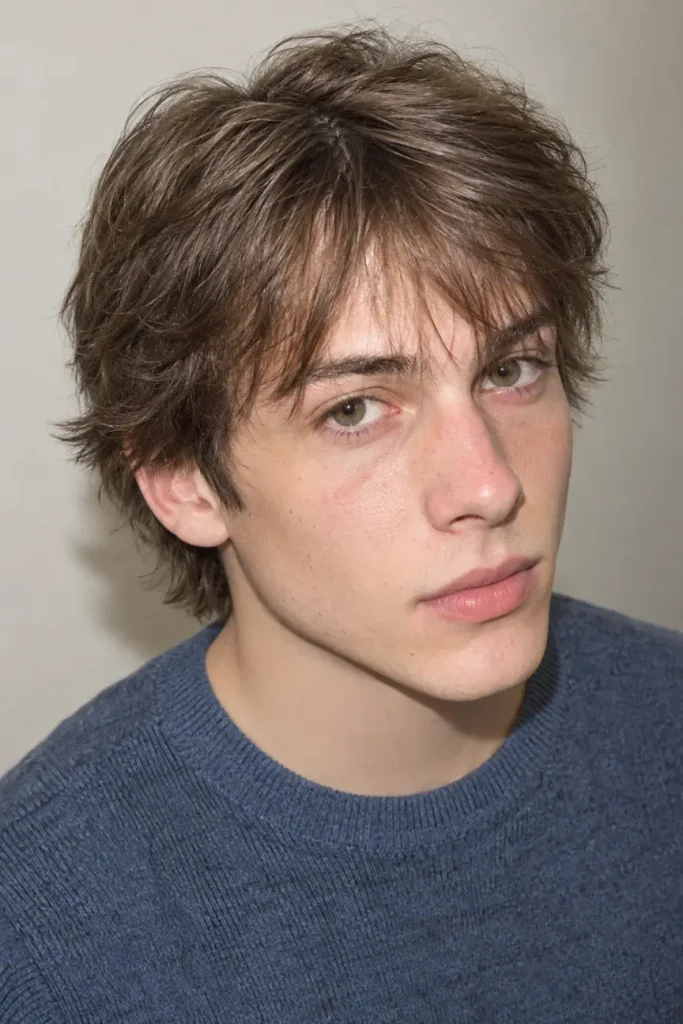
The fine hair version flips the strategy: longer, softer layers with minimal thinning so every strand of density stays. Shorter crown layers create root lift that reads as fullness.
- Best for: oval, heart, and square faces, and fine or thin straight hair.
- Upkeep: moderate. Volumizing shampoo helps.
- Style it: blow-dry with the head flipped forward, then mist a volumizing texture spray at the roots. Avoid heavy clay and oily creams.
- Ask the barber for: longer, soft layers with weight kept at the ends.
- Watch out for: over-layering, which exposes the scalp. More ideas live in the short haircuts for men with fine hair guide.
21. Shaggy Fringe (Shag with Bangs)
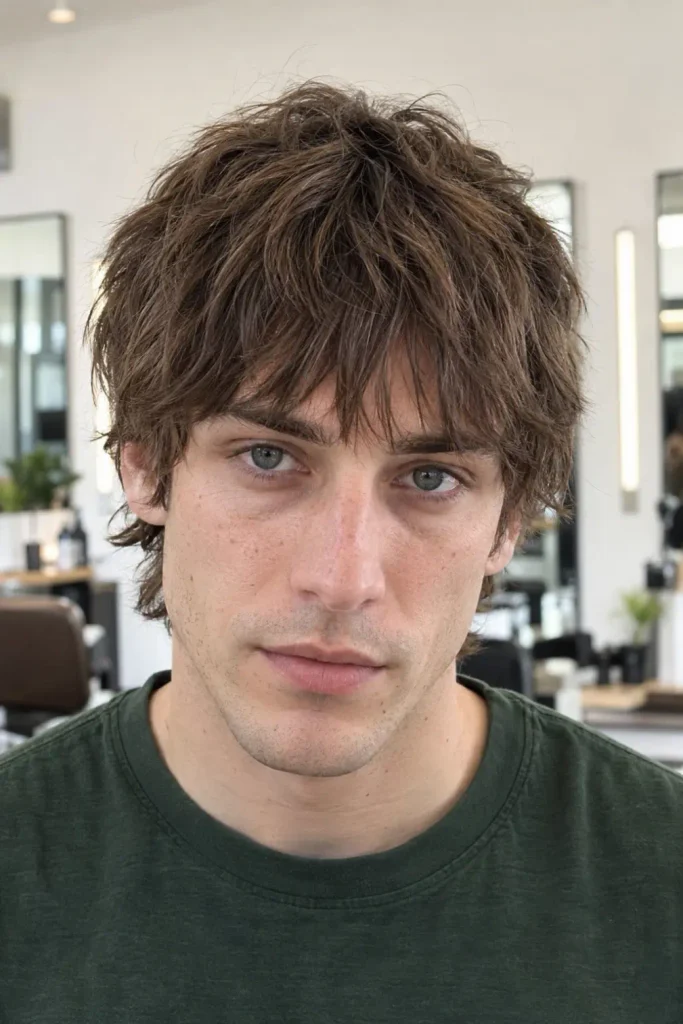
This version makes the front the centerpiece: a heavy, broken-up fringe falling to the brow while shorter layers move through the rest. The texture keeps it from reading as a solid curtain.
- Best for: straight, wavy, or thick hair, and long or oblong faces. Guys with a larger forehead can also compare it with the buzz cut for a big forehead ideas.
- Upkeep: higher at the front. Fringe trims between cuts keep it from covering the eyes.
- Style it: blow-dry the fringe forward or to the side, then define pieces with a light paste rubbed between the fingertips.
- Ask the barber for: a broken, point cut fringe at the brow or just below it.
- Watch out for: a blunt, solid fringe, which can turn the cut into a bowl shape.
22. Highlighted or Two-Tone Shag
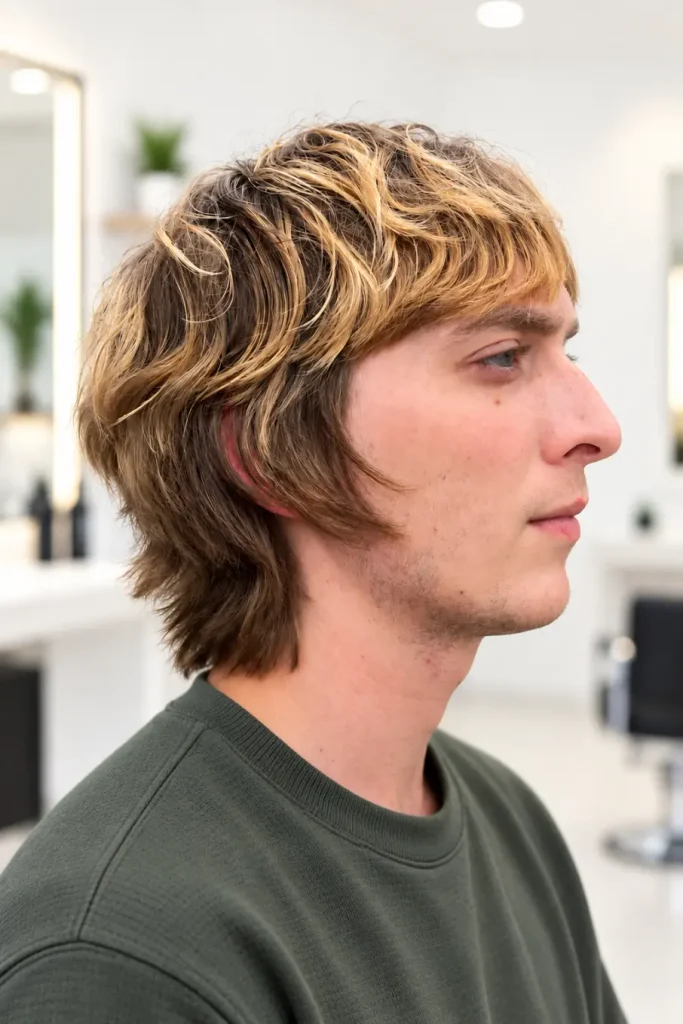
Lightened pieces make every layer visible, since the color catches along the feathered ends and exaggerates the movement.
- Best for: wavy or medium hair, and anyone who likes a sunlit, dimensional finish.
- Upkeep: higher. Color-safe shampoo and a lightweight leave-in cream keep the ends soft.
- Style it: air dry or diffuse with a light cream.
- Ask the barber for: fine, scattered highlights placed along the layers, not chunky panels.
- Watch out for: bleach damage, which shows up fast on point cut ends.
Color Add-Ons: Highlights, Blonde and Silver
Highlights show off layers because the lighter pieces catch along the feathered ends. Fine, scattered pieces usually look more natural than chunky panels. Bleached or highlighted shags need color-safe shampoo and a lightweight cream, since textured ends show dryness faster than blunt ones. Lighter or blonde hair can also work well with a shag, since the messy texture can make hair look thicker and fuller.
Who Suits a Shaggy Haircut? Hair Type, Density, Face Shape and Age
The shag is flexible, but it is not automatic. A few minutes of honest matching saves a lot of regret in the chair.
Hair Texture
- Wavy: the easiest match. The layers release the wave from its own weight, and the wave fills the layers with body. Luxe Digital calls wavy hair the ideal type for a shag.
- Curly: works well with a fuller, rounded shag. Barbers generally recommend a dry scissor cut so the curls can be shaped one by one and shrinkage is accounted for. A razor can cause frizz on tight curls.
- Straight: works, but the layers come from technique instead of natural bend. Point cutting and razor work create separation, and a texture product wakes the movement up each morning.
- Coily: works best as a rounded, textured shag cut dry with scissors. Coily hair shrinks more than looser textures, so the barber needs to see the pattern in its natural state before deciding how short to go.
Hair Density and Strand Thickness
- Fine or thin hair: longer, softer layers with minimal thinning keep the hair looking dense. Shorter crown layers add root lift, which reads as fullness. Over-layering can leave the ends see-through, so the barber should keep weight at the perimeter. Guys in this group can also browse short haircuts for men with fine hair for cropped shag options.
- Medium density: the most forgiving. Most variations in this guide work.
- Thick or coarse hair: the shag shines here because layers remove bulk. The key is removing weight from inside the cut. Surface thinning with thinning shears can cause frizz, and unmanaged bulk can turn the shape into a triangle.
Face Shape
No face shape is off limits, since the fringe and layer placement can be adjusted. These are the common barber guidelines.
| Face shape | What tends to work |
|---|---|
| Oval | Nearly any shag, from a short crop to a long layered version |
| Round | Longer layers that start below the widest part of the face, with a side-swept fringe instead of a full, heavy one |
| Square | Soft, feathered layers around the temples and a textured fringe to soften the jawline |
| Oblong or long | A forward-falling fringe and face-framing layers, which visually shorten the face |
| Heart or triangle | Medium-length layers with some fullness near the jaw, which is the shape stylists quoted by Byrdie say suits the Chalamet-style shag best |
| Diamond | Textured layers and a softer fringe to balance the cheekbones |
Men with a wider jaw and narrower forehead can look at the triangle face shape hairstyles guide for more detail.
Age and Lifestyle
No hard age limit exists for the shag. What changes with age is the version.
- Teens and early 20s: longer fringes, choppier layers, and messy finishes are common.
- 30s and 40s: tapered or cropped versions with softer layering tend to hold up well in more traditional workplaces.
- 50s and beyond, including silver hair: shorter or medium shags with healthy, moisturized ends look polished. Dry or wiry ends are what make a shag look neglected, so a light cream helps.
Office and Work Settings
Shorter, tapered shags generally pass in most offices without comment. Wolf cut shapes, 1970s revivals, and long grunge versions read more casual. Cleaning up the area around the ears and neckline and keeping the fringe controlled can make the same layers look sharper without losing the texture. For more polished options, the office hairstyles for men guide covers styles that work on the job.
Thinning Hair and Receding Hairlines
A shag can help thinning hair look fuller because layers add movement and root lift. That said, a haircut only changes how hair looks. It does not change why hair thins. Men concerned about hair loss should talk to a dermatologist. For styling, barbers usually keep the fringe textured and broken up, avoid heavy thinning, and choose longer, softer layers instead of a blunt, heavy front.
Who Might Want to Skip It
- Guys who want polished, no-effort hair on straight, flat hair, since the layers need a little styling to show up.
- Anyone who dislikes regular trims. The shape softens as hair grows, and an overgrown fringe is the fastest way to look unkempt.
- Men with very short hair who are not ready to wait for growth. A shag needs raw material to work with.
How to Ask a Barber for a Shaggy Haircut
The word “shaggy” covers about fifty years of hair history, so a barber’s mental picture may not match the one on a phone. The fix is to be specific. A clear request covers the version, the length anchors, the layering intensity, and the cutting technique.
The Five-Part Request
- Name the version and era. Modern shag, 70s shag, shaggy crop, curtain shag, or wolf cut narrows the target fast.
- Set three length anchors. The fringe (brow, eye, or cheekbone), the ears (covered, half covered, or exposed), and the back (above the collar, at the collar, or past it). These three points define the shape.
- Describe the layering intensity. Soft, blended feathering grows out gracefully. Choppy, visible steps look bolder but need more frequent upkeep.
- Ask for point cutting or razor work. Texturized ends are what separate a shag from a bluntly layered cut. Razor work suits straight and gently wavy hair. Fine, coarse, damaged, or tightly curled hair often does better with scissors and point cutting.
- Ask for a dry finish check. Layered cuts show their flaws once the hair is dry and sitting naturally, so a quick check before leaving the chair catches heavy sections.
Photos That Actually Help
Photos work best when the model has hair like the guy in the chair. A shag on thick wavy hair behaves very differently on fine straight hair. A front, side, and back photo is ideal, since layers show most clearly from the side.
Copy-and-Paste Scripts
Medium shag, wavy or medium hair: “I’d like a modern medium shag. Fringe to the eyebrow, ears half covered, back touching the collar. Soft feathered layers, not choppy. Point cut the ends and remove weight from the inside so it moves without puffing out at the sides.”
Short tapered shag for the office: “I’d like a short shag with a low taper on the sides and neckline. About 3 inches on top, point cut layers, a broken fringe at the brow. Keep it neat around the ears.”
Curly or coily hair: “I’d like a rounded shag cut dry with scissors. Please work curl by curl and allow for shrinkage. I would like to avoid a razor.”
Fine or thin hair: “I’d like longer, softer layers with the weight kept at the ends. Please go light on thinning, since I want the hair to look fuller.”
Straight, thick hair: “I’d like a shag with razor work and deep point cutting for separation, and weight removed from the interior, not the surface.”
What Not to Say
- “Just shaggy.” It leaves too much room for interpretation.
- “Thin it out.” Surface thinning with thinning shears can cause frizz and puffiness. Asking for weight removal from inside the cut is clearer.
- “Take a little off the fringe.” A shag fringe sits longer and heavier than a standard one, and repeated trims slowly turn it into a generic layered cut.
Barber or Salon Stylist?
Either can deliver a good shag, as long as the person holds scissors well. Shag layering is a scissor, point cutting, and razor skill more than a clipper skill. Checking a portfolio for layered work on hair that matches the client’s texture is the best way to choose. A consultation before the cut, with a question about how the barber plans to handle weight and the fringe, is a good sign.
Red Flags in the Chair
- The barber thins the surface heavily to “lighten it up.”
- The fringe is cut as a blunt, solid line.
- A wet cut on curly hair with no allowance for shrinkage.
- No dry check at the end.
How to Style a Shaggy Haircut, Plus Products and Maintenance
Daily styling takes only a few minutes, because the layers do most of the work. The aim is texture and grip, not hold.
5-Step Daily Styling Routine
- Start with damp hair. Towel dry so the hair is damp, not dripping. A touch of mousse or sea salt spray at the roots goes on now.
- Rough dry with the fingers. Skip the brush. Blow-dry on medium while raking and shaking the hair, tipping the head forward and side to side for root lift. Curly hair should be diffused on low heat or air dried instead.
- Add texture, not weight. Work a pea-sized amount of matte clay or paste through the ends in small pinches, not in a palmful.
- Define the fringe. Dry the fringe in the direction it should fall and let it cool, then separate a few pieces with a light paste.
- Stop early. Leave a little imperfection in. A shag looks better when it is not fully controlled.
Best Products by Hair Type
| Hair type | Core product | Finishing product | Avoid |
|---|---|---|---|
| Straight | Sea salt spray or texture spray | Texture powder at the roots, matte paste on the ends | Shiny gels and pomades |
| Wavy | Sea salt spray | Light styling cream | Heavy waxes that flatten waves |
| Curly | Curl cream on damp hair | Leave-in conditioner | Brushing dry curls |
| Coily | Moisturizing curl cream | Light oil or butter on the ends | Heavy razoring and harsh shampoos |
| Fine or thin | Mousse or volumizing spray | Light texture powder | Heavy clay, oily creams, too much salt spray |
| Thick or coarse | Smoothing cream or balm | Small amount of matte paste | Surface thinning shears and heavy gel |
Texture sprays tend to help a shag more than serums or oils. Matte finishes work best, since glossy products can make layers look greasy and flat.
Washing and Conditioning
Most barbers recommend washing a shag two to three times a week with a gentle shampoo and conditioning each time, since feathered ends dry out faster than blunt ones. Some stylists quoted by Byrdie suggest washing only once or twice a week for the lived-in look. Second-day hair often looks better, as natural oils relax the texture and the layers settle into shape. Between washes, a spritz of water or texture spray at the roots and a quick rough dry resets the shape in about two minutes.
Trim Schedule by Version
| Version | Full reshape | Extra upkeep |
|---|---|---|
| Short shag or shaggy crop | Every 4 to 6 weeks | A fringe trim between cuts |
| Tapered or faded shag | Every 3 to 4 weeks for the edges | Layers can wait a bit longer |
| Medium shag | Every 6 to 8 weeks | Optional crown refresh at the midpoint |
| Long shag | Every 8 to 10 weeks | Weekly leave-in conditioner |
The signs a trim is due are easy to spot: the fringe drops into the eyes, the layers lose definition, or the sides start to puff out. If only the crown feels flat, a crown layer refresh costs less time than a full reshape. Prices for haircuts vary by city and shop, so it is smart to ask before booking, and a budget should include a texture product and a conditioner.
How Long Does a Shag Take to Grow In?
Hair grows about half an inch per month, or roughly 6 inches a year, according to dermatologist Dr. Hadley King and the American Academy of Dermatology Association, as reported in USA Today via AOL. A short shag needs roughly 2 to 3 inches on top, so a guy starting from a standard short cut can expect about 2 to 4 months before a barber has enough length to layer. Starting from a buzz cut takes longer.
| Stage | What usually happens | What to ask the barber |
|---|---|---|
| Month 1 | Short and uneven, with little shape yet | A tidy-up of the neckline and sides only |
| Months 2 to 3 | Enough length on top for a short shag | A first shaggy crop with soft, point cut layers |
| Months 4 to 6 | Medium shag length with a growing fringe | A crown refresh and a taper to keep the sides neat |
| Month 6 and beyond | Long layers, possibly tie-back length | A reshape that protects length while refreshing the layers |
The grow-out awkward stage is gentler with a shag than with most cuts, because the shape comes from layers instead of hard lines. It loosens gracefully into a longer shag, a flow, or even a tie-back style like a man bun.
Common Shaggy Haircut Mistakes and Quick Fixes
| Mistake | Why it happens | Fix |
|---|---|---|
| Flat crown | Top layers grew too long or are coated in heavy product | Mousse or volumizing spray at the roots, lift with the fingers while drying, or ask for a crown layer refresh |
| Mushroom or triangle shape | Weight builds above the ears, common on thick hair | Interior weight removal and drying the sides slightly downward |
| Stringy fine hair | Too much layering or razoring | Longer, softer layers with minimal thinning |
| Frizzy curls or waves | Overhandling or a cutting technique that breaks the pattern | Curl cream, gentle scrunching, air drying, and a dry scissor cut |
| Fringe falls in the eyes or splits | Cowlick, oil, or an overgrown fringe | Dry the front in the desired direction, then ask for a curtain or side-swept adjustment |
| Dry, crispy ends | Feathered ends show damage quickly | Conditioner on every wash, a leave-in twice a week, and a light trim |
| Greasy, weighed-down look | Too much product or shiny formulas | Use less, keep product on the ends, and wash buildup out |
| Looks neglected, not deliberate | Overdue trim, dry ends, or a messy neckline | A dry shape check, a crown refresh, and cleanup around the ears and neckline |
The biggest overall mistake is mixing up a shag with simply grown-out hair. A real shag has layers placed with intent and weight removed from specific areas. Skipping appointments for three months leaves hair heavy around the ears and flat on top.
Shaggy Haircut FAQs
What is a shaggy haircut for men?
A shaggy haircut for men is a layered, textured cut with shorter layers at the crown, a loose fringe, and feathered ends. The layers are cut at varying lengths so the hair looks full on top and light at the edges, with a relaxed, slightly undone finish.
Is the shaggy haircut still in style in 2026?
Yes. Barber-led publications through 2026 still describe the shag as part of a sustained revival, driven by the wolf cut, soft waves, and 1970s and 1990s influences. Its flexibility across lengths and textures keeps it current, with shorter, tidier versions leading.
What is the difference between a shag and a wolf cut?
A shag keeps layers and length fairly even around the head with soft, feathered ends. A wolf cut crosses a shag with a mullet, with short layers at the crown and a sharper step to a longer back. The wolf cut reads wilder.
Is a shaggy haircut the same as a mullet?
No. A mullet is short on the front and sides and long at the back, with a clear break between them. A shag layers the length through the whole head, so it blends instead of splitting front to back.
How long does hair need to be for a shag?
A short shag needs about 2 to 3 inches on top. Medium and classic versions need roughly 4 to 6 inches on top, plus enough length at the sides and back to cover the ears and approach the collar. From a standard short cut, that usually means 2 to 4 months of growth.
Does a shaggy haircut work on straight hair?
Yes, with the right technique. Straight hair has no natural bend, so a barber uses point cutting or razor work to create separation, and a texture spray or powder brings out the movement each day.
Can a shaggy haircut work on thin or fine hair?
Yes, in the right version. Longer, softer layers with minimal thinning and shorter crown layers for lift help hair look fuller. Over-layering can expose the scalp, so the barber should keep weight at the ends.
Can curly or coily hair get a shag?
Yes. Curly and coily hair do well with a rounded shag cut dry with scissors, so the barber can work curl by curl and allow for shrinkage. Heavy razoring can disturb the pattern and cause frizz.
Is a shaggy haircut low maintenance?
Daily styling is quick, often just a rough dry and a little product. Care is the trade-off: layered ends need regular conditioning and trims every 4 to 8 weeks. It is low effort, but not zero attention.
How often should a shaggy haircut be trimmed?
Short shags usually need a trim every 4 to 6 weeks, and longer ones every 6 to 8 weeks, with some stretching to 8 to 10 weeks. Tapered edges look best when cleaned up every 3 to 4 weeks, and a fringe trim between cuts helps.
What should a guy ask the barber for?
A guy can name the version, such as a modern shag or shaggy crop, then set three length anchors for the fringe, ears, and back. He can also describe the layering intensity, ask for point cutting or razor work, and request a dry finish check.
What products work best on shaggy hair?
Texture-focused products work best: sea salt spray, texture powder, matte clay or paste, and light creams. Curl cream suits curls, and mousse suits finer hair. Glossy pomades and heavy gels tend to work against the cut.
Which face shapes suit a shaggy haircut?
The shag suits almost every face shape because the fringe and layers can be adjusted. Oval faces can wear nearly any version, round faces do well with longer layers and a side-swept fringe, and heart or triangle shapes often suit medium layers best.
Can a shaggy haircut look professional?
Yes. Short, tapered, and cropped versions pass in most offices. Cleaning up the area around the ears and neckline and controlling the fringe makes the same layers look more polished. Wolf cut shapes and long grunge versions read more casual.
Does a shaggy haircut suit men over 40 or 50?
Yes. There is no age limit, but the version matters. Short or medium shags with a taper and healthy, moisturized ends look polished on older men, and a light cream keeps gray hair from looking dry or wiry.
Final Thoughts
The shag lasts because it solves a common problem: wanting texture and personality without a long daily routine. The right version depends on hair texture, density, face shape, and workplace, and the cut works best when the barber is given clear anchors for the fringe, ears, and back. With a quick styling routine and a trim every 4 to 8 weeks, a shag can look relaxed on purpose. For more length-focused ideas, readers can explore the medium length haircuts for men and long layered hair for men guides, or head back to the MenHairInspo homepage for more haircut inspiration.