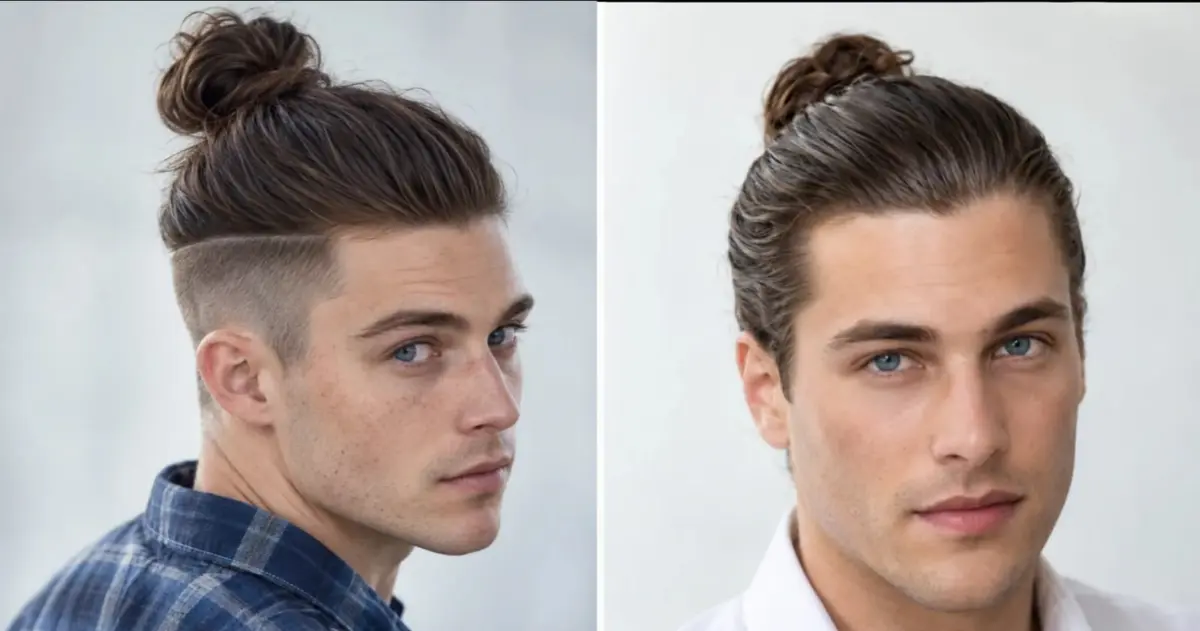
| What Is a Man Bun ? |
| A man bun is a men’s hairstyle in which longer hair is gathered and tied into a rounded knot at the crown, the back of the head or the nape of the neck. Most men need at least 6 inches of length to tie a basic bun and 10 to 16 inches for full versatility, which takes roughly 12 to 18 months of growth. The four core placements are the classic bun, the low bun, the high bun and the half-up bun, and each of those can be worn with long sides, a taper, a fade or an undercut. The easiest versions to live with are the low bun and the messy bun. The sharpest looking versions in 2026 are the fade and undercut variations. |
Man Bun Fast Facts
| Detail | What to expect |
|---|---|
| Minimum hair length | 6 inches on top, 8 inches for a bun that holds its shape |
| Ideal hair length | 10 to 16 inches for every variation |
| Time to grow from short hair | Roughly 12 to 18 months at about half an inch per month |
| Daily styling time | 30 seconds to 3 minutes for most versions |
| Difficulty | Easy once the length is there, 2 out of 5 |
| Barber visits | Every 6 to 8 weeks for the ends, every 2 to 4 weeks if the sides are faded |
| Best face shapes | Oval, square, diamond and rectangle, with placement adjusted for round and oblong |
| Works with | Straight, wavy, curly, coily and locked hair |
| Main risk | Traction alopecia from tying it too tight, in the same spot, every day |
| Typical yearly cost | Around 250 to 600 dollars in the United States, depending on whether the sides are faded |
The man bun has outlasted almost every men’s hair trend it came up with. It arrived in the mid 2010s attached to a very specific look, took a decade of jokes, and somehow came out the other side as a normal, mainstream way for men to wear long hair. The version that is popular now is tidier than the original. It is usually cut with intent, paired with a taper, a fade or a full beard, and worn by guys who simply want their hair off their face without losing the length.
What most guides skip is the practical part. They show 40 photos and never mention how much hair a style actually needs, how the bun looks on low density hair, what to say in the barber chair, or who should probably skip the look altogether. This guide covers 24 man bun hairstyles with those details attached, plus the grow out roadmap, the tying technique, the upkeep, and honest answers about hair loss.
Table of Contents
Will a Man Bun Suit Him? A 60-Second Check
Before the style list, four quick checks decide whether a man bun is going to look intentional or awkward. Length matters least of the four, because length only takes time. The other three are fixed.
1. Length: 6 inches is the floor, 10 is comfortable
Six inches of hair is the point at which most men can gather and secure a small knot. Eight to ten inches is where the bun starts holding its shape without a fight, and 10 to 16 inches opens up every variation including high buns, slicked back buns and braided versions. Curly and coily hair needs two to four inches more than straight hair because of shrinkage, so a man with 3C or 4A texture should measure his hair stretched, not as it sits. Scalp hair grows at an average of about half an inch per month, so the gap between a short cut and a real man bun is close to a year and a half of patience.
2. Density: the thing nobody mentions
Fine and thin are not the same thing. Fine describes the diameter of each strand. Thin describes how many strands grow per square inch. A man can have fine hair with excellent density and get a full, soft bun, while a man with coarse hair and low density will get a small, wiry knot no matter how long he grows it. Anyone with low density should expect a bun roughly the size of a golf ball rather than a tennis ball, and should lean toward messy and textured versions that read as fuller. Men who decide the bun is not worth the wait have a much easier option in the meantime: the short haircuts for men with fine hair guide covers styles that add volume without needing any length at all.
3. Hairline and crown: the honest conversation
A man bun pulls every hair backward, which exposes the temples and the front hairline completely. That is flattering on a strong, intact hairline and unflattering on a receding one. Men with a mature hairline can usually still wear a low, loose bun or a half-up version that leaves some hair forward. Men with an actively receding hairline or visible thinning at the crown will find the style highlights exactly what they would rather downplay, and the constant tension makes the situation worse over time. That is not a reason to avoid long hair altogether, only a reason to wear it down or in a half-up style.
4. Neck, jaw and proportion
A low bun sits at the nape and visually shortens the neck, so men with short necks or broad shoulders usually look better with the knot placed higher, at the crown. A high bun adds vertical height, which helps round and square faces but stretches an already long, oblong face. The most useful rule is that the sides matter more than the bun. Heavy, long sides widen the head, which is why round faces often do better with a taper or fade on the sides rather than a high knot alone.
| WHO SHOULD SKIP THE MAN BUN |
| Men with an actively receding hairline, visible crown thinning, diagnosed traction alopecia, or a job that forbids long hair for safety reasons. Men with under 6 inches of length are not excluded, they are simply early. A half-up bun or a small top knot with an undercut bridges the gap while the length arrives. |
All 24 Man Bun Hairstyles: The Four Core Placements
Everything else on this list is a variation of these. Placement alone changes how formal, how bold and how flattering the bun looks, so it is worth experimenting with height before changing anything about the cut itself.
1. Classic Man Bun
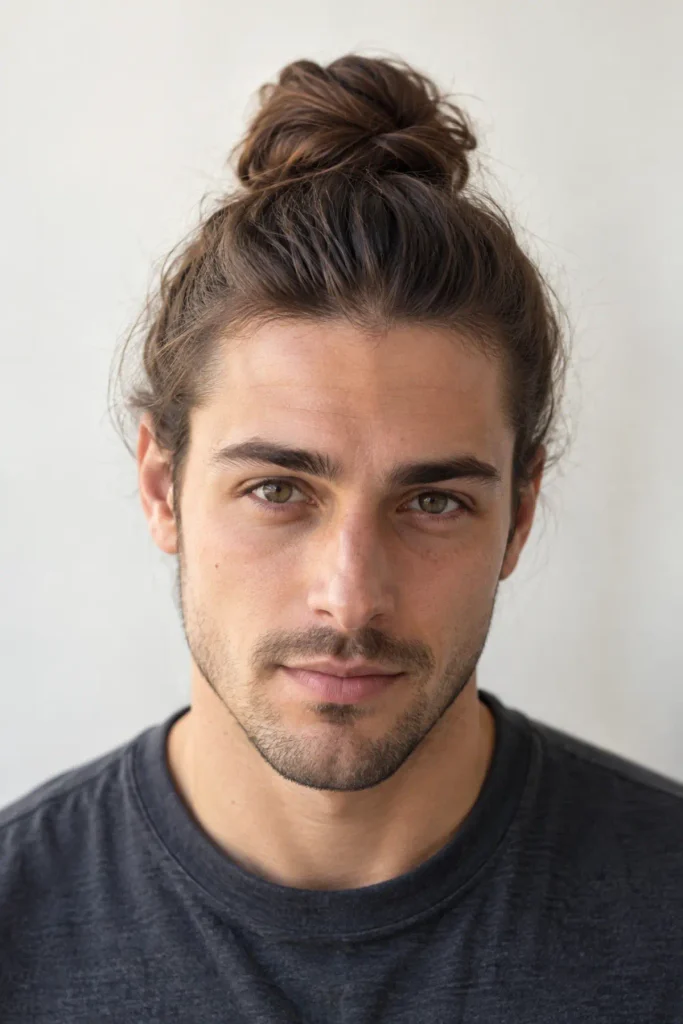
The original and still the most worn version. All of the hair is brushed back and gathered into a rounded knot sitting between the crown and the occipital bone, with the sides left long. It reads as relaxed but deliberate, and it is the placement that flatters the widest range of faces because it sits at the natural curve of the skull rather than fighting it.
- Suits: All face shapes, especially oval and rectangle. Straight to wavy hair of medium to high density.
- Specs: Minimum 10 inches. Upkeep medium. Styling time under a minute. Difficulty 1 out of 5.
- Ask the barber for: “I am growing my hair for a classic man bun. Dust the ends, tidy the perimeter, and keep all of the length.”
- Heads-up: With long sides and high density it can add visible width at the temples, which is the one thing round faces want to avoid.
2. Low Man Bun
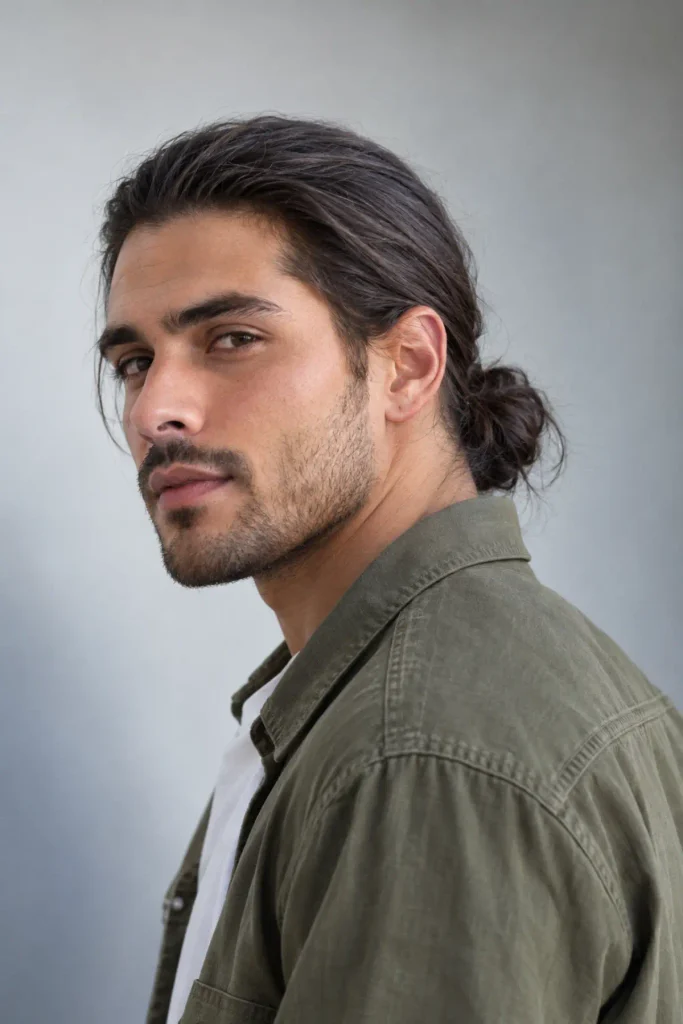
The knot sits at the nape of the neck rather than the crown. It is the most understated and the most workplace friendly placement, and because the hair is not pulled upward it puts the least tension on the hairline of any bun on this list. It also happens to be the easiest version to tie with borderline length.
- Suits: Rectangle, oblong and heart shaped faces. Any texture. Men with longer necks.
- Specs: Minimum 6 inches. Upkeep low. Styling time 30 seconds. Difficulty 1 out of 5.
- Ask the barber for: “Low man bun. Keep the length, shape the ends, I tie it low at the neck.”
- Heads-up: On a short neck or heavy shoulders it can make the head look like it is sitting low, so those guys are usually better off an inch or two higher.
3. High Man Bun
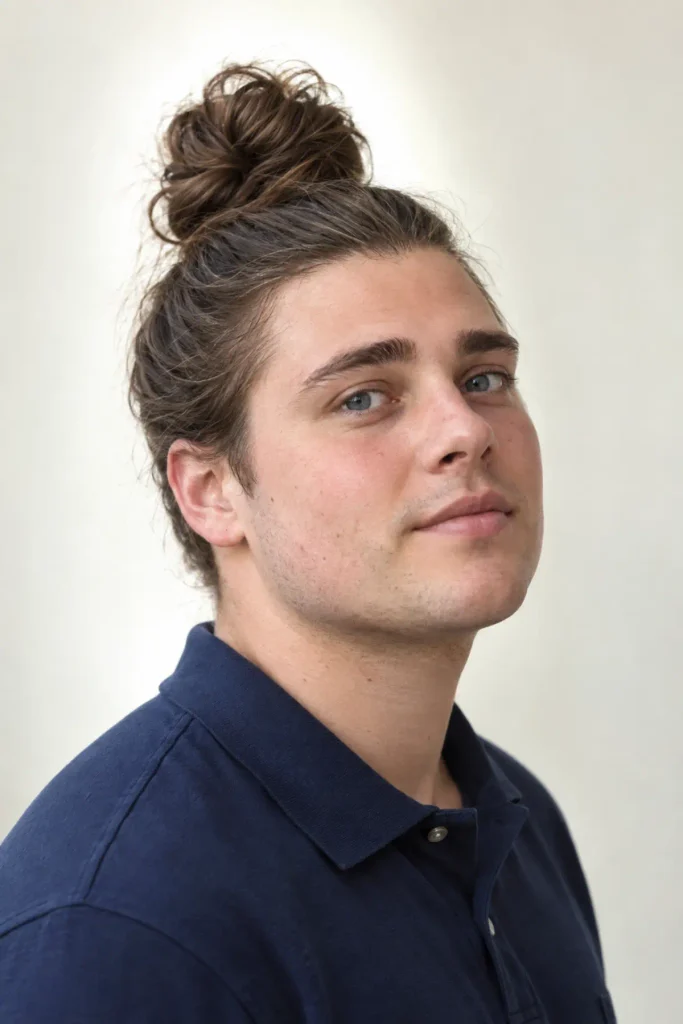
Gathered high on the crown for a taller, more athletic silhouette. This is the placement that draws the eye upward and adds visual length to the face, which is why it is the standard recommendation for round faces. It is also the most secure position for anyone who moves a lot during the day, because the knot sits above the point where the skull curves away.
- Suits: Round, square and diamond faces. Medium to high density. Straight, wavy or curly hair.
- Specs: Minimum 8 inches. Upkeep medium. Styling time one minute. Difficulty 2 out of 5.
- Ask the barber for: “High man bun. I tie it high on the crown, so keep the length and take the weight out of the ends.”
- Heads-up: It stretches an already long or oblong face, and it applies the most tension to the front hairline of any placement.
4. Half-Up Man Bun
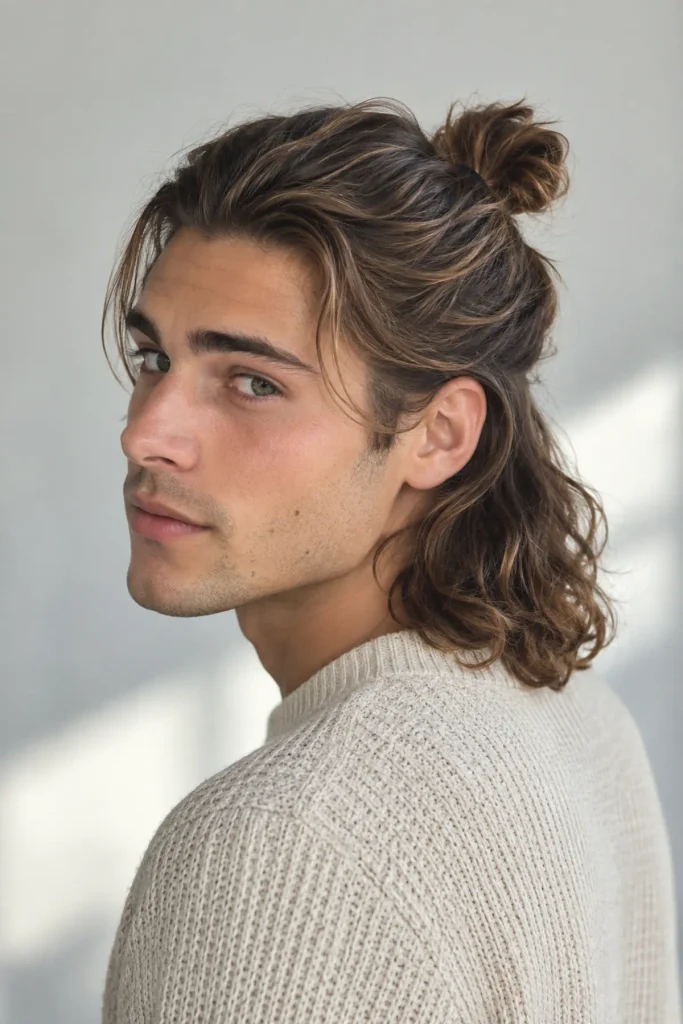
Only the top section is tied back, from roughly ear to ear, while the rest of the length stays down. This is the most useful style in the entire guide for men in the middle of a grow out, because it works long before a full bun is possible and it keeps the face clear without hiding the length. It is also the softest looking version, which helps balance a strong jaw.
- Suits: Oval, heart and rectangle faces. Wavy and curly hair especially. Any density.
- Specs: Minimum 5 inches on top. Upkeep low. Styling time under a minute. Difficulty 1 out of 5.
- Ask the barber for: “Half-up bun. Keep the top section long enough to tie back and leave layers in the length underneath.”
- Heads-up: Fine hair left down can go flat by mid afternoon, so a texturising spray at the roots is close to essential.
5. Short Starter Bun
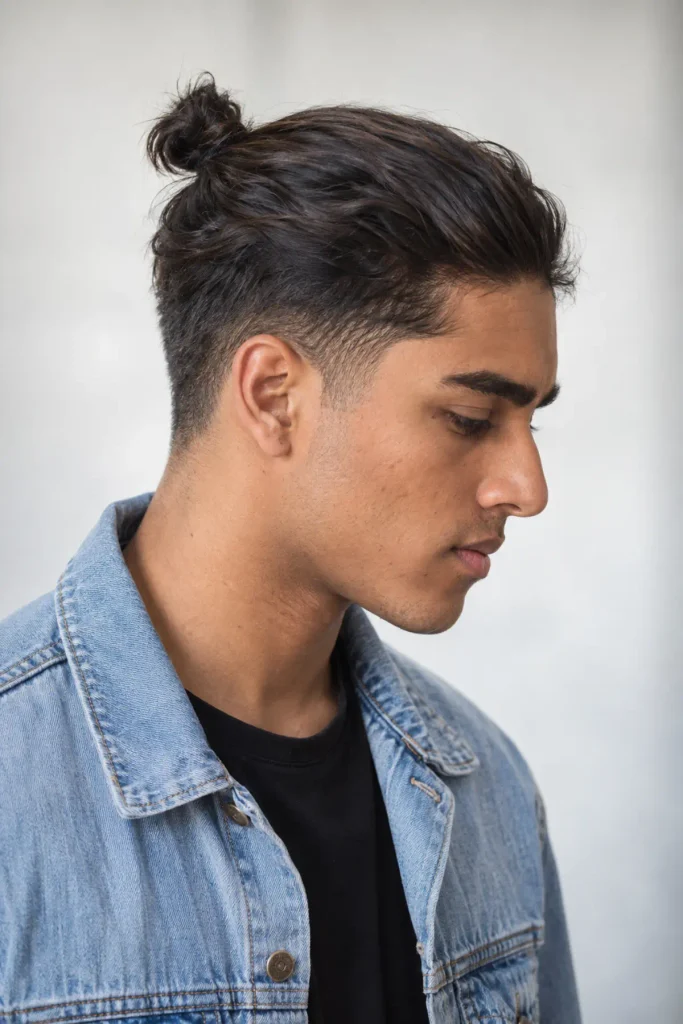
The stubby first bun, roughly the size of a walnut, usually worn with faded or tapered sides so that the short pieces have somewhere to go. This is the earliest point at which the look reads as intentional rather than as hair that has not been cut in a while, and most men pass through this stage on the way to something fuller.
- Suits: Men at the 6 inch mark. All face shapes. Straight to wavy hair.
- Specs: Minimum 6 inches. Upkeep low on top, higher if the sides are faded. Styling time one minute. Difficulty 2 out of 5.
- Ask the barber for: “Short man bun. Tie up whatever length I have on top and clean the sides with a low taper so nothing sticks out.”
- Heads-up: Short pieces will escape around the ears and neck. Bobby pins and a light cream handle it, but nothing makes it disappear entirely.
Man Bun With a Fade, Taper or Undercut
Shortening the sides is the single change that moved the man bun from a 2015 look to a 2026 one. It strips bulk, sharpens the outline and makes the knot read as a haircut rather than an accident. The three options below are not interchangeable, and they produce noticeably different results on the same head.
6. Man Bun With a Low Fade
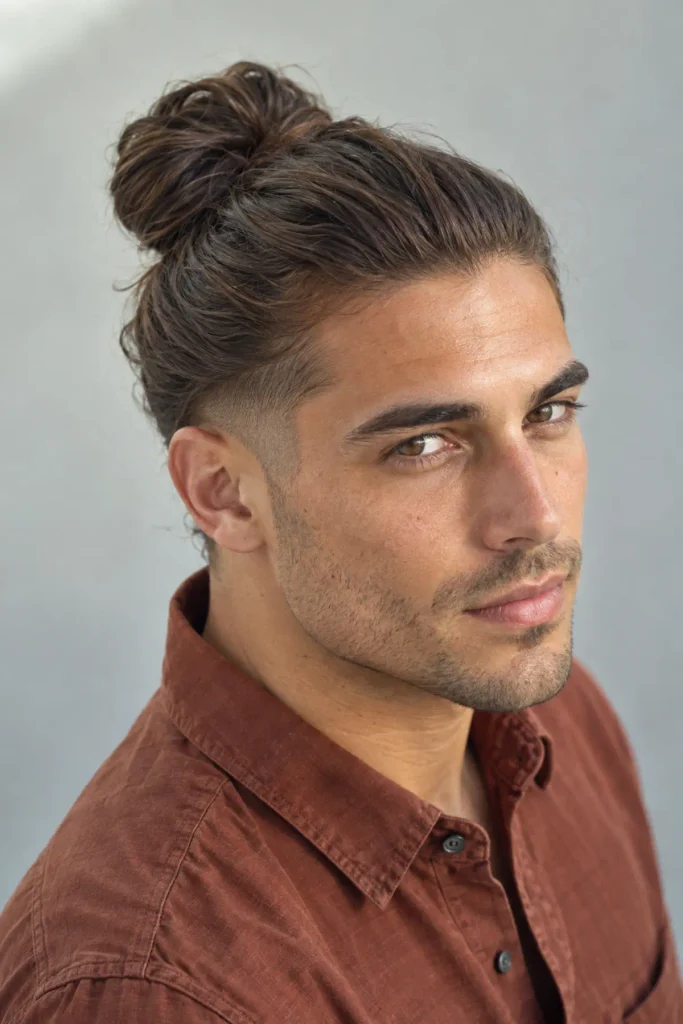
The fade begins just above the ear and blends into longer hair quickly, so the overall silhouette stays soft. This is the most versatile fade pairing on the list because it looks clean in an office without shouting, and it keeps enough hair around the sides to gather into the bun if the wearer wants a fuller knot.
- Suits: All face shapes. Any texture. Men who want contrast without commitment.
- Specs: Minimum 6 inches on top. Upkeep medium, fade refreshed every 2 to 3 weeks. Styling time one minute. Difficulty 2 out of 5.
- Ask the barber for: “Low fade on the sides, keep everything on top long enough to tie back. Blend it soft, nothing above the temple.”
- Heads-up: The fade grows out faster than the top, so skipping a touch up leaves the sides looking shapeless within a month.
7. Man Bun With a Mid Fade
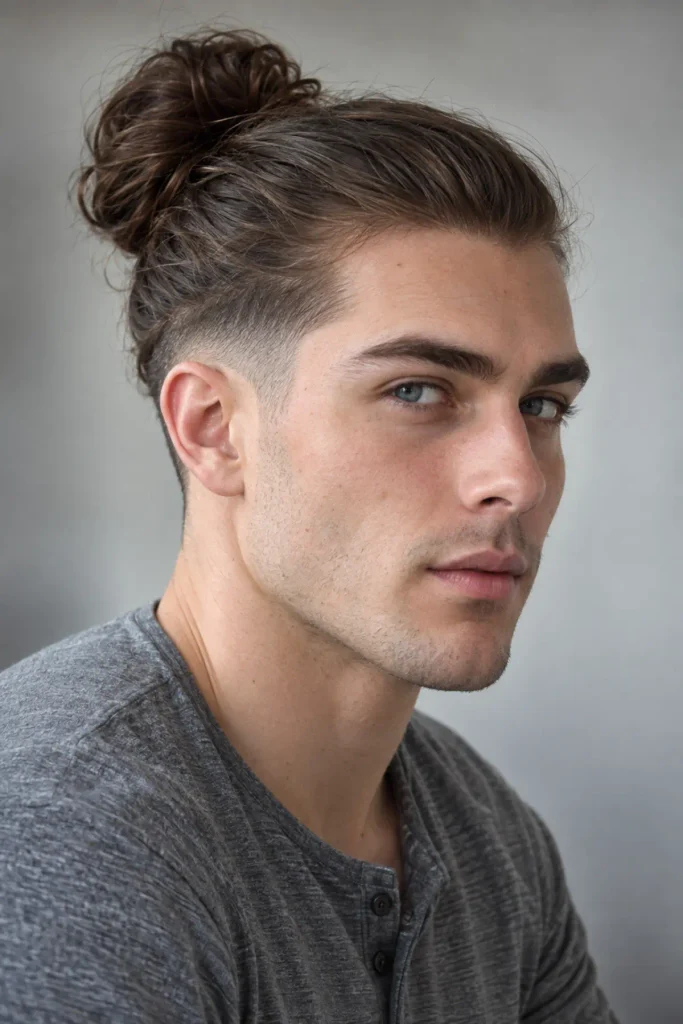
The blend starts around temple level, which is the middle ground between subtle and dramatic. It removes more width than a low fade, so it is the better pick for round faces and for men with heavy density at the sides. It also frames the bun more clearly, which makes the knot look deliberate from every angle.
- Suits: Round, square and oval faces. Medium to thick hair.
- Specs: Minimum 6 inches on top. Upkeep medium, refreshed every 2 to 3 weeks. Styling time one minute. Difficulty 2 out of 5.
- Ask the barber for: “Mid fade starting at the temple, long top for a bun, and keep the back long enough to reach the knot.”
- Heads-up: The back needs to stay long enough to gather. A barber who fades the back too high will leave a gap under the bun.
8. Man Bun With a Skin Fade
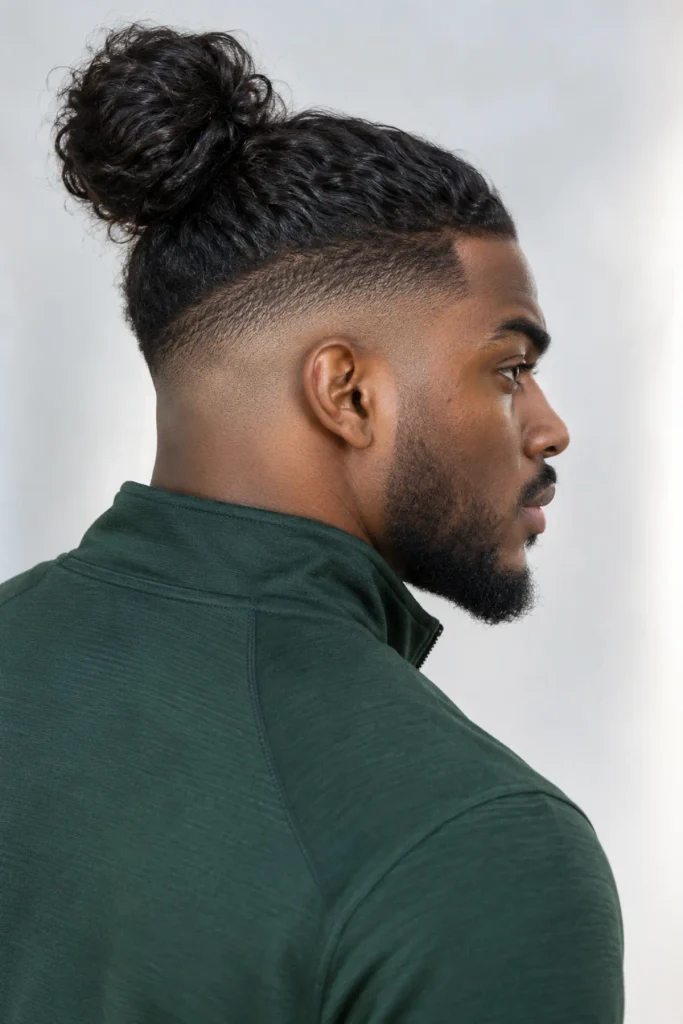
The sides taper all the way down to bare skin, creating the hardest contrast available. It is the sharpest looking version of the style, it removes the most weight, and it is genuinely practical in hot weather or for men who train in the heat. It is also the highest maintenance option here by a clear margin.
- Suits: Oval, square and diamond faces. Thick, coarse or coily hair. Warm climates.
- Specs: Minimum 6 inches on top. Upkeep high, refreshed every 2 weeks. Styling time one minute. Difficulty 2 out of 5.
- Ask the barber for: “Skin fade on the sides and back, low or mid to start, with all the length kept on top for a bun.”
- Heads-up: Two weeks between visits is not optional. A skin fade at week five stops reading as a fade and starts reading as neglected.
9. Man Bun With a Taper
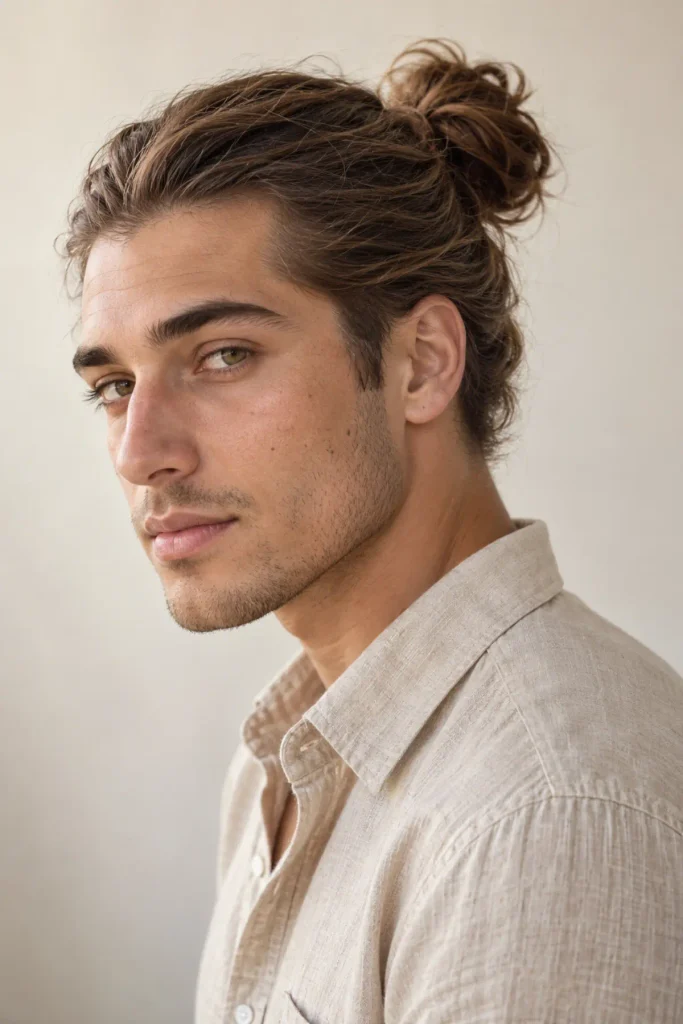
A taper shortens the hair gradually around the ears and the neckline only, leaving the sides essentially long. It is the most refined and the most forgiving option, and it is what most barbers recommend to men who want the bun to look groomed without committing to a fortnightly clipper schedule.
- Suits: All face shapes, particularly men over 35. Every texture. Conservative workplaces.
- Specs: Minimum 8 inches. Upkeep medium, tidied every 4 to 6 weeks. Styling time one minute. Difficulty 1 out of 5.
- Ask the barber for: “Just a taper around the ears and the neckline. Leave the sides long enough to go into the bun.”
- Heads-up: It removes less bulk than a fade, so men with very dense hair may still end up with visible width at the temples.
10. Man Bun Undercut
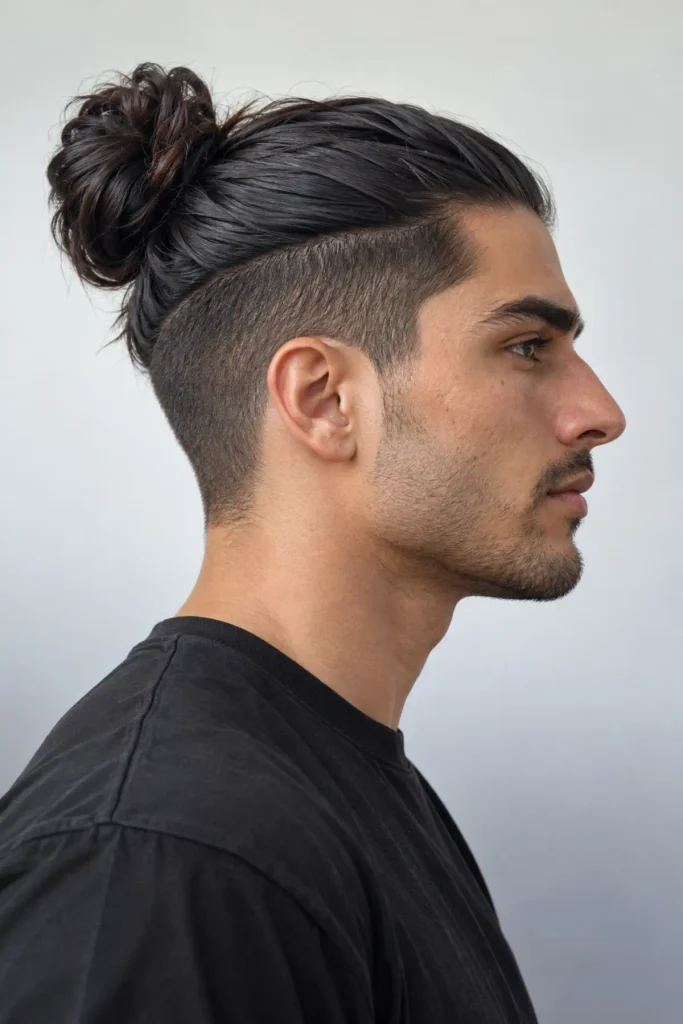
The sides and back are clipped short at one uniform length, with no blending, and the entire top section is left long to tie. It was the first man bun variation to go mainstream and it still works because the contrast is instant and the weight reduction is dramatic. Thick haired men in particular find that it turns an unmanageable bun into an easy one.
- Suits: All face shapes. Thick, coarse and curly hair. Men who want the bun to be the focal point.
- Specs: Minimum 8 inches on top. Upkeep medium to high, sides buzzed every 3 to 4 weeks. Styling time one minute. Difficulty 2 out of 5.
- Ask the barber for: “Undercut with a number one or two guard on the sides and back, no blending, and keep the whole top long for a bun.”
- Heads-up: Growing an undercut back out is genuinely awkward and takes several months, so it is worth being sure before the clippers come out.
11. Disconnected Man Bun
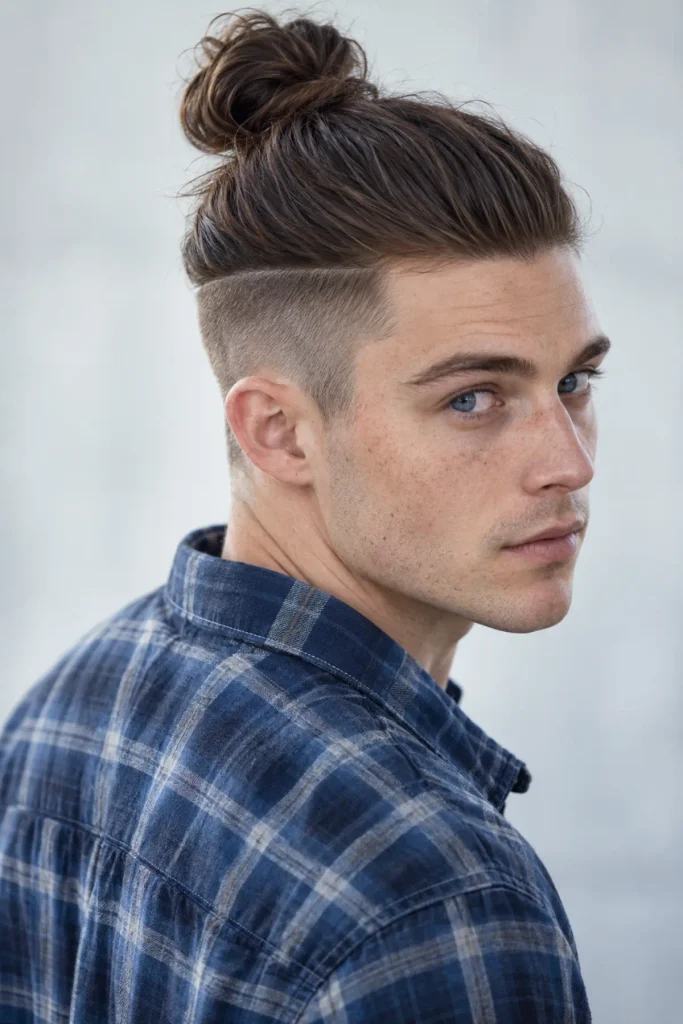
A step beyond the undercut, with a hard visible line where the short sides meet the long top and no transition at all. It is a strong fashion statement rather than a neutral haircut, and it photographs extremely well, which is part of why it keeps circulating.
- Suits: Oval and diamond faces. Straight to wavy hair where the line stays crisp.
- Specs: Minimum 8 inches on top. Upkeep high, line refreshed every 2 to 3 weeks. Styling time two minutes. Difficulty 3 out of 5.
- Ask the barber for: “Disconnected undercut. Hard line, no blend at all, buzzed sides, all the length on top for a bun.”
- Heads-up: When the hair is worn down the disconnect looks obvious and unfinished, so this style commits the wearer to tying it up most days.
Man Bun Styles by Hair Texture
Texture changes the technique more than the look. Straight hair slips and needs grip, curly hair holds beautifully but hates being brushed out, and coily hair needs moisture before it needs product.
12. Wavy Man Bun
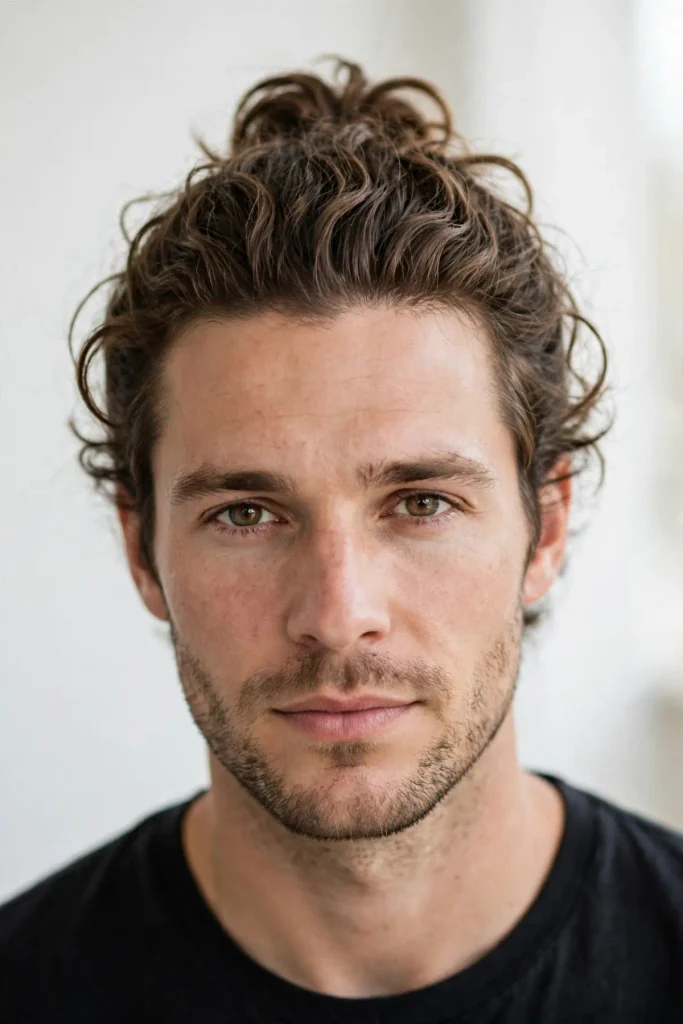
Wavy hair from 2A to 2C makes what is probably the easiest bun on this list. The natural bend gives the strands grip, so the knot holds without much product, and the slight irregularity means a loose tie looks styled rather than sloppy. Most men with waves get their best result by rough drying with sea salt spray and gathering without a brush.
- Suits: All face shapes. Wave patterns 2A to 2C. Medium density.
- Specs: Minimum 8 inches. Upkeep low. Styling time under a minute. Difficulty 1 out of 5.
- Ask the barber for: “Work with my waves. Take some weight out of the ends but keep the length so I can tie it back.”
- Heads-up: Waves frizz in humidity. A light leave-in on damp hair beats trying to fix it later in the day.
13. Curly Man Bun
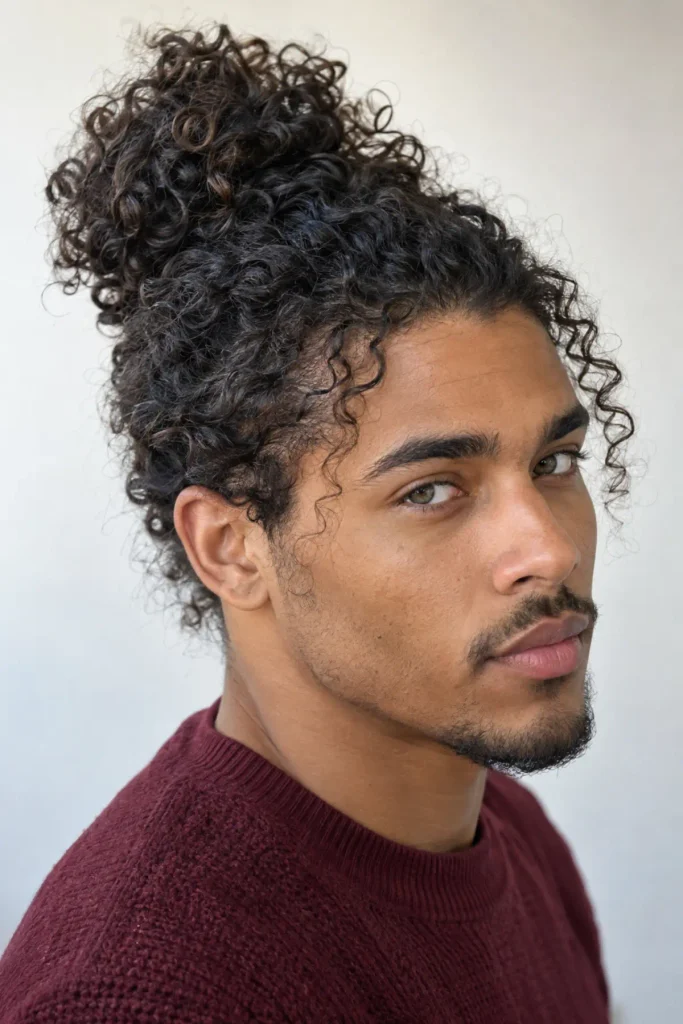
Curls in the 3A to 3C range create a fuller, rounder bun than straight hair of the same length, and the volume is the whole appeal. The rule is not to over manipulate it. Brushing curls out before tying flattens the pattern and produces frizz, so the hair should be gathered with fingers on damp, cream treated hair and tied loosely.
- Suits: All face shapes. Curl types 3A to 3C. Medium to high density.
- Specs: Minimum 10 inches stretched, because curls lose 20 to 40 percent of their apparent length to shrinkage. Upkeep medium. Styling time two minutes. Difficulty 2 out of 5.
- Ask the barber for: “Curly man bun. Keep the length and the curl pattern, cut it dry so the shape is accurate, and remove weight rather than length.”
- Heads-up: Tying curls when they are soaking wet stretches the strands and causes breakage. Damp is fine, dripping is not.
14. Coily Man Bun
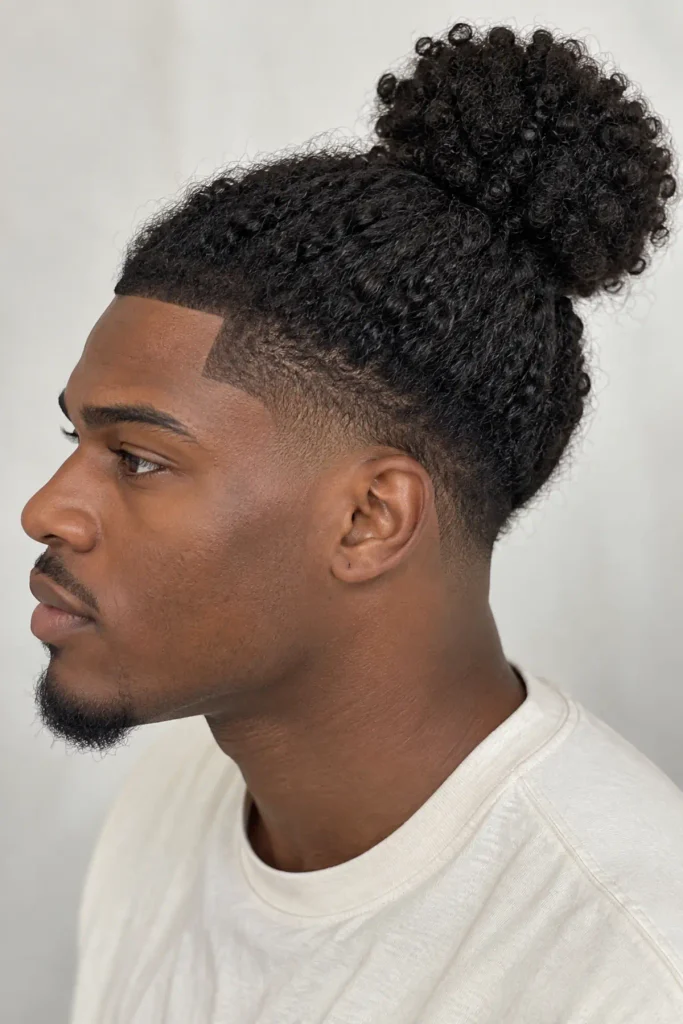
Coily and afro textured hair from 4A to 4C makes one of the most striking buns going, with dense volume and a clean silhouette. It also functions as a protective style, keeping the ends tucked away and reducing daily manipulation. Moisture is the priority here, and a satin lined tie does more to prevent breakage than any styling product.
- Suits: All face shapes. Curl types 4A to 4C. Pairs well with a taper or a line up.
- Specs: Minimum 8 inches stretched. Upkeep medium. Styling time three minutes. Difficulty 3 out of 5.
- Ask the barber for: “Coily man bun. Keep the length, tidy the perimeter, and give me a clean line up at the front with a low taper.”
- Heads-up: Edge control applied daily along the hairline plus a tight tie is the fastest route to thinning edges. Loose is better.
15. Fine or Thinning Hair Man Bun
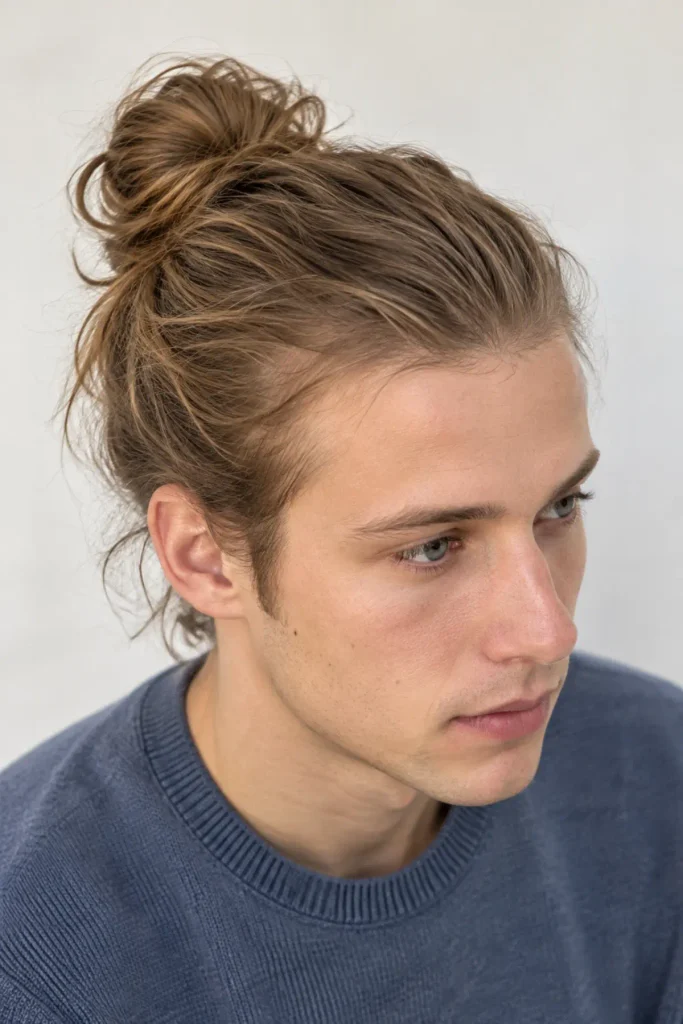
Lower density hair can absolutely carry a bun, but the shape has to be built rather than assumed. Tying it high and slightly forward, twisting before wrapping, and leaving the knot deliberately loose all make it read fuller. A dry texture spray at the roots before gathering adds grip and apparent thickness in a way that creams and oils cannot.
- Suits: Men with low density or fine strands. Best with a low or mid placement that does not expose the crown.
- Specs: Minimum 8 inches. Upkeep low. Styling time two minutes. Difficulty 3 out of 5.
- Ask the barber for: “I have fine hair and I want to tie it back. Keep the weight in, use blunt ends rather than heavy layers, and clean up the neckline.”
- Heads-up: A slicked, tight bun on thin hair exposes the scalp through the pulled back sections. Texture and looseness are the fix.
16. Thick and Coarse Hair Man Bun
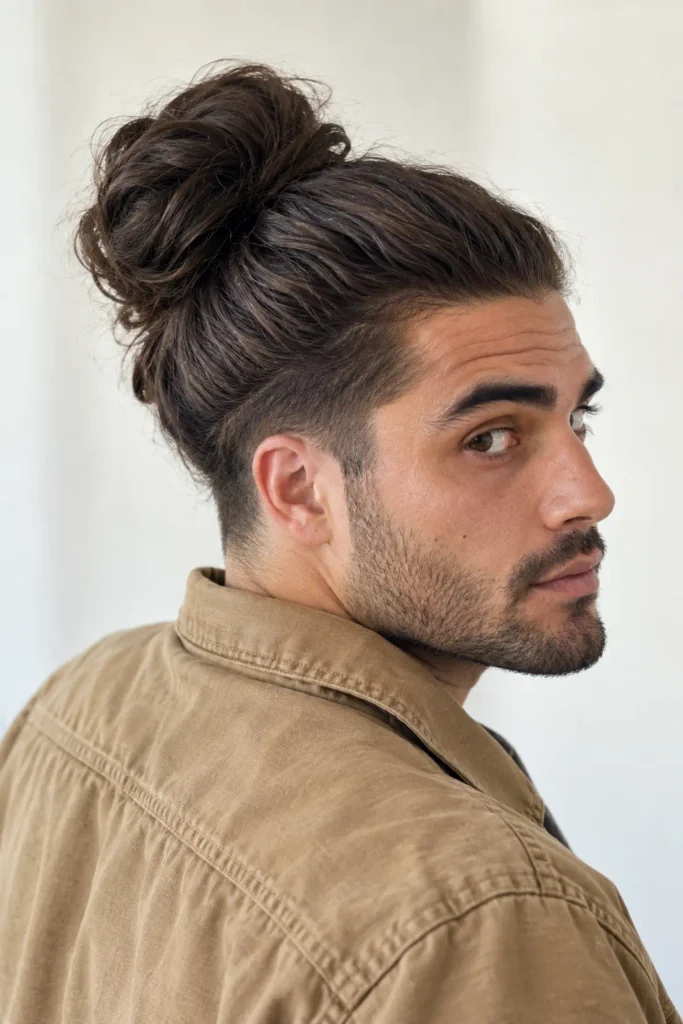
High density hair makes the most substantial bun of any texture, which is the good news and the problem at the same time. Left long on the sides, thick hair adds width at the temples and can make the head look wider than it is. Internal weight removal by the barber, plus a taper or undercut, keeps the volume in the knot rather than around the ears.
- Suits: Oval, square and rectangle faces. Coarse straight or wavy hair.
- Specs: Minimum 10 inches. Upkeep medium. Styling time two minutes. Difficulty 2 out of 5.
- Ask the barber for: “Take weight out from the inside with point cutting, do not take length off the ends, and taper the sides so it is not so wide.”
- Heads-up: A heavy bun pulls harder on the follicles than a light one, so thick hair benefits most from rotating the tie position.
Layering is the other tool for taming thick hair before it ever reaches bun length. The long layered hair for men guide shows how the same weight removal technique looks when the hair is worn down instead of tied up.
17. Loc Man Bun
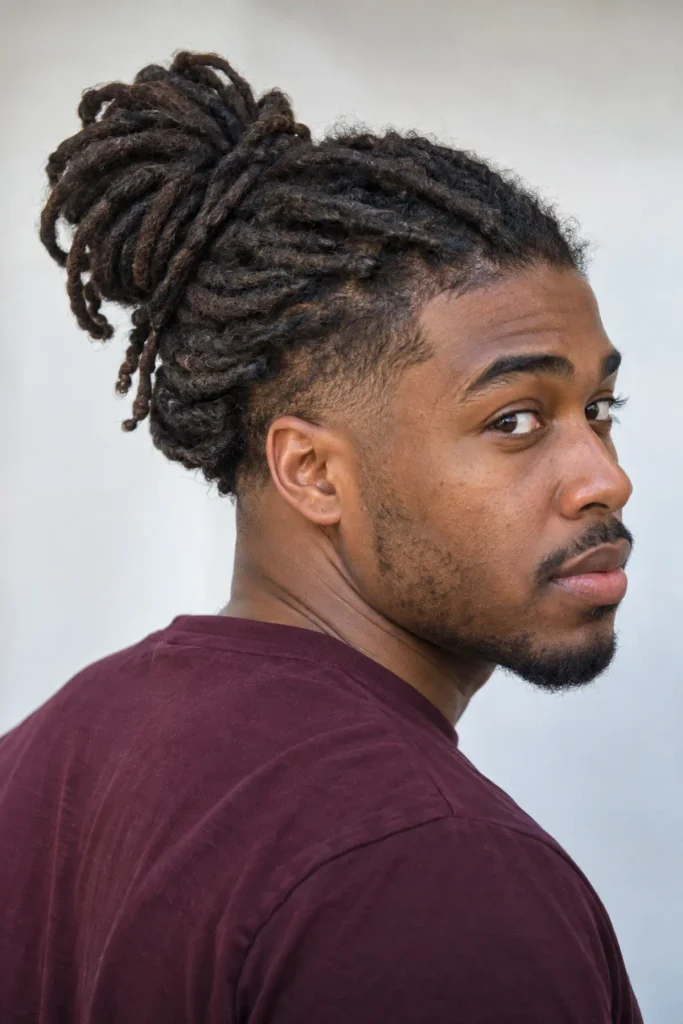
Established dreadlocks gathered and tied up at the crown or the back. It is one of the neatest ways to wear locs during the working day, it keeps the length off the collar, and it suits a faded or tapered side just as well as a full head of locs. The weight is the main consideration, since mature locs are heavier than loose hair.
- Suits: Men with established locs at roughly shoulder length or longer. All face shapes.
- Specs: Locs long enough to gather. Upkeep medium, retwist every 6 to 8 weeks. Styling time two minutes. Difficulty 2 out of 5.
- Ask the barber for: “Keep the locs, tidy the perimeter, and give me a low taper on the sides so the outline is clean.”
- Heads-up: Heavy locs tied in the same spot every day put real tension on the hairline. Alternating between a high and a low tie matters more here than with loose hair.
Textured and Statement Man Buns
These are the versions with personality. They take slightly longer to style and they suit some settings far better than others, but they are also the ones that stop the man bun looking generic.
18. Messy Man Bun
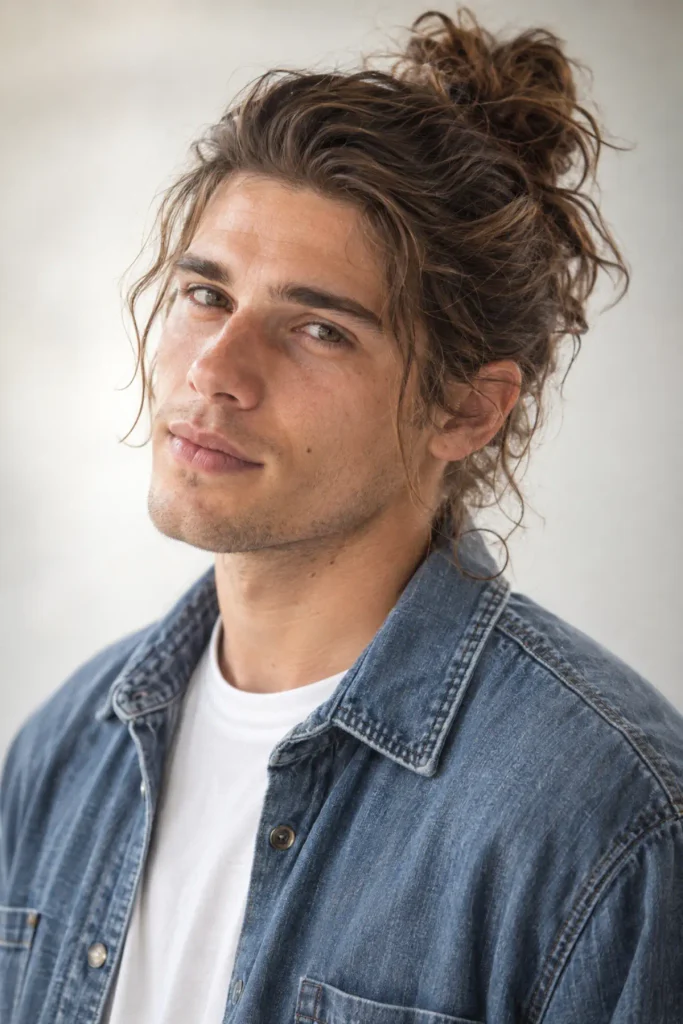
A deliberately loose knot with a few strands left out around the temples. Despite the name it is the most practical version on the list for daily wear, because it takes seconds, it puts almost no tension on the hairline, and small imperfections are part of the look rather than a failure. The distinction to hold onto is messy, not unwashed.
- Suits: All face shapes, particularly square faces that benefit from softened edges. Wavy and curly hair.
- Specs: Minimum 8 inches. Upkeep low. Styling time 30 seconds. Difficulty 1 out of 5.
- Ask the barber for: “I wear it loose and messy, so just shape the ends and leave plenty of movement in it.”
- Heads-up: There is a narrow line between casual and scruffy, and clean hair is what keeps it on the right side.
19. Braided Man Bun
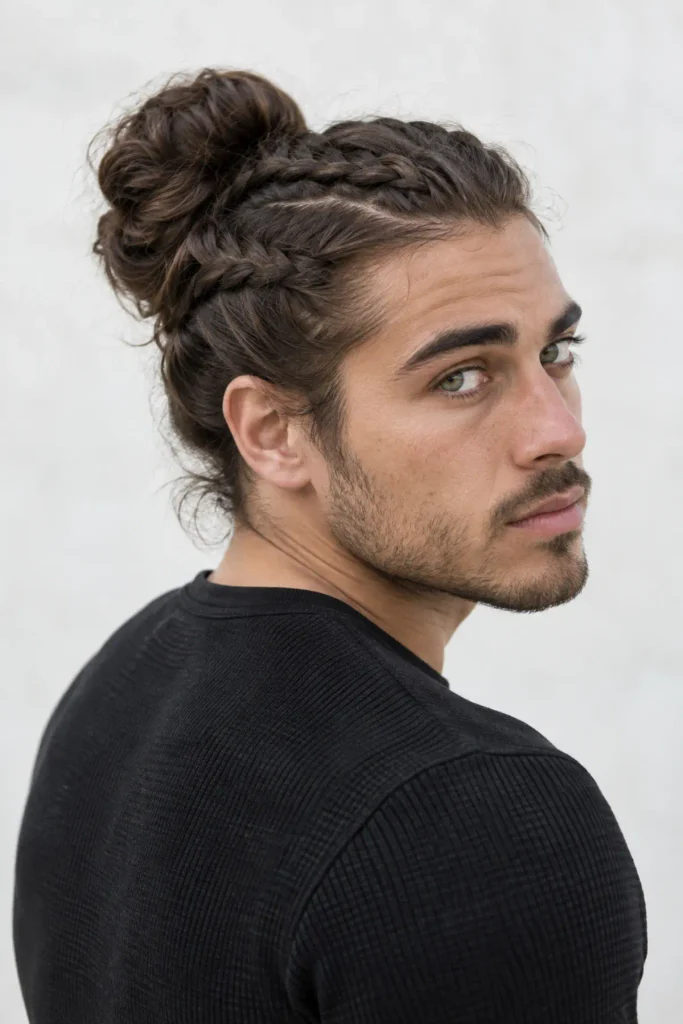
One or more braids running back into the knot, either as a single plait along the crown, two side braids meeting at the back, or cornrows feeding into a gathered bun. Braiding adds grip and controls frizz, which makes it particularly effective on coarse and textured hair, and it holds far longer through a working day than a plain bun.
- Suits: All face shapes. Coarse, curly and coily hair. Men willing to spend time on it.
- Specs: Minimum 10 inches. Upkeep high. Styling time 10 to 20 minutes. Difficulty 4 out of 5.
- Ask the barber for: “I braid it back into a bun, so keep the length even across the top and take out any weight that stops it braiding cleanly.”
- Heads-up: Tight cornrows plus a tied bun stack two sources of tension on the same follicles, which is the fastest route to hairline damage.
20. Viking Bun
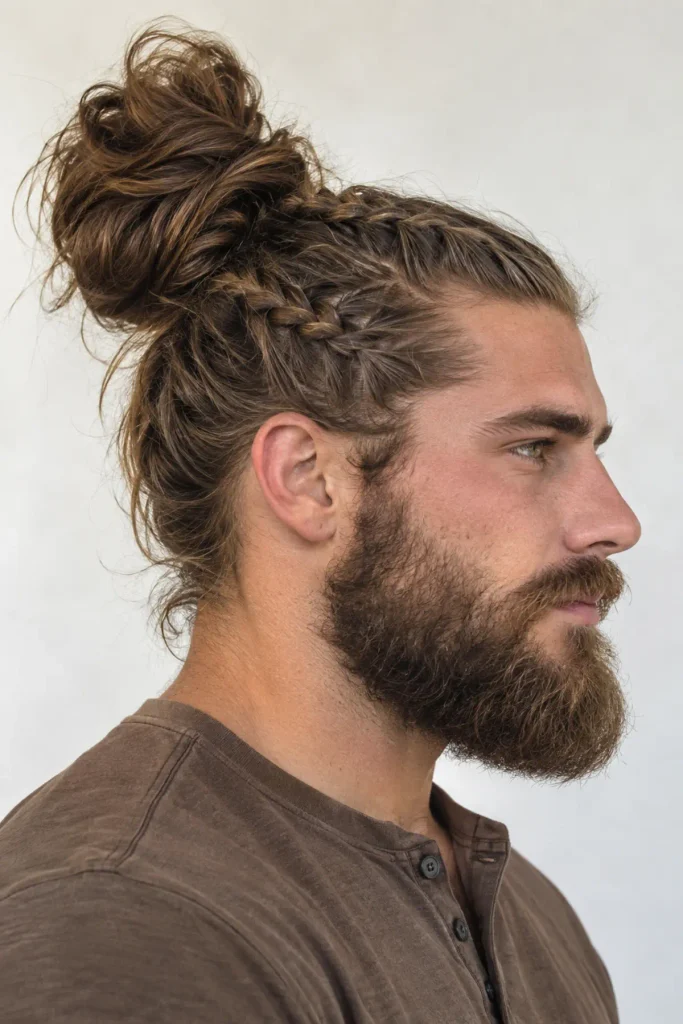
A substantial knot worn high, often with braided sections at the temples and always with a full beard. It borrows from Norse styling and it commits fully to the rugged end of the spectrum. The proportion is what makes or breaks it, since a large bun and a large beard need a visible gap of skin between them or the whole head reads as top and bottom heavy.
- Suits: Oval and square faces. High density hair. Men with a genuinely full beard.
- Specs: Minimum 10 inches. Upkeep medium. Styling time five minutes. Difficulty 3 out of 5.
- Ask the barber for: “Viking style. Thick bun on top, shave or taper the temples, and keep the beard full and shaped.”
- Heads-up: It is a strong look rather than a neutral one, and it does not translate well to conservative offices.
21. Samurai Bun and Top Knot
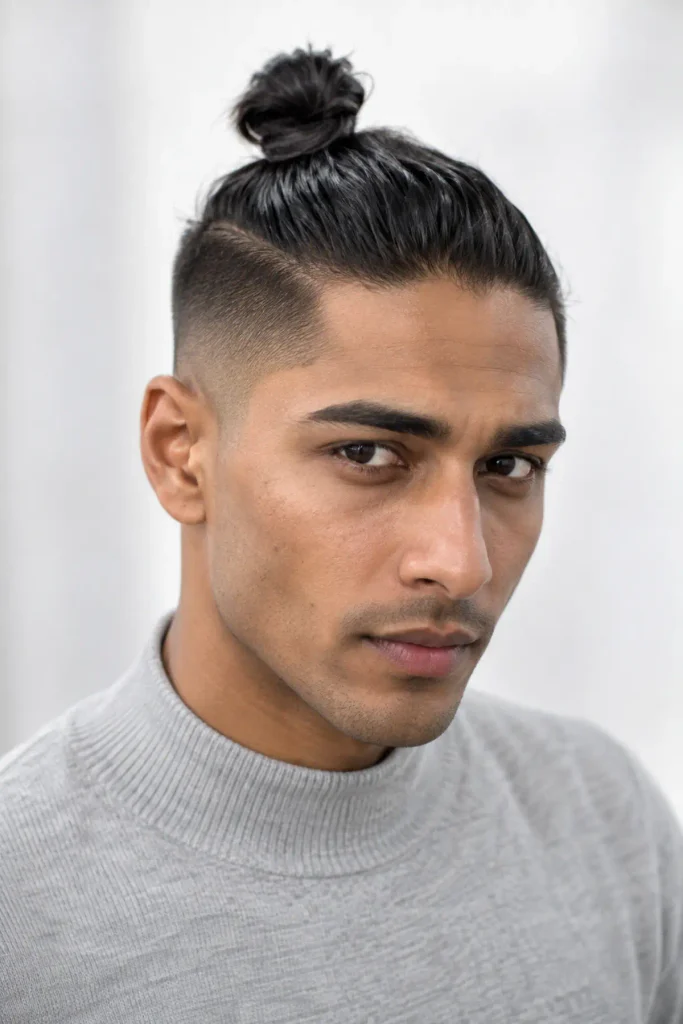
A small, tight knot sitting at the very top of the head, almost always paired with short, faded or shaved sides. It takes its cue from the chonmage worn in Edo period Japan, and the modern version is the most structured member of the bun family. Because only the top section needs length, it is also the fastest style here to achieve from short hair.
- Suits: Square, diamond and round faces. Straight to wavy hair. Men who want the look without a full year of growing.
- Specs: Minimum 5 inches on top. Upkeep medium, sides every 2 to 4 weeks. Styling time two minutes. Difficulty 2 out of 5.
- Ask the barber for: “Top knot. Leave five or six inches on top to knot, fade or shave the sides, and keep the outline sharp.”
- Heads-up: A small knot on a high crown can look like a sprout if it is placed too far forward. The knot belongs at the vertex, not the front.
Polished Man Buns for Work and Formal Settings
Long hair on men is far less of an issue in American workplaces than it was a decade ago, but neatness still carries the argument. These three versions are the ones that survive a boardroom.
22. Slicked Back Man Bun
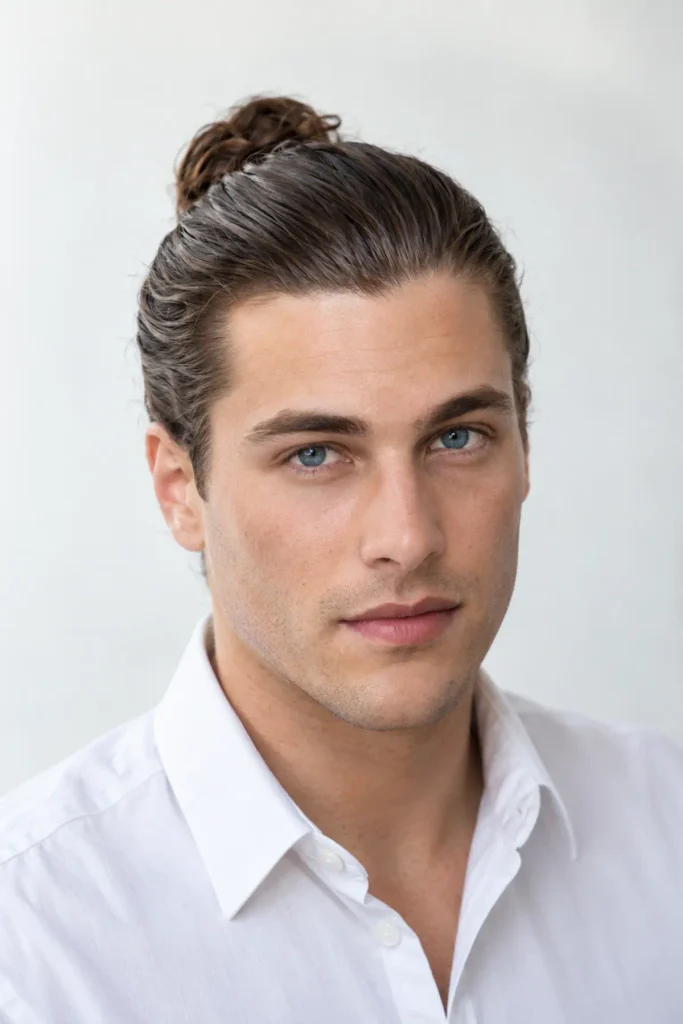
Hair combed smoothly back with pomade or a strong cream before being tied into a tight, glossy knot. It is the most formal version available and the one that photographs best under evening light. On men with an intact hairline it looks sharp and intentional, which is why it turns up on red carpets far more often than the messy version does.
- Suits: Oval and rectangle faces. Straight to wavy hair. Medium to high density.
- Specs: Minimum 8 inches. Upkeep medium. Styling time five minutes. Difficulty 3 out of 5.
- Ask the barber for: “I slick it back into a tight bun, so keep the length and make sure the ends are healthy enough to sit flat.”
- Heads-up: This is the least forgiving style for a receding hairline or low density, since everything is pulled flat and fully exposed.
23. Professional Low Bun
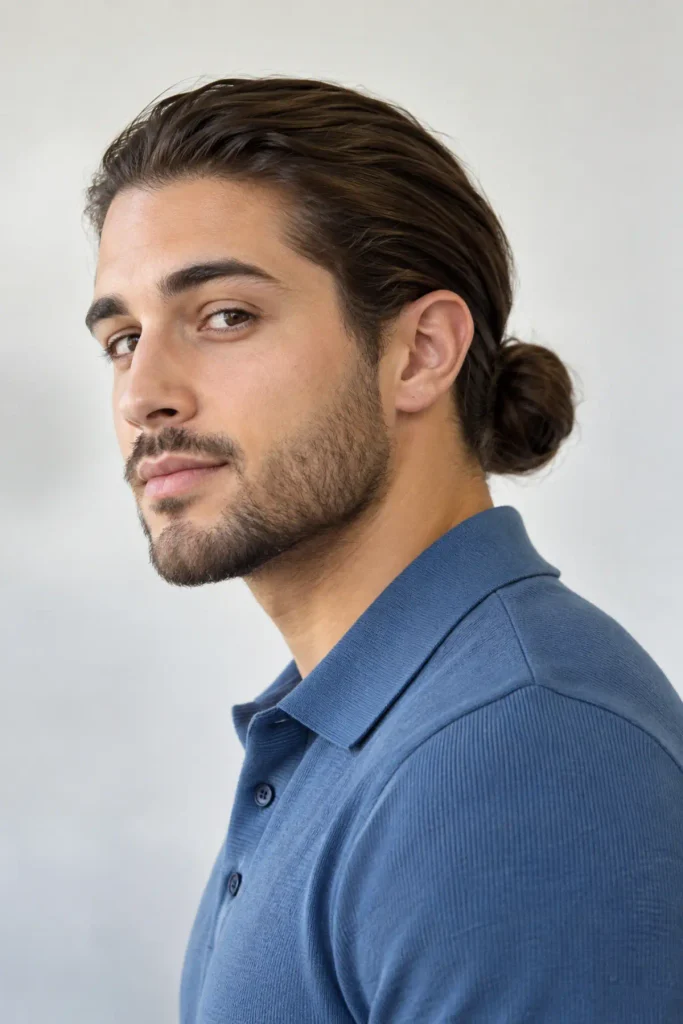
A tidy knot at the nape with no flyaways, a clean neckline and a groomed beard or clean shave. It is the quietest way to wear long hair at work, it holds through a full day of meetings, and it draws no attention at all, which in a corporate setting is exactly the point.
- Suits: All face shapes. Any texture. Client facing roles.
- Specs: Minimum 8 inches. Upkeep low. Styling time two minutes. Difficulty 2 out of 5.
- Ask the barber for: “Neat low bun for work. Clean the neckline, taper around the ears, and keep the length.”
- Heads-up: Neatness is doing all the work here. A single loose section undercuts the effect the style depends on.
24. Interview Bun

The most conservative build on the list: a low bun, tapered sides, a sharp neckline, no visible product shine and a trimmed beard. It is worth treating as a separate style because the goal is different. Nothing about the hair should be the thing the room notices first.
- Suits: Any man walking into a traditional industry, from finance to law to healthcare administration.
- Specs: Minimum 8 inches. Upkeep low. Styling time three minutes. Difficulty 2 out of 5.
- Ask the barber for: “I have an interview. Taper the sides, sharpen the neckline, and clean up the ends so it ties back flat.”
- Heads-up: Some industries and some individual interviewers remain conservative about long hair on men. Research the sector rather than assuming.
Man Bun vs Top Knot vs Ponytail vs Half-Up Bun
These four get used interchangeably and they are not the same thing. The differences come down to how much hair goes up, where it sits, and how the sides are cut.
| Man bun | Top knot | Ponytail | Half-up bun | |
|---|---|---|---|---|
| Hair used | All of it | Top section only | All of it | Top half only |
| Position | Crown to nape | Very top of the head | Back of the head | Crown |
| Sides | Long, tapered or faded | Usually faded or shaved | Long | Long |
| Length needed | 6 inches or more | 5 inches on top | 6 inches or more | 5 inches on top |
| Ends visible | No, tucked into the knot | No | Yes, hanging loose | Yes, underneath |
| Formality | Casual to formal | Modern and sharp | Casual to smart | Casual |
| Best for | Everyday versatility | Shorter hair, sharp look | Speed and comfort | Mid grow out |
| Tension on hairline | Low to medium | Medium to high | Medium | Low |
How to Tie a Man Bun, Step by Step
The whole thing takes about 30 seconds once the technique is familiar. The most common mistake is pulling everything as tight as possible, which looks severe, causes headaches and stresses the hairline for no benefit.
What is needed
- One snag free fabric or spiral elastic, never a rubber band or an office band
- A wide tooth comb or a boar bristle brush
- Optional grip product: sea salt spray, dry texture spray or a light styling cream
- Two or three bobby pins for shorter pieces
The method
- Start with dry or barely damp hair. Day old hair grips better than freshly washed hair, which is why many men find the bun easier on the second day.
- Work a small amount of texture spray or cream through the mid lengths if the hair is fine or slippery. Thick hair rarely needs it.
- Brush or finger comb everything straight back from the forehead, removing tangles from the ends upward rather than dragging the comb from root to tip.
- Gather all of the hair with both hands at the chosen height: the crown for a high bun, the curve at the back of the skull for a classic bun, the nape for a low bun. Sweep the fingers along the hairline and behind the ears to catch strays.
- Hold the gathered hair in one hand and twist it two or three turns until it starts to coil naturally.
- Slide the elastic over the twist and loop it once. On the second loop, pull the hair only halfway through so the length folds back on itself and forms the knot. A third loop can be added if the elastic is loose.
- Tug the knot gently outward to loosen it and set the shape, then pin or tuck anything that escaped. The finished bun should feel secure without pulling at the temples.
Quick variations on the same method
- Messy version: skip the brush, gather with fingers, then pull two or three face framing strands loose after tying.
- Half-up version: use both thumbs to draw a line from ear to ear across the crown, gather only what sits above that line, and tie it in the same way.
- Slicked version: apply pomade to damp hair, comb straight back with a fine tooth comb, tie low and tight, then smooth a trace of product over the finished knot.
- Short hair version: gather only the top, place the knot higher than feels natural, loop the elastic three times and pin the sides.
Eight Common Man Bun Problems and How to Fix Them
Almost every complaint about the style comes back to one of these eight issues, and all eight have straightforward fixes.
| Problem | Why it happens | The fix |
|---|---|---|
| The bun slips out by midday | Clean, slippery hair and a single elastic loop | Texture spray before tying, twist the hair first, and use a spiral or fabric tie looped twice |
| The bun looks too small | Low density rather than insufficient length | Tie it higher and looser, backcomb the mid lengths lightly, and avoid slicking it flat |
| A bump appears at the crown | The hair is being gathered from too far forward | Move the gathering point back an inch so it sits behind the crown whorl |
| The ends poke out like a tail | Uneven lengths from layering, or the ends were not folded in | Fold the last loop fully, tuck the ends under the knot and pin them, and ask the barber for blunter ends |
| Flyaways around the hairline | Breakage from previous tight styles, or new growth | A trace of light cream or edge control on the palms, smoothed over the hairline. Avoid daily heavy product |
| The bun looks like a sprout | The knot is too small and placed too high and forward | Drop the placement to the crown or the back of the head until there is more length |
| A dent stays after taking it out | The elastic sat in the same place for hours | Rinse and rough dry, or wear the hair down the following day to reset it |
| The roots look greasy | Long hair is being washed too often or not often enough for the scalp type | Shampoo two or three times a week, condition every wash, and use dry shampoo on the off days |
Growing a Man Bun: What Works at Every Length
The grow out is where most men quit, usually somewhere in the third or fourth month when the hair is too long to look sharp and too short to tie. Knowing what is achievable at each stage makes it far easier to ride out. The middle stretch, once the hair passes the awkward stage but before it is long enough for a full bun, is exactly what the medium length haircuts for men guide covers, and it is worth bookmarking for those months.
| Length | Roughly | What is possible | What to ask the barber |
|---|---|---|---|
| 2 to 4 inches | Months 4 to 8 | Nothing tied yet. The awkward stage | Shape the perimeter only, taper the sides and neckline, no length off the top |
| 4 to 6 inches | Months 8 to 12 | Small top knot if the sides are undercut | Keep the top, clean the undercut every three weeks |
| 6 to 8 inches | Months 12 to 16 | Half-up bun, short starter bun, low bun | Dust the ends, remove weight from underneath, keep the length |
| 8 to 10 inches | Months 16 to 20 | Full classic bun, high bun, messy bun | Dust the ends every 6 to 8 weeks, taper or fade the sides if wanted |
| 10 to 16 inches | Around two years | Every variation including braided and slicked | Shape the perimeter, remove internal weight, protect the ends |
Surviving the awkward stage
- Book a shaping trim every 6 to 8 weeks. Trimming a quarter inch does not slow the grow out, and split ends travelling up the shaft do.
- Tuck the sides behind the ears and use a light cream to stop them flicking outward, which is the specific thing that makes month four look untidy.
- Use the half-up tie as soon as the top reaches five inches. It buys months of looking deliberate.
- Caps, beanies and headbands are legitimate tools, not cheating.
- Consider an undercut early. It removes the worst of the width at the sides and makes the top look intentional long before it is bun length.
What to Ask a Barber For
Barbers are trained to cut hair, which means the default instinct is to take length off. The single most useful sentence a man growing a bun can say is that he wants the ends dusted and the shape tidied, with no length removed. These scripts can be used word for word.
- Growing it out: “I am growing my hair for a man bun. Dust the ends, shape the perimeter, and please do not take any length off the top.”
- With a fade: “Keep at least six inches on top for a bun. Give me a low, mid or skin fade on the sides and blend it into the length. Keep the back long enough to reach the knot.”
- With an undercut: “Number one or two guard on the sides and back, no blending, and leave the entire top long for a bun.”
- With a taper: “Just a taper around the ears and the neckline. Leave the sides long enough to gather into the bun.”
- Thick hair: “Remove weight from the inside with point cutting rather than taking length off the ends. I want less bulk at the sides, not a shorter bun.”
- Curly hair: “Cut it dry so the curl pattern is accurate. Remove weight, keep the length, and shape the perimeter.”
Trim schedule by version
| Version of the style | How often to book |
|---|---|
| Full man bun with long sides | Every 8 to 12 weeks, ends only |
| Man bun with a taper | Every 4 to 6 weeks |
| Man bun with an undercut | Every 3 to 4 weeks for the sides |
| Man bun with a fade | Every 2 to 3 weeks for the fade |
| Man bun with a skin fade | Every 2 weeks |
| Actively growing it out | Every 6 to 8 weeks for shaping only |
| Locs tied into a bun | Retwist every 6 to 8 weeks |
Man Bun Maintenance and Care
Long hair is not more work than short hair on a daily basis, but it is less forgiving of neglect. The ends of a 12 inch bun are around two years old and have survived every wash, tie and towel dry since. Keeping them intact is most of the job.
Washing
Two to three shampoos a week suits most men with long hair. Daily shampooing strips the natural oils that keep the length flexible, and dry hair breaks. Conditioner goes on every single wash and belongs on the mid lengths and ends, not the scalp. A clarifying shampoo once a month clears product buildup, which matters more for men using pomade or salt spray daily.
Drying and detangling
- Squeeze water out with a towel or a cotton t shirt rather than rubbing, which roughs up the cuticle and creates frizz.
- Detangle from the ends upward with a wide tooth comb, never from the roots down.
- Never tie hair up while it is soaking wet. Wet hair stretches and snaps under tension.
- Air dry where possible. If a dryer is used, keep it on low heat with a heat protectant.
Hair ties: what to buy and what to throw out
- Use: fabric covered elastics, spiral or coil ties, and satin lined ties for coily hair and locs.
- Avoid: rubber bands, office bands, and thin elastics with a metal crimp, which all snag and snap strands.
- Replace ties once they stretch out. A tired elastic gets tied tighter to compensate, which is exactly the wrong direction.
Products worth owning
The list is shorter than most guides suggest. Five items cover almost every version of the man bun.
- Sea salt or dry texture spray, for grip on fine and straight hair
- Light styling cream, for smoothing flyaways and finishing a neat bun
- Leave-in conditioner, the single most useful product for anyone with length
- Curl cream, for 3A to 4C textures
- Pomade, only for the slicked back and formal versions
Sleeping with long hair
Sleeping in a tight bun is one of the more damaging habits available, because it applies eight hours of continuous tension. A loose low tie or a plait is far kinder, and a satin or silk pillowcase measurably reduces friction and morning tangles. Hair should never be slept on while wet.
Man Buns and Hair Loss: The Straight Answer
A man bun does not cause male pattern baldness. It can cause a different, entirely preventable kind of hair loss called traction alopecia, which comes from repeated pulling on the follicles. The American Academy of Dermatology advises that tight styles including buns, ponytails and pulled back updos should be worn only occasionally rather than every day, and its guidance is worth reading in full for anyone wearing the style long term.
Warning signs worth taking seriously
- Soreness or a pulling headache after tying. Styling hair should not hurt.
- Small bumps resembling pimples along the hairline, sometimes with itching or flaking.
- Short, broken hairs at the temples, or a hairline that is visibly thinner than it was a year ago.
- A retained fringe of hair at the very front edge with thinning just behind it, which dermatologists refer to as the fringe sign.
How to prevent it
- Tie it loose. If the tension is noticeable, it is too tight.
- Rotate the position through the week: high one day, classic the next, low after that.
- Wear it down on days when it does not need to be up, and take it out at night.
- Use fabric or spiral ties and never rubber bands.
- Avoid stacking tension, for example tight cornrows feeding into a tight bun.
Early traction alopecia is usually reversible once the tension stops. Left long enough, the follicles scar and the loss becomes permanent, so anyone noticing thinning at the temples should loosen the style immediately and see a board certified dermatologist rather than waiting to see what happens.
Wearing a Man Bun in Real Life
At work
Neatness does the heavy lifting. A low bun with a clean neckline, no flyaways and a groomed beard is accepted in the overwhelming majority of American workplaces, including client facing roles. Creative, technical and trade industries are essentially neutral on it. Finance, law and some corporate sales environments remain more conservative, and traditional interviewers in those sectors may still read long hair as informal. The practical approach is to wear the tidiest possible version for the first few weeks in a new role and relax it once the culture is clear.
Under helmets and hard hats
A bun sitting high at the crown will not fit under most hard hats or motorcycle helmets, and forcing it creates a pressure point that is both uncomfortable and a genuine safety issue because the helmet no longer sits correctly. A low bun at the nape, or a flat plait, solves it. Anyone wearing a helmet daily should also expect a tension line where the strap and the tie meet, which is another reason to vary the position.
At the gym
A high bun placed just above the occipital bone stays put through most training, because that is the point of least movement. Two elastics rather than one, a sweat absorbing headband, and dry shampoo afterwards cover the rest. Lying flat for bench work is the exception, where a low bun or a plait is more comfortable.
Kitchens, healthcare and food service
Hair restraints are a legal requirement in most American food service settings, and long hair must be fully contained. A low bun under a net or cap is the standard solution and is usually easier to work with than a high knot. Healthcare settings vary by employer, but tied back and off the collar is the near universal baseline.
Man Bun Pros and Cons
| Pros | Cons |
|---|---|
| Takes under a minute once the length is there | Needs 12 to 18 months of growing before it is possible |
| Works with straight, wavy, curly, coily and locked hair | Exposes the hairline completely, which is unforgiving on a receding one |
| Switches between casual and formal by changing placement alone | Risks traction alopecia if worn tight in the same spot daily |
| Keeps hair off the face for work, training and hot weather | Long hair needs conditioning, careful detangling and protected ends |
| Pairs naturally with a beard and with fades or undercuts | Fade and undercut versions need barber visits every two to four weeks |
| Long hair can be worn down on any day the bun is not wanted | Low density hair produces a smaller knot than most men expect |
| Cheaper over a year than a short cut that needs monthly trims | Still divides opinion in conservative industries |
Man Buns by Age
The style itself has no age limit. What changes with age is hair density, hairline position and how much informality suits a man’s setting, and all three point toward the same adjustments.
- In his twenties: density is usually at its peak, so every variation is available. This is the stage where high buns, undercuts and braided versions work best.
- In his thirties: the hairline position is usually settled by now. A classic or low bun with a taper reads as grown up without looking severe.
- In his forties: density typically starts to soften and grey appears. A low bun, a well kept beard and slightly shorter overall length flatter more than maximum length does.
- In his fifties and beyond: grey hair is often coarser and holds a bun well, but crown density is usually lower. A neat low bun at eight to ten inches looks far better than a longer, thinner one, and heavy slicking is best avoided.
What a Man Bun Actually Costs
One of the quiet advantages of the style is the cost. Men’s haircuts in the United States commonly run between roughly 28 and 45 dollars before tip depending on the city and the shop, with fades typically adding 10 to 20 dollars for the extra blending time, and a 15 to 20 percent tip is standard. Because a full man bun with long sides only needs attention every 8 to 12 weeks, the annual spend drops sharply compared with a short cut that needs a visit every three or four weeks.
| Version | Visits per year | Rough annual cost including tip |
|---|---|---|
| Full man bun, long sides | 5 to 6 | Around 200 to 300 dollars |
| Man bun with a taper | 9 to 12 | Around 350 to 500 dollars |
| Man bun with a fade or undercut | 17 to 26 | Around 600 to 1,000 dollars |
| Products for the year | n/a | Around 60 to 150 dollars |
| Hair ties for the year | n/a | Around 10 to 25 dollars |
Figures are United States averages and vary widely by city. Rural shops sit well below these ranges and premium grooming lounges in coastal metros sit well above them.
Man Bun FAQs
How long does hair need to be for a man bun?
Six inches is the working minimum for a small bun, eight inches is where it starts holding its shape properly, and 10 to 16 inches opens up every variation. Curly and coily hair needs two to four more inches than straight hair because shrinkage hides real length.
How long does it take to grow a man bun?
Roughly 12 to 18 months from a short haircut, since scalp hair grows about half an inch per month or six inches per year on average. Genetics, age and overall health shift that rate slightly in either direction, and no product reliably speeds it up.
What is the difference between a man bun and a top knot?
A man bun gathers most or all of the hair into a larger knot that can sit anywhere from the crown to the nape, usually with long or tapered sides. A top knot uses only the top section, sits at the very top of the head, and is almost always paired with faded or shaved sides. The top knot needs less overall length, which makes it the faster style to achieve.
Do man buns cause hair loss?
Not on their own. Worn tightly, in the same position, every day, a bun can cause traction alopecia, which is hair loss driven by tension on the follicles rather than by genetics. It is preventable by tying loosely, rotating the position, using fabric ties and taking the hair down at night. Early cases usually recover once the tension stops.
Is a man bun professional?
Yes, in its tidy form. A low bun with a clean neckline, no flyaways and groomed facial hair is accepted across most American workplaces, including client facing roles. Messy and Viking versions are weekend styles. Conservative sectors such as law and finance still favour the most understated version, particularly for interviews.
Can a man with thin hair wear a man bun?
Yes, with adjustments. Low density hair produces a smaller knot, so texture spray, a twist before tying and a deliberately loose finish all help it read fuller. The style to avoid is the tight slicked back version, which pulls the hair flat and exposes the scalp. A receding hairline is a different question, and that is the situation where a half-up style or wearing the hair down usually looks better.
What face shape suits a man bun best?
Placement matters more than face shape. Oval faces suit any version. Round faces do best with a higher knot and shorter sides, which adds height and removes width. Square faces suit softer, messier buns that take the edge off a strong jaw. Long or oblong faces suit a low bun, since extra height stretches the face further. Heart shaped faces benefit from a low bun paired with a beard to balance a narrow chin.
How does a man stop his bun from falling out?
Four things fix almost every case: applying texture spray or dry shampoo for grip before tying, twisting the hair two or three turns before wrapping the elastic, looping a spiral or fabric tie twice rather than once, and placing the knot where the skull naturally curves rather than on a flat plane. Two bobby pins hidden inside the bun handle anything left over.
Choosing the Right One
For men at the six inch mark, the half-up bun or the short starter bun is the place to begin. For thick hair or hot climates, a fade or an undercut solves the bulk problem better than anything else. For offices and interviews, the low bun with a taper is the safest version and looks the most considered. For men who want the style without waiting two years, the samurai bun and top knot deliver most of the effect from five inches of length on top.
Whichever version fits, three habits protect the hair underneath it: tie it loose, move the position around through the week, and keep the ends trimmed even while growing. Everything else is preference. Anyone still not sure the commitment is worth it can compare it against a wolf cut, which delivers a similar messy, textured, low-effort look without needing anywhere near the same length or patience.
2 thoughts on “Man Bun Hairstyles: 24 Best Styles for Men in 2026”