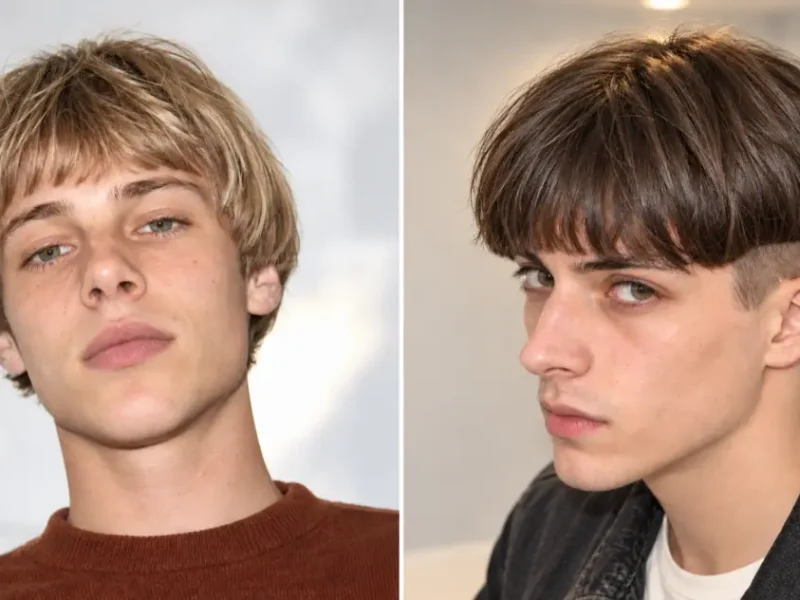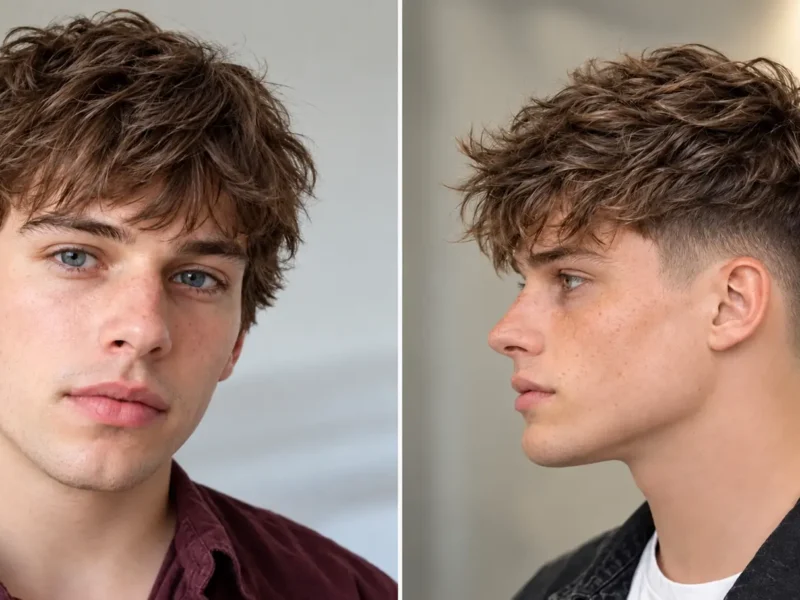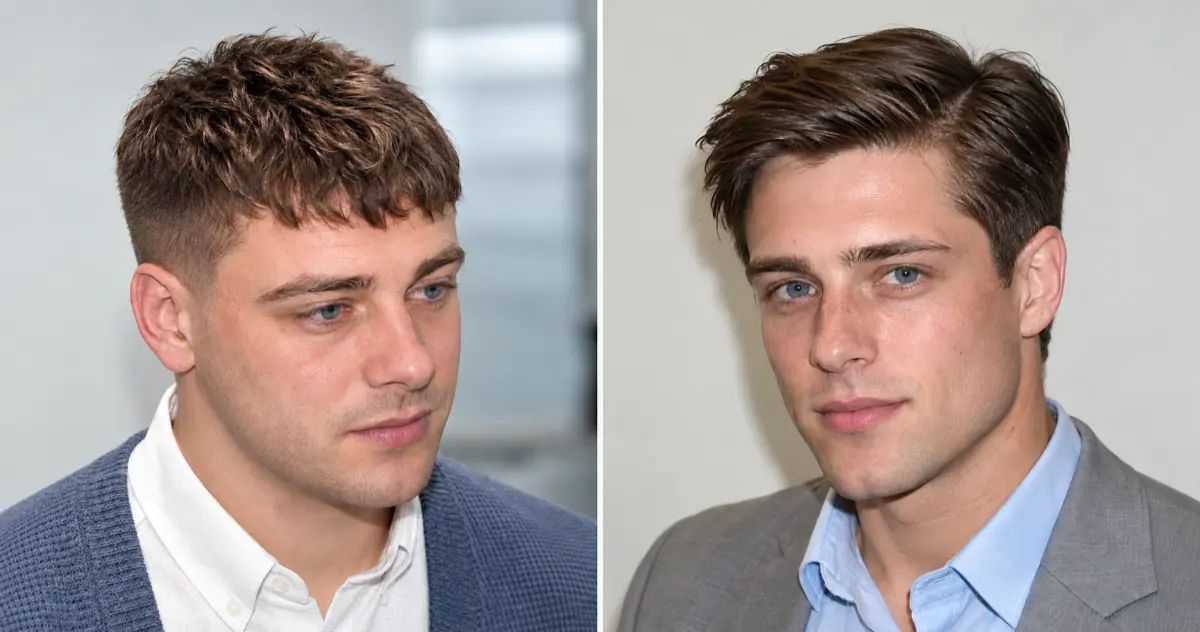
The safest office hairstyles for men are the classic side part, the Ivy League cut, the crew cut and a low taper with a textured top. They stay neat through a full workday, fit most dress codes and take about five minutes or less to style. Men in business casual or creative offices can step up to a textured crop, a controlled quiff or a mid fade.
| Workplace or goal | Best picks | Typical styling time | Typical barber visit |
|---|---|---|---|
| Traditional corporate (law, banking, government) | Side part, Ivy League, scissor cut | 3 to 5 minutes | Every 3 to 4 weeks |
| Business casual | Low taper with textured top, textured crop, French crop | 2 to 5 minutes | Every 3 to 5 weeks |
| Creative and tech | Quiff, brushed back, medium length flow | 5 to 10 minutes | Every 4 to 6 weeks |
| Lowest maintenance | Crew cut, buzz cut, Caesar | Under 1 minute | Every 2 to 4 weeks |
| Job interview | Side part, Ivy League, crew cut with low taper | 3 to 5 minutes | Cut 5 to 7 days before |
| Thinning or receding hair | Short crop, crew cut, buzz cut | Under 2 minutes | Every 3 to 4 weeks |
| Curly or coily hair | Short curl crop with taper, tapered afro, waves with a low fade | 3 to 8 minutes | Every 2 to 4 weeks |
The times and visit gaps above are typical barbering guidelines, not hard rules. Hair density, growth rate and the exact cut change them.
Table of Contents
Office Hairstyles for Men: Why the Right Cut Matters
A good office haircut does a quiet job. It makes a man look put together before he says a word, it holds its shape from the first meeting to the last, and it does not demand twenty minutes at the mirror every morning. The best office hairstyles for men are not the most dramatic ones. They are the cuts that look intentional on a Monday morning and still look sharp at 5 p.m. on a Friday.
This guide walks through 25 professional haircuts, from conservative classics to modern business casual cuts and styles built for curly, coily, fine, thick and thinning hair. Each idea comes with the practical details a barber would explain in the chair: who the cut suits, which face shapes and hair types work best, how much upkeep it needs, and exactly what to ask for. For more cut ideas beyond the office, the MenHairInspo homepage collects men’s haircut and hairstyle guides by length, texture and style.
What Makes a Haircut Office Appropriate?
An office appropriate haircut comes down to four traits that barbers look for again and again:
- Control. The hair stays where it is styled. No flyaways, no sections that collapse by lunch.
- Clean edges. A tidy neckline, sideburns and temples frame the face and make even a simple cut look finished.
- Good proportions. The balance between the sides, the top length and the weight line (the visible point where the sides meet the longer hair on top) looks deliberate.
- Consistency. The cut still looks good two to three weeks after the barber visit, not only on day one.
Hair grows about half an inch per month on average, according to the American Academy of Dermatology, as reported by USA TODAY. That means a tight fade starts to lose its crisp edge in roughly two to three weeks, while a softer taper or scissor cut can look presentable for four weeks or more. This is why the cut itself, and not just the style on top, decides how professional a man looks late in the cycle.
Professional does not have to mean boring. A subtle fade, natural waves, healthy curls or a carefully shaped longer top can all look polished when the edges are clean and the styling is restrained.
How to Choose: Workplace and Face Shape
Barbers usually start with one question: how conservative is the most formal room this man regularly walks into? A side part can be loosened after hours, but a sharp skin fade is hard to hide when an important client meeting begins. Choosing for the strictest setting of the week is the simplest rule.
Workplace Tiers
| Tier | Typical settings | Safe cut features |
|---|---|---|
| Very conservative | Law, banking, private wealth, government, defense | Soft taper or scissor sides, natural part, matte or light finish, no visible skin line |
| Business casual | Consulting, healthcare, sales, education, most corporate offices | Low fade or taper, textured top, short to medium length |
| Creative and tech | Marketing, design, media, startups | Mid fade, longer top, natural texture, brushed back styles |
| Remote and hybrid | Video calls, occasional client days | Neat edges and a top that photographs well on camera, any of the tiers above |
Best Cuts by Face Shape
Face shape is a starting point, not a rulebook. Barbers also weigh the hairline, forehead height, jaw and hair density. The table below follows guidance that several barbers repeat consistently.
| Face shape | What the cut should do | Good office picks |
|---|---|---|
| Oval | Almost anything works, so the cut can follow the dress code | Side part, quiff, textured crop |
| Round | Add height on top and keep the sides tight to lengthen the face | Controlled quiff, short pompadour, side part with taper |
| Square | Strong jaw handles structure and contrast well | Crew cut, side part, mid fade with side sweep |
| Oblong or rectangular | Avoid extra height and avoid sides cut very short | Side swept Ivy League, fringe based cuts, medium length styles |
| Diamond | Soften the cheekbones with some fullness on top or a longer fringe | Textured crop, French crop, medium length flow |
| Heart or triangle | Keep some weight at the top and fringe to balance a narrower chin | Side swept fringe, medium length styles. See triangle face shape hairstyles for men for more |
25 Best Office Hairstyles for Men
Every idea below includes a quick fit card: who it suits (including the best face shapes), hair type and density, upkeep, and what to ask the barber. Guard numbers are the standard clipper sizes (a #1 leaves about 1/8 inch, a #2 about 1/4 inch, a #3 about 3/8 inch and a #4 about 1/2 inch). Brands differ slightly, so a barber’s judgment always wins.
Conservative Classics (Safe in Any Office)
1. Classic Side Part

The side part is the most dependable office haircut there is. A clean part, short tapered sides and a soft sweep across the top fit a suit, a button down or a polo equally well. Direction matters more than sharpness, so a natural part that follows the way the hair already falls usually looks better than a ruler straight line.
- Best for: traditional corporate offices, interviews and client facing roles.
- Hair type and density: straight to wavy, medium to thick density
- Upkeep: low to medium, 3 to 4 weeks between cuts, 3 to 5 minutes to style
- Ask the barber: “Natural side part, tapered sides, about an inch and a half on top, soft neckline.”
- Watch out: very fine hair can look flat, and a hard part looks severe on a receding hairline
2. Ivy League Cut
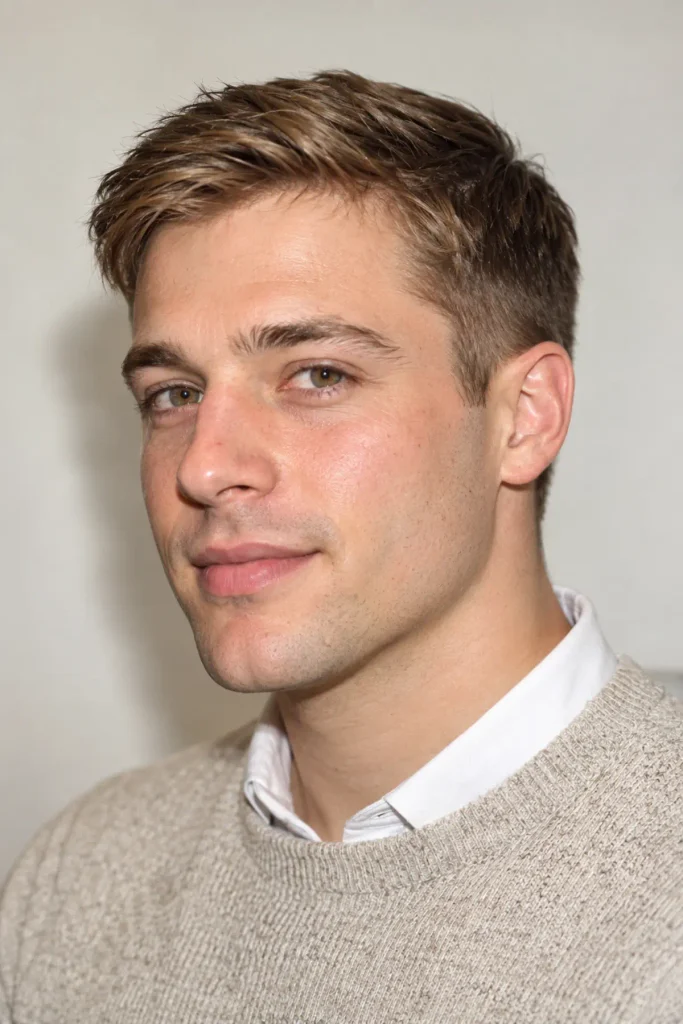
The Ivy League is a slightly longer crew cut with enough length on top for a side sweep or part. It is compact, tidy and flexible. Men with a high forehead can leave a little extra length at the front.
- Best for: corporate, academic and professional services settings.
- Hair type and density: straight to wavy, medium density
- Upkeep: low, every 3 to 4 weeks, under 3 minutes to style
- Ask the barber: “Ivy League with a taper on the sides and enough length on top to part or sweep.”
- Grow out: the top gets floppy first, so a trim at week four keeps the shape
3. Crew Cut
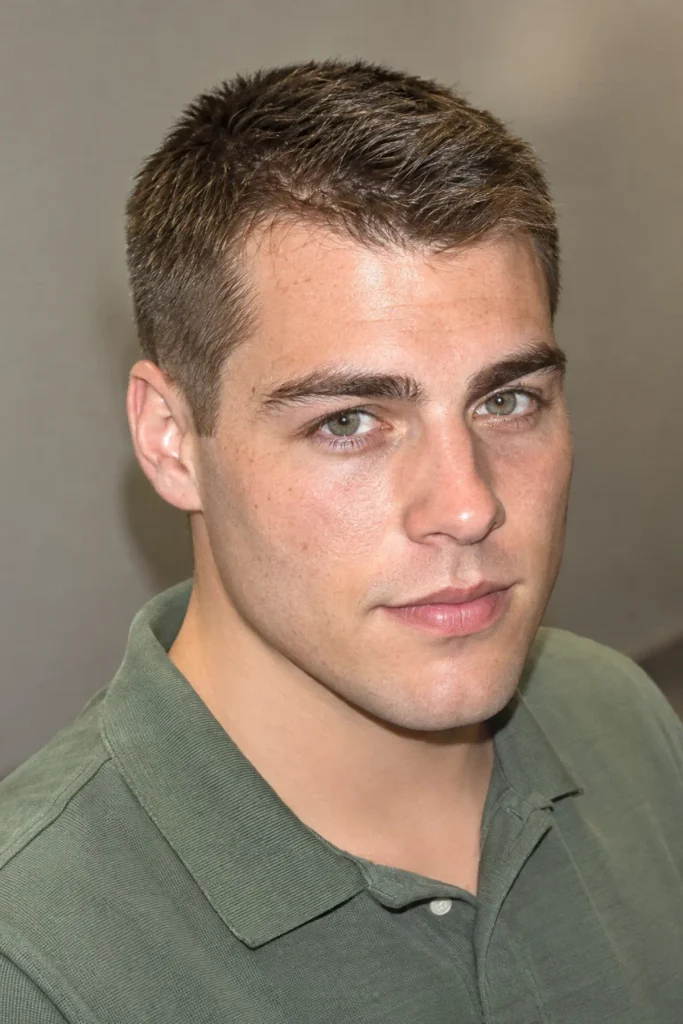
A modern crew cut has short tapered sides and a top that is a little longer toward the front. The detail that separates polished from dated is the blend between the sides and the top, so one flat length all over is best avoided.
- Best for: the lowest effort style that still reads as professional.
- Hair type and density: straight, wavy and curly hair, fine to thick density
- Upkeep: very low styling, but regular trims, every 2 to 4 weeks
- Ask the barber: “Crew cut, a #2 or #3 on top with the front slightly longer, tapered sides.”
- Who may skip it: men who want styling variety
4. Classic Business Cut (Taper with Length on Top)
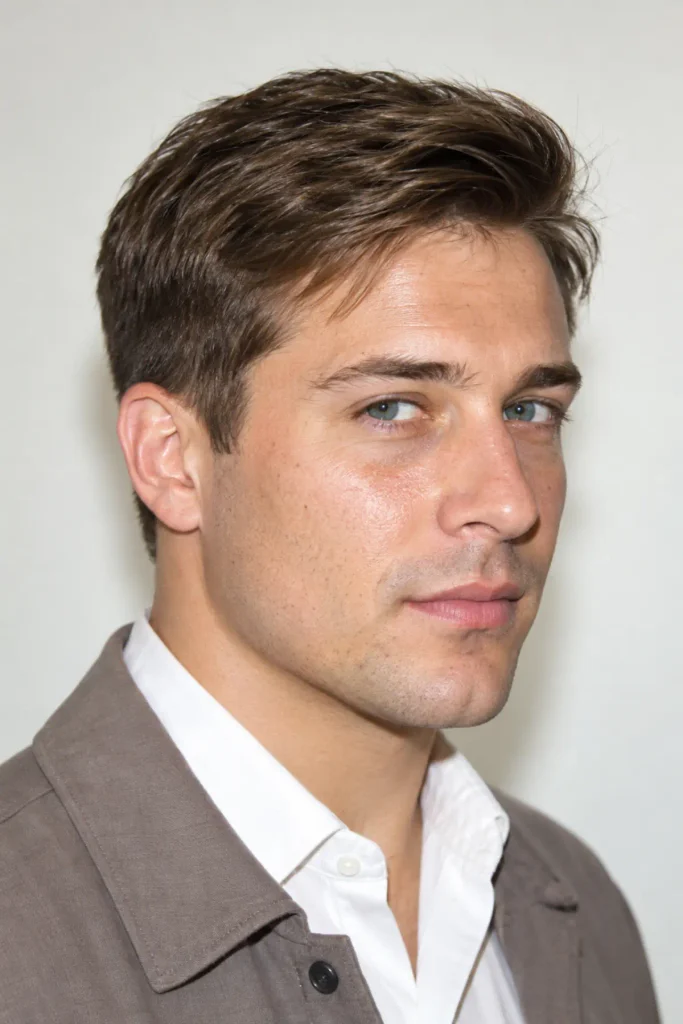
Sometimes called the executive haircut or the businessman’s cut, this style pairs a classic taper with a longer top that is combed or swept to one side. It is neat, balanced and almost impossible to get wrong.
- Best for: managers, executives and anyone who wants one cut that works everywhere.
- Hair type and density: straight to wavy, medium to thick
- Upkeep: medium, every 3 to 4 weeks, 3 to 5 minutes to style
- Ask the barber: “Classic taper, scissor cut top, comb it to the side.”
- Grow out: the sides grow in evenly, which is why barbers like this cut
5. Executive Comb Over
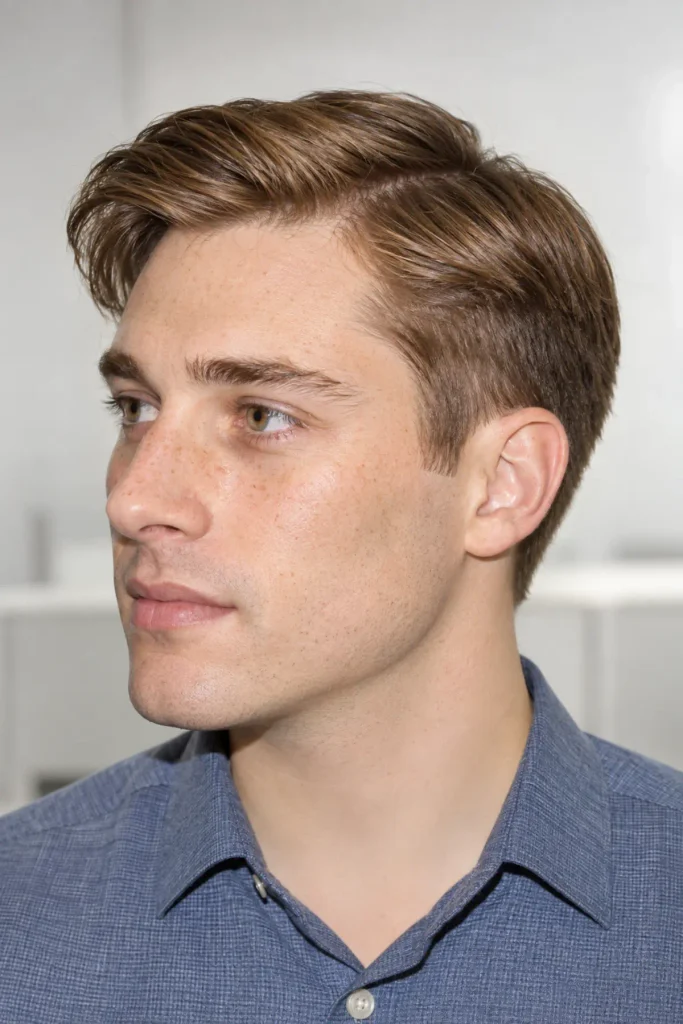
A modern comb over is a styled side sweep, not hair dragged across the scalp. It also works well for men with a thinning crown or a receding hairline because the sweep adds coverage and direction.
- Best for: men who want a formal look or more coverage on top.
- Hair type and density: straight to wavy, medium density
- Upkeep: medium, 3 to 4 weeks, 4 to 5 minutes with light pomade or cream
- Ask the barber: “Short taper on the sides, keep length on top for a natural side sweep.”
- Watch out: heavy product breaks up the sweep and looks greasy
6. Scissor Cut Gentleman’s Cut

A scissor cut skips the clipper lines and blends the sides by hand, which gives soft transitions and a natural grow out. It suits men who dislike the sharp contrast of a fade.
- Best for: very conservative workplaces and men with uneven growth patterns.
- Hair type and density: straight and wavy, fine to medium (thick hair needs careful weight removal)
- Upkeep: medium, but it stays presentable longer, around 4 weeks
- Ask the barber: “Scissor over comb on the sides, no skin fade, keep it natural around the ears.”
- Who may skip it: men who like a very crisp edge
7. Professional Buzz Cut

The buzz cut removes nearly every styling decision. Because the hair is so short, head shape, hairline and crown growth become the main features, so a barber usually picks the guard length with those in mind. A slightly longer guard feels softer and a faded version looks sharper.
- Best for: busy schedules, hot climates and thinning hair. Works on oval, square and diamond faces. Men with a big forehead may want a slightly longer guard. See buzz cut for a big forehead
- Hair type and density: all types, including thinning hair
- Upkeep: zero styling, but a visit every 2 to 3 weeks keeps the edge clean
- Ask the barber: “Buzz cut with a #2 on top and a soft taper at the sides and neckline.”
- Who may skip it: men with scalp scars or noticeable bumps who prefer some coverage
8. Caesar Cut
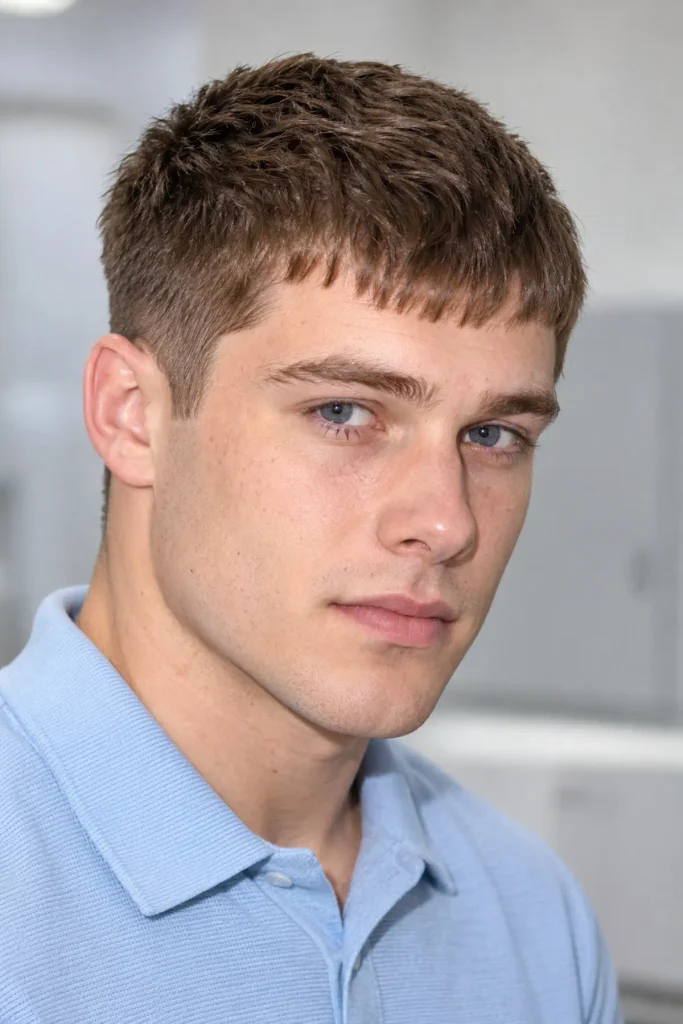
The Caesar has a short, forward fringe and even length around the head. It needs almost no styling and hides a receding hairline well.
- Best for: low maintenance days, receding hairlines and thick, straight hair.
- Hair type and density: straight to wavy, medium to thick
- Upkeep: low styling, every 3 to 4 weeks to keep the fringe crisp
- Ask the barber: “Caesar cut with a #2 or #3, textured fringe, no hard line.”
- Watch out: a very blunt horizontal fringe looks harsh, so a little texture softens it
Modern Business Casual Cuts
9. Low Taper Fade with Side Part
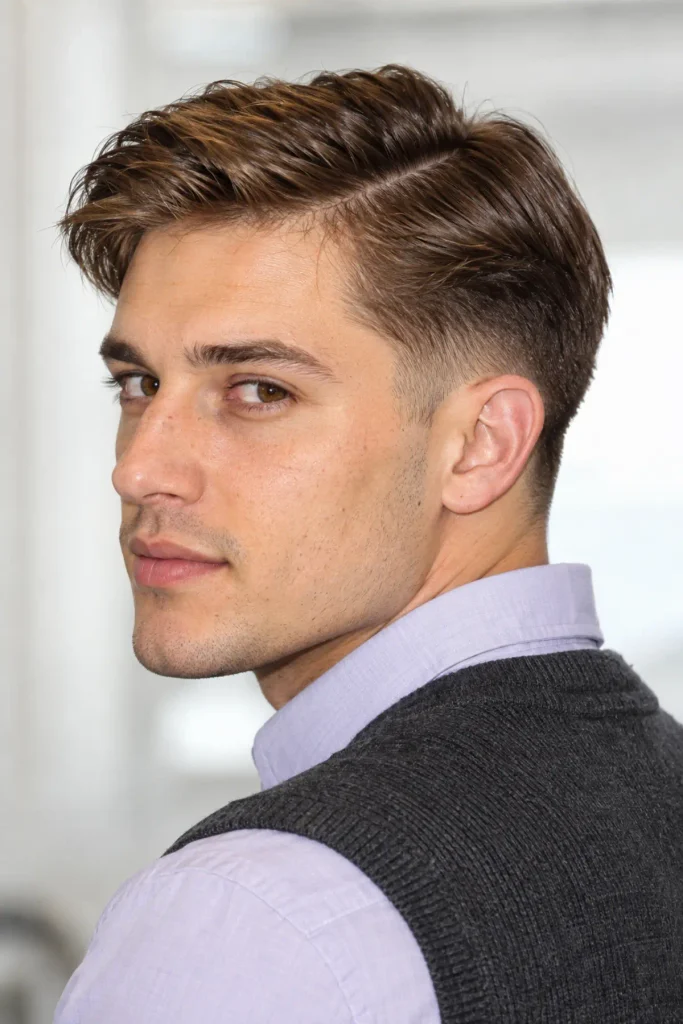
This is the modern version of the classic. The sides fade gently from short to a little longer near the top, while the side part keeps the shape formal. Keeping the fade low is what keeps it office safe.
- Best for: business casual and corporate offices that accept a subtle fade
- Hair type and density: straight to wavy, medium to thick
- Upkeep: medium, every 3 weeks, 3 to 5 minutes with matte clay or light pomade
- Ask the barber: “Low taper fade, not a skin fade, natural side part on top.”
- Watch out: a bald (skin) fade reads trendier and shows grow out sooner
10. Textured Crop
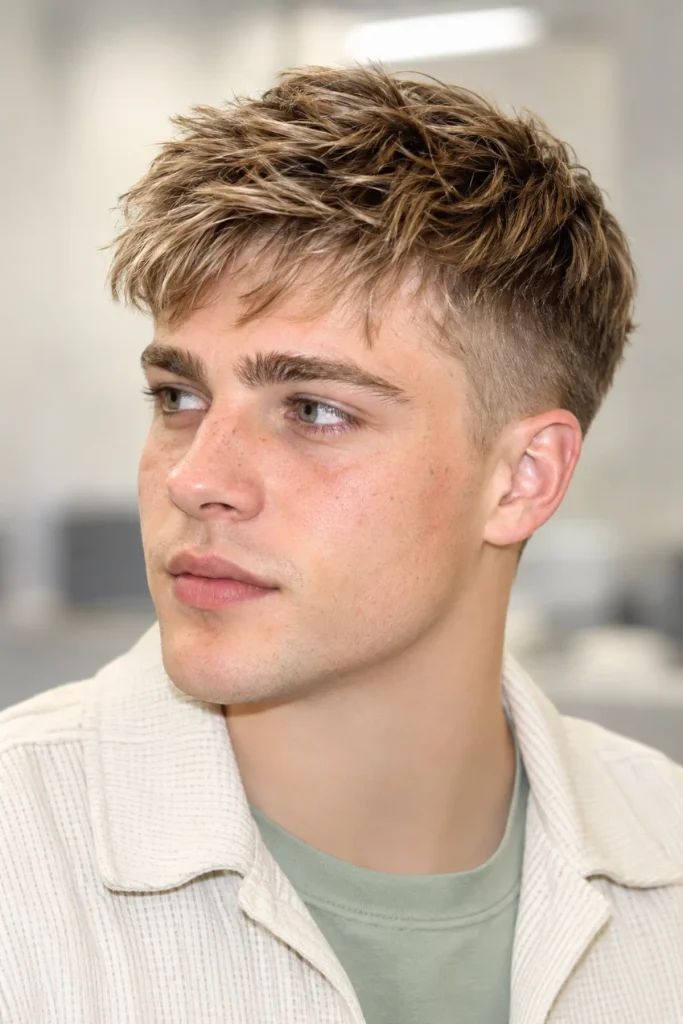
The textured crop is short on the sides with a choppy, point cut top. It needs very little time, looks modern and works across hair types. The texture should look deliberate, with controlled separation instead of random spikes.
- Best for: business casual offices, men who want a low effort modern cut
- Hair type and density: straight and wavy. Fine hair does well when the texture is restrained
- Upkeep: low, every 3 to 5 weeks, about 2 minutes with a matte paste or clay
- Ask the barber: “Short textured crop, tapered sides, point cut the top for movement.”
- Watch out: too much texturizing can thin out fine hair
11. French Crop
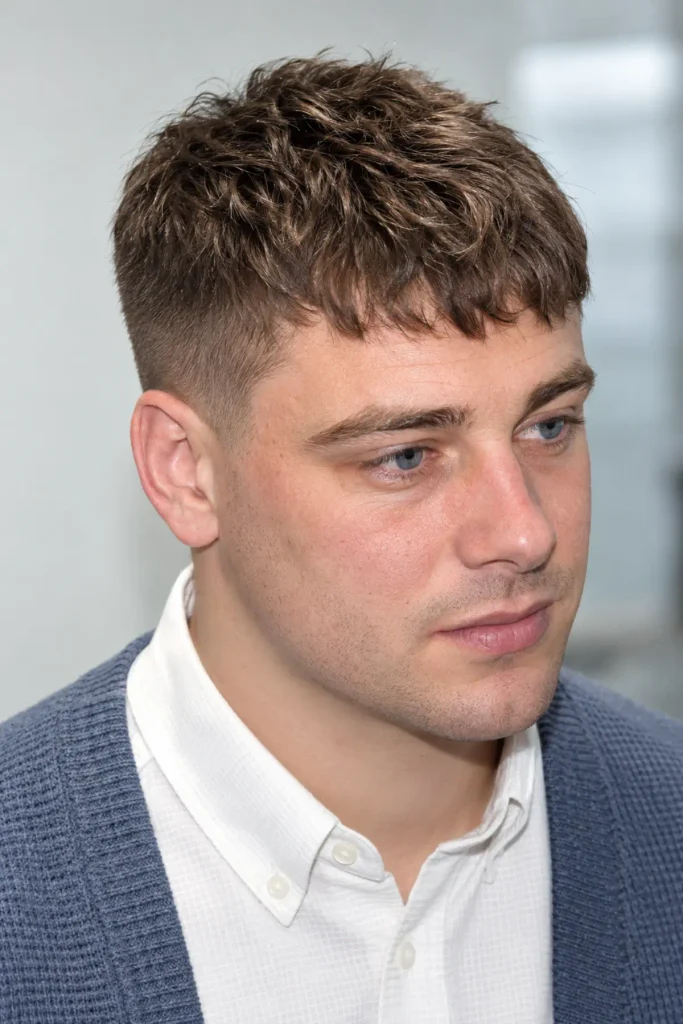
The French crop has short sides and a short, forward fringe. It is a cleaner, more compact take on a crop and hides a high forehead without much fuss.
- Best for: men with a larger forehead or a mild receding hairline
- Hair type and density: straight to slightly wavy, medium to thick
- Upkeep: low styling, trims every 3 to 4 weeks
- Ask the barber: “French crop, textured fringe, low taper, no blunt line across the front.”
- Who may skip it: men with strong cowlicks at the front hairline
12. Office Ready Quiff
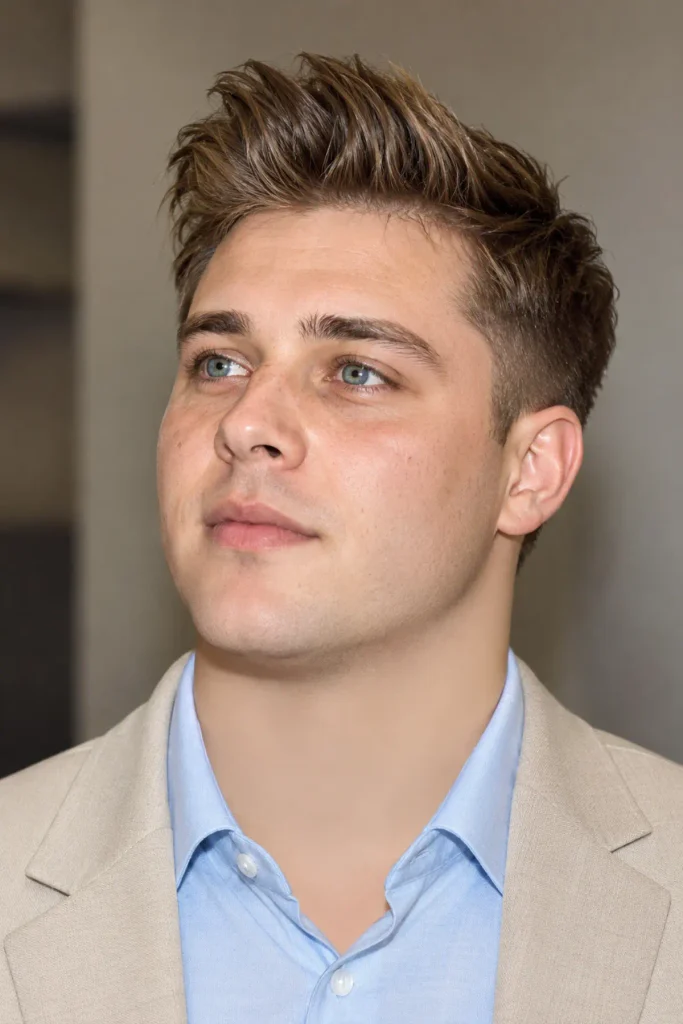
An office quiff sits at moderate height, not maximum volume. The front lifts for structure, the sides stay tight, and the finish stays matte. Blow drying the front up and slightly back before adding a little product gives better control than building height with wax alone.
- Best for: business casual and creative offices
- Hair type and density: straight to wavy, medium to thick. Fine hair needs root lift and a light product
- Upkeep: medium, 5 to 8 minutes, trims every 3 to 4 weeks
- Ask the barber: “Quiff with a low taper and about 2 to 3 inches at the front, enough to blow dry up and back.”
- Watch out: over styled shine reads as nightlife, not the office
13. Short Pompadour (Controlled)
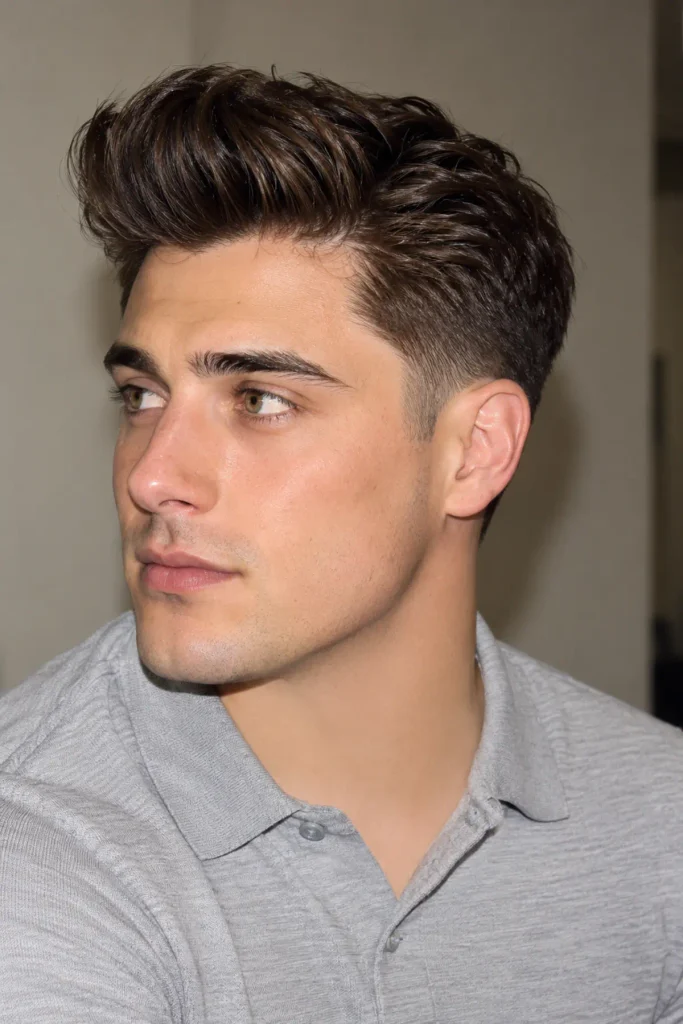
A controlled pompadour keeps volume at the front and lets the crown follow behind it. It brings classic energy to a business casual office without turning into a statement.
- Best for: client facing creative or sales roles
- Hair type and density: thick, straight to wavy. Curly hair can work in a shorter version
- Upkeep: medium to high, about 8 minutes with mousse, a blow dryer and matte pomade
- Ask the barber: “Short pompadour with a low or mid taper, volume at the front only.”
- Who may skip it: men who want a five minute morning
14. Contemporary Slick Back
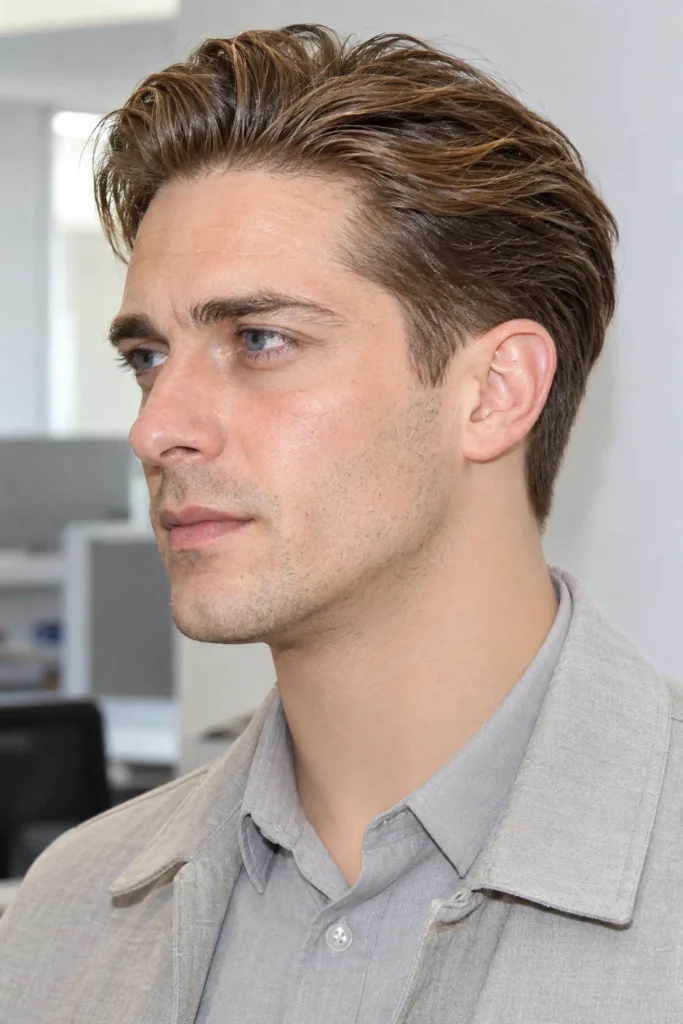
The office slick back is not wet or glued flat. Medium length hair is blow dried back with a little lift at the roots, then finished with a light cream or matte pomade. Straight and thick hair holds it easily, and wavy hair gives a softer look.
- Best for: executive or client facing roles, men with enough length on top
- Hair type and density: straight to wavy, medium to thick
- Upkeep: medium, 4 to 6 minutes, trims every 4 weeks
- Ask the barber: “Longer on top to comb back, tapered sides, clean neckline.”
- Watch out: a tight slick back can emphasize a receding hairline, so some men leave a little movement at the front
15. Brushed Back with Taper

Brushed back hair is the relaxed cousin of the slick back. Strands keep a little separation, and a light cream controls flyaways. Waves add depth and make this one of the most natural looking business casual styles.
- Best for: creative and hybrid offices, men with natural waves
- Hair type and density: wavy and straight, medium to thick
- Upkeep: low to medium, 3 to 5 minutes, trims every 4 weeks
- Ask the barber: “Enough length to brush back, tapered sides, keep it soft at the temples.”
- Grow out: the sides can look bulky after week four, so a quick clean up helps
16. Mid Fade with a Textured Top
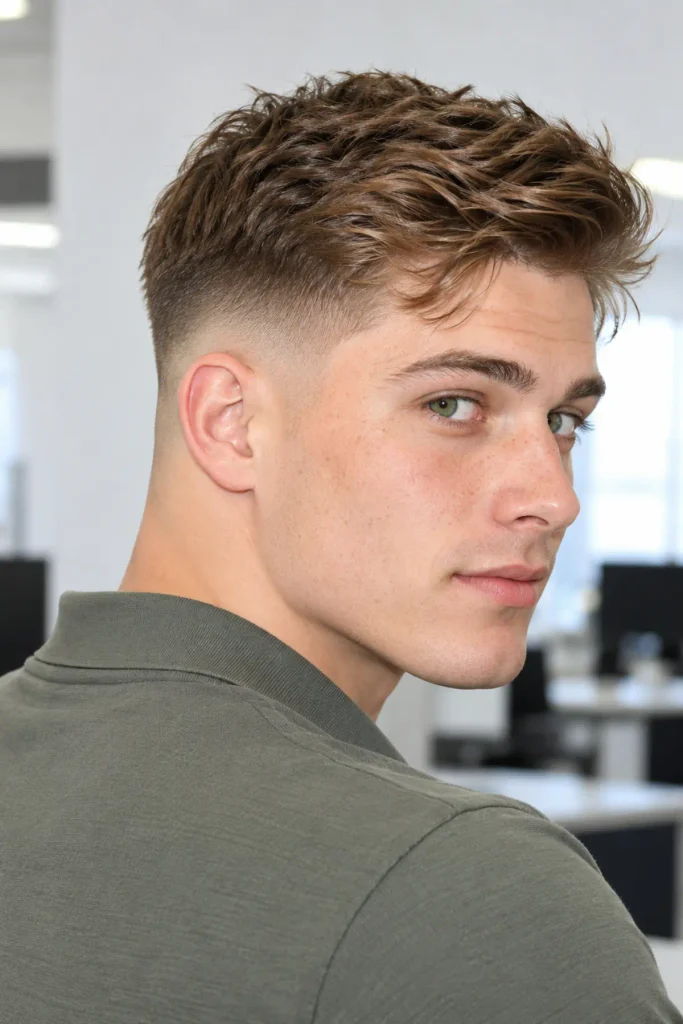
A mid fade has more contrast than a low taper. It works in workplaces that accept contemporary grooming, as long as the top stays controlled. For a full breakdown of fade heights and variations, see the mid fade haircuts for men guide.
- Best for: tech, marketing and modern corporate offices
- Hair type and density: straight, wavy and curly, medium to thick
- Upkeep: medium to high, every 2 to 3 weeks to keep the fade crisp
- Ask the barber: “Mid fade with a soft blend, no skin line at the top, textured side swept top.”
- Who may skip it: very conservative offices, interviews at traditional firms
17. Buzz Cut Fade with a Beard
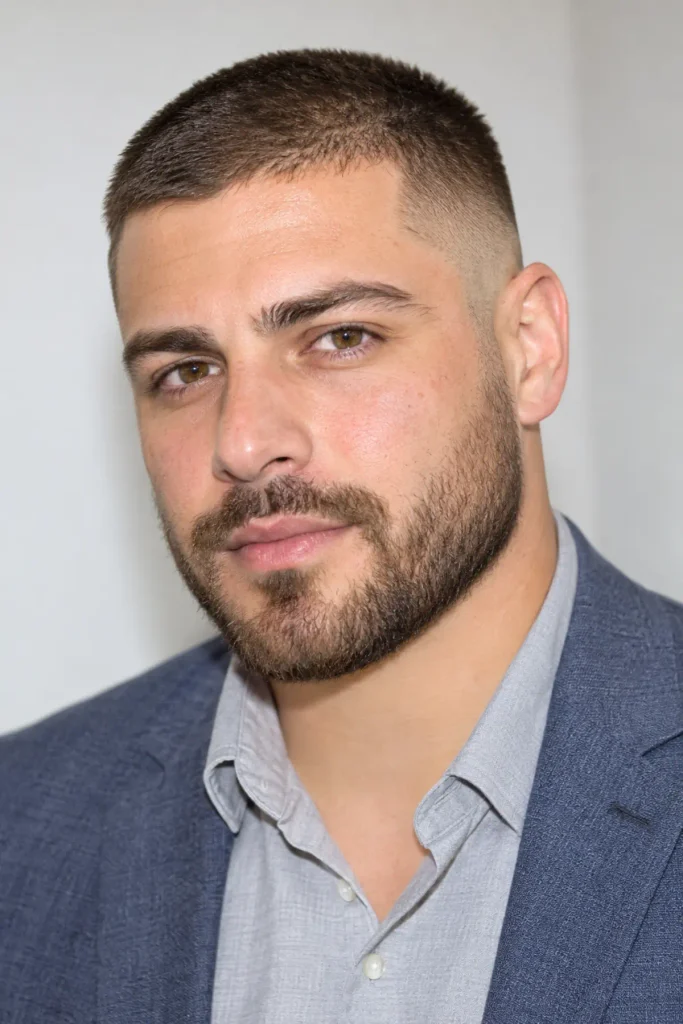
A short, faded buzz cut pairs naturally with a well groomed beard because the fade can blend straight into the beard line. A trimmed beard that matches the cut looks tidy and professional, while a scruffy beard next to a sharp cut looks inconsistent. The buzz cut fade with beard guide shows more combinations.
- Best for: men with strong jaw lines who like a low maintenance, bold look
- Hair type and density: all hair types
- Upkeep: medium to high, 2 to 3 weeks, beard line cleanup at each visit
- Ask the barber: “Faded buzz cut blended into a short boxed beard, clean neckline and cheek line.”
- Watch out: the beard needs regular trimming to look office ready
Longer, Textured and Hair Situation Cuts
18. Medium Length Executive Flow

Medium length hair looks professional when the outline stays deliberate. Layers keep the shape from getting bulky, and a clean neckline prevents it from looking overgrown. It can be brushed back, parted or swept sideways depending on the day. For more length options, see the medium length haircuts for men collection.
- Best for: creative offices, hybrid roles, men who like variety
- Hair type and density: straight and wavy, medium density. Very thick hair needs layering
- Upkeep: medium, 5 to 8 minutes, trims every 5 to 6 weeks
- Ask the barber: “Medium length with light layers, tapered neckline, keep the sides off the ears.”
- Watch out: long layered looks tip into casual fast. See long layered hair for men for the relaxed version
19. Business Casual Wavy Style
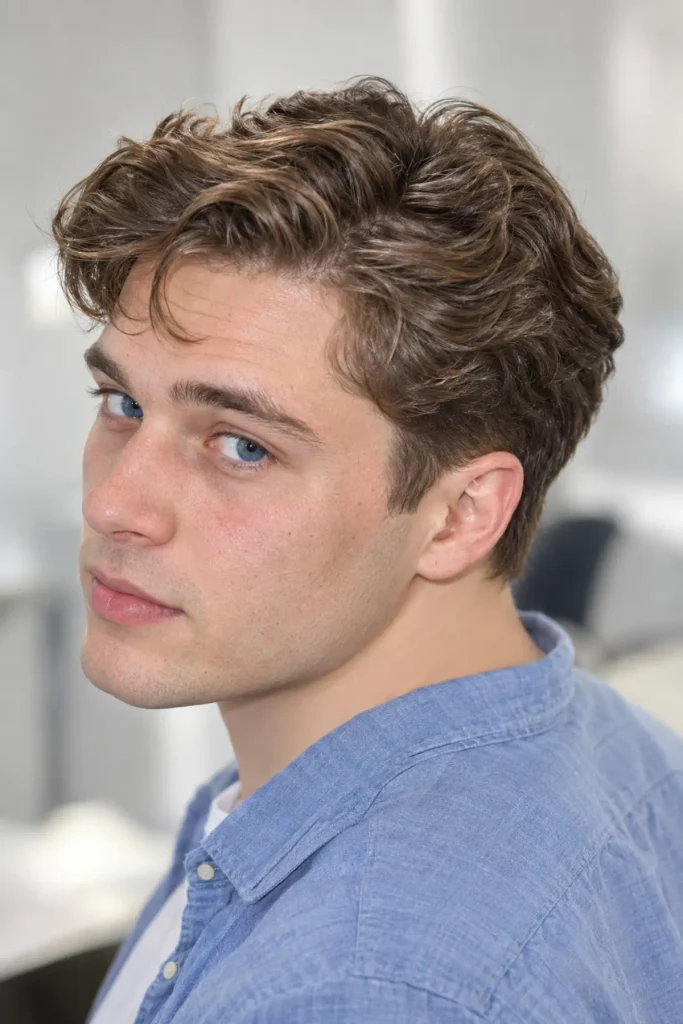
Natural waves do not need to be straightened for the office. Shaping the cut around the wave pattern, trimming bulk from the sides and styling the hair damp usually gives a more convincing result than fighting it with a flat iron.
- Best for: wavy hair (2A to 2C) in business casual or creative offices
- Hair type and density: wavy, medium density
- Upkeep: low to medium, 3 to 5 minutes with a bit of curl cream or sea salt spray, then air dry or diffuse on low heat
- Ask the barber: “Keep the waves on top, taper the sides so they do not puff out.”
- Watch out: frizz and puffiness at the sides in humid weather
20. Short Curl Crop with Taper
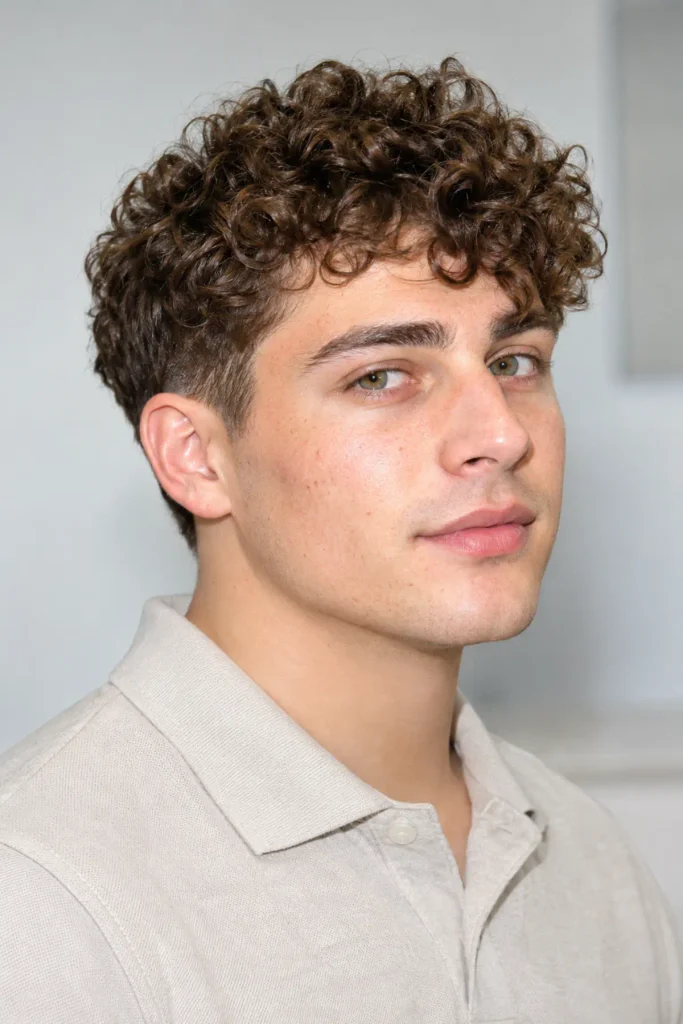
For curly hair (3A to 3C), a short crop on top with a clean taper keeps curls defined and the perimeter neat. A little length helps curls form instead of compressing. For a bolder option with more contrast, see burst fade haircuts for curly hair. A low or soft version of that cut can be neat enough for relaxed offices.
- Best for: curly hair, men who want a defined but tidy look
- Hair type and density: curly, medium to thick
- Upkeep: medium, 3 to 4 weeks, 3 to 5 minutes with curl cream or a light gel
- Ask the barber: “Taper the sides and neckline, keep the curls on top about 2 to 3 inches, no heavy thinning.”
- Watch out: moisture matters more than hold, so dry curls look frizzy fast
21. Tapered Afro or Neat Natural

A tapered afro has a rounded top and a clean fade or taper at the sides and neckline. It shows natural texture while staying very polished. Shape and edge work do most of the visual work here.
- Best for: coily hair (4A to 4C), formal and business casual settings
- Hair type and density: coily, medium to thick
- Upkeep: medium, every 2 to 4 weeks for the edge and neckline, a leave in conditioner for moisture
- Ask the barber: “Tapered sides and neckline, shape the top into a round afro, sharp but natural edge up.”
- Watch out: dryness and shrinkage can change how long the top looks, so a barber who knows coily hair helps
22. Twists or Locs, Neat and Tied Back
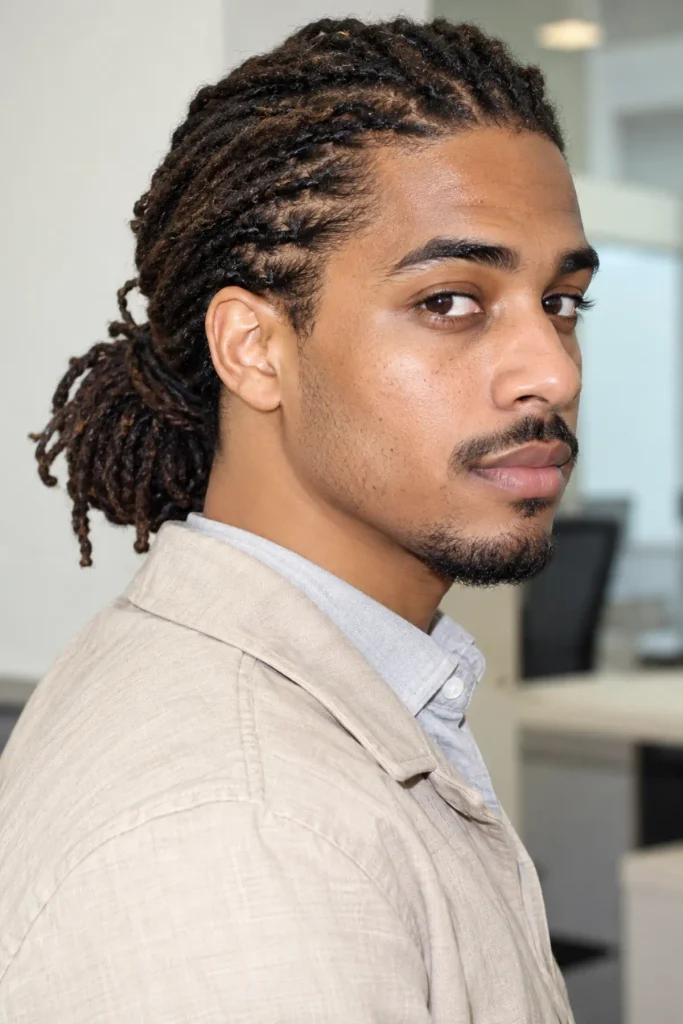
Twists and locs can look tidy in many offices when they are well maintained, kept clean at the roots and tied back or pulled into a low style. They are also a case where state law may matter, covered further below in the natural hair section.
- Best for: men with coily hair who want a protective style
- Hair type and density: coily and curly, any density
- Upkeep: medium to high, regular retwisting or maintenance and a scalp care routine
- Ask the stylist: “Neat retwist, clean parts, tidy edges and neckline.”
- Watch out: loose or messy sections can read as unkempt in strict offices
23. Thick Hair Business Style
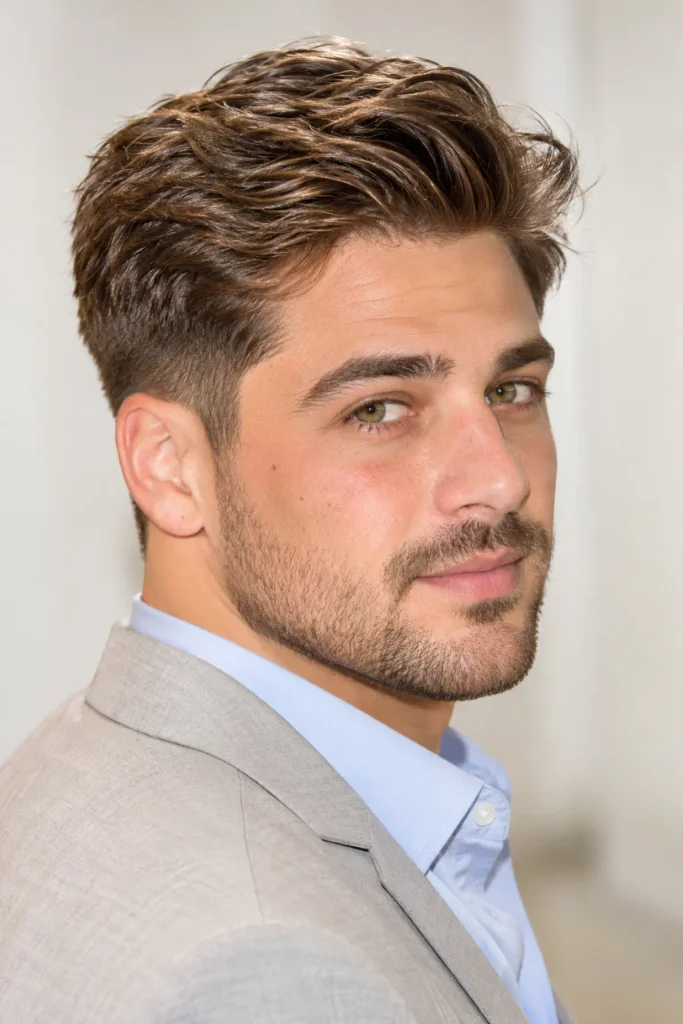
Thick hair does not need to be thinned everywhere. Barbers remove weight where bulk builds up, usually at the temples, the sides and behind the crown, and leave density through the top for a strong silhouette. A lightweight cream or matte product works better than heavy wax.
- Best for: dense, straight or wavy hair
- Hair type and density: thick, straight to wavy
- Upkeep: medium, trims every 3 to 4 weeks, because bulk returns fast
- Ask the barber: “Remove weight at the sides and crown, keep density on top, taper the neckline.”
- Watch out: bulky sides at week three, so mention the grow out plan to the barber
24. Fine Hair Short Crop

Fine hair looks best when the barber preserves density instead of thinning it. A short crop with a light texture keeps the top looking fuller. For more ideas, read short haircuts for men with fine hair.
- Best for: fine or thin strands, men who want a clean look in under two minutes
- Hair type and density: fine, straight to wavy, low to medium density
- Upkeep: low, every 3 to 4 weeks, a light mousse or sea salt spray for lift
- Ask the barber: “Short textured crop, light point cutting only, do not thin the top.”
- Watch out: heavy pomade weighs fine hair down
25. Cuts for a Receding Hairline or Thinning Crown

Short and neat usually works best for a receding hairline. A crew cut, a French crop, a Caesar or a short buzz cut puts attention on the cut and not on the hairline. According to the American Hair Loss Association, androgenetic alopecia (male pattern baldness) causes over 95% of hair loss in men, two thirds of American men notice some hair loss by age 35, and about 85% have significantly thinning hair by 50. In other words, it is common, and a good cut can make it look intentional. A hair loss specialist or dermatologist can explain medical options. The Norwood scale is the system doctors use to describe the stages.
- Best for: men with a receding hairline, temple recession or crown thinning
- Hair type and density: all types, low to medium density
- Upkeep: low styling, every 3 to 4 weeks
- Ask the barber: “Short crop or crew cut, textured top, soft taper, nothing combed forward.”
- Watch out: long strands combed over a large bald area tend to attract attention, and a shorter cut usually looks cleaner
How to Ask the Barber for an Office Haircut
The best results come from specifics. “Take a little off” leaves too much room for surprise, while four short details give the barber a clear plan:
- Top length. Say it in inches, such as “about an inch and a half on top.”
- Sides. Name the guard or the fade height (low, mid or high) and say taper or skin fade.
- Neckline. Square for a classic formal look, rounded or tapered for a natural finish.
- Finish and part. Matte or light shine, natural part or hard part.
It also helps to mention the job. A barber who knows the cut is for a law firm, a startup or a first week at a new job can dial the fade height, part and layering up or down. Reference photos work best when they show real working professionals with hair like his, since editorial photos are lit and styled in ways daily life is not. Bringing a photo and explaining what he likes about it (the fade, the length, the texture) is more useful than naming a haircut.
Clipper Guard Cheat Sheet
| Guard number | Approximate length left | Common office use |
|---|---|---|
| #1 | 1/8 inch (about 3 mm) | Close buzz, lower part of a fade |
| #2 | 1/4 inch (about 6 mm) | Short crew cut, buzz cut, taper start |
| #3 | 3/8 inch (about 9 mm) | Longer buzz, crew cut top |
| #4 | 1/2 inch (about 12 mm) | Short textured top, soft taper |
Sizes vary slightly between clipper brands, so a barber may adjust by eye.
Styling Basics and Products
A few simple habits keep an office haircut looking natural:
- Style damp hair. Hair holds shape better when it is towel dried and then styled, not styled bone dry.
- Use less product than expected. A pea sized amount is usually enough. More can always be added.
- Match product to finish. Styling cream gives flexible control and a natural look. Matte clay adds texture and separation. Pomade suits structured classics. Sea salt spray adds movement to waves. Mousse adds volume before blow drying.
- Choose matte over shine for most offices. Heavy shine can look dated or overdone.
- Use a blow dryer for lift. Drying the front up and back gives quiffs and brush ups most of their shape.
| Hair type | Good product pairing |
|---|---|
| Straight and thick | Light pomade or cream, comb through |
| Fine | Mousse or sea salt spray at the roots, light cream |
| Wavy | Sea salt spray or curl cream, diffuse or air dry |
| Curly and coily | Leave in conditioner, curl cream, light gel for definition |
| Thinning | Matte powder or light paste, avoid heavy wax |
Trim Schedule and Grow Out
Because hair grows roughly half an inch per month, a haircut changes noticeably every week. A realistic grow out timeline for a taper based cut looks like this:
| Week | What it looks like | What to do |
|---|---|---|
| Week 1 | Freshly cut, edges crisp | Best for interviews and photos after a day or two of settling |
| Week 2 | Lines soften, still sharp | Prime time for most office days |
| Week 3 | Sides start to fill in, fades lose contrast | Neckline and sideburn cleanup helps |
| Week 4 | Top gets heavier, shape fades | Time to book |
| Week 5 and beyond | Looks grown out | A tight fade or buzz cut is clearly overdue |
Fades usually need a visit every 2 to 3 weeks, tapers and scissor cuts closer to 3 to 5 weeks. A quick edge cleanup between full cuts can stretch the look.
Budget tip: annual upkeep equals visits per year times the local price. A man who books every 3 weeks goes about 17 times a year, and a man who books every 5 weeks goes about 10 times. Prices differ by city and barbershop, so he can multiply the number of visits by his barber’s rate for a realistic yearly figure.
Job Interview Haircuts
For an interview, the goal is to look neat, not like a new person. Safe choices include a side part with a taper, an Ivy League cut, a crew cut with a low taper or a short comb over. Many barbers suggest getting the cut about 5 to 7 days beforehand, so the hard clipper lines settle and he can practice styling it. Skipping a high skin fade and avoiding visible shaved designs is the safer move for conservative interviews. Stubble looks fine when groomed, and a full beard should be neatly lined. After starting a new job, it helps to hold the same look for a few weeks before changing anything big, until the office culture is clear.
Hairstyles for Video Calls
For video calls, the hairline, top and sides are the main parts the camera shows. A clean neckline matters less than neat temples, sideburns and a top without flyaways. Matte products photograph better than shiny ones, and a slightly lower fade looks more consistent under webcam lighting than a high contrast one. Quiffs and brushed back styles work well because they read clearly on screen.
Natural Hair at Work and the CROWN Act
Coily, curly and protective styles are professional when they are well kept. In the United States, the CROWN Act (Creating a Respectful and Open World for Natural Hair) bans race based hair discrimination in many places. As of August 2026, the Economic Policy Institute reports that 30 states have passed some version of the law, with Pennsylvania and Rhode Island the most recent in 2025. Kentucky and Missouri have limited versions. A federal CROWN Act has been introduced in Congress but had not received a vote at the time of that report. Rules differ by state, and this is general information, not legal advice.
Styles to Approach with Caution at the Office
Some trendy cuts work in creative offices but may raise eyebrows in conservative ones. A man bun can work in relaxed workplaces when it is neat and low, and the man bun hairstyles guide shows tidy versions. A wolf cut for men and a burst fade mullet are strong style statements, so they suit weekends and very casual workplaces better than client meetings. Bleached or brightly colored hair, shaved designs and mohawks also tend to stand out in traditional offices.
Common Mistakes Men Make with Office Haircuts
- Choosing a cut from a photo of a model with a different hair type, density or hairline.
- Using too much product, which makes even a classic cut look greasy.
- Ignoring the neckline and sideburns, which frame the face and show growth fastest.
- Skipping trims, since a tight fade shows regrowth within two to three weeks.
- Picking a high skin fade for a conservative interview.
- Thinning thick hair everywhere instead of removing weight in the right spots.
- Combing long strands over a large thinning area.
- Forgetting to tell the barber about the job, upcoming interviews or events.
FAQs About Office Hairstyles for Men
What is the most professional hairstyle for men?
The side part, Ivy League cut and crew cut are the most widely accepted professional hairstyles for men. Each has short, tidy sides, controlled length on top and clean edges, so they suit almost any dress code and take only a few minutes to style.
Are fades professional for the office?
Yes, in most offices. A low taper or low fade with a controlled top is widely accepted. High skin fades with dramatic contrast can look too bold in very conservative workplaces such as law, banking or government, so a softer taper is the safer pick there.
What haircut is best for a job interview?
A side part with a taper, an Ivy League cut or a crew cut with a low taper is the safest choice. Many barbers recommend getting the haircut 5 to 7 days before the interview so the edges settle and styling feels natural.
How often should a man get a haircut for work?
Most office haircuts need a trim every 3 to 4 weeks. Fades and buzz cuts look best every 2 to 3 weeks, while scissor cuts and soft tapers can last about 4 to 5 weeks. Hair grows roughly half an inch per month.
What is the easiest professional haircut to maintain?
The crew cut, buzz cut and Caesar cut are the easiest because they need almost no daily styling. They do need regular trims, since short hair shows regrowth quickly, usually every 2 to 4 weeks.
Can men with long hair look professional?
Yes. Medium length hair with light layers, a clean neckline and neat sideburns can look polished. Longer hair also looks professional when it is tied back neatly, though very conservative offices may prefer shorter styles.
Can curly or coily hair look professional at work?
Yes. Defined curls with a clean taper, a tapered afro, waves or neat twists and locs all look professional when edges are tidy and the hair is moisturized. Many US states also have CROWN Act laws that protect natural hair at work.
What is the best office haircut for thinning hair or a receding hairline?
Short, neat cuts work best, such as a crew cut, French crop, Caesar or buzz cut. They draw attention to the cut instead of the hairline. Combing long strands across a large bald area usually looks less polished.
What hair product is best for the office?
Light styling cream, matte clay or a small amount of pomade works best. These products give control without heavy shine. Fine hair does better with mousse or sea salt spray, and curly hair does better with leave in conditioner and curl cream.
What haircut looks best on video calls?
Neat temples, tidy sideburns and a top without flyaways matter most on camera. A low taper with a quiff, brushed back style or textured crop reads clearly on screen, and a matte finish photographs better than a shiny one.
Is a man bun professional?
He should say the top length in inches, the side treatment (taper or fade and how high), the neckline shape and the finish. Mentioning the job and bringing a reference photo of a similar hair type helps the barber match the cut to the workplace.
Final Thoughts
The best office hairstyle for a man is the one that fits his workplace, behaves well with his natural hair and still looks good three weeks after the barber visit. Classic cuts like the side part, Ivy League and crew cut stay safe almost everywhere. Modern tapers, textured crops and quiffs add personality to business casual offices, and cuts built around curls, coils, fine hair and thinning hair prove that every hair type can look sharp at work. Clear instructions to the barber, a small amount of product and regular trims do most of the rest. For more ideas to try next, the MenHairInspo homepage has guides for every length, fade and texture.