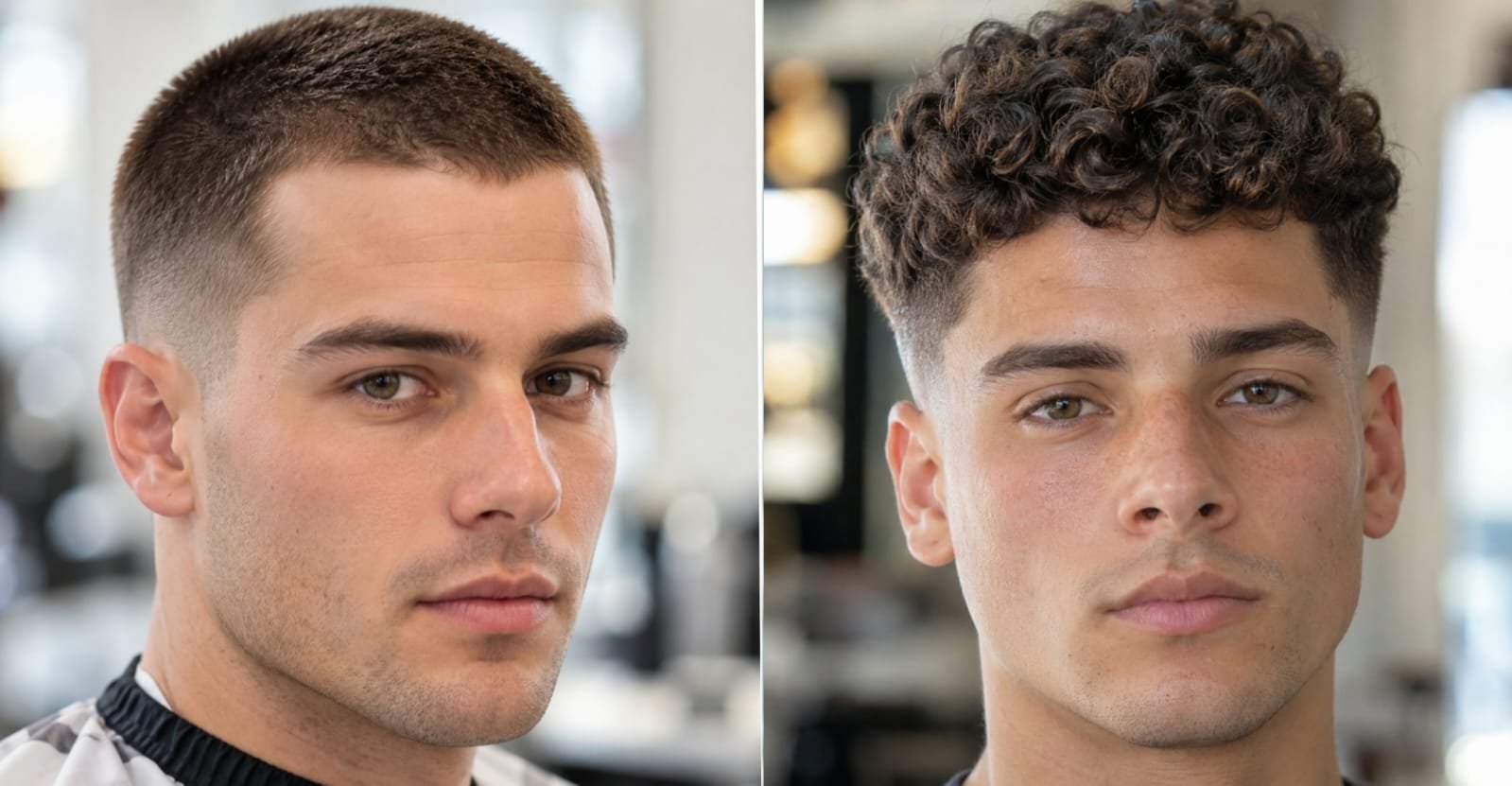
| Quick Answer Yes, a buzz cut can work well with a big forehead. Barbers usually start with a #3 or #4 on top, a low taper on the sides, and a natural hairline with only light cleanup. Short, even hair reduces the contrast between hair and forehead. A razor-sharp lineup or a very high skin fade can do the opposite and make the forehead look taller. |
Quick pick: the best buzz cut setup by situation
| Situation | Top length | Sides | Hairline finish |
|---|---|---|---|
| Tall forehead, stable hairline, thick hair | #3 to #4 | Low taper | Natural, light cleanup |
| Tall forehead, fine or thinning hair | #2 to #3 | Low taper or even buzz | Natural, soft temple corners |
| Mild temple recession (mature hairline) | #2 to #3 | Low or mid fade | Soft corners, no deep lineup |
| Deep M-shaped hairline | #1 to #2, or shaved | Even buzz or low fade | Natural, no sharp corners |
| Wide forehead, narrower jaw | #3 to #4 | Low taper | Natural, plus stubble or beard |
| Wants a hint of fringe | Crew cut, #4 top | Taper | Forward-brushed front |
| First buzz cut ever | Start at #4 | Low taper | Natural |
A big forehead and a buzz cut can feel like a risky pair. When hair is clipped short, there is nowhere to hide, so many men with a tall or wide forehead assume a fringe is the only safe option.
The truth is more encouraging. Barbers often reach for a buzz cut on exactly these heads, because very short, even hair can soften the line where hair meets forehead. The details decide everything: guard length, side treatment, hairline finish, hair density, and even beard length. This guide walks through each decision, lists 25 buzz cut styles with barber-ready instructions, and explains how to get the look without a bad surprise in the chair.
Table of Contents
25 Best Buzz Cut Styles for a Big Forehead
Every style below includes who it suits, what to ask the barber, and what to watch out for. Upkeep is the typical time between touch-ups. A quick decoder: a guard number is the hair left in eighths of an inch, so #3 means 3/8 inch and #4 means 1/2 inch. Taper, fade, and lineup choices are explained in the sections after the list.
Even-length buzz cuts
1. Classic #3 Buzz (Butch Cut)
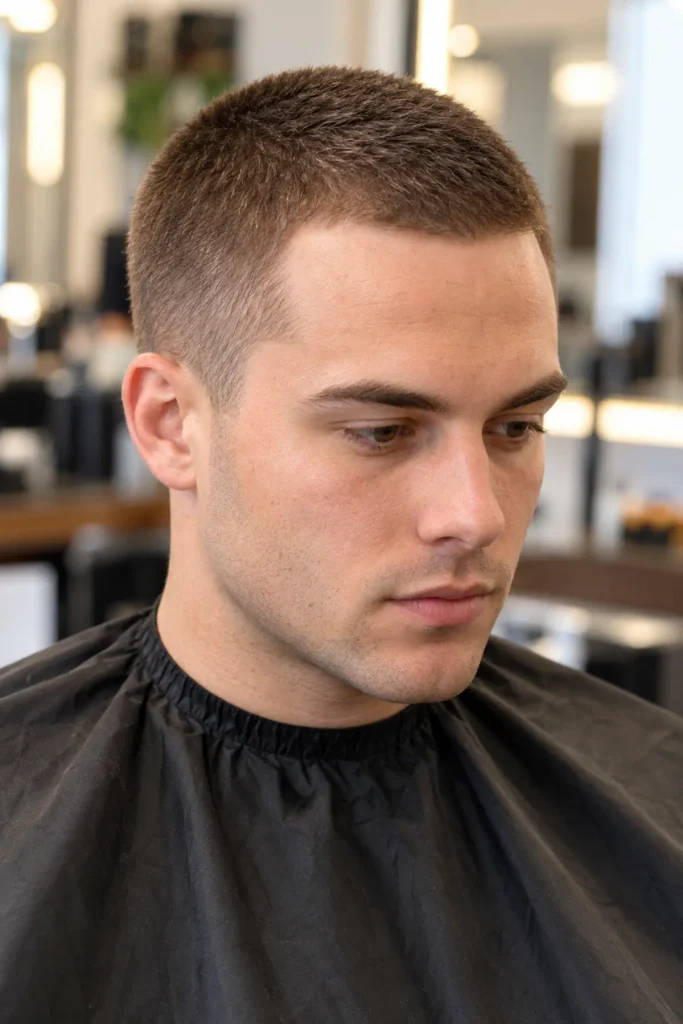
The most balanced starting point. At 3/8 inch, the hair adds a soft shadow around the temples while keeping the clean buzz look.
Best for: dense hair, stable hairlines, oval and square faces. Ask for: “A #3 all over, natural hairline, clean neckline.” Upkeep: every 2 to 3 weeks. Watch out: fine hair can show scalp at this length.
2. #4 Buzz for Beginners
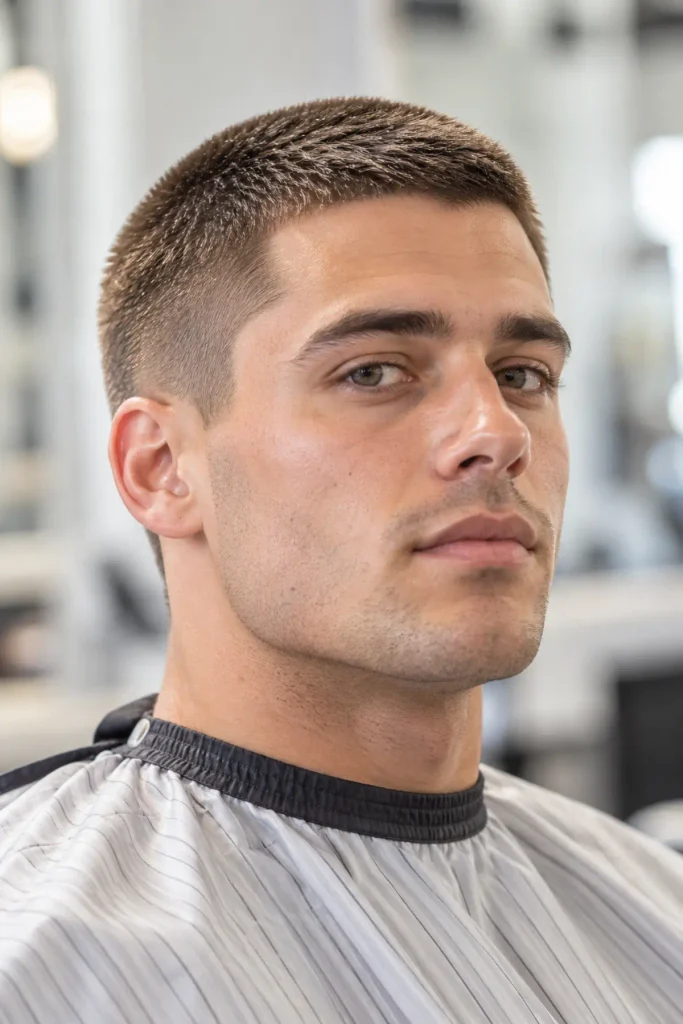
Half an inch of hair softens the hairline even more and hides scalp on lighter or finer hair. It is the classic “test drive” length before going shorter.
Best for: first-timers, fine to medium hair, men who want zero risk. Ask for: “A #4 all over, blend the edges, keep the front natural.” Upkeep: every 3 weeks. Watch out: growth shows quickly on fast-growing hair.
3. #2 Burr Cut
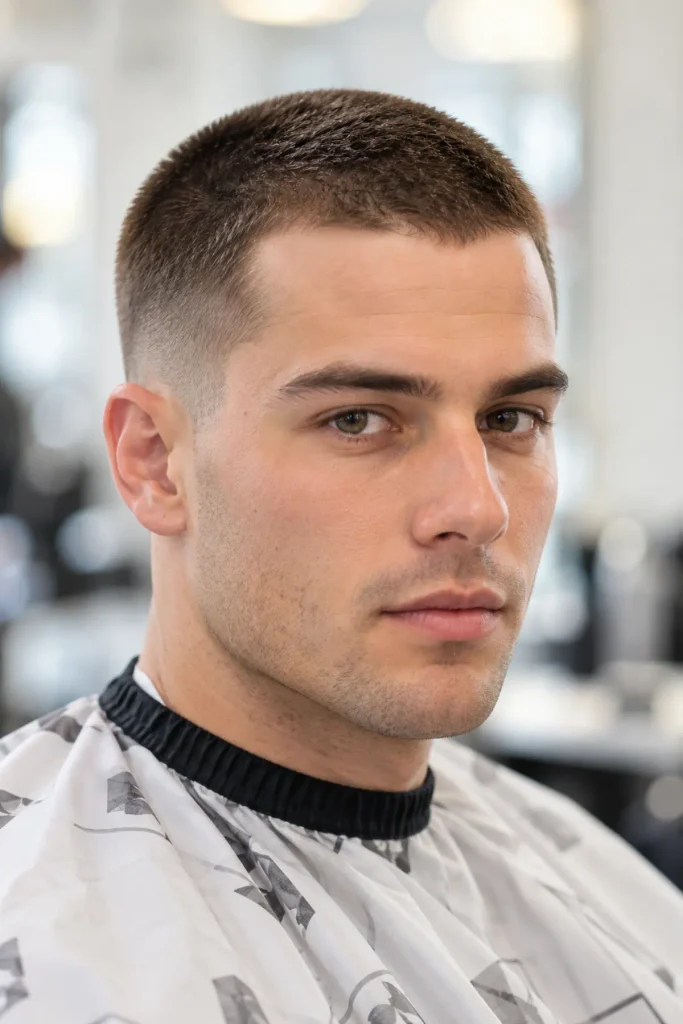
A quarter inch of hair creates a uniform, low-contrast surface that makes thinning less noticeable. Men with fine hair can browse more short haircuts for men with fine hair if a fuller texture is the goal.
Best for: thin or early receding hair, strong skull shapes. Ask for: “A #2 all over with a natural hairline.” Upkeep: every 2 weeks. Watch out: it exposes head shape and needs sunscreen.
4. #1 Buzz With Stubble

A very short buzz paired with a few days of facial growth. The stubble adds weight to the lower face, which pulls attention away from the forehead.
Best for: deeper temple recession, uneven density, men who can grow facial hair. Ask for: “A #1 all over, keep the hairline natural, match the stubble length.” Upkeep: every 1 to 2 weeks. Watch out: every bump and scar becomes visible.
Taper and fade buzz cuts
5. Buzz With a Low Taper
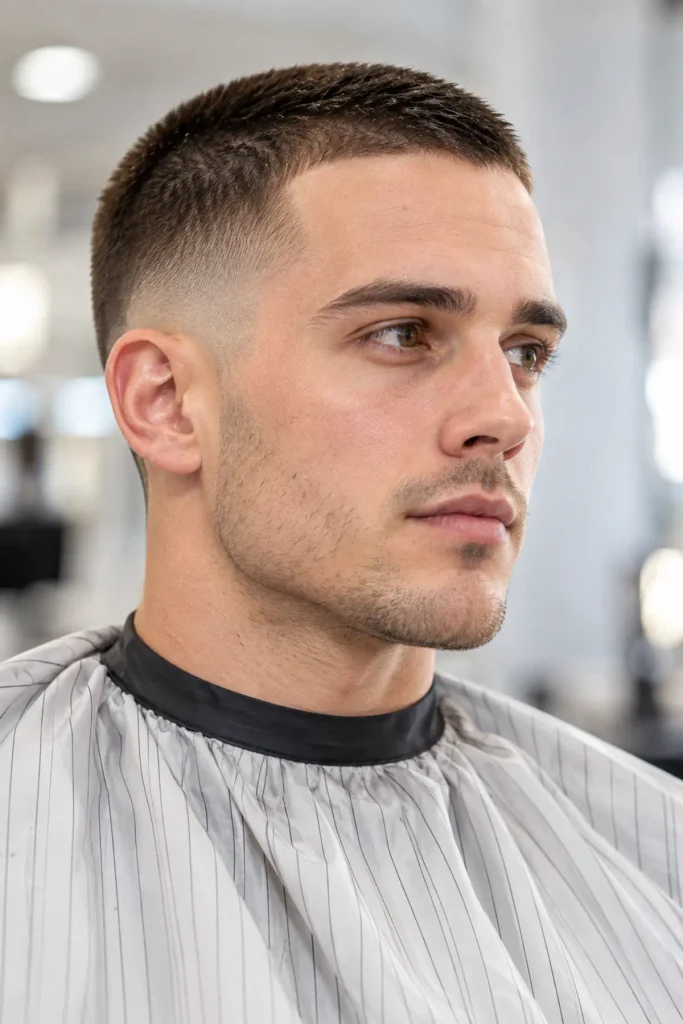
The sides and neckline step down gradually, with the taper limited to sideburns and nape. Weight stays around the temples, which is why this is the go-to default for a big forehead.
Best for: most tall or wide foreheads with stable hairlines. Ask for: “A #3 on top, low taper, natural hairline.” Upkeep: every 2 to 3 weeks. Watch out: a taper that starts too high can shrink the sides.
6. Buzz With a Low Fade
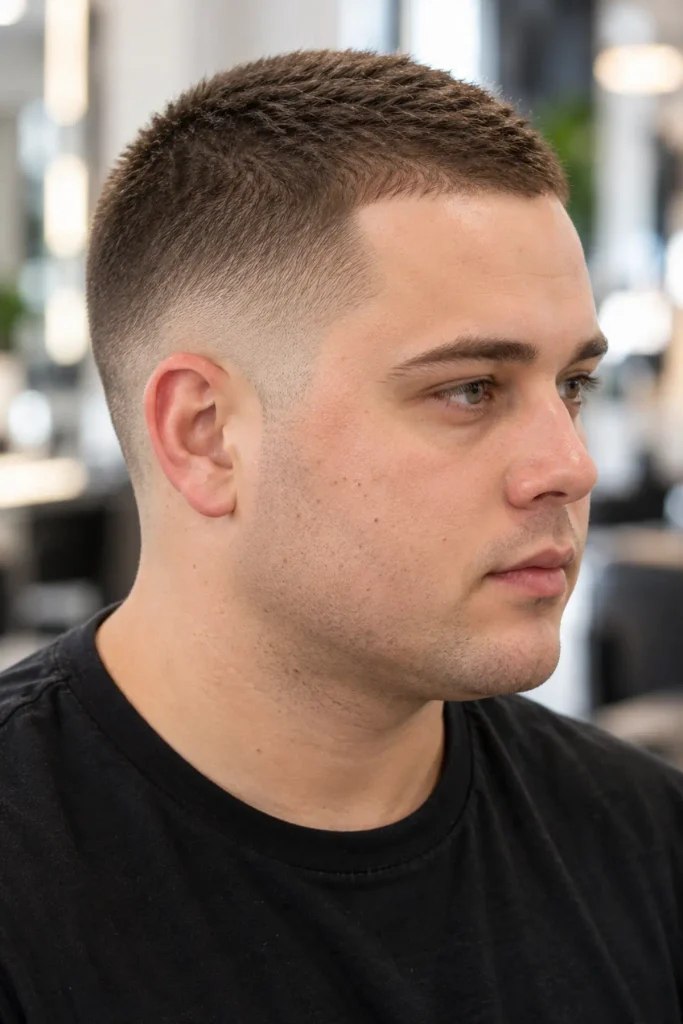
The fade begins near the ears and blends down to a shorter length. It looks modern while keeping most of the upper side hair.
Best for: men who want a contemporary shape with a soft look. Ask for: “A #3 on top with a low fade, no lineup at the front.” Upkeep: every 2 weeks. Watch out: fades lose their blend faster than an even buzz.
7. Buzz With a Mid Fade
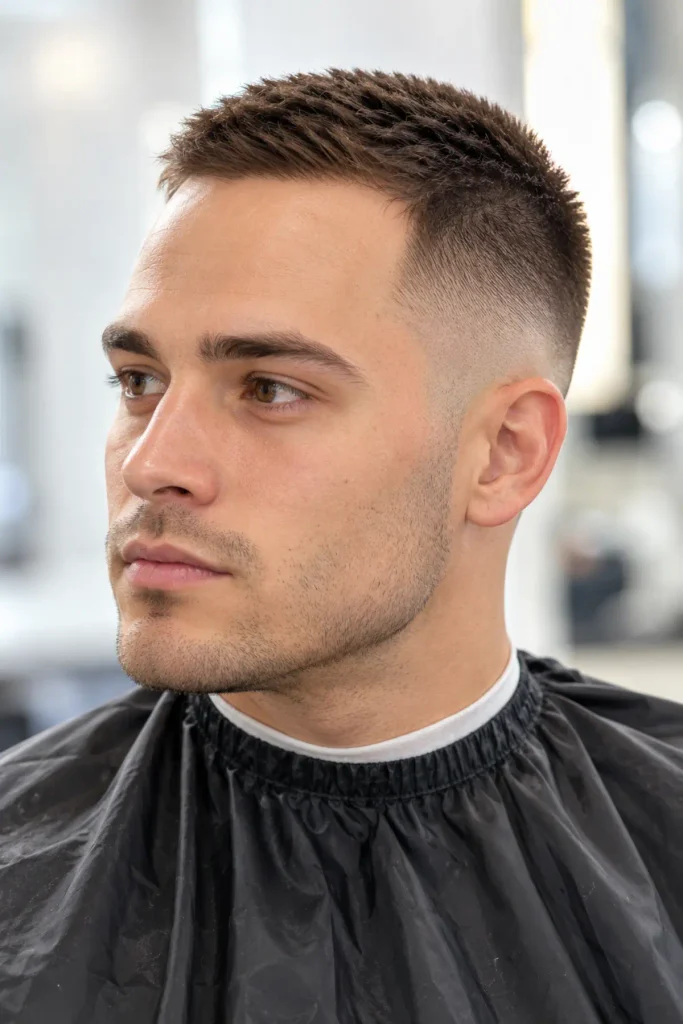
The fade starts around the middle of the sides, which adds contrast and pulls attention to the top of the head. Anyone who likes this shape can compare mid fade haircuts for men for more variations.
Best for: mild recession, dense hair, men who want extra edge. Ask for: “A #3 top with a mid fade, natural front edge.” Upkeep: every 2 weeks. Watch out: higher contrast can make a tall forehead read taller.
8. Buzz With a Low Skin Fade
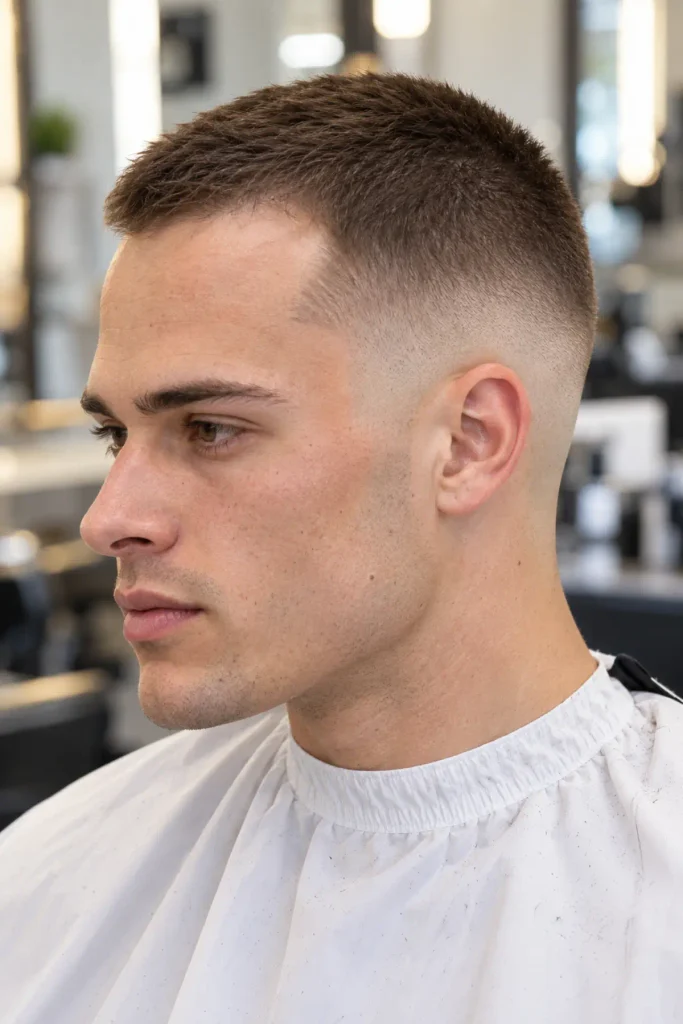
The bottom of the fade goes to skin, creating a crisp look at the neckline and around the ears while the top stays at a soft length.
Best for: men who like a sharp finish and have dense hair. Ask for: “A #3 top, low skin fade, and keep the hairline natural.” Upkeep: every 2 weeks. Watch out: the strong contrast needs frequent touch-ups.
9. Buzz With a Drop Fade
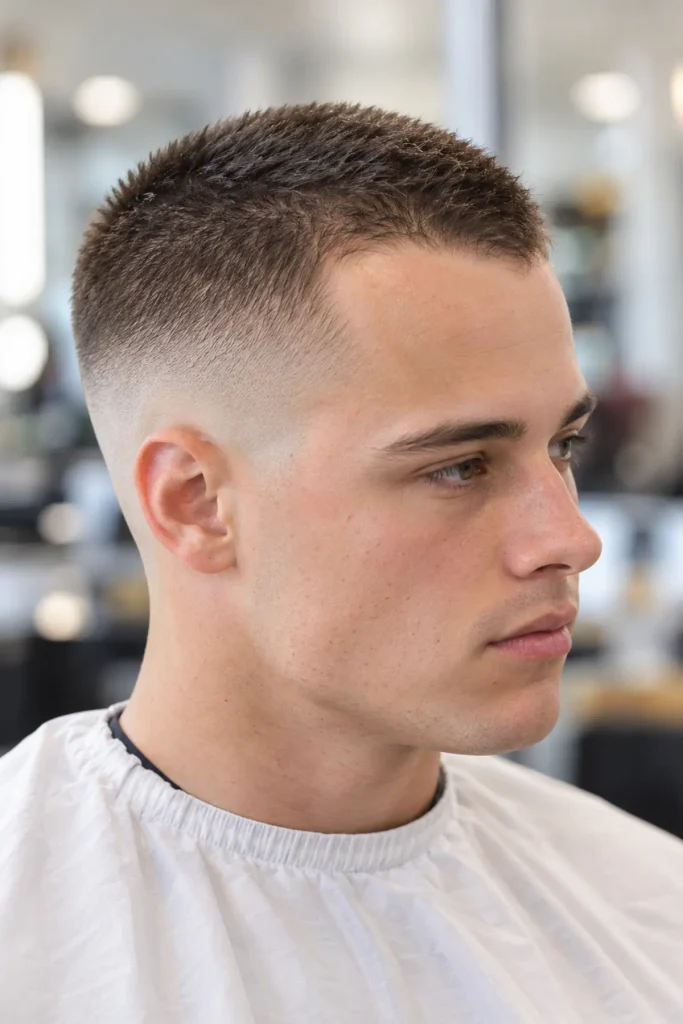
The fade curves down behind the ear instead of running straight across. The curve draws the eye around the ear instead of up the forehead.
Best for: men with a stable hairline who want shape without going high. Ask for: “A #3 on top with a drop fade, no aggressive lineup.” Upkeep: every 2 to 3 weeks. Watch out: the curve must be cut carefully to stay even.
10. Buzz With a Burst Fade
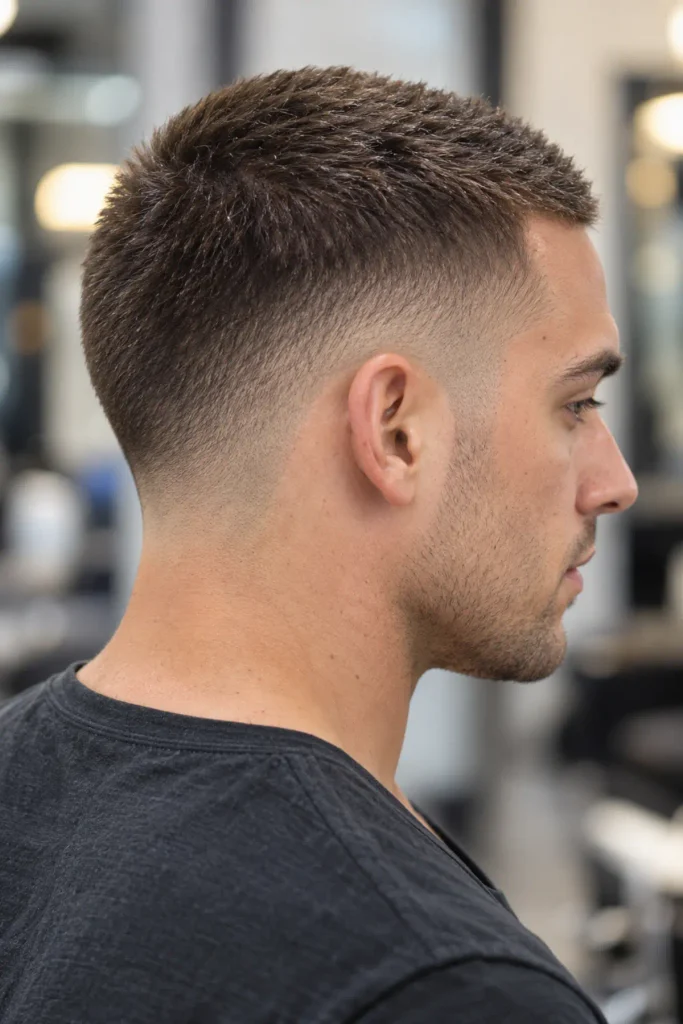
A burst fade curves around the ear in a semicircle and leaves length at the back. It adds interest at the sides and away from the forehead.
Best for: men who want a detail-rich look with a #3 or #4 top. Ask for: “A #4 on top with a burst fade around the ears.” Upkeep: every 2 weeks. Watch out: the shape blurs quickly as new hair grows.
11. High and Tight (Use With Care)
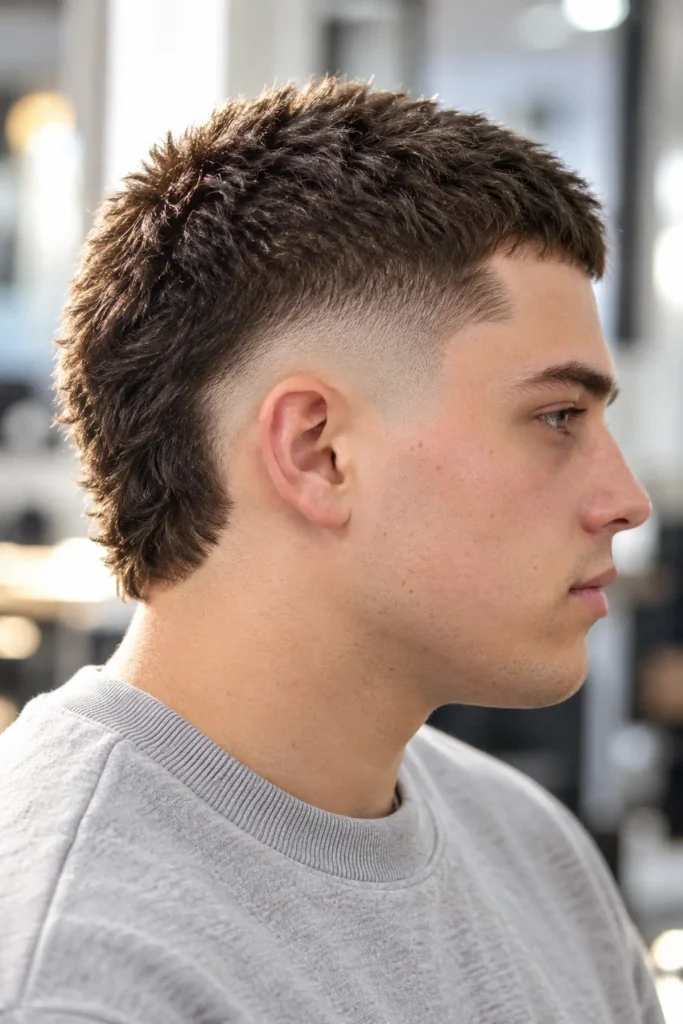
The sides go very short and high, with a short top. It looks sharp and military, though the strong contrast draws the eye upward.
Best for: men with a stable hairline, dense hair, and a short top of #2 to #3. Ask for: “A high fade with a #3 top and a natural front edge.” Upkeep: every 2 weeks. Watch out: it can accentuate a tall forehead or receding temples.
Hairline-focused buzz cuts
12. Buzz With a Natural Hairline
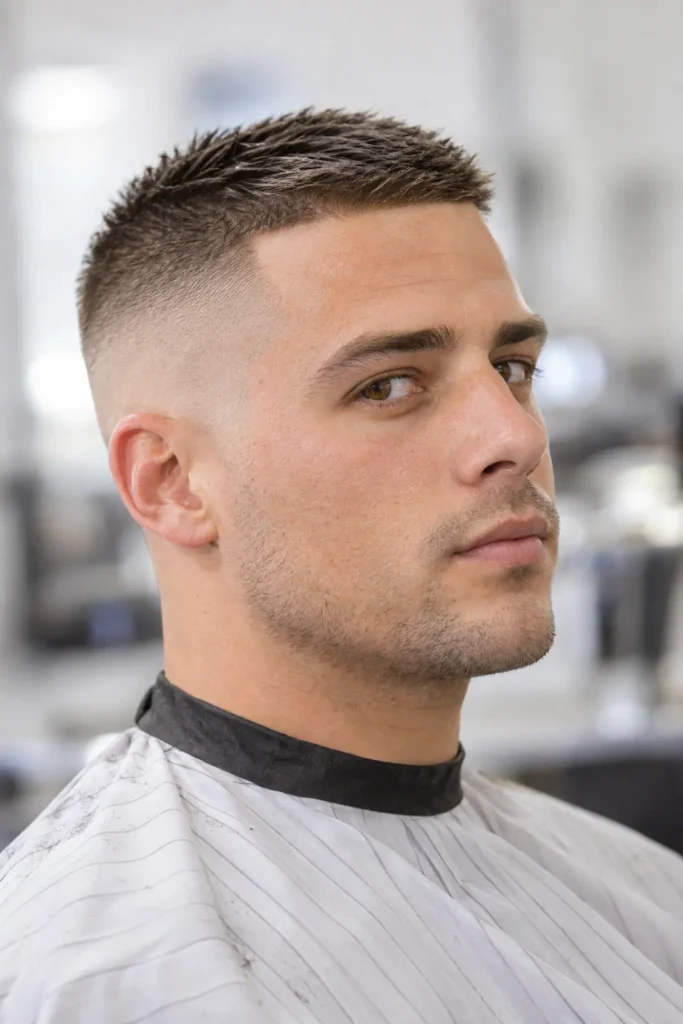
The barber removes stray hairs and leaves the front edge exactly where it grows. This version ages the best, since nothing is cut into healthy hair.
Best for: nearly every big forehead, especially maturing hairlines. Ask for: “Keep my natural hairline, just clean up the stray hairs.” Upkeep: every 2 to 3 weeks. Watch out: it looks less dramatic than a squared lineup.
13. Buzz With Light Temple Cleanup

Only the temples and the sideburn area get tidied, while the center of the hairline stays untouched. Corners look natural and soft.
Best for: men with mild temple recession. Ask for: “Clean up the temples lightly, leave the front hairline alone.” Upkeep: every 2 to 3 weeks. Watch out: over-trimming the temples pushes them back.
14. Buzz With a Soft Lineup
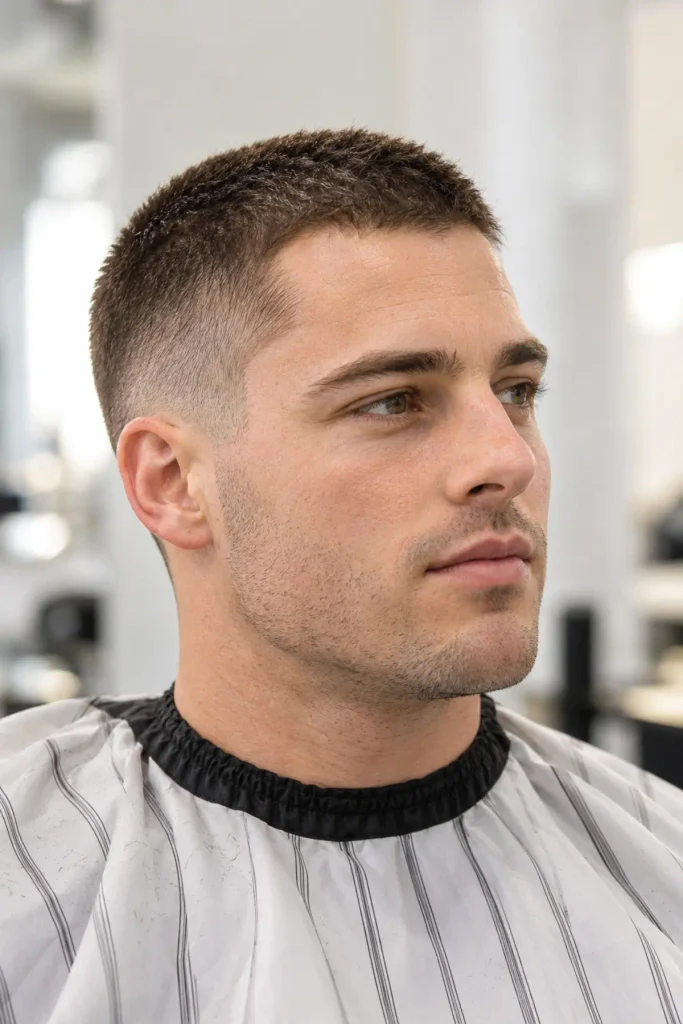
A small, rounded edge-up along the forehead and temples. The line starts at the center of the forehead and stays close to the natural boundary.
Best for: men with dense, healthy hairlines who still want some structure. Ask for: “A soft lineup with rounded corners. Show me the line before cutting.” Upkeep: every 2 weeks. Watch out: deep cuts into the hairline make the forehead look bigger over time.
15. Longer-Front Buzz
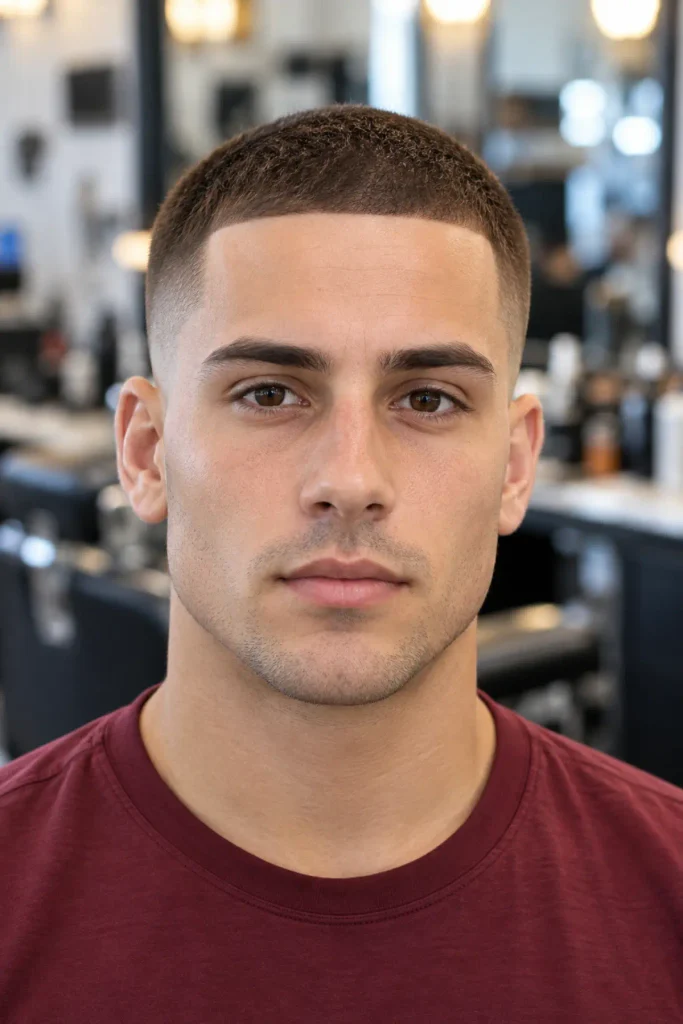
The front section stays one guard longer than the top and sides, for example a #4 in front and a #3 behind it. The extra length adds a tiny shadow across the front hairline.
Best for: men who want softness without a visible fringe. Ask for: “A #4 at the front hairline, blend back to a #3, low taper.” Upkeep: every 2 to 3 weeks. Watch out: the blend must be smooth or it will look uneven.
Crew cut and longer buzz styles
16. Classic Crew Cut

A crew cut keeps the top around a #4 while the sides and back are tapered short, often at a #1. The contrast frames the jaw and keeps forehead attention modest.
Best for: oval, square, and diamond faces, and all hair textures. Ask for: “A #4 on top, #1 on the sides and back, tapered neckline.” Upkeep: every 3 to 4 weeks. Watch out: the top needs enough density to look neat.
17. Forward-Brushed Textured Crew
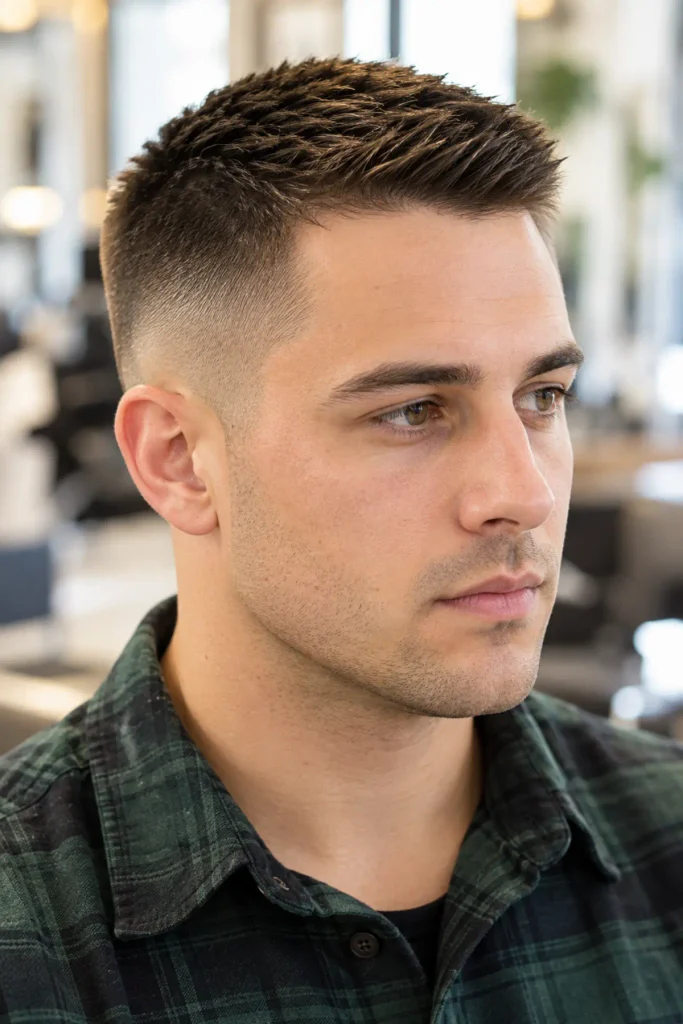
The top stays about an inch long and is brushed forward with a little matte paste, creating a faint fringe that covers the front of the forehead.
Best for: men with medium to thick hair who want a hint of coverage. Ask for: “A crew cut, about an inch on top, point cut for texture, styled forward.” Upkeep: every 3 to 4 weeks. Watch out: it needs a few minutes of styling.
18. Long Buzz (#5 to #6)
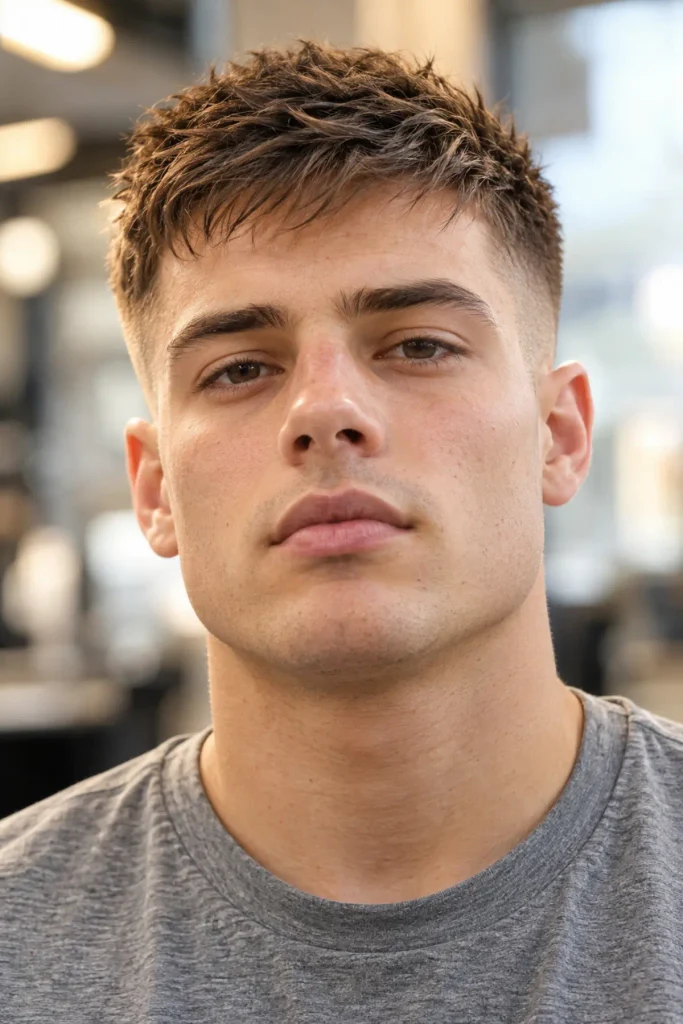
A longer buzz with 5/8 to 3/4 inch of hair. It looks soft, works with light styling, and keeps things simple.
Best for: oval and oblong faces, and men who fear going too short. Ask for: “A #5 all over with a low taper.” Upkeep: every 3 to 4 weeks. Watch out: it can look shapeless without a clean neckline.
19. Brush Cut

About 1/2 to 1 inch on top with tapered sides. It usually stands upright, but on a big forehead it reads better brushed slightly forward instead of up.
Best for: thicker hair with a wiry texture. Ask for: “A brush cut, brushed forward, short tapered sides.” Upkeep: every 3 weeks. Watch out: upright styling adds height and can lengthen the face.
20. Ivy League Crew
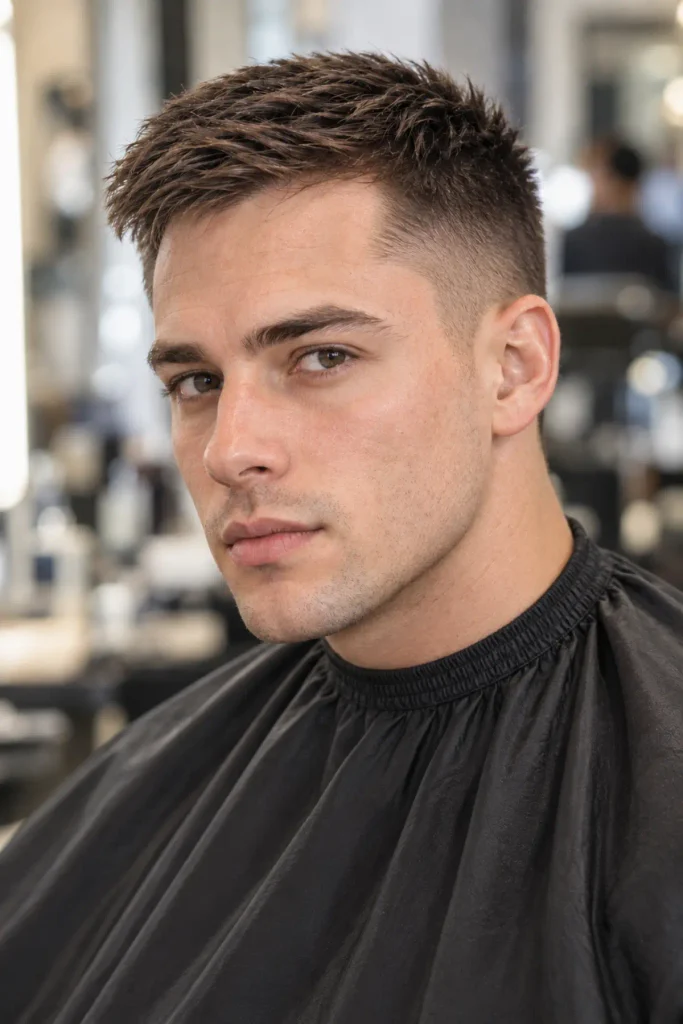
A crew cut with a longer front swept to the side. It brings a classic, professional feel and covers part of the forehead.
Best for: office-friendly looks and thicker hair. Ask for: “An Ivy League cut, short tapered sides, front left long enough to sweep.” Upkeep: every 3 to 4 weeks. Watch out: it needs a comb and a small amount of styling product.
Buzz cuts with facial hair
21. Buzz Cut Fade With a Full Beard
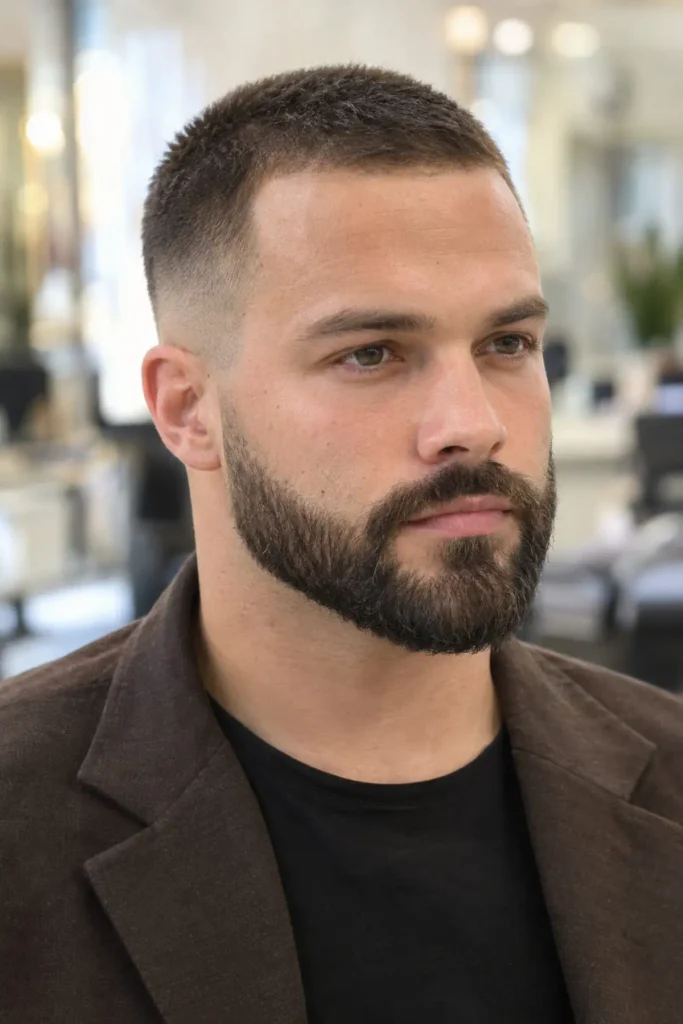
A full beard shifts visual weight down the face and away from the forehead, which is why it is such a reliable pairing. A well-shaped beard on a #2 or #3 buzz creates balance almost instantly. The full buzz cut fade with a beard guide shows more ways to blend the two.
Best for: men who can grow a full beard and want a rugged, balanced look. Ask for: “A #3 buzz with a low fade, and blend the beard into the sideburns.” Upkeep: head every 2 weeks, beard trimmed weekly. Watch out: patchy beards can look uneven against a clean buzz.
22. Buzz With Heavy Stubble

A few days of growth adds enough weight to the lower face to balance a tall forehead, and it needs far less upkeep than a full beard.
Best for: men with light to medium beard growth. Ask for: “A #3 buzz with a taper, and I am keeping the stubble.” Upkeep: head every 2 to 3 weeks, stubble trimmed every few days. Watch out: stubble that varies in length looks messy.
Texture-specific buzz cuts
23. Wavy Hair #3 Buzz With Texture
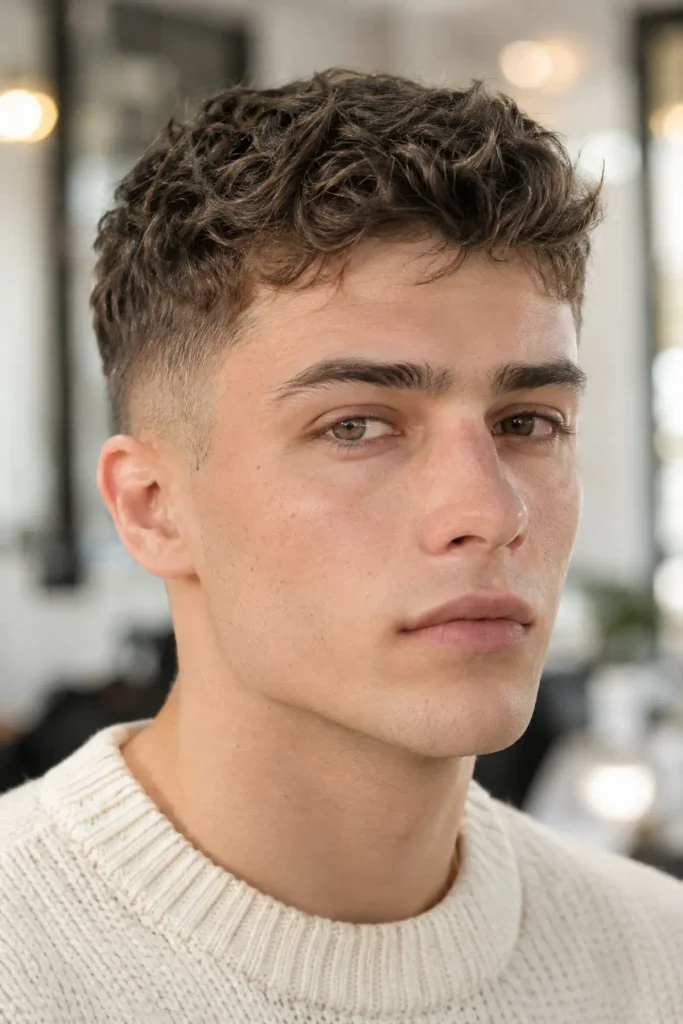
Wavy hair can flatten when buzzed too short, so #3 or longer keeps a little natural movement and shadow along the front.
Best for: wavy hair of any density. Ask for: “A #3 on top with a low taper, keep the natural texture.” Upkeep: every 2 to 3 weeks. Watch out: going shorter than #3 removes the wave pattern.
24. Curly Top Buzz With Taper
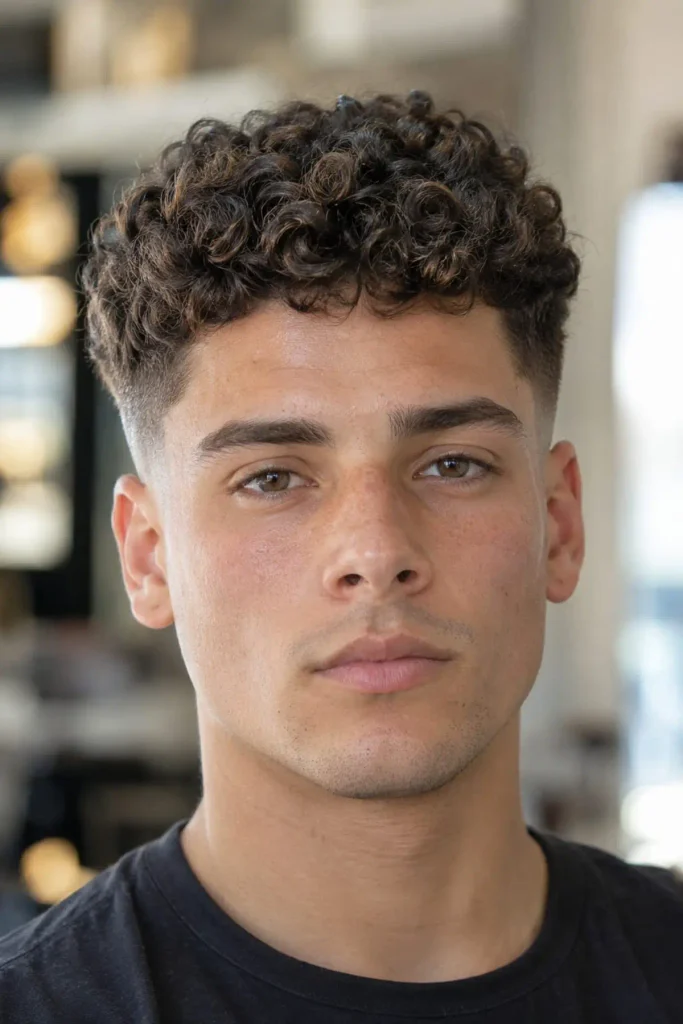
Curly hair tightens once length is cut, so a #4 to #5 on top often looks closer to what is expected. A low taper keeps the sides clean while the curls hold their shape.
Best for: curly hair with medium to high density. Ask for: “A #4 on top, low taper, and account for the curl shrinking.” Upkeep: every 3 weeks. Watch out: guard sizes look shorter on curly hair.
25. Coily Hair Buzz With Taper and Natural Edge
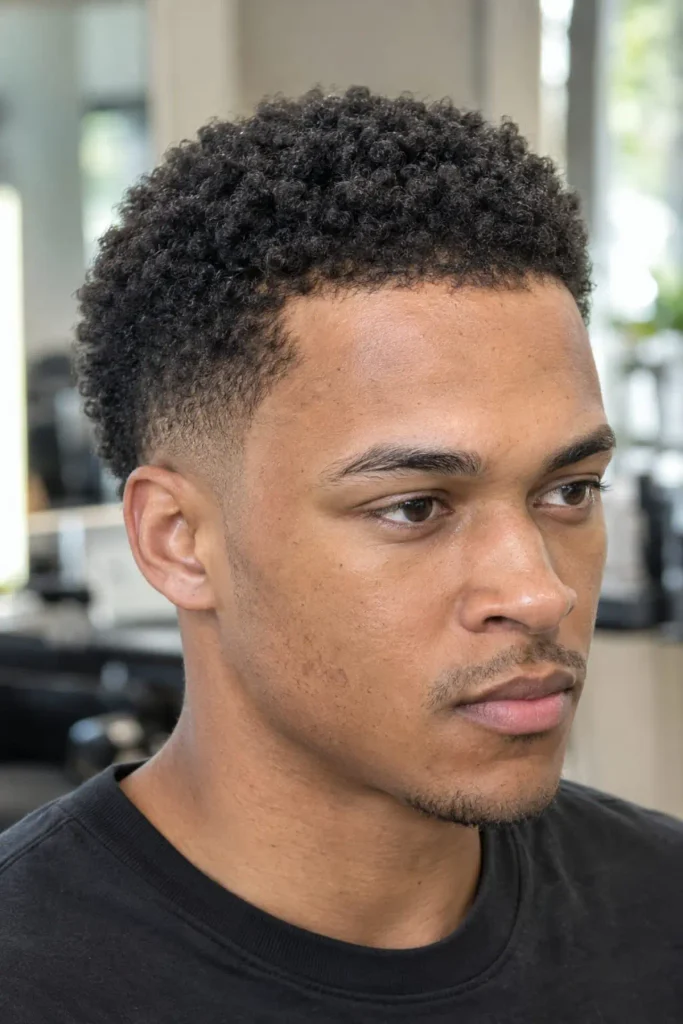
Coily hair often looks fuller and denser when buzzed, since the coils compress. A low taper and a natural edge keep the shape clean without overexposing the forehead.
Best for: coily hair, especially with a stable hairline. Ask for: “A #3 or #4 on top, low taper, natural hairline, and moisturize the scalp.” Upkeep: every 2 to 3 weeks. Watch out: a dry scalp shows flaking more on short hair.
Does a Buzz Cut Work With a Big Forehead?
Usually, yes, with the right setup. The main idea behind it is contrast. Longer hair with a fringe or a part draws a clear line between hair and skin, and that line shows exactly where the forehead begins and how tall it is. A short, even buzz blurs the line, so the eye reads the head as one continuous shape instead of a hairline plus a large open space. Barbers have leaned on this logic for years, especially for men with receding temples.
Not every stylist agrees, and the disagreement is worth knowing about. Some argue that a buzz cut removes fringe coverage and leaves the full forehead on display, so they pair it with a beard. Both views hold up in different situations. These are barbering rules of thumb rather than lab-tested laws, which is why a trial run at a longer guard is the safest way to see how a particular head responds.
When a buzz cut tends to work best
- The hairline is fairly even and hair is dense enough to look full at #3 or #4.
- The edges stay soft, with a natural hairline instead of a hard geometric line.
- The sides keep some weight, usually through a low taper instead of a high skin fade.
- A beard or stubble balances the lower half of the face.
When a buzz cut can backfire
- A very high skin fade plus a razor-sharp lineup frames the forehead like a picture frame.
- Dark, thick hair on light skin creates heavy contrast at the hairline.
- Hair loss leaves patchy density, so a buzz looks uneven instead of clean.
- The scalp has flat spots or bumps that a very short cut exposes.
How to Tell if a Forehead Is Really “Big”
Forehead size is judged by proportion more than by centimeters. Facial analysis splits the face into thirds: hairline to brow, brow to the base of the nose, and base of the nose to the chin. A forehead reads as tall when the top third is clearly larger than the other two. Two quick checks help. The four-finger test says that more than four fingers stacked between the brows and hairline suggests a taller-than-average forehead, though it is only a rough shortcut. A commonly cited range for adult men is about 7 to 8 centimeters (roughly 2.75 to 3.15 inches) from brow to hairline, and that number shifts with face length.
One more question matters even more: has the hairline always sat there, or is it moving? A stable high hairline is simply a variation. A hairline that keeps climbing points to recession. Two photos taken a year apart in the same lighting answer the question quickly, and a dermatologist can confirm it if the change looks fast.
Tall, wide, or receding: three different situations
- Tall forehead: the top third is long. A slightly longer top (#3 to #4) and a low taper keep the head from looking stretched.
- Wide forehead: the temples sit far apart. Keeping some hair weight at the temples and adding stubble or a beard balances the width.
- Receding hairline: the frontal hairline is moving back. Shorter guards (#1 to #3) and softer edges usually look cleanest.
Common hairline shapes
- Straight or rounded: the easiest to buzz, since almost any guard works.
- M-shaped: the temples sit higher than the center. Short, even lengths keep the shape from looking sparse.
- Widow’s peak: a point at the center. A natural finish looks best, and a hard lineup can exaggerate it.
- Uneven or asymmetric: one side sits higher. Barbers usually clean up gently instead of forcing symmetry.
Buzz Cut Guard Sizes for a Big Forehead
Clipper guards are numbered in eighths of an inch, so a #3 leaves 3/8 inch of hair. The number describes the hair that stays on the head, not the hair that comes off. Wahl, Andis, and BaByliss PRO follow that eighths convention, while Oster numbering works differently, and cheap unbranded sets can vary by a millimeter or two. The official Wahl guide combs chart is a handy reference for standard sizes.
| Guard | Hair left | Approx. mm | Look | Big forehead notes |
|---|---|---|---|---|
| #1 | 1/8 inch | 3 mm | Very short, scalp shows | Works for thin or receding hair, exposes everything |
| #2 | 1/4 inch | 6 mm | Short with a light shadow | Good for fine or thinning hair and strong head shapes |
| #3 | 3/8 inch | 10 mm | Balanced, visible texture | The middle ground for most big foreheads |
| #4 | 1/2 inch | 13 mm | Fuller, softer | The safest first try |
| #5 | 5/8 inch | 16 mm | Long buzz | Adds softness and a hint of styling room |
| #6 | 3/4 inch | 19 mm | Very long buzz | Bridges into crew cut territory |
| #8 | 1 inch | 25 mm | Short crew length | Allows a forward brushed front |
Across barber and clinic guides, the recommended zone for a big forehead lands between #2 and #4, with #3 as the center. That is a useful rule: go a guard longer for softness and dense coverage, and a guard shorter for thin or receding hair.
Why #3 to #4 is the safest start
At 3/8 to 1/2 inch, the hair casts enough shadow around the temples to soften the transition, yet it is short enough to keep the clean buzz look. It also leaves room to go shorter at the next visit, while going longer is impossible once the hair is on the floor.
When #1 to #2 helps
Thin, fine, or receding hair tends to look more even at #1 to #2, because the gap in density becomes harder to see. The trade-off is exposure: shorter guards show every bump and flat spot on the scalp.
When #5 to #6 makes sense
A long buzz keeps a bit of softness across the front and works well for men who are nervous about going very short. It also makes a natural bridge toward a crew cut.
Even Buzz, Taper, or Fade? Choosing the Sides
- Even buzz: the same length everywhere. Simple, easy to maintain, and forgiving.
- Taper: a gentle step down at the sideburns and neckline only. It keeps weight around the temples, which suits a big forehead.
- Low fade: starts near the ears and blends down. More visible than a taper but still keeps upper side weight.
Mid fade: starts around the middle of the sides and creates stronger contrast. Anyone curious about the technique can explore mid fade haircuts for men before choosing this version.
- High fade: starts near the temples. Bold and clean, but it removes side hair high up and can make the head look taller.
- Skin fade: the bottom goes all the way to skin. Sharp and modern, and it needs touch-ups about every two weeks.
Sources disagree on high fades. Some barbers say a high fade absorbs mild temple recession, while others warn that it draws the eye upward and spotlights the recession. The practical takeaway is simple: a stable, tall hairline usually looks best with a low taper, mild recession with dense hair can handle a low to mid fade, and a high fade deserves a conversation with the barber first.
Lineup or Natural Hairline?
A lineup, also called an edge-up or shape-up, uses a trimmer to sharpen the front hairline and temples. It gives a buzz cut a crisp finish, yet on a big forehead it carries a real risk. Chasing perfectly square corners can mean cutting into healthy hair or pushing the front edge farther back, and the new line becomes obvious as the hair grows in. One licensed barber quoted by Barber’s Take says he would rather strengthen the natural hairline than move it, because regrowth exposes an artificial line quickly.
A safer plan has three parts. First, ask for a natural hairline with stray hairs removed. Second, keep the corners slightly rounded instead of square. Third, ask the barber to show the intended line before the trimmer touches the forehead. Some barbers also work the very front with the direction of hair growth to keep a touch more softness there, while cutting the rest of the head against the grain for an even finish. That technique is worth asking about.
Best Buzz Cut by Face Shape
Face shape changes how the guard and fade should be chosen, because the forehead is only one piece of the overall proportion.
| Face shape | Best buzz approach | Watch out for |
|---|---|---|
| Oval | Almost any guard, low taper or mid fade | Very little, the most flexible shape |
| Round | #3 top with a mid taper to add vertical lines | Very short sides with a thin top |
| Square | #2 to #3 with an even buzz or low taper | Long buzz that softens a strong jaw |
| Oblong (long) | #3 to #4 with a low taper for side weight | High fades and #1 lengths that stretch the face |
| Heart (wide forehead, narrow chin) | #3 to #4 with stubble or a short beard | #1 tops with a high skin fade |
| Diamond | #3 to #4 with a beard to add jaw weight | Extra-short cuts that make cheekbones look wide |
| Triangle | Slightly longer top (#3 to #4) with soft sides | Tight sides that narrow the upper head |
Men with a wider jaw and narrower upper face may also find useful ideas in this collection of hairstyles for a triangle face shape, especially when deciding how much length to leave on top.
Best Buzz Cut by Hair Type, Density, and Color
| Hair situation | Best approach | Why it helps |
|---|---|---|
| Fine, straight hair | #2 to #3, even buzz | Short, uniform length hides low density better than a long buzz |
| Thick, straight hair | #3 to #4, low taper | Holds shape and looks full, softens the hairline |
| Wavy hair | #3 or longer | Keeps some wave and avoids a flat look |
| Curly hair | #4 to #5 on top | Curls tighten after cutting, so length reads shorter |
| Coily hair | #3 to #4, natural edge | Coils compress and look fuller and denser |
| Dark hair, light skin | Go one guard longer | Reduces sharp contrast at the hairline |
| Gray, light, or blond hair | #2 to #3 works well | Blends softly with the scalp |
Big Forehead With Thinning or Receding Hair
Hair loss changes the picture, and it is very common. According to American Hair Loss Association figures shared by the Skin Cancer Foundation, about two thirds of men have noticeable thinning by 35 and about 85 percent by 50. The Hamilton Norwood scale describes seven stages of male pattern hair loss, and stage 2, often called a mature hairline, is generally viewed as normal adult recession. Stage 3 is the first stage counted as balding, with deeper temple recession forming an M, U, or V shape.
- Mature hairline (stage 2): #2 to #3 with soft corners and a low taper usually looks natural.
- Deeper M shape (stage 3): #1 to #2 keeps the density gap less obvious, with no sharp lineup.
- Advanced recession or thin crown: a fully shaved head often looks cleaner than a patchy buzz, and many men move down the guard sizes gradually to make the change feel natural.
A steady hairline is a variation, while a moving hairline deserves medical attention. A dermatologist can explain options, and a barber can adjust the buzz alongside any treatment plan.
Buzz Cut Advice by Age
- Twenties: a naturally high hairline often looks great at #3 to #4 with a low taper, and it is the easiest time to experiment.
- Thirties and forties: maturing temples are common, so soft corners, #2 to #3, and light stubble tend to look best.
- Fifties and beyond: hair density and color change, so gray hair blends nicely at #2 to #3, and shaving becomes a clean option if recession is deep.
Beard, Eyebrows, and Glasses: Balancing the Face
A buzz cut puts the whole face in the spotlight, so supporting details matter. Facial hair adds weight to the lower face, and even a few days of stubble makes a difference. Neat eyebrows help define the upper face and add symmetry. Glasses with a stronger frame line can draw attention to the eyes. Before committing to a very short cut, the barber can also feel the head for flat spots, bumps, or an asymmetric crown, since a shorter buzz shows every one of them.
What to Tell the Barber
A buzz cut leaves little room for error, so clear instructions matter. Every request comes down to three specs: the top length in a guard number, the side treatment, and the hairline finish.
Scripts for five common situations
- Tall forehead, stable hairline: “A #3 on top, low taper, natural hairline.”
- Thin or fine hair: “A #2 all over, keep the corners soft, no sharp lineup.”
- Mild temple recession: “A #3 top with a low fade, and just clean up the temples.”
- First buzz cut: “Start at a #4 so I can go shorter next time.”
- Wants a hint of fringe: “A crew cut, #4 top, forward-brushed, tapered sides.”
Picking a reference photo
A reference photo works best when the model has a similar hairline, hair density, and face shape. A clean buzz on a thick, straight hairline will not translate the same way to a receding one. Showing the photo and asking what should change to fit the head is a smart move.
What not to say
“Just make it look good” is too vague. “Cover my forehead” does not fit a buzz cut. Guard numbers, fade height, and the hairline finish give the barber exactly what is needed.
Buzz Cut Maintenance and Scalp Care
Scalp hair grows about half an inch per month on average, according to the U.S. National Library of Medicine’s MedlinePlus. That means a #3 (3/8 inch) becomes roughly a #7 (7/8 inch) after a month. On a big forehead, the growth line at the front is what makes a buzz look sloppy, so regular touch-ups matter.
| Style | Typical touch-up | Note |
|---|---|---|
| #1 to #2 buzz | Every 1 to 2 weeks | Growth shows fast at short lengths |
| #3 to #4 buzz | Every 2 to 3 weeks | The most forgiving schedule |
| Any fade or skin fade | About every 2 weeks | Blends soften quickly |
| Crew cut or long buzz | Every 3 to 4 weeks | Length hides regrowth longer |
A buzzed scalp shows more skin, so sun care becomes part of the routine. Dermatology guidance recommends broad-spectrum, water-resistant sunscreen of SPF 30 or higher on exposed skin, applied about 15 minutes before going out and reapplied every two hours. Coverage should include the hairline, forehead edge, ears, and neck. The Skin Cancer Foundation’s scalp guide explains why the scalp is easy to overlook, and a hat adds extra protection on long days outdoors.
Other habits keep short hair looking tidy. A lightweight moisturizer prevents visible dryness, a gentle scrub or soft brush once a week helps prevent ingrown hairs, and lukewarm water is kinder to the scalp than hot water.
Common Mistakes to Avoid
- Going too short on the first try instead of starting at #4.
- Asking for a razor-sharp lineup on a tall forehead.
- Choosing a very high skin fade without discussing hairline stage.
- Ignoring hair color contrast against the skin.
- Skipping sunscreen on the newly exposed scalp.
- Comparing guard numbers between brands without checking the actual length.
- Copying a photo of a model with a different hairline or density.
- Waiting too long between touch-ups, so the shape blurs and the forehead stands out again.
A Safe Test Plan for a First Buzz Cut
- Start at #4. It shows how the hairline and head shape respond.
- Live with it for two weeks. Photos in normal lighting reveal more than a mirror.
- Step down to #3. If the look works, keep the taper and natural hairline.
- Try #2 last. Only go shorter when the shape, contrast, and scalp all look good.
If a Buzz Cut Is Not the Right Fit
Some men try the test plan and decide they prefer more coverage. Several short and medium styles keep forehead attention down, though density matters: the Caesar cut, for example, needs thick hair to look right.
| Alternative | Coverage | Best for |
|---|---|---|
| Crew cut | Low to medium | A hint of length with easy upkeep |
| Ivy League | Medium | Professional settings and thicker hair |
| French crop | High | Textured hair and a strong forward fringe |
| Caesar cut | High | Thick hair without deep recession |
| Textured crop | High | Fine to medium hair with movement |
Men who want more length can look at medium length haircuts for men, where a fringe or side sweep provides natural coverage.
Layered cuts add movement and can soften the front hairline, so long layered hair for men is another route for anyone letting the buzz grow out.
A modern shag with a short fringe is another option, and the wolf cut for men brings volume and texture around the face.
One thing to avoid while growing out: tight styles that pull all the hair back. A tight man bun and other slicked-back looks expose the full forehead, so they work best once hair is long enough to leave a loose fringe.
How a Buzz Cut Grows Out
At half an inch per month, a #3 buzz reaches about 1.5 inches in three months. Most men can style a crew cut after two to three months and a textured crop after three to four. The awkward middle stage is the hardest, so visits every three to four weeks help the barber shape the grow-out. A slightly longer front can be guided forward into a fringe while the sides stay tapered.
FAQs
Does a buzz cut make a big forehead look bigger?
Not usually. A short, even buzz reduces the contrast between hair and forehead, so the hairline stands out less. It can backfire when a very high skin fade and a sharp lineup frame the forehead. A #3 or #4 on top with a low taper and a natural hairline is the safest setup.
What is the best guard for a buzz cut with a big forehead?
Most barbers land between a #2 and a #4, with #3 (3/8 inch) as the middle ground. A #4 (1/2 inch) is the safest first try, and a #2 (1/4 inch) suits thinner or receding hair. Starting longer is smart, because hair can always be cut shorter later.
Should a man with a big forehead get a fade or a taper?
A low taper is the usual starting point because it keeps hair around the temples and sides. A low or mid fade can also work, especially with dense hair. A very high fade removes side weight and can make the forehead look taller, so it needs a barber’s judgment.
Should a buzz cut have a lineup with a big forehead?
A light cleanup is fine, but a deep or perfectly square lineup can push the hairline back and make the forehead look bigger as the hair grows in. Many barbers prefer to keep the natural hairline, remove stray hairs, and soften the temple corners instead.
Is a buzz cut good for a receding hairline and a big forehead?
Often yes. Short, even hair makes thinning at the temples less noticeable, and #1 to #2 is a commonly suggested range for thinner hair. When recession is deep or density is patchy, a fully shaved head can look cleaner and more intentional than a buzz.
What is considered a big forehead for a man?
Forehead size is judged by proportion. A forehead looks tall when the top third of the face, from hairline to brow, is clearly larger than the middle and lower thirds. A commonly cited range is about 7 to 8 cm above the brows, but face length changes how it reads.
Does a beard help balance a big forehead with a buzz cut?
Yes. A beard or a few days of stubble adds visual weight to the lower face, which shifts attention away from the forehead. A short, well-kept beard paired with a #2 to #4 buzz is one of the most reliable combinations for a tall forehead.
Can a man with a widow’s peak or M-shaped hairline get a buzz cut?
Yes. Short hair usually softens both shapes. A widow’s peak looks best with a natural hairline and no aggressive lineup. A pronounced M shape often works better at #1 to #2, or shaved, because longer lengths highlight the gaps at the temples.
How often does a buzz cut need a touch-up?
Most buzz cuts look best with a touch-up every two to three weeks, and fades need one about every two weeks. Scalp hair grows roughly half an inch per month, so a #3 turns into about a #7 in a month.
What if a buzz cut looks bad on a big forehead?
It grows back. At about half an inch per month, a buzz reaches a styleable crew cut length in roughly two to three months and a textured crop in three to four. Barbers can shape the grow-out with regular visits so it looks intentional.
Does hair color or skin tone change how a buzz cut looks?
Yes. Dark hair on lighter skin creates strong contrast, so edges look sharper and the forehead can look larger. Light, gray, or blond hair on a light scalp blends more softly. Barbers often go a guard longer for contrast-heavy combinations.
Does a buzz cut need sunscreen?
Yes. A buzzed scalp shows more skin, so dermatology guidance applies: broad-spectrum SPF 30 or higher on exposed skin, applied about 15 minutes before going out and reapplied every two hours, with extra attention to the hairline, forehead edge, ears, and neck.
Final Thoughts
A big forehead does not rule out a buzz cut. The best results come from choosing the right length, keeping the sides soft with a low taper, protecting the natural hairline, and adjusting for hair density, color, and hairline stage. A #3 or #4 with a low taper is the friendliest starting point, and the barber can always go shorter at the next visit.
One thought on “Buzz Cut for a Big Forehead: 25 Styles, Guard Sizes and Barber Tips”