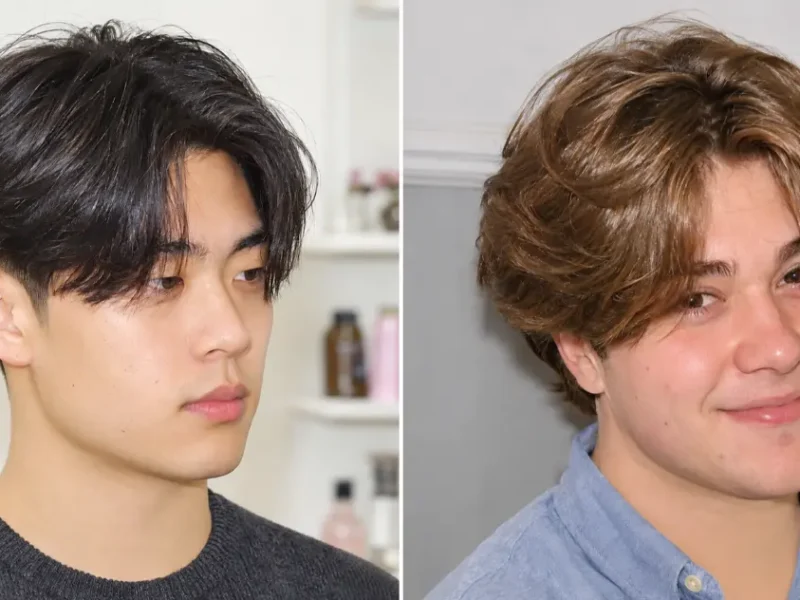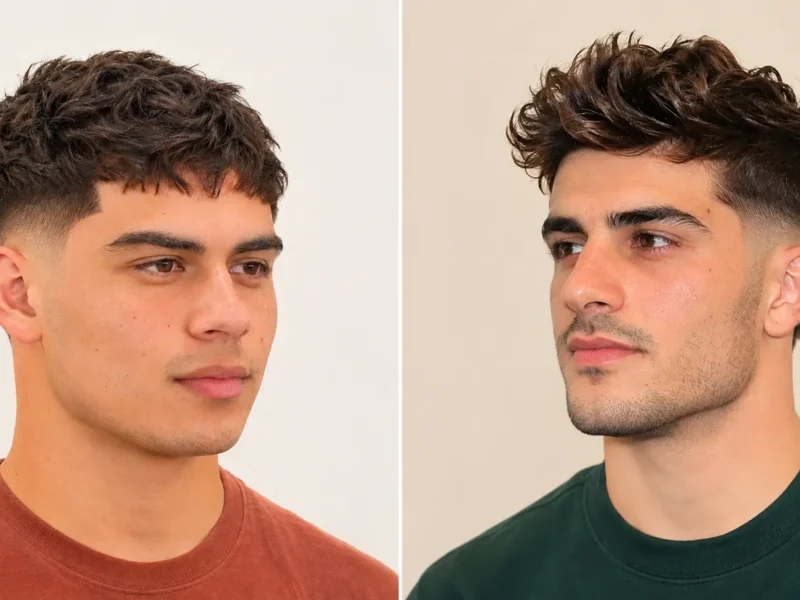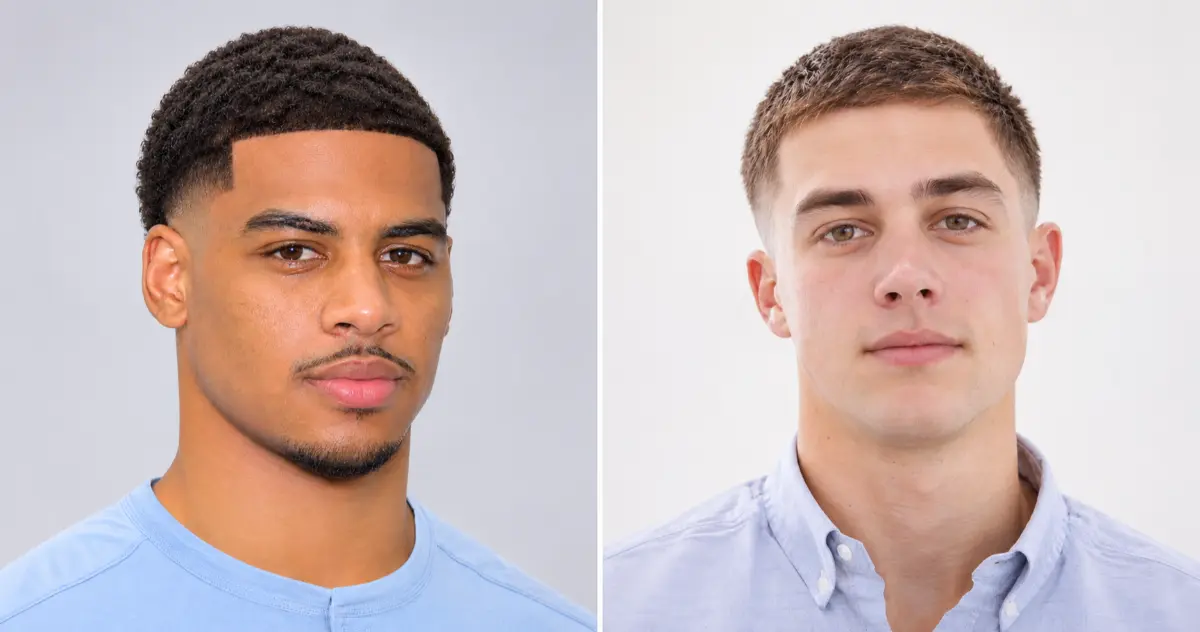
A burst fade buzz cut pairs a short, even buzz on top with a fade that curves in a half circle around each ear. The curve is what sets it apart from a regular fade, and most men keep it sharp with a barber visit every two to three weeks.
What to say in the chair: “Number 2 on top, mid burst fade, down to a 0.5 behind the ear, back matched to the top.” For most barbers, that covers it.
Plenty of guys bring a photo to the barber and still leave with something a little off. The photo shows the curve, but the barber needs three numbers: how short the top goes, how high the curve climbs, and how close the fade gets behind the ear. Once those are settled, a burst fade buzz cut is one of the easiest cuts to order and one of the easiest to live with.
This guide starts with 20 real-world versions, each with a line that can be read out loud in the chair. After that come face shape and hair type advice, a guard chart, upkeep, and what the cut costs. Anyone after a longer top can jump to the mid burst fade or low burst fade pages.
Table of Contents
Burst Fade Buzz Cut at a Glance
| Detail | What to Know |
|---|---|
| Best for | Men who want a short, sharp, low-effort cut with a little shape |
| Top length | #1 to #4 guard (1/8 inch to 1/2 inch) |
| Fade height | Low, mid, or high |
| Barber visits | Every 2 to 3 weeks, or every 1 to 2 weeks for a skin finish |
| Daily styling | Almost none |
| Typical US cost | About $30 to $65 per visit, plus a 15% to 20% tip |
What Is a Burst Fade Buzz Cut?
A burst fade curves around the ear and leaves length at the back, which is how the barbers interviewed by Modern Barber describe it. Picture a taper that wraps around the ear in a half circle instead of running straight down the side of the head, with the shortest hair sitting right behind the ear.
On a buzz cut, that curve has nothing to hide behind. The top is already short, so the fade shows up as a soft gradient on a clean surface, which looks great when it is done well and obvious when it is not. The same shape turns up under longer styles like the burst fade mullet, but the buzz is the simplest and lowest-maintenance way to wear it.
20 Burst Fade Buzz Cut Styles (With What to Tell Your Barber)
Each entry covers who the style suits, how much upkeep it asks for, and the line to say in the chair. Visit timing follows the usual pattern: every two to three weeks for a standard fade and every one to two weeks for a skin finish.
Core Builds
1. Low Burst Fade Buzz Cut (#2 on Top)
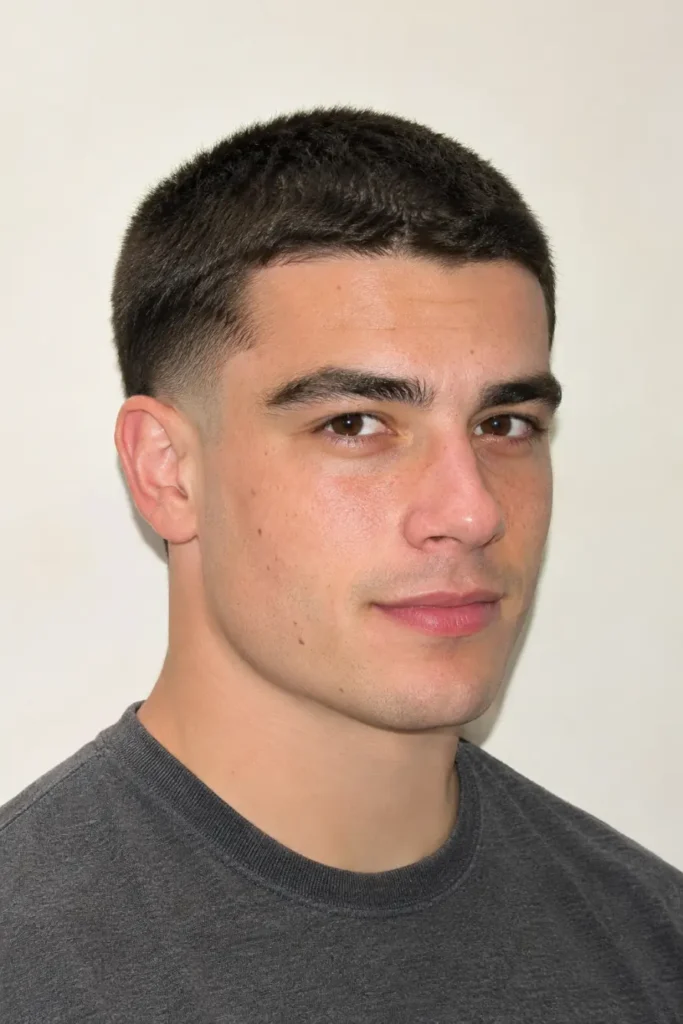
The low burst keeps the curve close to the ear and hairline, so the sides stay a little fuller than on any other height. That makes it the quiet option, the one that passes in a conservative office without a second look. It works on oval, square, and oblong faces, on any texture, and on average to thick hair.
In the chair: “Number 2 on top, low burst fade, stopping at a 1 guard behind the ear, natural neckline.” Expect a visit about every three weeks. The one catch is the extra width at the sides, so round faces usually look better a notch higher. It also grows out more gracefully than the other heights.
2. Mid Burst Fade Buzz Cut (#2 on Top)
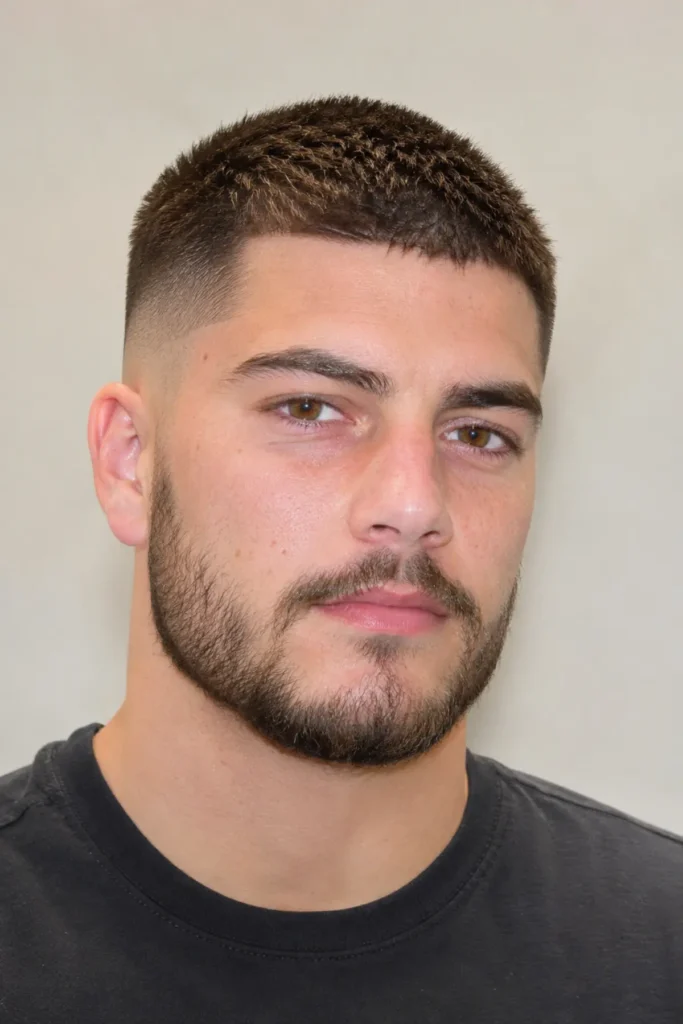
Mid is the height most guys ask for, and for good reason. The curve sits halfway up the side of the head, which is enough contrast to read as a burst without turning dramatic. It suits nearly every face and head shape, handles thin or thick hair, and looks right on straight, wavy, and curly textures alike.
The order: “Number 2 on top, mid burst fade, down to a 0.5 behind the ear.” Plan on two to three weeks between visits, since the curve starts to blur around week two. Anyone who wants a longer top with the same fade can see the mid burst fade haircut page.
3. High Burst Fade Buzz Cut (#1 or #2 on Top)
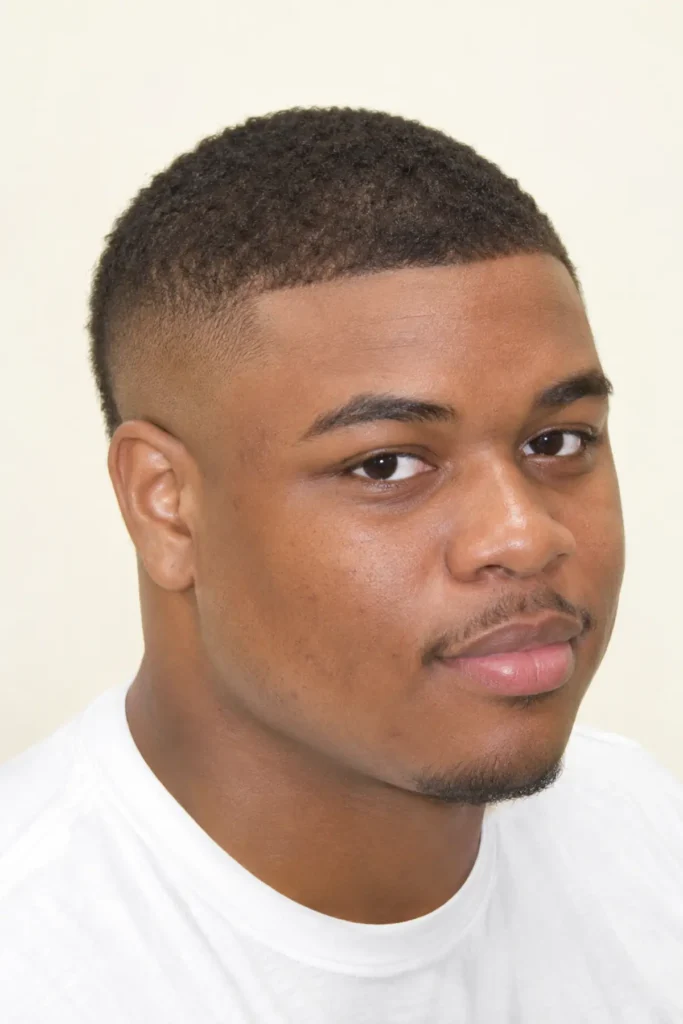
A high burst runs up toward the crown and gives the strongest contrast of the three heights. It slims round and wide faces and sharpens a strong jaw, and it looks best on thick, dark hair where the gradient really shows.
Say: “Number 1 on top, high burst fade, skin at the lowest point.” Book every one to two weeks, because regrowth shows fastest at this height. Guys with a tall forehead or an uneven skull should look at the shape in a mirror before committing, since a high burst exposes both.
4. Burst Skin Fade Buzz Cut
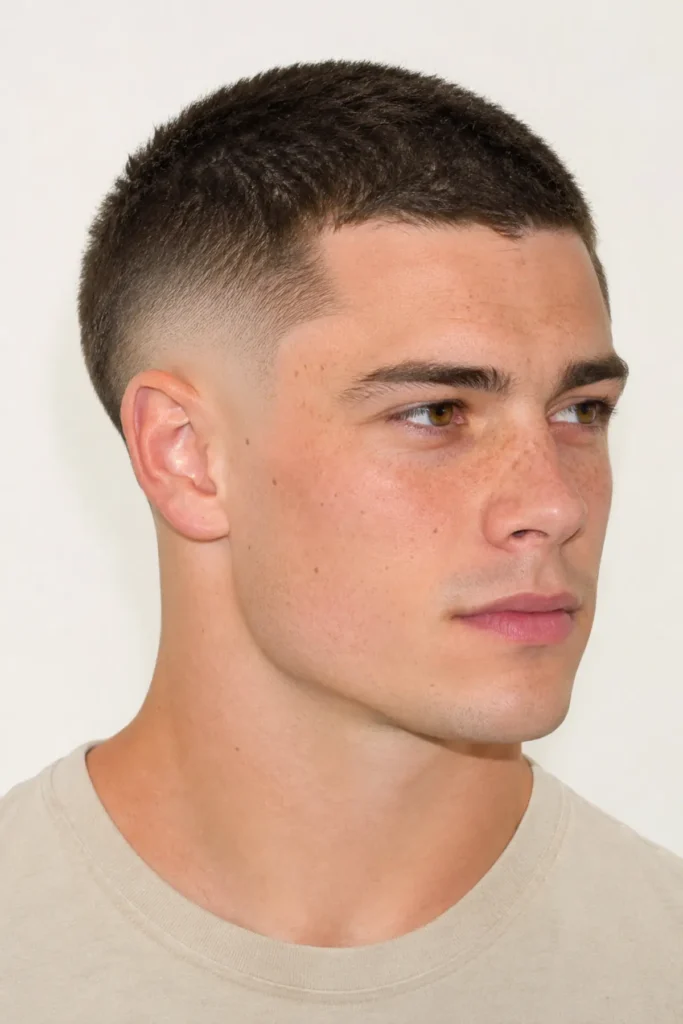
This version takes the shortest point behind the ear all the way down to bare skin. It is the cleanest and most dramatic take on the cut, and it gets a lot of love on dark and coily hair for its crisp edges. It suits dense hair and a healthy, even scalp.
Tell the barber: “Number 2 on top, mid burst skin fade, taken to skin behind the ear.” It needs a visit every one to two weeks. Skin that has spent years under hair can look paler than the face at first, and it burns easily, so sunscreen is part of the deal.
5. Burst Taper Buzz Cut (Guard Finish)

A burst taper keeps the curve around the ear but blends with a gentle taper instead of dropping to skin. It is the softest way to wear the shape, which makes it a smart first burst. It suits every face shape and tends to look polished without looking sharp.
In the chair: “Number 2 on top, burst taper, stopping at a number 1 behind the ear.” A visit every three to four weeks is usually enough. The tradeoff is less contrast, so the curve is subtler. It also grows out the neatest, because the gap between short and long stays small.
6. Drop-Style Burst Buzz Cut
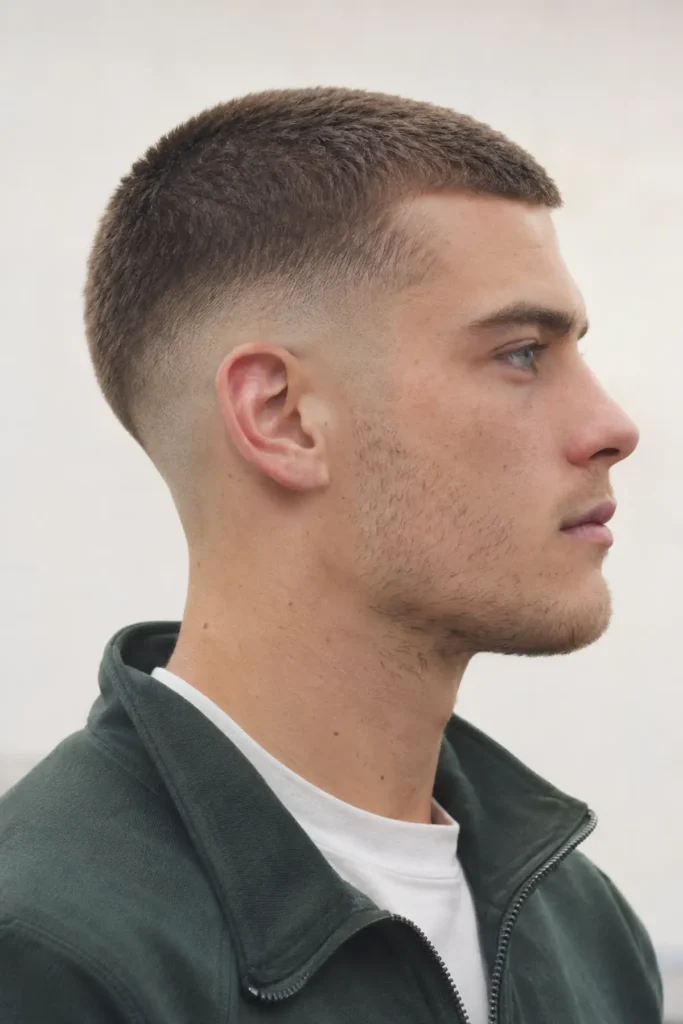
The drop-style version lets the fade dip lower behind the ear for a more angular line. It suits oval and longer faces, since the curve follows the skull instead of climbing high. It is easy to wear and easy to maintain.
The order: “Number 2 on top, drop burst fade, curving lower behind the ear.” Visit every two to three weeks. On a very round head the angular line can look harsh, and the lower curve shows nape regrowth sooner.
Top Length Variations
7. High and Tight Burst Buzz Cut (#1 on Top)
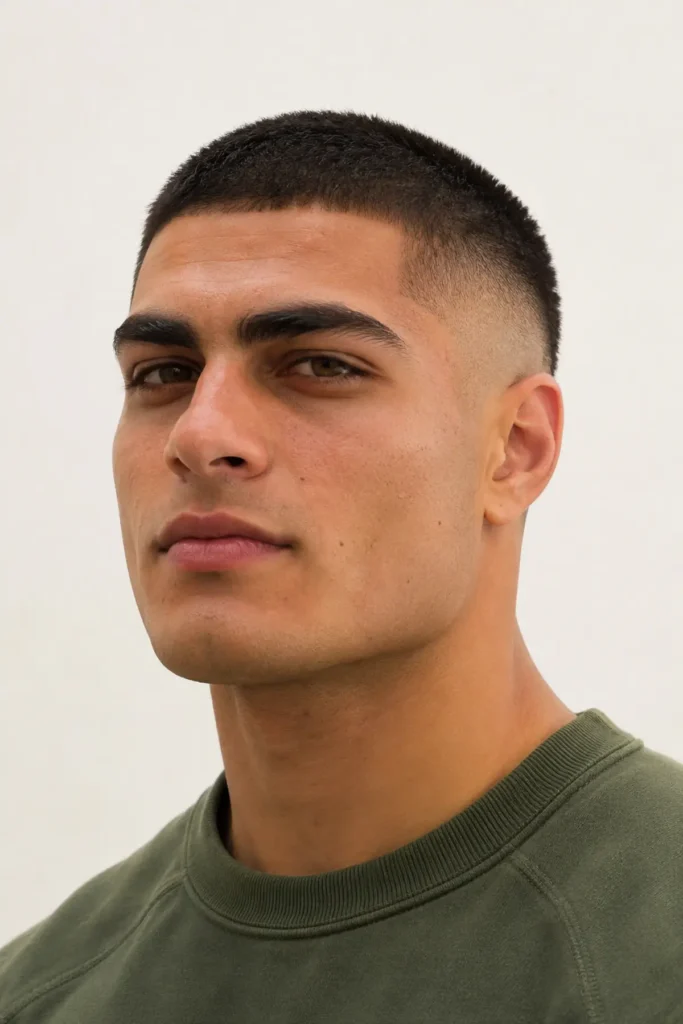
A #1 on top with a high burst gives the clean, athletic look that suits military and sports lifestyles. It works on square faces and strong jawlines, and thin hair often looks denser cut this short.
Say: “Number 1 on top, high burst fade, tight neckline.” It needs a visit every one to two weeks. Every bump and scar shows at this length, so it is a poor match for an uneven skull. The upside is a quick return to normal, since there is so little length to grow.
8. Soft #3 Burst Buzz Cut

A #3 on top leaves enough length for a little softness, which suits guys who feel too exposed at a #1 or #2. Men with fine or thinning hair also like it as a gentle step, since it keeps some coverage.
In the chair: “Number 3 on top, low to mid burst, stopping at a number 1.” A visit every three weeks works. The curve is a bit less visible against the longer top, so this is the subtlest buzz version. It is also the best launch point for growing the hair out.
9. Longer #4 Burst Buzz Cut (Crew Cut Territory)
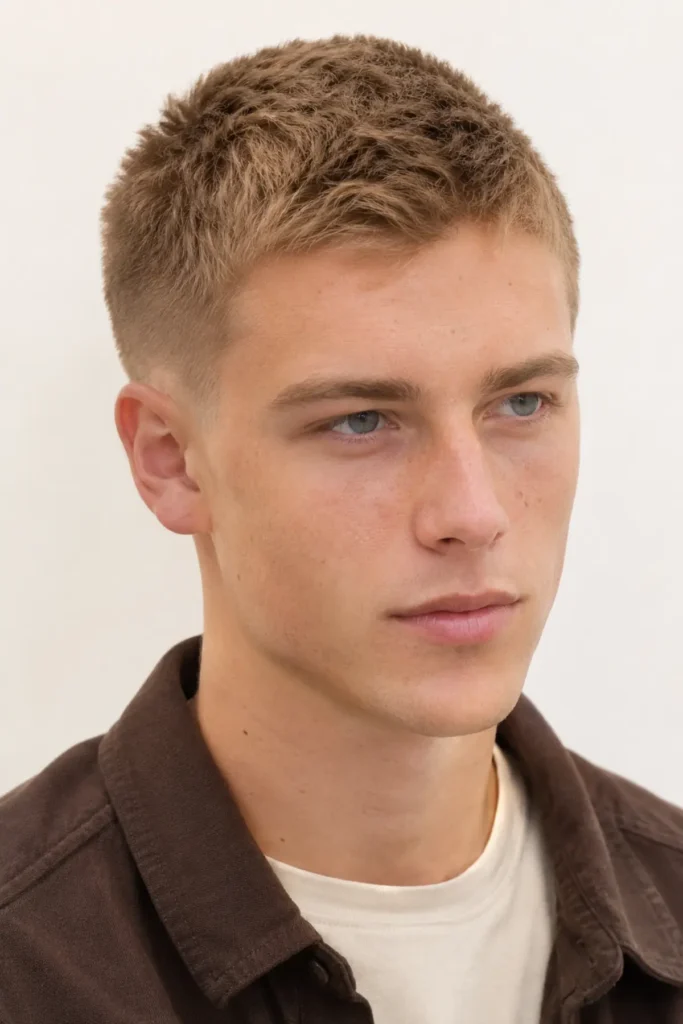
A #4 sits at the edge of crew cut territory with half an inch on top. Wavy and curly hair show real texture at this length, and it needs only a quick brush or a pea-sized dab of matte clay.
The order: “Number 4 on top, mid burst with a 1 guard finish.” Visit every three weeks. The short fade looks sharp against the longer top, so the contrast is easy to see, but the top starts to want a little styling in a way a #2 never does.
10. Induction (Zero Guard) Burst Buzz Cut
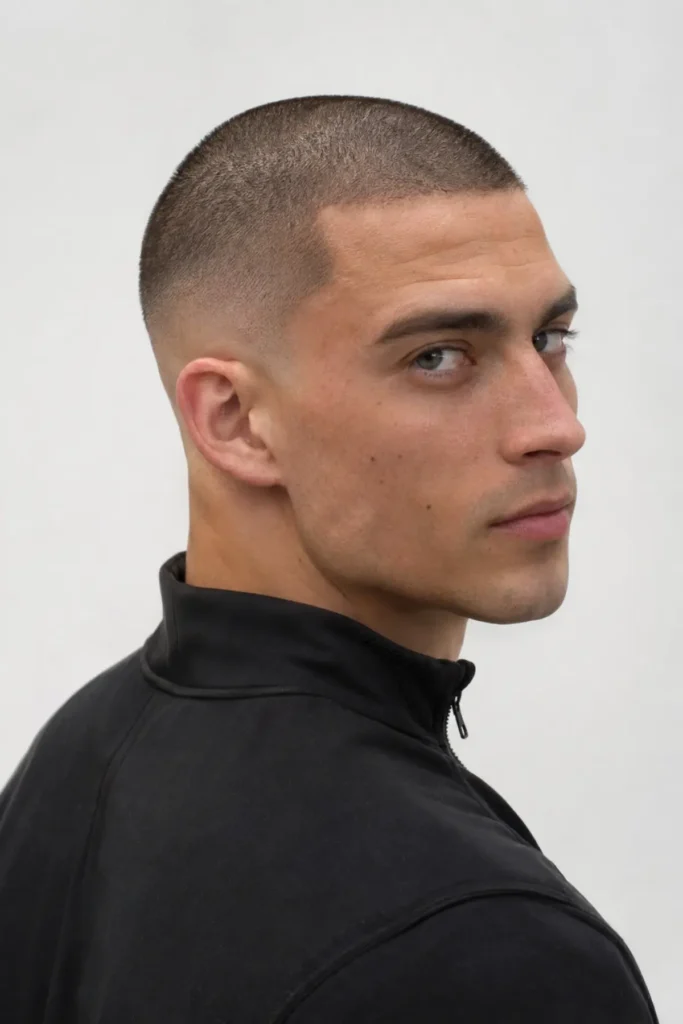
The induction cut uses no guard and nothing is blended on top, so it is the closest cut short of a shave. It suits strong bone structure and an even skull, and with a burst fade the curve reads like a soft shadow around the ear.
Say: “No guard on top, high burst fade, skin finish.” Because zero varies by clipper, it helps to ask the barber to check the length before finishing. Plan on a visit every one to two weeks and start scalp care in the first week.
Edges and Details
11. Natural Line-Up Burst Buzz Cut
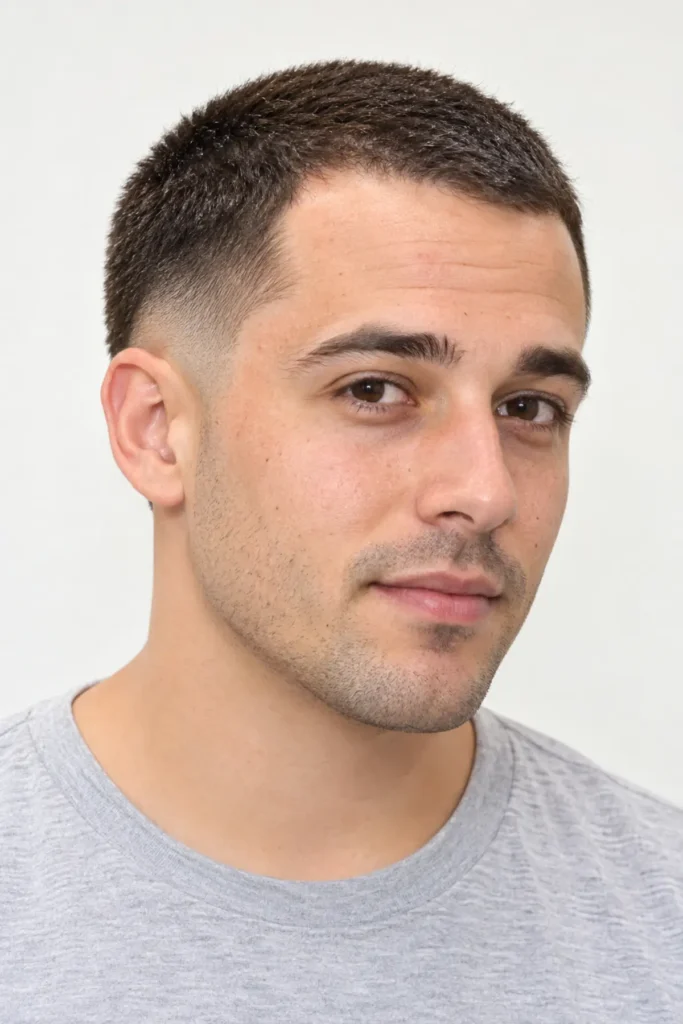
A natural line-up tidies the hairline without pushing it back, so the buzz looks neat rather than sculpted. It suits a receding hairline, a widow’s peak, or uneven edges, and it is the least effort option for work and everyday wear.
In the chair: “Number 2 on top, mid burst, natural line-up, no hard edge at the temples.” It lasts about as long as the cut itself. The drawback is that it looks softer than a crisp line, so guys who love a sharp edge may find it too relaxed.
12. Hard Line-Up Burst Buzz Cut
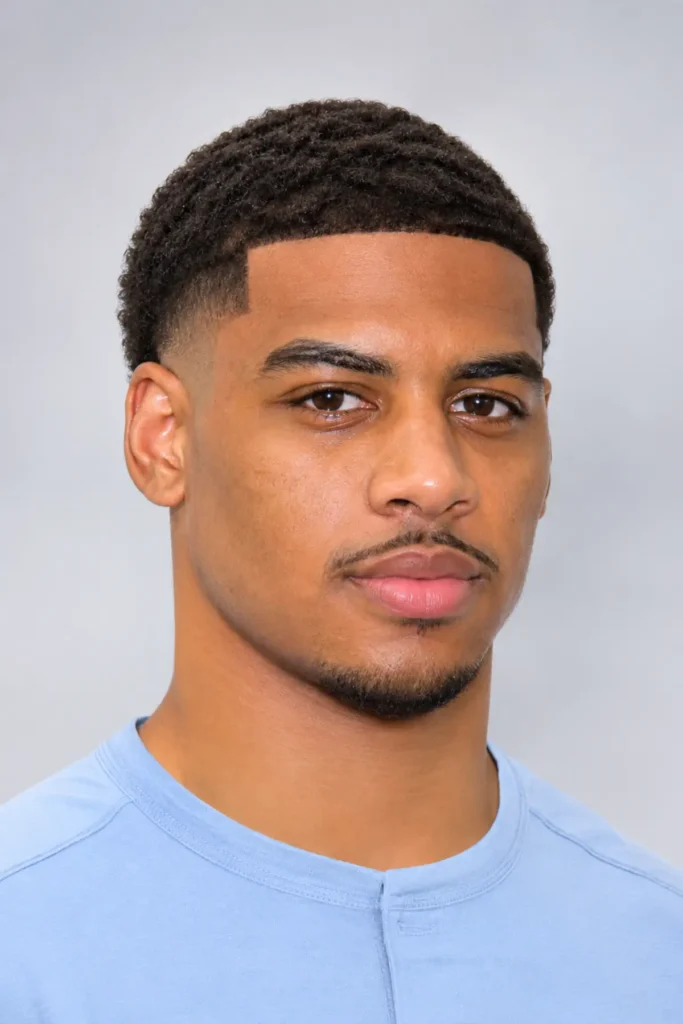
A hard line-up cuts a crisp edge across the forehead and temples with a trimmer and makes the burst curve look extra sharp. It suits a strong, even hairline and dense hair, and it photographs very well.
The order: “Number 2 on top, mid burst, hard line-up with a straight forehead edge.” It needs a visit about every two weeks to stay sharp. A receding hairline is a reason to skip it, because the crisp edge points right at the spot worth softening.
13. Burst Buzz Cut With a Shaved Part or Design Line
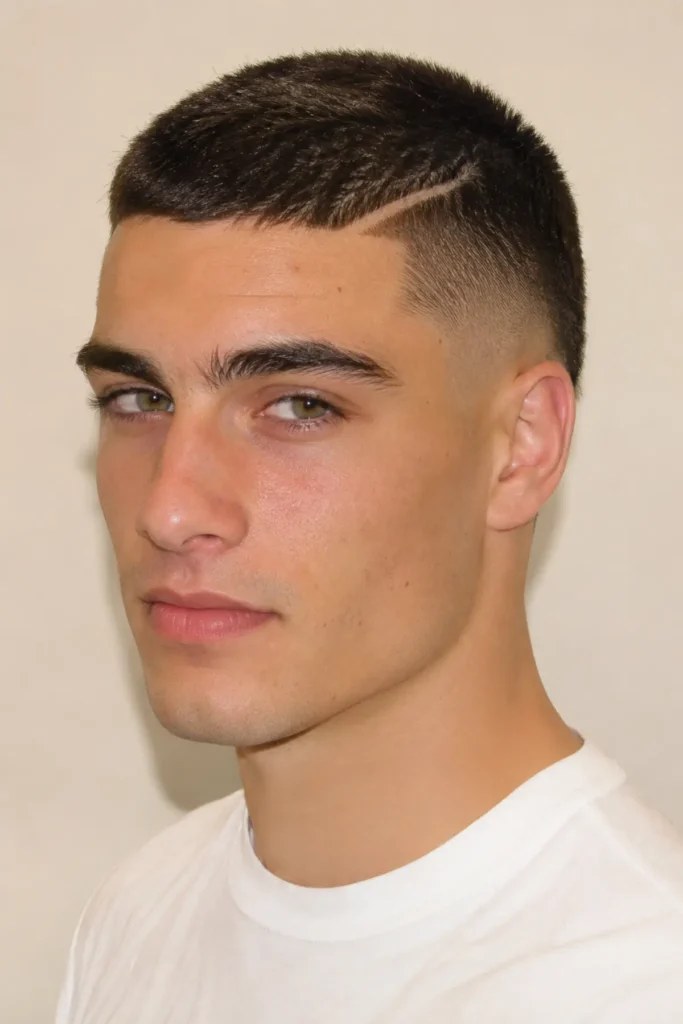
A shaved part is a thin line cut into the side of the top with a trimmer, and it adds a little personality without needing any length. It works best with a #2 or #3 on top.
Say: “Number 2 on top, mid burst, small shaved part on the left side.” The line blurs quickly, so a refresh every one to two weeks keeps it clean. Schools, teams, and some workplaces limit visible designs, so it pays to check first.
Beard Pairings
14. Burst Buzz Cut With Stubble
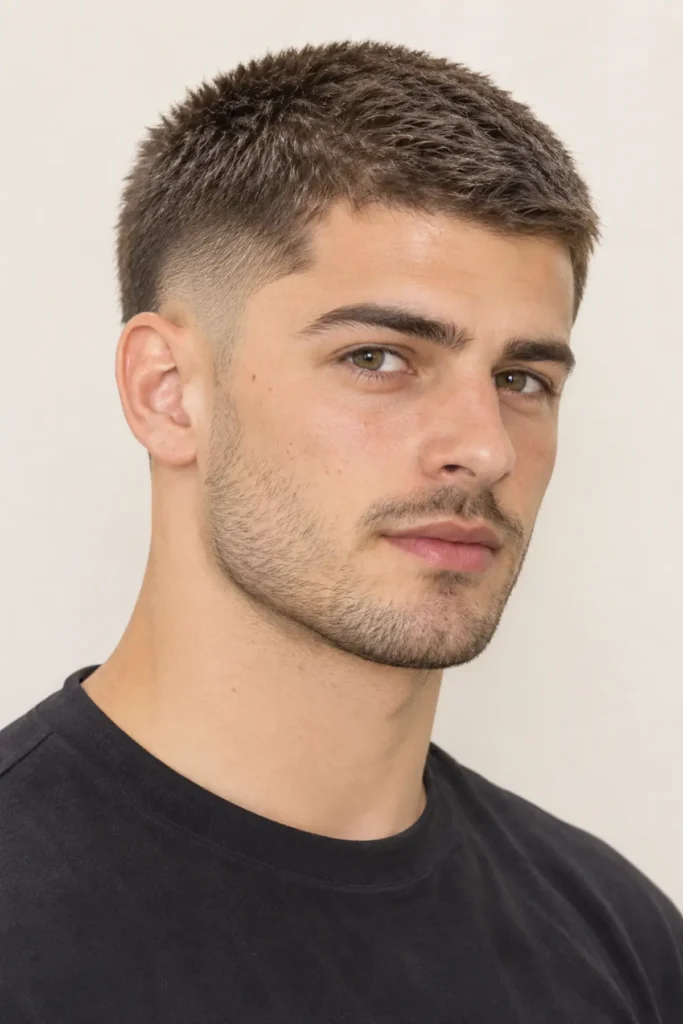
Light stubble is the easiest beard match because the fade flows into it without a hard contrast. It suits nearly every face shape and softens a round or square jaw. Upkeep is a trimmer set to a 1 or 2 every few days.
In the chair: “Burst fade into my stubble, with the cheek line kept soft.” Visit every two to three weeks for the cut. Patchy stubble can look uneven, so a clean neckline matters more than usual.
15. Burst Buzz Cut With a Full Beard
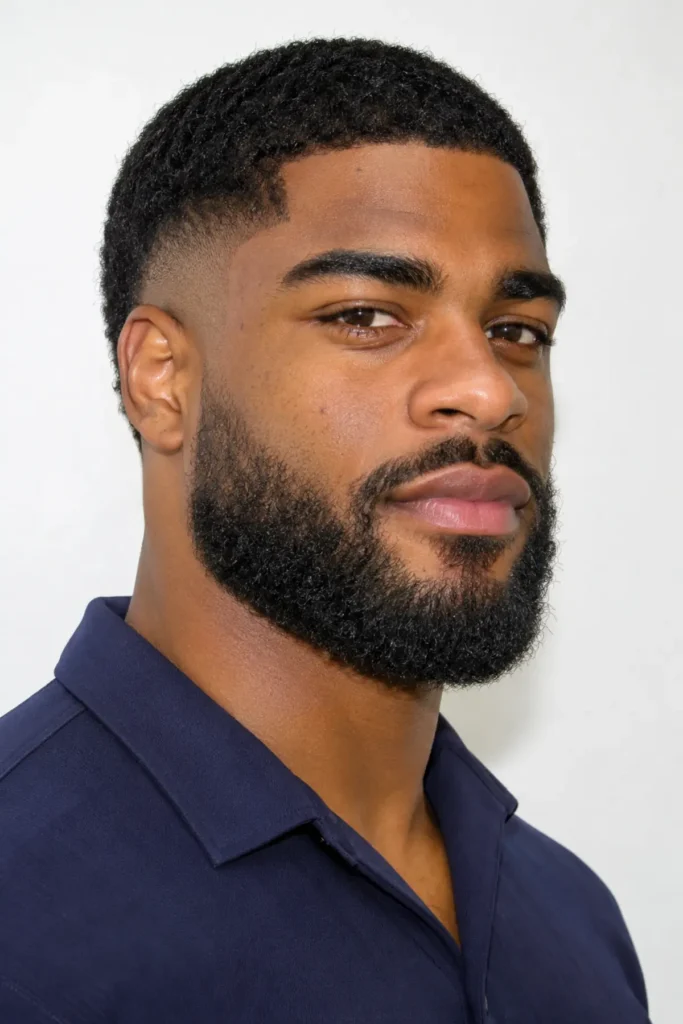
A full beard blended into the burst looks dramatic and polished, with the fade running straight into the beard line at the sideburn. It suits oval and square faces and guys with thick, even facial hair. The buzz cut fade with beard guide shows the blend in more detail.
The order: “Mid burst fade blending into the beard at the sideburn, beard shaped to a natural cheek line.” Plan on a visit every two weeks, with beard trims in between. A little beard oil helps keep the skin underneath comfortable.
Texture and Density
16. Burst Buzz Cut for Curly and Coily Hair
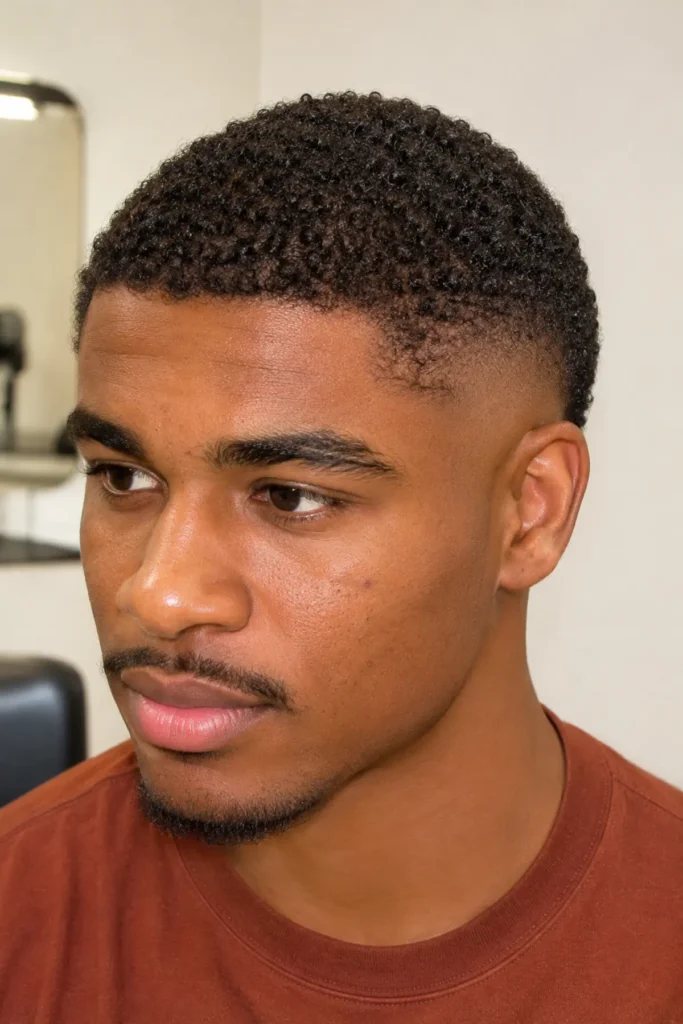
On curly and coily hair, a #1 or #2 on top with a mid or high burst gives a clean shape with deep contrast, and it gives the curls a break from daily styling. A light moisturizer on the scalp after washing keeps the skin comfortable and the shape sharp.
Say: “Number 1 on top, mid burst skin fade, soft natural line-up.” A skin finish needs a visit every one to two weeks. Razor bumps are a real concern on tightly coiled hair, so it helps to ask the barber to work with the grain and finish with a gentle aftershave. The burst fade for curly hair styles cover versions with more length.
17. Burst Buzz Cut for Waves
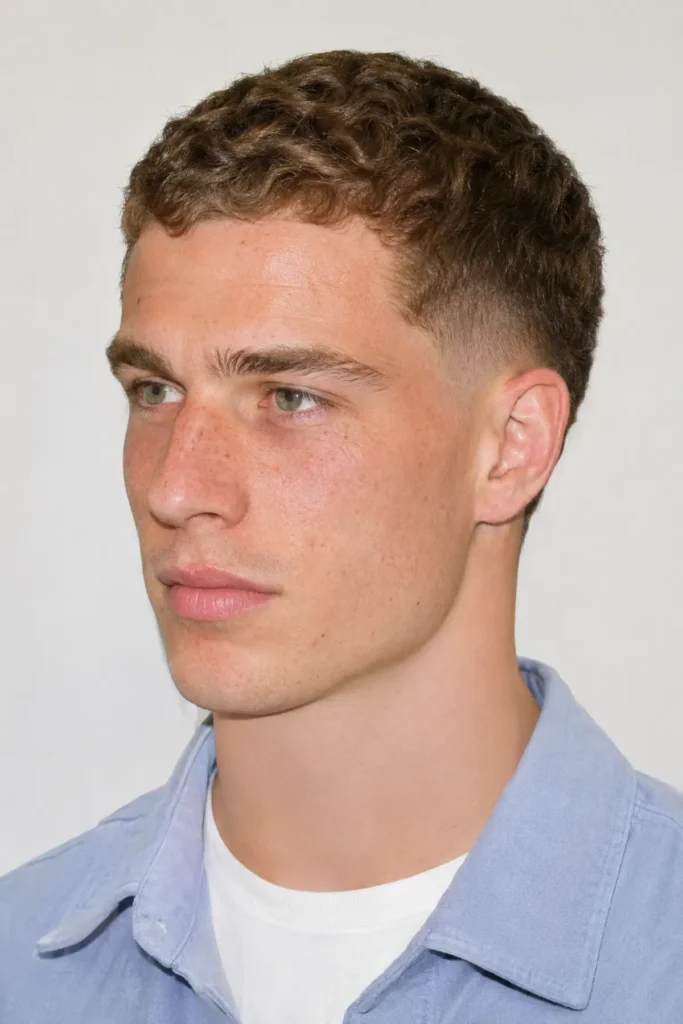
On wavy hair, a #2 or #3 on top lets a little natural wave show while the burst keeps the sides clean. It suits guys who want a low-effort cut with a hint of texture, and a quick brush after washing keeps the surface smooth.
In the chair: “Number 3 on top, low to mid burst, taper finish.” Visit every three weeks. Waves can pop up in odd places as the hair grows, so a trimmer touch-up between visits is handy.
18. Burst Buzz Cut for Thinning Hair or a Receding Hairline
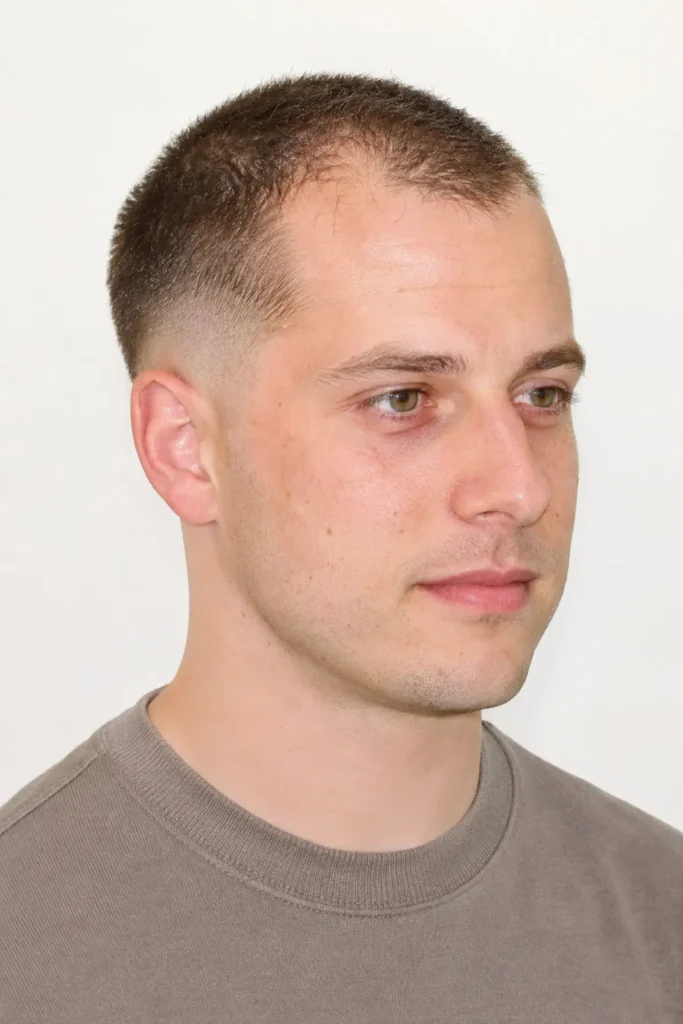
A short, even buzz reduces the contrast between thick and thin areas, and a burst fade frames the ear while keeping attention off the hairline. It suits early thinning or temple recession, and it usually looks cleaner than trying to cover the area with longer hair.
The order: “Number 2 on top, mid burst, natural line-up, no hard edge at the temples.” Start with a #2 and go shorter only if it still looks even. If the loss has reached a horseshoe pattern, a full shave may look cleaner than a buzz. With less hair to shield the skin, scalp care matters.
19. Burst Buzz Cut for Grey or Salt-and-Pepper Hair
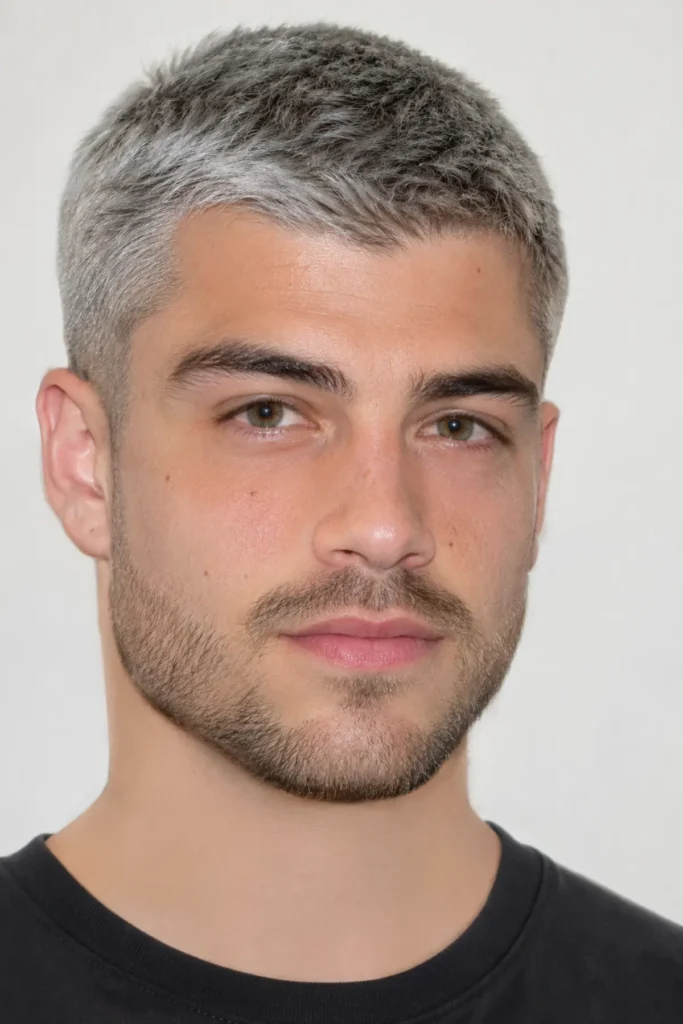
Grey hair looks tidy and intentional at buzz length, and the burst adds a clean frame around the ear. It suits men in their forties and up who want to look sharp without a long morning routine. A mid burst with a #3 on top feels polished without feeling severe.
Say: “Number 3 on top, mid burst, guard finish at a number 1, natural neckline.” Visit every three weeks. Lighter hair has less contrast against the scalp, so a guard finish usually looks more natural than skin.
Statement Look
20. Buzz Mullet Burst Fade
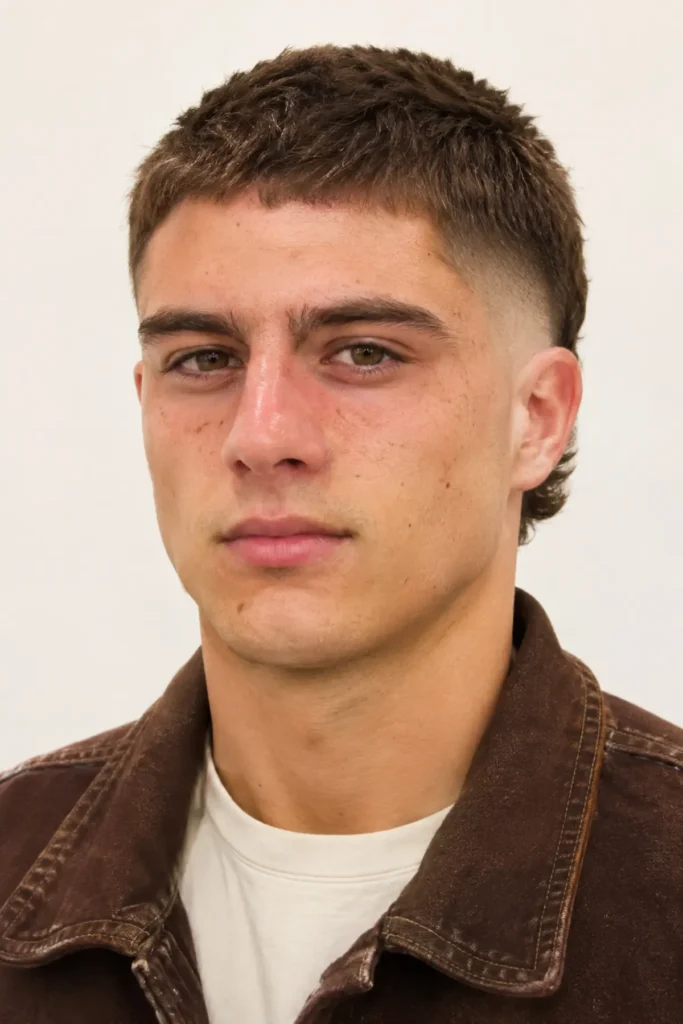
The buzz mullet burst pairs the curve around the ears with a slightly longer back, usually a #3 or #4 at the nape against a shorter top. It is a bold, modern take on the buzz for guys with confident style, and it works best on straight to wavy hair with round to oval faces.
In the chair: “Number 2 on top, mid burst fade, back left at a number 4 and softly rounded.” Visit every three weeks. The longer nape needs a little care and can look uneven in the in-between stage. For a longer back, the full burst fade mullet guide goes further.
The Three Ways Barbers Finish the Back
This is where most burst fade orders go sideways. A classic burst leaves the nape longer than the sides, but a buzz cut has no long hair to leave, so each barber fills that gap a little differently. Three finishes come up again and again, and it pays to name one out loud.
| Version | How the back looks | Best for |
|---|---|---|
| A: Matched back | The back stays at the same guard as the top, and the fade curves only around the ears | Men who want the most visible curve and the easiest grow-out |
| B: Blended neckline | The fade curves around the ear and also tapers into a short, clean neckline | Men who want the tidiest overall finish |
| C: Longer back | The top is a #3 or #4 and the back is left a bit longer, like a mini mullet | Men who want a softer outline that nods to the burst fade mullet |
These three labels are shorthand for talking with a barber, not an industry standard, so confirm the details before the clippers come out.
How a Burst Fade Compares to Other Fades
Burst, taper, drop, and skin get mixed up constantly, partly because they describe different things. Taper and burst describe shape: a taper is a gradual blend at the sideburns and neckline, and a burst is the curve around the ear. A drop fade is a shape too, one that dips lower behind the ear and looks more angular. Skin describes how close the fade goes, which is why a skin fade can be a burst, a drop, or a straight line.
| Cut | What defines it | Where the hair is shortest | The back |
|---|---|---|---|
| Burst fade | A half circle around the ear | Just behind the ear | Stays longer or matched to the top |
| Taper fade | A gradual blend at the edges | Sideburns and neckline | Neckline cut short |
| Drop fade | A curve that dips behind the ear | Lower behind the ear | Follows the angular drop |
| Skin fade | Fades down to bare skin | Wherever the fade ends | Depends on the shape chosen |
| Low fade | A fade that starts low on the head | Close to the ear and hairline | Straight line around the head |
For a look at plain height-based fades, the mid fade haircuts guide shows how a straight fade differs from a curved one.
Who Suits a Burst Fade Buzz Cut?
Most guys can pull it off, but a buzz cut puts the skull, ears, jaw, and any scars or bumps on display, so a quick honest look at the head comes first. Luxe Digital points out that lumps, dents, scars, an uneven skull, and cowlicks that stand up at short length all show at buzz length. A barber who is willing to say so before the first cut is worth keeping.
The burst helps more than a plain buzz does. The curve around the ear gives the eye somewhere to land, and a slightly longer top such as a #3 or #4 takes the edge off for anyone nervous about going very short.
Best Burst Fade Buzz Cut by Face Shape
The rule of thumb barbers use is visual weight. A low burst leaves more hair at the sides, which adds width. A high burst takes that weight away, which slims and lengthens. Forte Series lists round, oval, and square faces as strong matches for the burst shape, while Luxe Digital makes the fair point that hair density, growth pattern, and how often a man will visit the barber matter more than any chart. The table below applies the visual weight idea and works as a starting point, not a rule.
| Face shape | Best fade height | Best top guard | Why it tends to work |
|---|---|---|---|
| Oval | Any height | #1 to #3 | Balanced proportions carry almost every version |
| Round | Mid to high | #2 to #3 | Removing side weight slims the face, and a bit of top length adds height |
| Square | Low to mid | #1 to #2 | Keeps the strong jaw as the focus without adding bulk |
| Oblong | Low | #3 to #4 | A longer buzz and a low fade avoid making the head look taller |
| Diamond | Low to mid | #2 to #3 | Keeps width at the temples balanced against the cheekbones |
| Heart | Low to mid | #2 to #4 | Leaves a little weight near the jaw to balance a wider forehead |
| Triangle | Mid to high | #2 to #3 | Trims width at the jaw side while adding visual height on top |
For deeper dives, see the round face haircuts, oblong face hairstyles, heart face shape styles, and triangle face shape styles guides.
Hair Texture: Straight, Wavy, Curly, and Coily
The burst works on every texture because the clippers create the shape, not the hair. Straight hair gives the smoothest gradient and also shows every uneven patch. Waves add a little movement even at a #2 or #3. Curly and coily hair show the curve with the most contrast, since a tightly packed top sits against faded sides. Guys who want to keep length on top can look at the burst fade for curly hair ideas.
Texture changes upkeep too. Coily hair often reads fuller at a #2 than straight hair does, so a #1 may be needed for the same look. Waves and curls can also form tiny ridges between visits, and a quick brush after washing keeps the surface smooth.
Hair Density and Thinning Hair
Thick hair fills in nicely at a #2 and looks deliberate. Fine hair can look see-through under a #3 or #4, so a #1 or #2 usually looks cleaner. The short haircuts for men with fine hair guide has more on that.
Early thinning or a receding hairline is one of the better reasons to buzz, because Luxe Digital explains that a short cut reduces the contrast between thick and thin areas. The exception is advanced loss in a horseshoe pattern, where a buzz can look patchy and a full shave looks cleaner. A simple test is a #1 at home on a weekend: if it looks even, keep buzzing. Men with a larger forehead can also check the buzz cut for a big forehead guide before picking the top length.
Age, Work, and Skin Tone
The cut works from the teen years into the sixties and beyond, but the version changes. Students should check school and team dress codes first, since some limit shaved designs and very short sides. Office jobs tend to suit a low or mid burst with a #2 or #3 on top, and the office hairstyles for men guide covers more polished options. Men in their fifties and up often like a mid burst with a #3, which stays tidy without exposing much scalp.
Hair color and skin tone change how visible the fade is. Lighter or grey hair against fair skin reads softer, so a skin finish gives the curve more definition. Dark hair on lighter skin gives strong contrast, which makes a clean blend look great and a messy one obvious. On deeper skin tones a skin fade is crisp, but razor bumps and ingrown hairs are common, so a gentle shave and a moisturizer afterward matter.
Build a Burst Fade Buzz Cut in 5 Decisions
Every order comes down to five choices. Settled before sitting down, they give the barber what is needed to get it right the first time.
1. Choose the Top Length (Guard Chart)
The guard number sets the length on top. A #1 leaves an eighth of an inch and a #8 leaves a full inch, and that difference looks bigger on a real head than on paper. First-timers usually do well with a #2 or #3, then go shorter once the shape of the head is clear.
| Guard | Length (inches) | Length (mm) | Look |
|---|---|---|---|
| No guard (0) | Varies by clipper | Varies | Closest cut, almost scalp |
| #1 | 1/8 | 3 | Very short, scalp shows through |
| #2 | 1/4 | 6 | The classic buzz and the safest first choice |
| #3 | 3/8 | 10 | Soft, a little shape on top |
| #4 | 1/2 | 13 | Longest common buzz, close to a crew cut |
| #6 | 3/4 | 19 | Long buzz, starts to read as a short crop |
| #8 | 1 | 25 | Longest guard, more crop than buzz |
One catch: zero means no guard, but it is not a fixed length. The bare blade on one clipper cuts closer than on another, so expect it to vary from shop to shop, as Luxe Digital points out.
2. Choose the Burst Height: Low, Mid, or High
A low burst stays close to the ear and hairline and gives a quiet contrast that works in an office. A mid burst sits halfway up the side of the head and is the height most guys ask for. A high burst climbs toward the crown, gives the strongest contrast, and needs the next appointment sooner.
On a buzz, height matters more than on longer styles because there is no top length to distract from the curve. When unsure, mid is the safe pick, since it suits most head shapes and holds up longer than a high fade.
3. Choose Skin or Guard at the Shortest Point
Right behind the ear, the fade can go all the way to skin or stop at a short guard. Barbers blend in half steps, usually somewhere between a 0.5 and a 3, working outward from that spot. Skin is sharper and has more contrast, but it shows regrowth sooner.
A guard finish sidesteps the pale-scalp surprise that some guys get from a first skin fade. A good beginner version follows the 3-2-1 rule that Luxe Digital describes: a #3 on top, a #2 on the sides, and a #1 at the bottom, so every step is a full guard and nothing is blended by eye. Because the top and bottom sit only a quarter inch apart, it also grows out nicely.
4. Choose What Happens at the Nape
This is the choice most guys forget. The back can stay matched to the top (Version A), blend into a short neckline (Version B), or stay slightly longer (Version C), as laid out above. It needs saying out loud, because “burst fade” can mean a longer nape in one shop and a tight neckline in the next.
A softly rounded neckline grows out best and hides the odd crooked edge. A squared or blocked neckline looks sharp for a few days but needs more frequent visits.
5. Choose the Edges
A natural line-up tidies the hairline without pushing it back. A hard line-up cuts a crisp edge across the forehead and temples with a trimmer, which looks sharp on day one and needs a visit about every two weeks to stay that way.
For most buzz cuts, natural is the better match, especially with a receding hairline, since a hard edge can point right at the spot a man would rather soften.
How to Ask Your Barber for a Burst Fade Buzz Cut
A good order has five parts: the top guard, the burst height, the finish behind the ear, what happens at the nape, and the edges. Photos help, but only from more than one angle, since a burst is easy to see from the side and easy to lose from the front. A single side shot can produce a cut that looks great in profile and flat in the mirror.
Put together, the whole order sounds like this: “Number 2 on top. Mid burst fade, curving around the ear, down to a 0.5 behind the ear. Back matched to the top with a soft natural neckline, and a natural line-up at the front.” If anything looks off, it is worth saying so before the barber reaches for the trimmer, because a fade is easy to shorten and impossible to lengthen.
Styling and Scalp Care for a Burst Fade Buzz Cut
Styling barely exists, which is a big part of the appeal. A gentle shampoo, a pat dry, and a brush for wavy or curly hair cover the basics. A light moisturizer keeps the scalp comfortable, and gentle exfoliation once or twice a week helps with flakes and ingrown hairs, especially on a skin finish. A #3 or #4 top can take a pea-sized dab of matte clay or texture powder for a little separation.
Sun protection is the part most guys underestimate. With little or no hair to shield the scalp, the skin takes more UV. The Skin Cancer Foundation says hats are often the best protection for the scalp and recommends a wide brim, tightly woven fabric, and a UPF 50+ rating. The American Academy of Dermatology advises a broad-spectrum, water-resistant sunscreen with SPF 30 or higher, reapplied every two hours and after sweating. Redness, flaky patches, or rough spots on the scalp that do not go away are worth showing to a dermatologist.
How Often to Visit the Barber: Week by Week
Dermatologist Dr. Hadley King and the American Academy of Dermatology put average hair growth at about half an inch per month. That works out to roughly an eighth of an inch a week, so a fade starts to blur once the short and long areas have both grown about a quarter inch. Luxe Digital reports regrowth showing at around two weeks and a blurred fade by weeks three to four.
| Week | What it looks like | What to do |
|---|---|---|
| 1 | Crisp curve, clean neckline, sharp contrast | Moisturize, and use sunscreen outdoors |
| 2 | Slight fuzz on a skin finish, curve still clear | Book the next visit if running a skin fade or hard line-up |
| 3 | The blend softens and the neckline starts to look fuzzy | Most men rebook here for a standard fade |
| 4 | The curve is blurry and the top has grown past its guard | Rebook now, or use this as a grow-out starting point |
Most guys do well on a two to three week schedule, a skin fade or high burst on a one to two week schedule, and a guard finish on three to four weeks. When money or time is tight, a low burst with a guard finish is the pick, because it ages best.
What a Burst Fade Buzz Cut Costs in the US
Prices swing with the city, the shop, and the barber’s experience. Booksy listings show most adult haircuts at roughly $30 to $65, and fades are often priced the same as a standard cut unless the shop lists skin fades as a separate service. A tip of 15% to 20% is typical, with 20% common for detailed fades.
The bigger number is the schedule. As an example, a $40 cut every three weeks comes to about 17 visits and $680 a year before tips, and the same cut every two weeks is 26 visits and about $1,040. Those figures are illustrations, so local prices decide the real total. Guys watching the budget often pick a guard finish and a #3 top to stretch the time between visits.
How to Grow Out a Burst Fade Buzz Cut
A buzz needs about six weeks to reach a length that lies down, and the middle weeks are the awkward ones. Around a #4 the hair stands straight up, the sides lose their shape, and the neckline looks fuzzy. The simplest fix is to keep visiting for neckline and sideburn cleanups while leaving the top alone. Because the burst leaves the top and back at similar lengths, the curve hides a lot of the in-between phase.
To get back to the pre-buzz length, the Art of Manliness estimates three to four months, depending on how long the hair was to begin with. A sensible plan is to let the top grow first, keep the sides tidy with a taper, and pick a new cut once the length lies flat. The burst fade mullet is a popular next step.
Common Mistakes to Avoid
- Saying only “burst fade.” The barber still needs the top guard, the height, the finish, and the nape.
- Skipping the nape. The same name can mean a long back in one shop and a tight neckline in the next.
- Going straight to skin with no sunscreen plan. A newly exposed scalp burns fast.
- Pairing a hard line-up with a receding hairline. The crisp edge highlights exactly what a man wants to soften.
- Showing one photo. Front, side, and back views prevent surprises.
- Cutting it at home. The curve is hard to balance on both ears without a second pair of eyes.
- Waiting until the fade is gone. The blend is the first thing to disappear, so booking the next visit before leaving the chair works better.
Pros and Cons of a Burst Fade Buzz Cut
| Pros | Cons |
|---|---|
| Almost no daily styling | Needs frequent barber visits to stay sharp |
| Works on every hair texture | Shows scalp, scars, and head shape |
| Frames the ear and jaw for a clean, modern look | A skin finish needs sunscreen and scalp care |
| Easy to order once the five decisions are settled | The curve is hard to balance for a barber new to bursts |
| Flexible, from low and soft to high and bold | Grow-out takes patience |
| No bad hair days to fix | Not ideal for advanced horseshoe-pattern hair loss |
Burst Fade Buzz Cut FAQ
What is a burst fade buzz cut?
A burst fade buzz cut is a short clipper cut with a fade that curves in a half circle around each ear and a top buzzed to one even guard length, usually between a #1 and a #4. The shortest point sits just behind the ear, and the fade can end at bare skin or at a short guard.
What guard number is best for a burst fade buzz cut?
A #2 on top is the safest starting point because it leaves about a quarter inch. A #1 looks sharper and shows more scalp, while a #3 or #4 adds softness and works well for fine or thinning hair. Men who feel unsure should start longer and go shorter next time.
What is the difference between a burst fade and a taper fade?
A taper is a gradual blend at the sideburns and neckline, while a burst is a specific shape, the curve around the ear. The two can be combined into a burst taper, which stops at a guard instead of going to bare skin.
What is the difference between a burst fade and a drop fade?
A drop fade dips lower behind the ear and looks more angular, while a burst fade curves around the ear and leaves the back matched to the top or slightly longer. The drop tends to suit longer faces, and the burst is flexible across most face shapes.
How often does a burst fade buzz cut need a touch-up?
Most men visit every 2 to 3 weeks. A skin fade, a high burst, or a hard line-up needs a visit every 1 to 2 weeks, while a low burst with a guard finish can stretch to 3 or 4 weeks.
Does a burst fade buzz cut work on curly or coily hair?
Yes. The shape comes from the clippers, so it works on straight, wavy, curly, and coily hair. Curly and coily textures often show the curve with the strongest contrast, but they can be prone to razor bumps on a skin finish, so a guard finish or a gentle shave helps.
Is a burst fade buzz cut good for thinning hair or a receding hairline?
Often, yes. A short, even buzz reduces the contrast between thick and thin areas, and a natural line-up keeps attention off the hairline. If hair loss has reached a horseshoe pattern, a full shave usually looks cleaner than a buzz.
What is the best burst fade buzz cut for a round face?
A mid or high burst with a #2 or #3 on top usually works best because removing weight from the sides slims the face, and a little length on top adds height. A low burst keeps more hair at the sides, which can add width.
Is a burst fade buzz cut professional enough for work?
Yes, when it is kept simple. A low or mid burst with a #2 or #3 on top, a guard finish, and a natural line-up looks tidy in most offices. Shaved designs and very high skin fades are better saved for casual settings.
How much does a burst fade buzz cut cost?
Most US barbershops charge about $30 to $65 per visit, depending on the city and the barber. A tip of 15% to 20% is typical, and 20% is common for detailed fades. The yearly cost depends mostly on how often the cut is refreshed.
How long does it take to grow out a burst fade buzz cut?
Hair grows about half an inch a month. A buzz reaches a length that lies flat in about six weeks, and returning to a previous length can take three to four months. Regular neckline and sideburn cleanups make the in-between phase easier.
Final Thoughts
The burst fade buzz cut rewards a clear order. Settle the top guard, the height of the curve, the finish behind the ear, the nape, and the edges, and the barber has almost nothing left to guess. A mid burst with a #2 on top and a guard finish is the safest first try, and skin or a higher curve are easy upgrades once the shape feels familiar.
After that it is mostly routine: book the next visit before leaving the chair, protect the scalp from the sun, and keep the neckline tidy between appointments. More ways to wear the curve are on the mid burst fade haircut, low burst fade haircut, and buzz cut fade with beard pages.