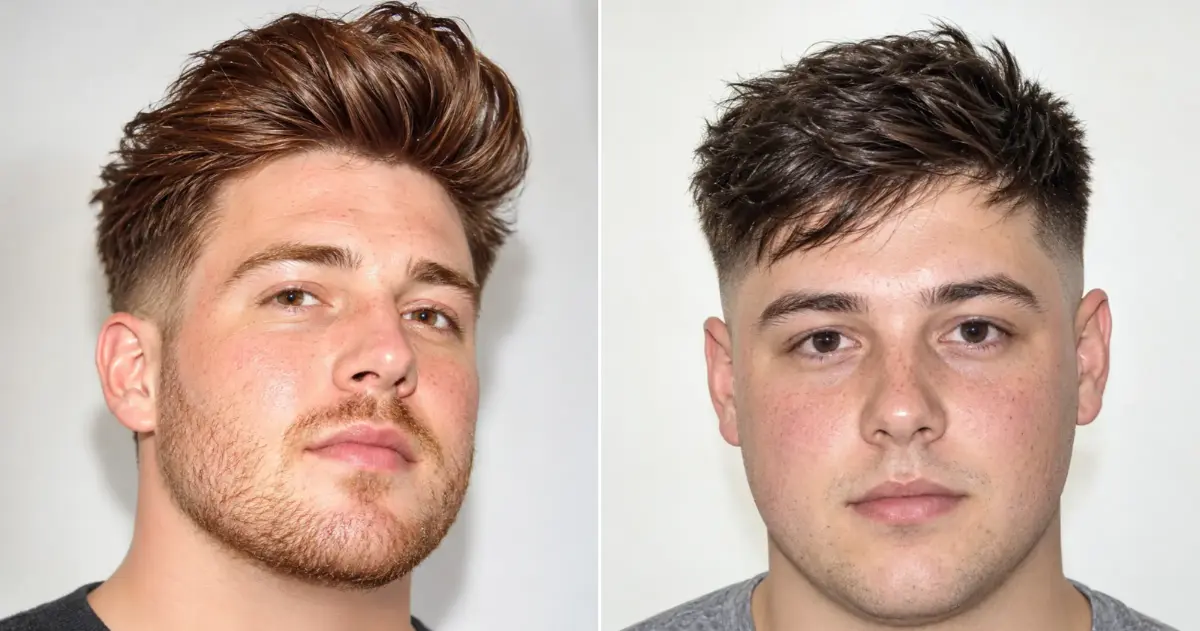
The best haircuts for a round face add height on top, keep the sides short, and include one sharp angle, such as a side part, a hard part, or a diagonal fringe. Textured crops, quiffs, pompadours, side parts with a fade, and angular fringes do all three jobs at once.
Pick a Cut in 30 Seconds
| If the goal is… | Best pick | Upkeep |
|---|---|---|
| Lowest effort | Textured crop with a mid fade | Barber every 2 to 4 weeks, 2 minutes to style |
| Safe for the office | Side part with a taper | Barber every 3 to 4 weeks, 3 minutes |
| Maximum face lengthening | Pompadour or quiff | Barber every 2 to 3 weeks, 5 to 10 minutes with a blow dryer |
| Thinning or fine hair | Short textured crop or a buzz cut with a high fade | Barber every 2 to 4 weeks (1 to 2 for a skin fade), almost no styling |
| Curly hair | Curly top with a fade or taper | Barber every 2 to 4 weeks, curl cream and a diffuser |
| Coily hair | Short afro with a fade and shape-up | Barber every 1 to 3 weeks, moisture and a pick |
| Longer hair | Layered flow with tight sides | Barber every 6 to 8 weeks |
| A softer jaw | Any of the above plus a short boxed or pointed beard | Beard line touched up every few days |
The Three Rules Behind Every Cut Below
- Height on top. Length at the front and crown makes the face read longer.
- Tight sides. Less hair at the temples and ears removes width where a round face is already widest.
- One sharp angle. A part, a diagonal fringe, or a squared line-up gives the eye a straight line to follow.
A good rule for the fade is to match it to the top. Most barber guides favor a mid or high fade for the strongest slimming effect, while a few list a low fade as fine for round faces when the top carries real height. The 25 ideas below show both.
Why the Right Haircut Changes So Much on a Round Face
A common pattern shows up on round faces. A fresh cut with wide, fluffy sides makes the face look rounder, while the same face with a tight fade and some lift on top suddenly looks longer and sharper. Nothing about the bone structure changed. The haircut simply moved the eye up and in instead of out.
That is the whole idea behind round face shape haircuts for men, and it is the advice most barber guides repeat: build height, remove width, add an angle. This guide turns that rule into 25 specific ideas. Each one lists the hair type it suits, how much styling it takes, how often the barber chair is needed, and what to say when the clippers come out.
How to Tell If a Face Is Round
The easiest check is a mirror, good light, and a soft tape (or a piece of string and a ruler). Hair gets pulled back first, then four measurements get compared.
- Forehead: across the widest part, about halfway between the eyebrows and the hairline.
- Cheekbones: across the widest point, just below the outer corner of each eye.
- Jawline: from the chin tip to the point below the ear where the jaw turns upward, then doubled.
- Face length: from the center of the hairline to the chin tip. Men with a shaved or receding hairline estimate where the hairline would sit.
A round face usually shows cheekbone width and face length that are very close, both larger than the forehead and jaw, with a soft, curved jawline and no strong corners. If the length is clearly longer than the width, the face is more oval or oblong. If the jaw is as wide as the cheekbones and has square corners, it is square.
Men who land between shapes can compare notes with the guides to oblong face hairstyles for men, men’s hairstyles for a heart face shape, and triangle face shape hairstyles for men.
What a Haircut Can and Cannot Do
A haircut changes how long, wide, and angular a face reads. It cannot change cheek fullness or skull shape, so realistic expectations matter. A round face is a shape, not a flaw. The goal is balance, not hiding anything. For a flatter back of the head, a barber may suggest a mid drop fade so the shape behind the ear does not look cut off.
Why Height, Tight Sides, and One Angle Work
Height on top
Length on top stretches the outline upward. Exact numbers vary by barber and hair type, but as a rough guide, a pompadour needs about 3 to 4 inches on top, a quiff about 2 to 3 inches, and a textured crop about 1.5 to 2 inches. Fine or thin hair needs lighter products and a short, honest cut, because hair that cannot stand up will not add height no matter how it is styled.
Tight sides
The sides are where a round face is widest, so that is where clippers do the most work. The fade type changes both the look and the upkeep.
| Fade | Where it starts | What it does on a round face | How soon it grows out |
|---|---|---|---|
| Skin (bald) fade | Down to bare skin, then blends up | Strongest contrast, sharpest look | Often 1 to 2 weeks |
| High fade | Above the ear line, near the temple | Strongest slimming, draws the eye up | Needs frequent upkeep |
| Mid fade | Around the temple or top of the ear | Balanced and office friendly | Typically 2 to 4 weeks |
| Low fade | Just below the top of the ear | Subtle, works best when the top has real height | Typically 2 to 4 weeks |
| Taper | Sideburns and nape only | Soft, classic, least dramatic | Grows out most naturally |
| Burst or drop fade | Curves around or behind the ear | Adds shape and softens the back view | Typically 2 to 3 weeks |
Barbers talk in clipper guard numbers, so a quick cheat sheet helps. A #1 guard leaves about 3 mm (1/8 inch) and a #4 about 13 mm (1/2 inch), with a #2 near 6 mm and a #3 near 10 mm in between. Numbers can differ slightly between brands, so a client can also describe the look, such as “skin up to the temple, blended into a number 2.” Wahl publishes its own clipper cutting lengths for anyone who wants to check. The mid fade haircuts guide on MenHairInspo breaks down the most versatile option in more detail.
One sharp angle
Round faces have few straight lines, so a haircut can add one. A side part, a razor-cut hard part, a diagonal fringe, or a squared line-up at the forehead all do the job. Point cutting, where the barber snips into the ends for a choppy finish, adds the same kind of broken edge to a fringe or crop.
25 Best Round Face Shape Haircuts for Men
Every idea below follows the same card: why it works, the hair type and density it suits, how hard it is to style, how often the barber is needed, a script to read to the barber, and what to watch out for. Maintenance and styling difficulty are ranked easy, moderate, or high so it is simple to match a cut to a real morning routine.
Short and Low Effort Cuts
1. Textured Crop with a Mid Fade
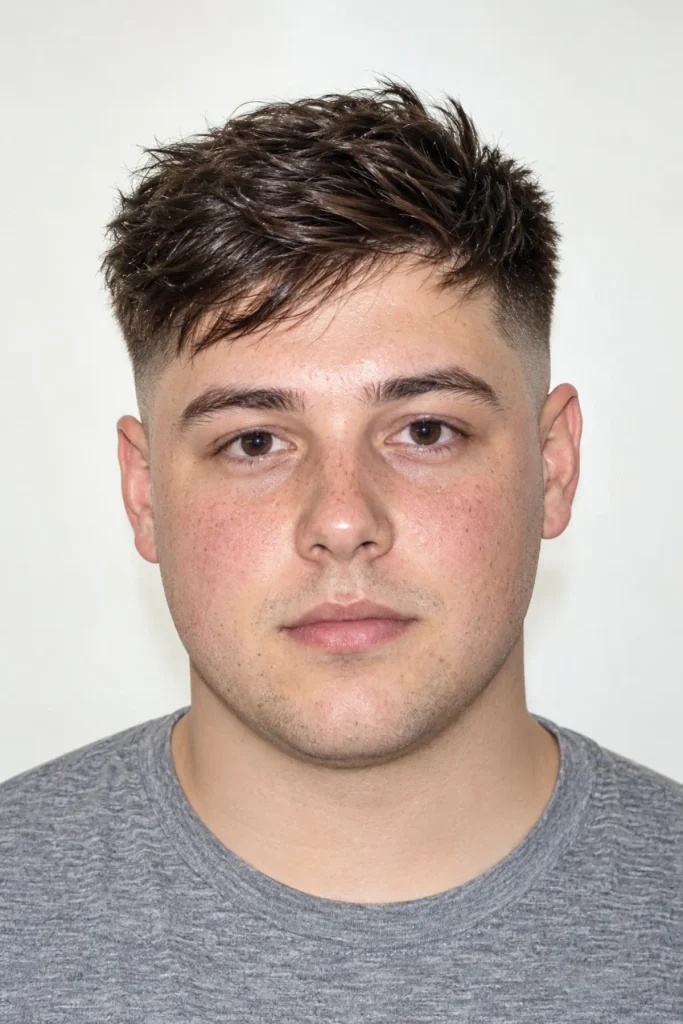
A choppy, point-cut top gives a round face its angles without needing a blow dryer, and the mid fade keeps the sides tight. The fringe falls on a diagonal instead of straight across, which is the key detail. Hair that is straight, wavy, or on the thicker side suits it, at medium to high density, with a barber visit every 2 to 4 weeks.
Styling is simple: a little matte clay through the fingers, pushed forward and to one side. At the shop, the request that gets it right is “Textured crop, about two inches on top, point cut and pushed to one side, with a mid skin fade blended up from the ears.” Very fine, flat hair can look limp in this cut, and a blunt fringe cancels the angles it is built on.
2. Modern Crew Cut with a Taper
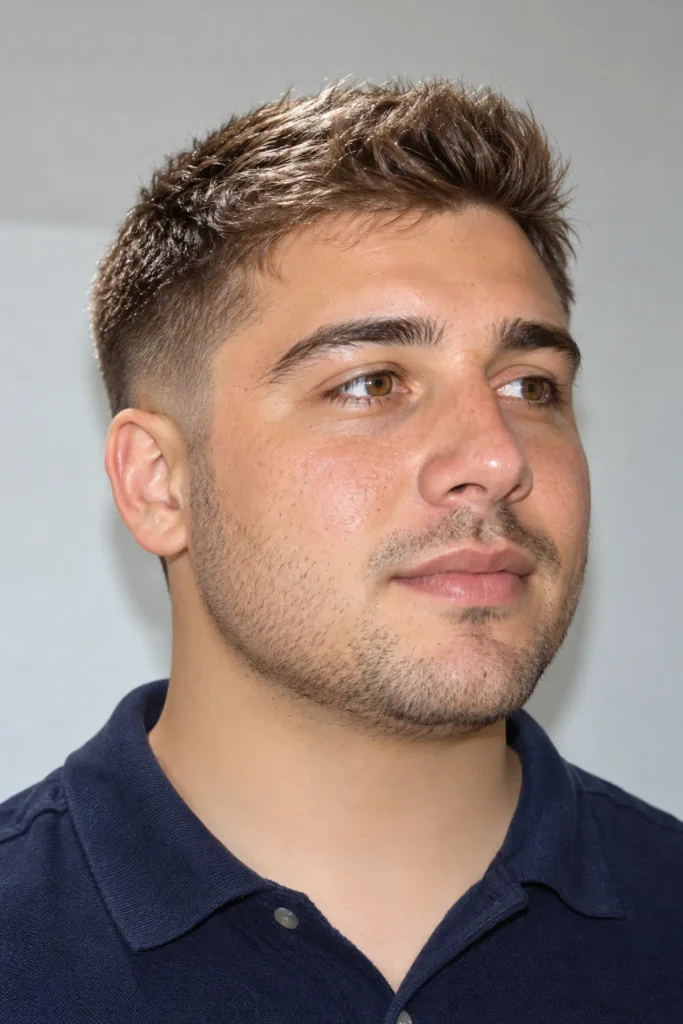
The crew cut builds height into the cut, since the front sits slightly longer than the crown and brushes upward. The sides stay short by design, which makes it a dependable everyday option for a round face. Fine, medium, and thick hair all take it well, thinner density included, and a trim every 3 to 4 weeks keeps it tidy.
The morning routine is a towel dry and a quick brush of the front upward. A barber can handle “Crew cut, a little longer at the front so it brushes up, with a taper on the sides.” The mistake to dodge is styling it flat, because then it reads like a buzz cut and the lift disappears.
3. Ivy League with a Taper
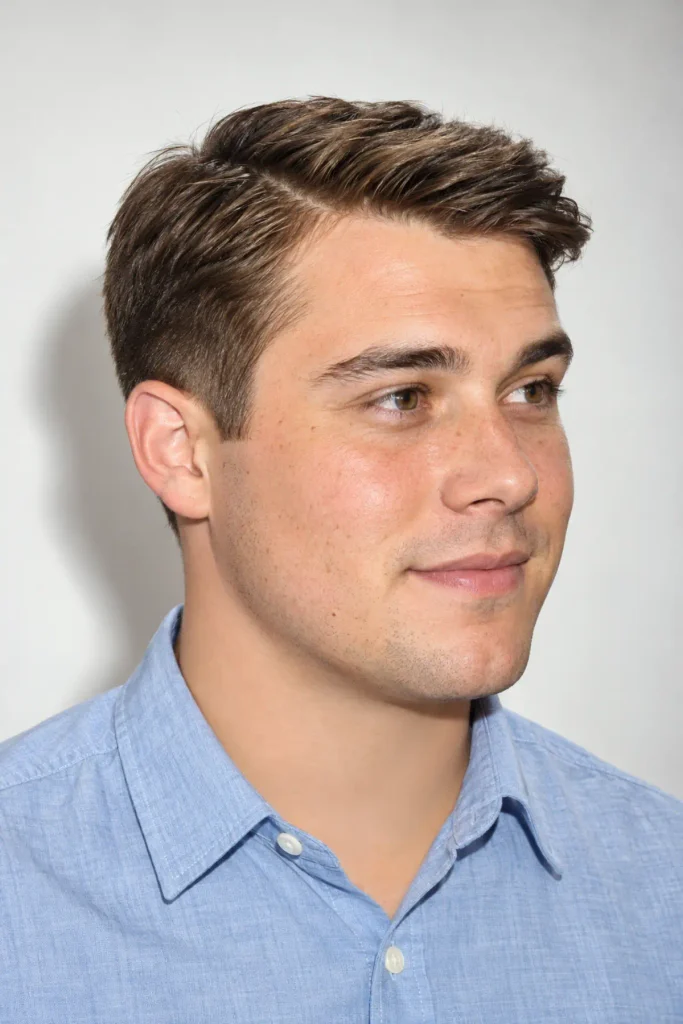
The Ivy League is a slightly longer crew cut that takes a part. The height is modest, so the side part does most of the work by adding a diagonal line, while the taper keeps the sides close. Straight or fine hair at low to medium density gets the most out of it, and it is easy to keep up, with a barber visit about every 3 weeks.
Each morning, damp hair gets combed to the side with a light pomade. The order to give is “Ivy League, about an inch and a half at the front going shorter toward the crown, a side part, and a number 2 taper.” One detail matters more than the rest: the part should sit off center, since a part set exactly in the middle looks flat.
4. Short Back and Sides with a Textured Top

This is the classic barbershop cut with a modern finish. The sides come in close and clean, and the layered top adds movement and a few angles. Straight or wavy hair at low to medium density is the natural fit, and upkeep is easy, with a visit every 3 to 4 weeks.
Styling takes seconds with a little clay or paste rubbed through the top. A good request is “Short back and sides with a taper, not skin, and a layered, textured top long enough to lift at the front.” Keep an eye on the temples, because bulk left there makes the whole cut look wide.
5. Buzz Cut with a High Fade
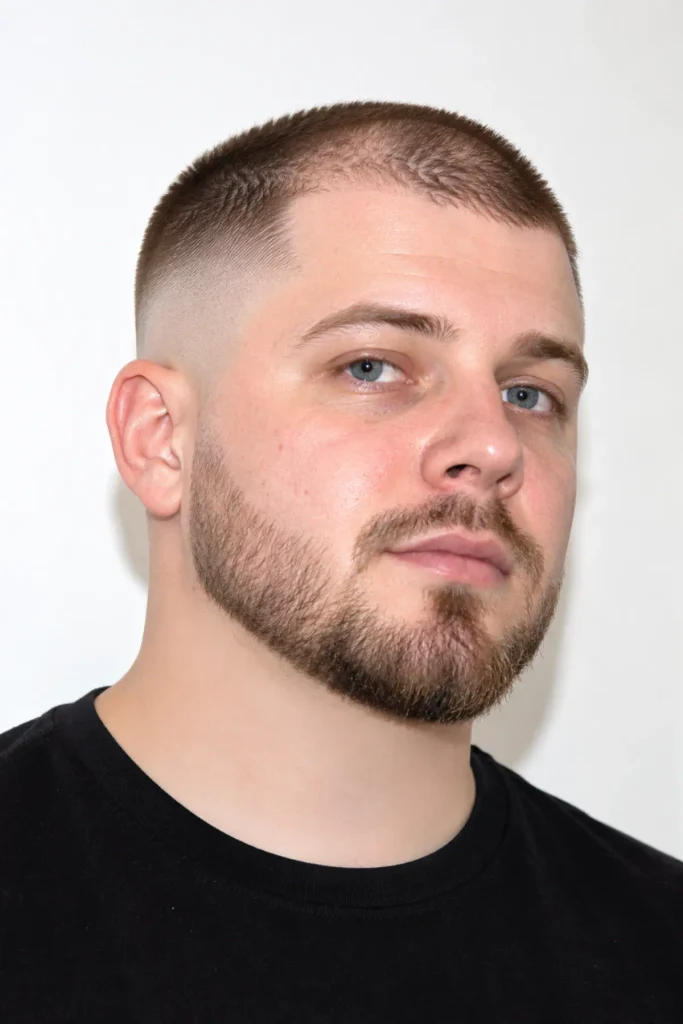
A one-length buzz follows the curve of the skull, which can make a round head look rounder. A buzz with a high skin fade is different, because the sides disappear and the top keeps a visible step. Many barbers pair it with a short boxed beard for extra jaw definition, and the buzz cut fade with beard guide shows how the two work together. It suits most hair textures and densities, thinning hair included.
Styling stops after the cut, but upkeep is the catch, since the fade only looks crisp with a barber visit every 1 to 2 weeks. The order that works is “A number 2 on top with a high skin fade, and a short boxed beard squared off and left a little longer underneath.” Skipping both the fade and the beard is the one real mistake, because a plain, uniform buzz gives a round face nothing to contrast against.
Height Builders
6. Textured Quiff with a Mid or High Fade
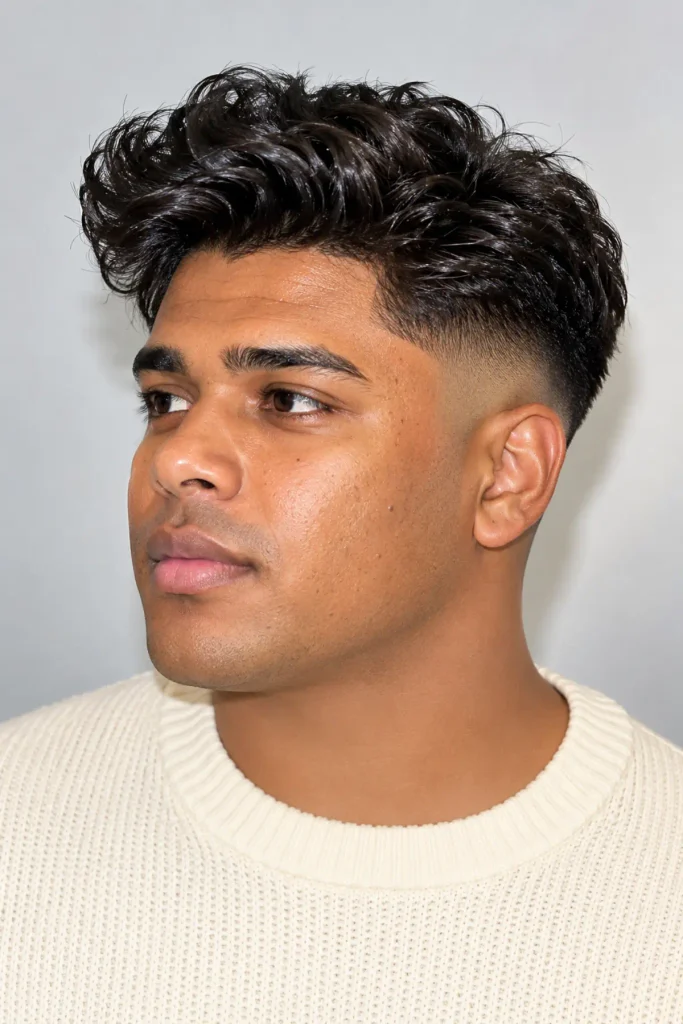
The quiff delivers most of a pompadour’s height for about half the work. The front lifts up and slightly back, the crown stays shorter, and the faded sides keep all the visual weight above the forehead instead of beside the cheeks. Straight, wavy, or loosely curly hair with medium to high density holds it best, with a barber visit every 2 to 3 weeks.
Plan on about a minute of blow drying on damp hair, then clay or putty at the front, lifted with the fingers. The script is “Quiff, about three inches at the front, shorter through the crown, with a mid or high fade and a textured finish.” Fine or thinning hair tends to collapse by afternoon, and a crew cut is the better fit there.
7. Modern Pompadour with Tapered Sides
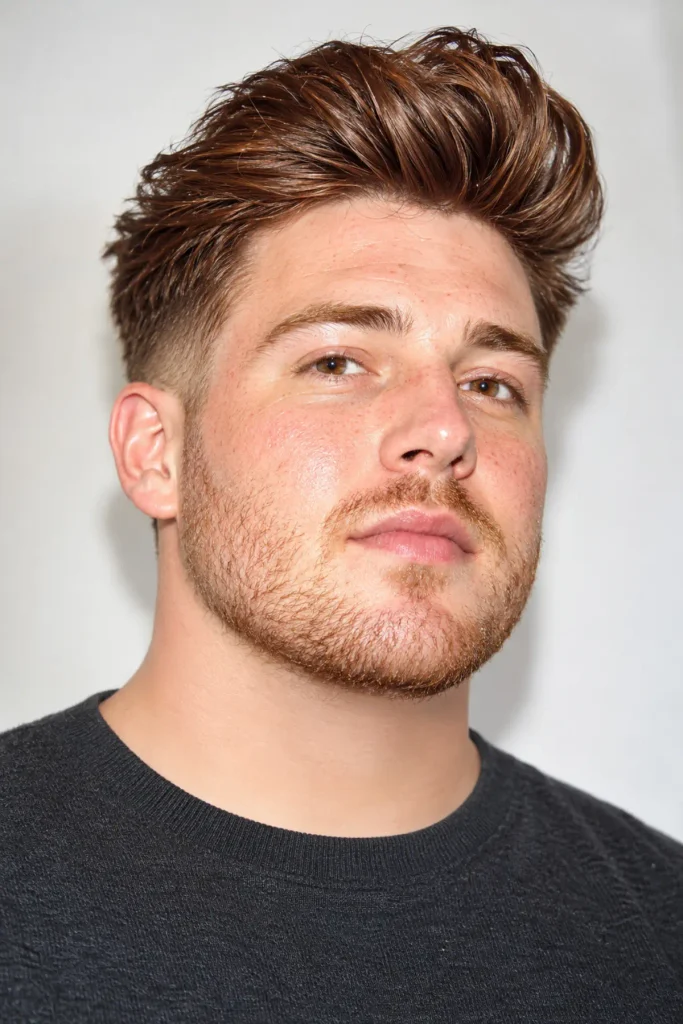
Few cuts add as much height, so few lengthen a round face as dramatically. The modern version is softer and more textured than the glossy old-school helmet. It needs straight or wavy hair with medium to high density, and it is the hardest style on the list to live with, with a barber visit every 2 to 3 weeks.
Barbers suggest at least 3 to 4 inches on top, a round brush, a blow dryer aimed up and back, and then a matte pomade, which adds up to about ten minutes at the mirror each day. The request to bring is “Pompadour with four inches at the front, tight tapered sides, soft layering through the top so it is not one heavy block.” Thin or fine hair struggles to hold it.
8. Brush Up with a High Fade
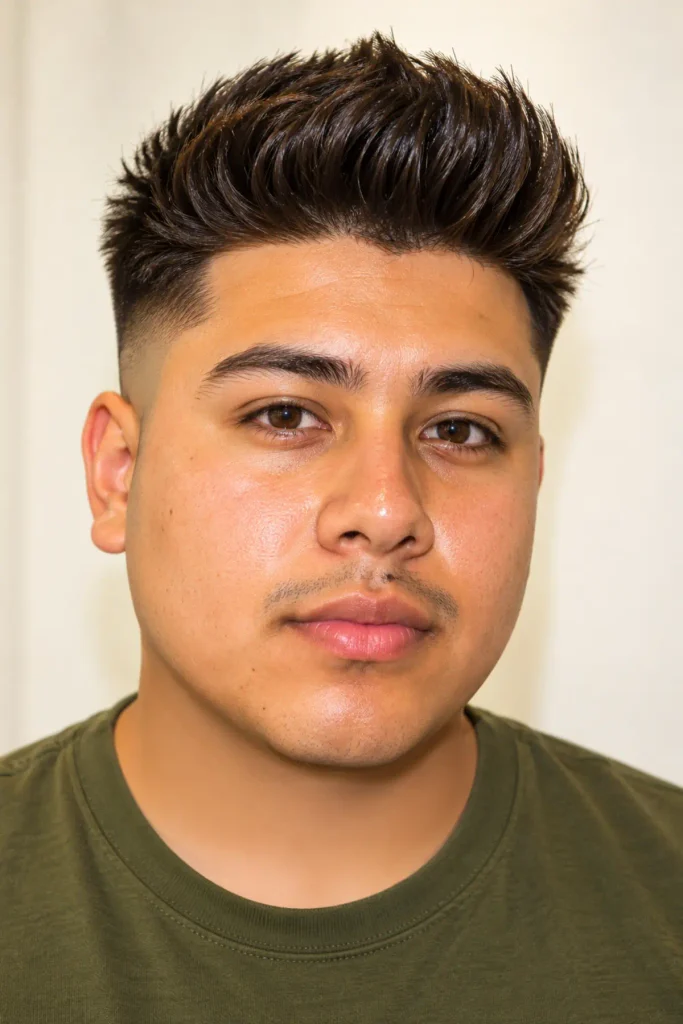
The brush up is the quick way to look sharper. The hair is pushed straight up at the front, and the high fade removes the side weight that makes cheeks look fuller. Straight, wavy, or slightly curly hair at low to medium density works well, and a barber visit every 2 to 3 weeks keeps the fade clean.
The routine is easy: blow dry upward, then work a little putty or powder into the roots. The words to use are “Brush up with a high fade, a textured top with enough length to lift at the front, and a smooth blend with no shelf.” Watch the length, because too much makes the front flop forward and brings back the heavy fringe look.
9. Faux Hawk with a Burst Fade
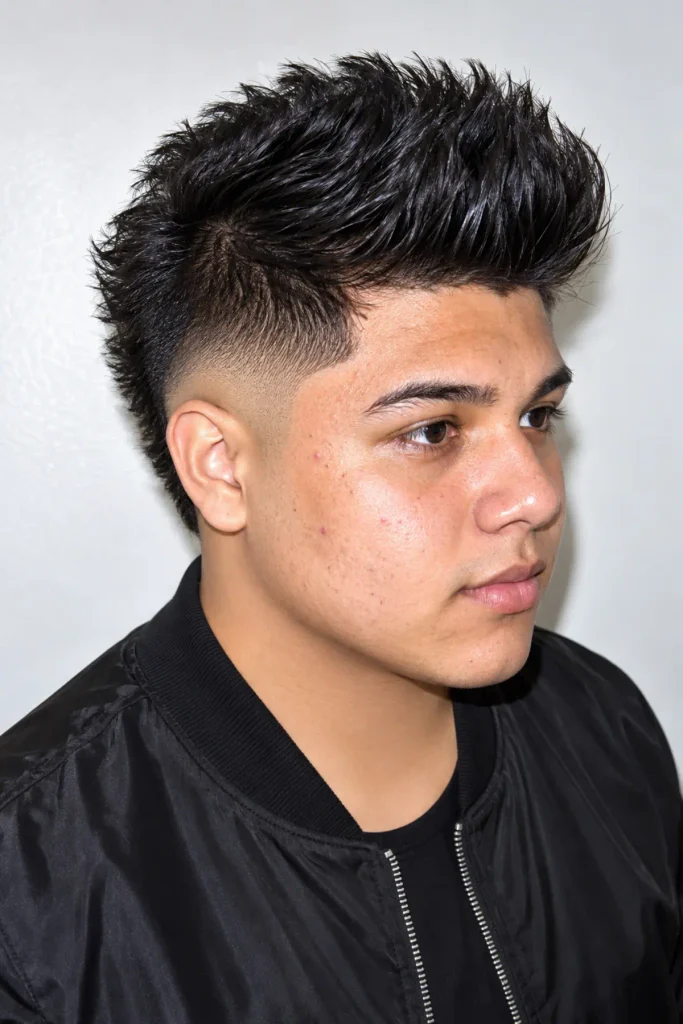
A strip of height runs down the center of the head while the burst fade curves around the ears. The ridge is a very direct vertical line. Thick, straight, or wavy hair with medium to high density is the starting point, and the barber chair becomes a regular stop, about every 2 weeks, because the burst fade needs frequent clean-ups.
Styling is moderate: matte clay through the center strip, pushed up and slightly back. The ask is “Faux hawk with a burst fade around the ears, longer through the center, sides kept tight.” It is also a bold look, so the dress code at work is worth a thought, and skipped clean-ups let the fade grow out unevenly.
10. Spiky Textured Top with a Fade
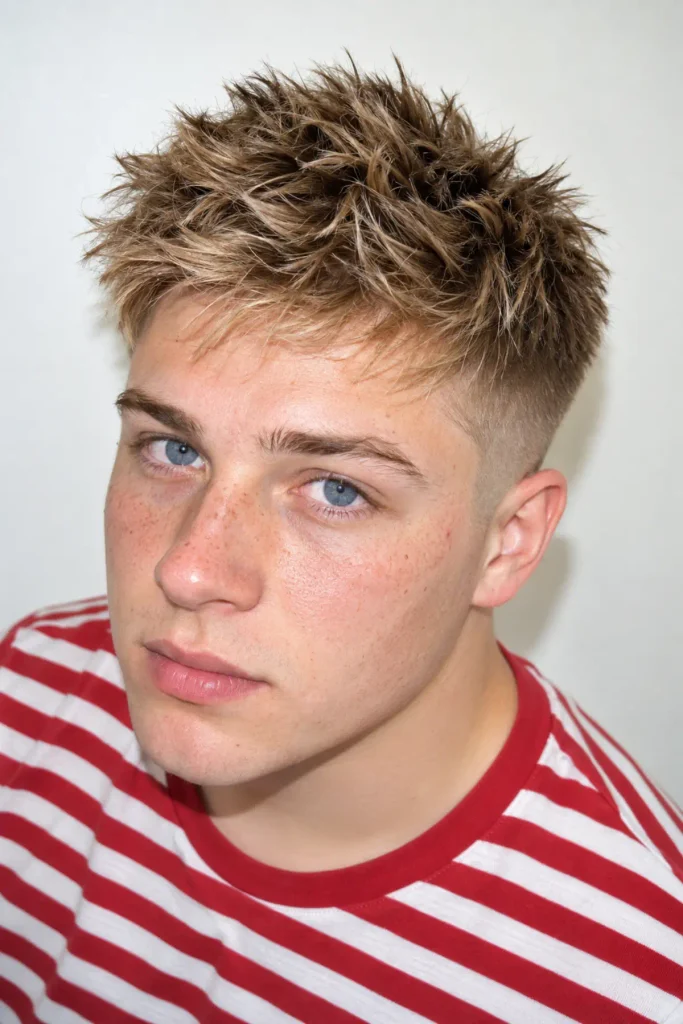
Spikes turn the length that is already there into visible height, and a choppy top breaks up the smooth curve of the outline. Today’s version uses matte paste and soft separation rather than the stiff gel of the early 2000s. Straight or wavy hair at any density works, tight curls get the same effect with a sponge and a shape-up, and a barber visit every 2 to 3 weeks keeps it neat.
Styling takes about two minutes with a matte paste or clay. The order is “A short choppy top, point cut for separation, faded to a number 2 on the sides.” Two things date the look: heavy, shiny gel, and wide-set spikes that add width instead of height.
Cuts That Add an Angle
11. Side Part with a Fade
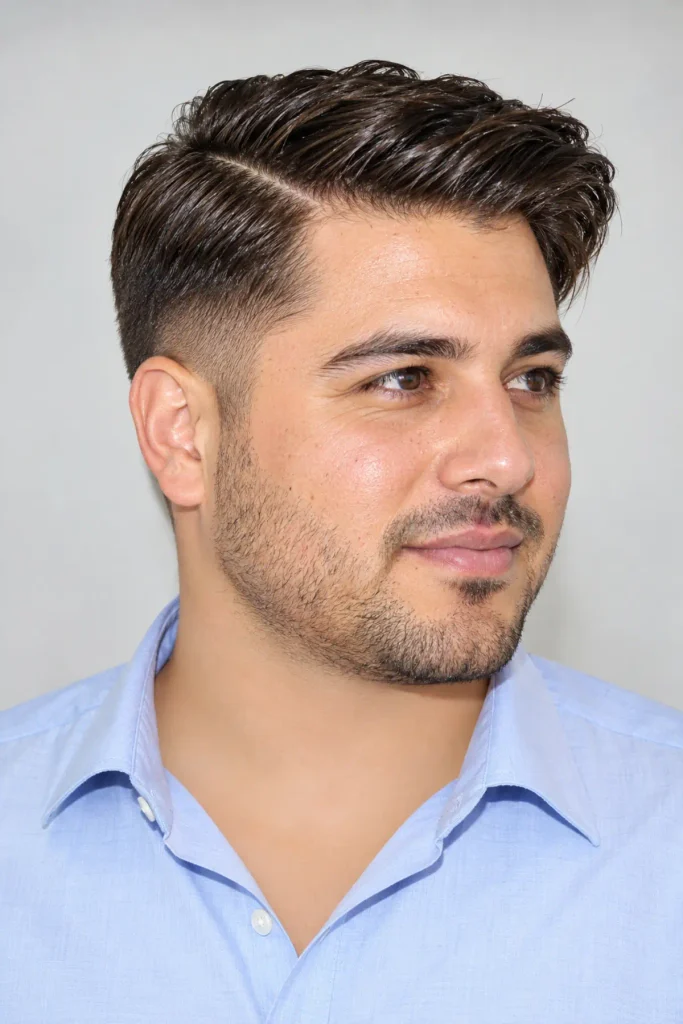
The part is the sharp line a round outline is missing, and the short sides against a longer top make the head look taller than it is. It is also the easiest cut to wear in a conservative workplace, which is why it shows up in the office hairstyles for men conversation so often. Straight to wavy hair that holds a part, at low to medium density, is the best match.
Upkeep sits at a barber visit every 3 to 4 weeks, with a comb and a light pomade or clay for styling and a little lift at the front. A solid request is “Side part with a hard part on the natural parting, tapered sides, and scissor length on top.” Two snags to know: a dead-center part reads flat on a round face, and a stubborn cowlick at the part line needs the barber’s input.
12. Hard Part Comb Over with a Drop Fade
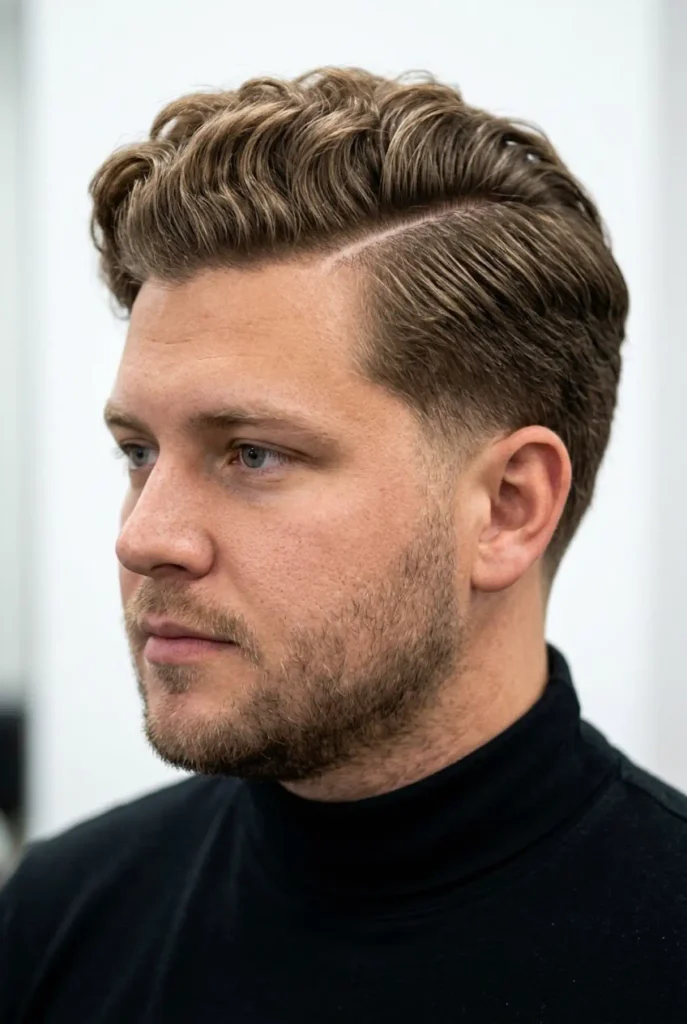
A hard part is a thin line shaved right into the hair, and it adds a crisp, straight edge. The drop fade curves down behind the ear, which keeps the profile narrow from the side. Straight or wavy hair at medium density suits it, and the upkeep is steep, a barber visit every 2 weeks, since the shaved line fades fastest.
Styling is moderate: matte clay, combed across, with a little volume at the front. The ask is “Comb over with a hard part, about two and a half inches on top with the wave left in, and a blended drop fade.” A thinning crown shows more in a comb over, and a soft, undefined part loses the whole point.
13. Angular Fringe with Tapered Sides
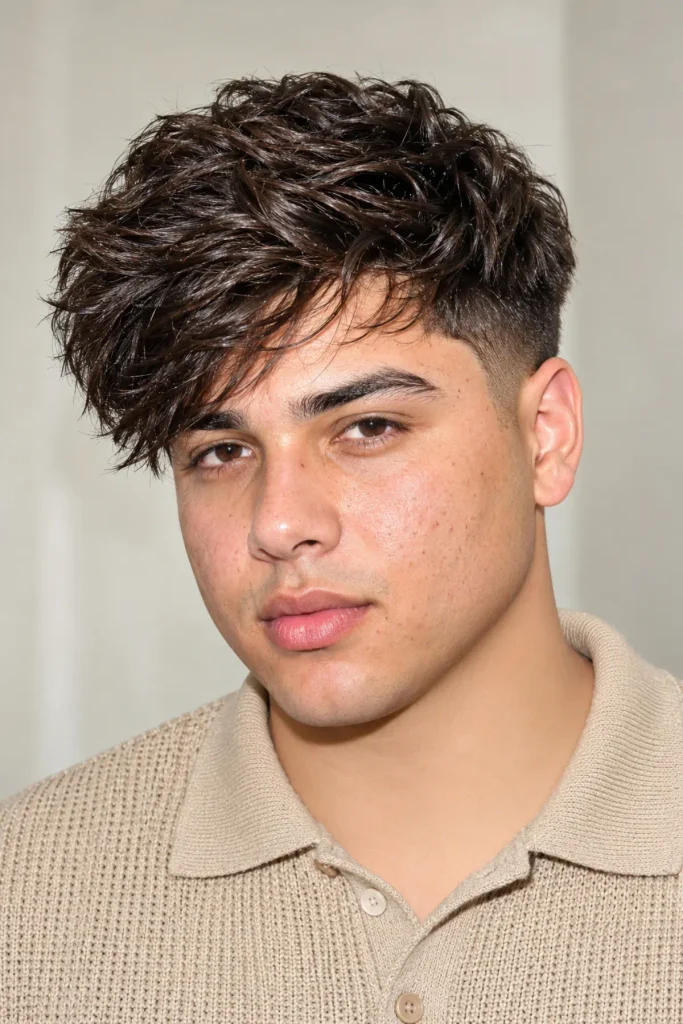
A fringe cut on a diagonal draws the line that a round face does not have. The same length cut straight across does the opposite, since it adds a horizontal bar and makes the face look wider. Men who like longer fronts can browse more ideas in the fluffy fringe haircuts for men guide. Straight or wavy hair with some natural texture and medium density works best, with a barber visit every 2 to 3 weeks.
Styling is easy to moderate: a little styling cream or powder, then the fringe is pushed across the forehead and pinched into pieces. The words are “Angular fringe, longer on one side and cut on a diagonal, textured on top, with the sides tapered short.” Very fine, dead-straight hair can split into strands and lose the angle, so a side part is the safer choice there.
14. Short Slick Back with a Low or Mid Fade
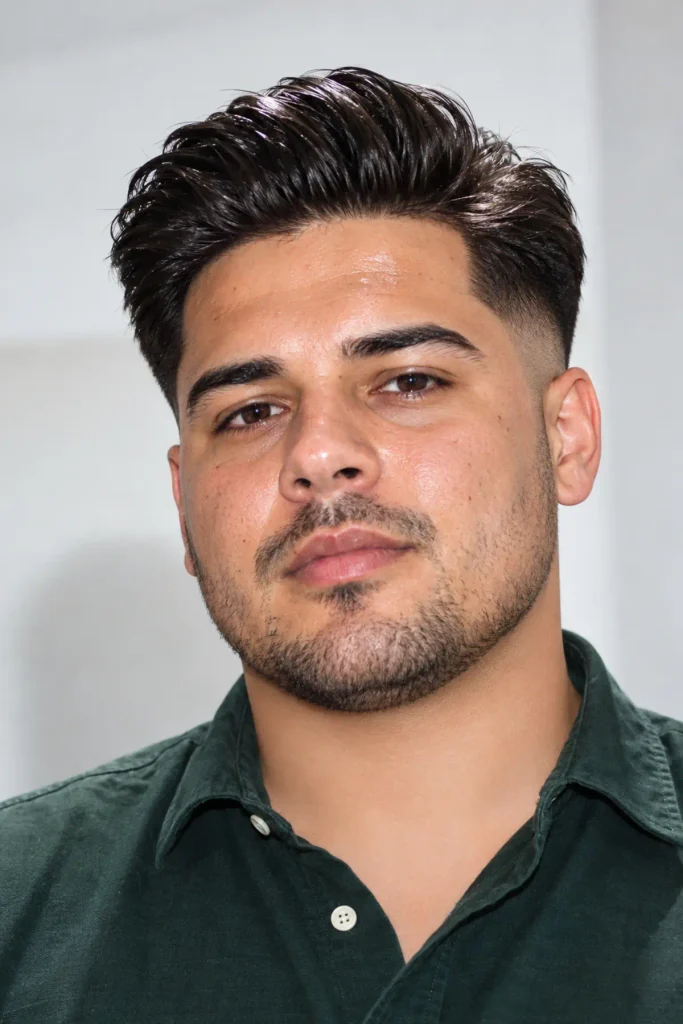
Slicking hair back clears the forehead, and a fully visible forehead reads as extra length. The cut needs enough length on top to comb backward and a fade that stops the sides from ballooning past the temples. Thick, straight, or slightly wavy hair does this job best, since it has the weight to stay combed back without flopping forward. Medium to high density is the sweet spot, because thin spots show up fast once everything is pulled off the forehead.
A barber visit every 3 to 4 weeks keeps the shape sharp, and the morning routine is about five minutes: blow dry the hair up and back first for lift, then comb it through with a little pomade. At the chair, a clear request works wonders: “About two inches on top to comb back, a mid fade, and squared corners at the temples.” The one trap is pressing the hair completely flat, which throws away the height a round face needs.
15. Textured French Crop with a Point-Cut Fringe
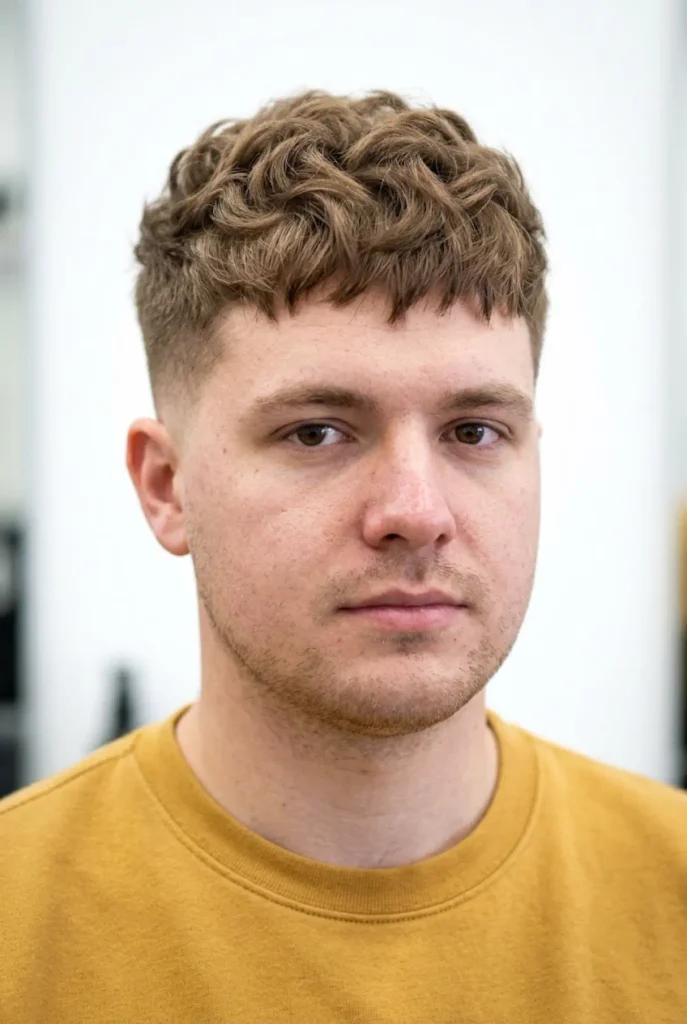
A French crop sounds risky because it has a short fringe, but the point-cut version is the fix. The fringe is cut into short, uneven pieces above the brow instead of a solid line, and the mid fade keeps the sides tight. Hair from straight to wavy with medium to high density is all it takes, and a barber visit every 2 to 3 weeks keeps the fringe uneven in the right way.
Styling is about as easy as it gets, a little matte clay worked in with the fingers. The request is “French crop, about an inch and a half on top, the fringe point cut short and uneven, with a mid skin fade.” A heavy, blunt fringe sitting at the brow is the one thing to avoid, because it shortens the face and widens it at eye level.
Curly, Wavy, and Coily Hair Ideas
16. Curly Quiff with a High Fade
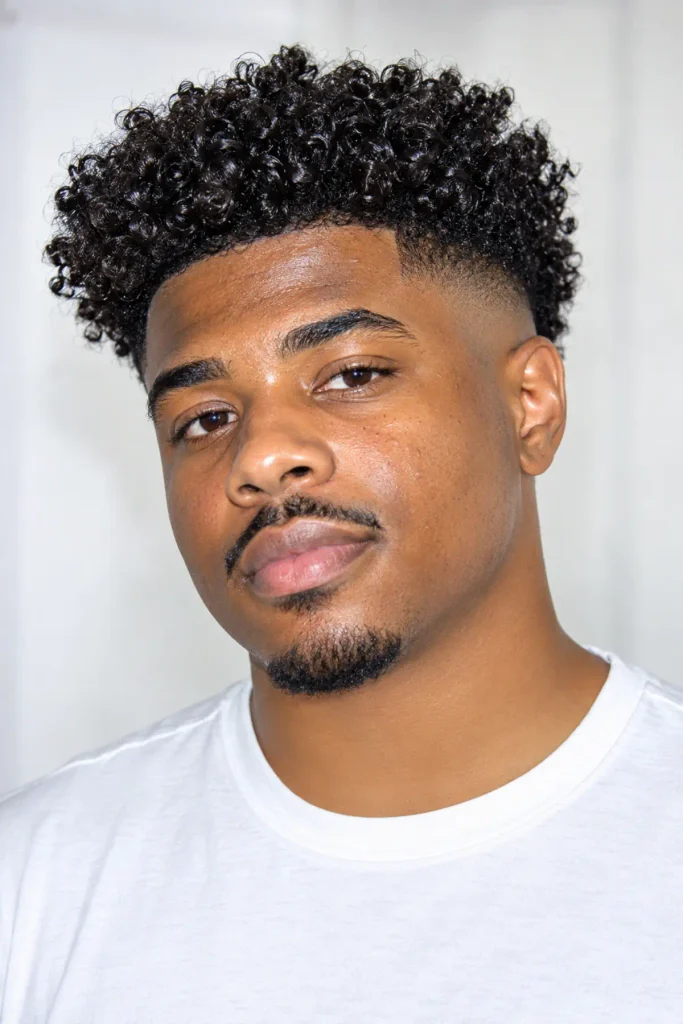
Natural curls grow upward when the sides are kept tight, so the hair builds its own height. The high fade stops the curls from spreading sideways. Curly guys can see more variations in the burst fade haircuts for curly hair guide. It is made for curls, types 3A to 4A, at medium to high density, with a barber visit every 2 to 4 weeks.
Styling is curl cream on soaking wet curls, scrunched upward, then air dried or diffused on low. At the shop, the ask is “High fade, about two inches of curls on top pushed up and forward, a sharp line-up, and cut the curls dry so the real shape shows.” Humid days make curls expand, so a curl cream and a short top matter.
17. Wavy Top with a Temple Fade
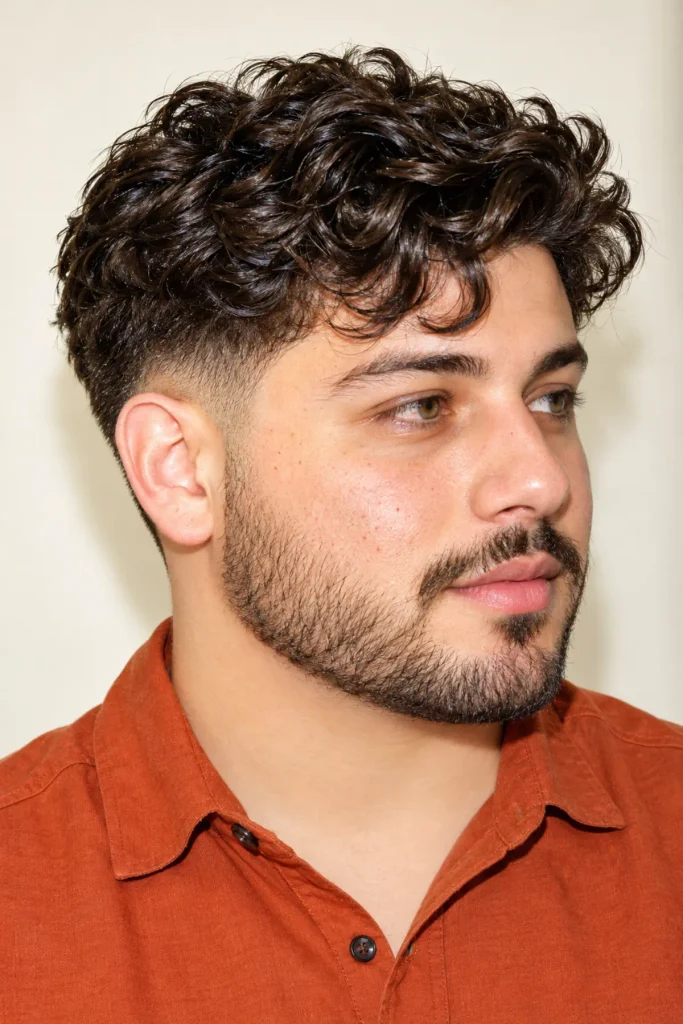
Wavy hair shrinks as it dries and spreads outward as well as up, so a wavy top can add width along with its height. A fade at the temple takes that width back out while the waves stay on top. Wavy hair, types 2A to 3A, at medium density is the target, and a barber visit every 2 to 4 weeks is enough.
Styling is easy: curl cream or sea salt spray, then air dry without brushing. The order is “About two inches on top with the wave left natural, a fade at the temples and nape, and the beard shaped to the jawline.” Overworking the hair with a brush flattens the waves and brings back the roundness.
18. Short Afro with a Shape-Up
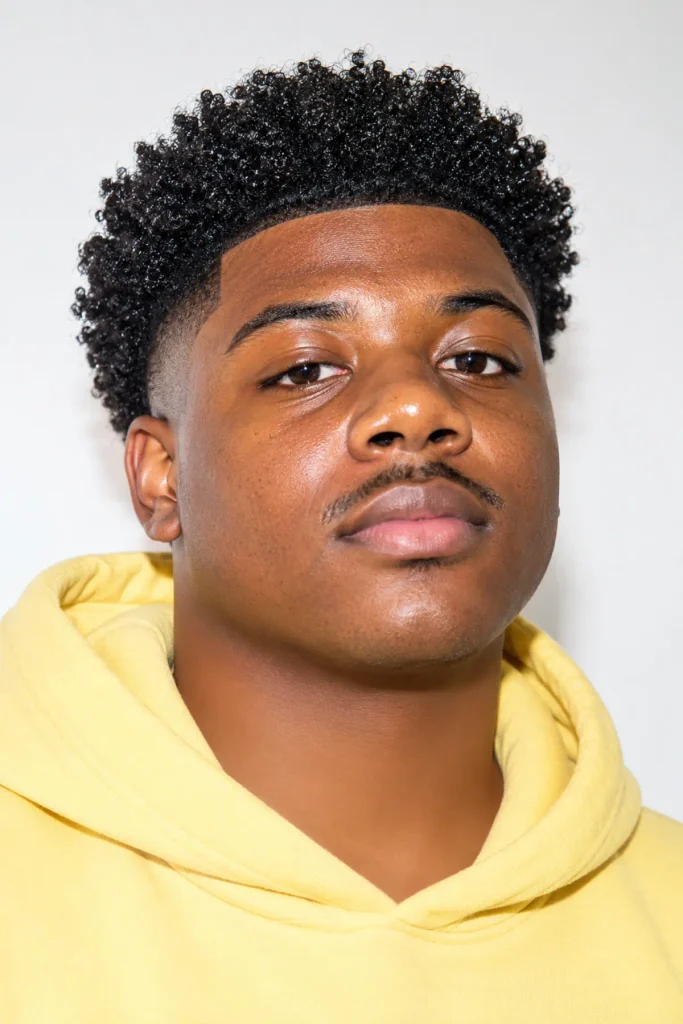
A short afro follows the same rule as a pompadour. It is shaped tall rather than wide, with a low or mid fade holding the sides close and a sharp line-up at the forehead and temples adding the angle. Coily hair, types 4A to 4C, suits the cut across most densities, and the shape-up needs frequent attention, with a barber visit every 1 to 3 weeks.
Styling is easy: a pick, a moisturizing cream, and a light oil on dry ends. The request is “Short afro, about an inch and a half on top shaped tall rather than wide, a low fade, and a sharp line-up.” A rounded outline with no fade defeats the purpose, and dry hair loses its definition fast.
19. Short Twists with Faded Sides
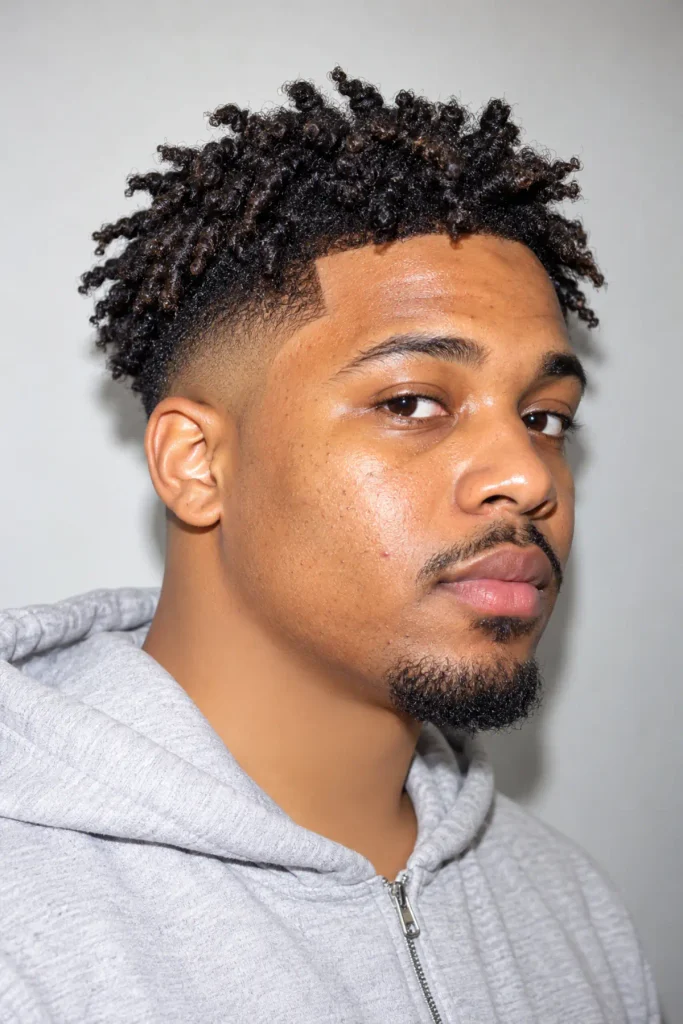
Twists stand up on top while the faded sides stay tight, so all the growth goes upward. A neat goatee can add a little length at the bottom of the face to match the height at the top. Coily or textured hair that holds twists works at medium to high density, and a barber visit every 2 to 3 weeks keeps the sides sharp.
Twists get redone as they loosen, and styling is easy once set: moisturize and retwist as needed. The ask is “Short twists on top, about two inches long, the sides faded short, and a neat goatee with the cheeks shaved clean.” A full, wide beard works against the shape, so the cheeks should stay tight.
20. Curly Fringe with a Low Taper
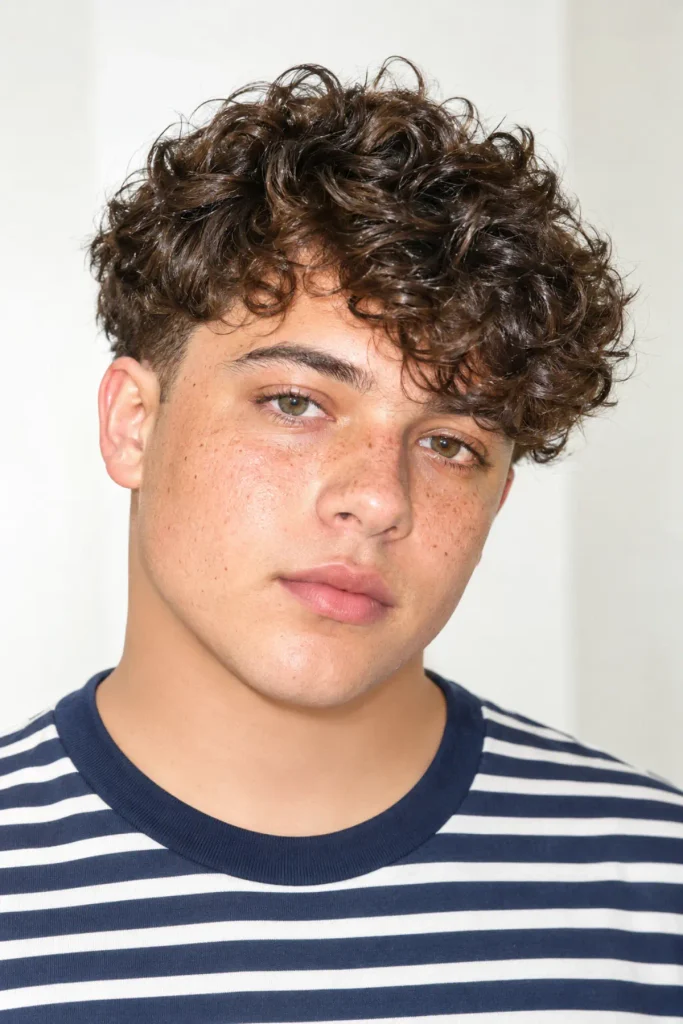
A curly fringe is soft in front and clean on the sides. On a round face, the fringe needs to stay textured and slightly angled, never a heavy, straight shelf across the forehead. Wavy to curly hair at medium to high density is the right canvas, and a barber visit every 3 to 4 weeks does it.
Styling is easy to moderate: curl cream, scrunched upward, with the fringe shaped forward and off to one side. The request is “Curls left longer on top with a broken, textured fringe and light layering, and a low taper around the ears and neckline.” A low taper leaves more at the sides, so the top has to carry real height.
Longer Hair, Thinning Hair, and Silver Hair
21. Layered Medium Flow with Tight Sides

Medium-length hair can suit a round face when the layers move backward instead of puffing out at the cheeks. An off-center part adds the asymmetry, and a slightly longer back than sides creates a subtle lengthening effect. More options live in the medium length haircuts for men guide. Wavy or straight hair with medium to high density works.
It is the low-maintenance pick of the bunch, with trims every 6 to 8 weeks, though styling takes a bit more effort: sea salt spray, a blow dry that lifts the roots, and a quick shake of the ends. The order is “Medium length, layered and scissor blended with no harsh clipper lines, an off-center part, and weight removed from the sides.” Bulk at cheek level and flat, one-length hair both widen the face.
22. Long Layered Waves
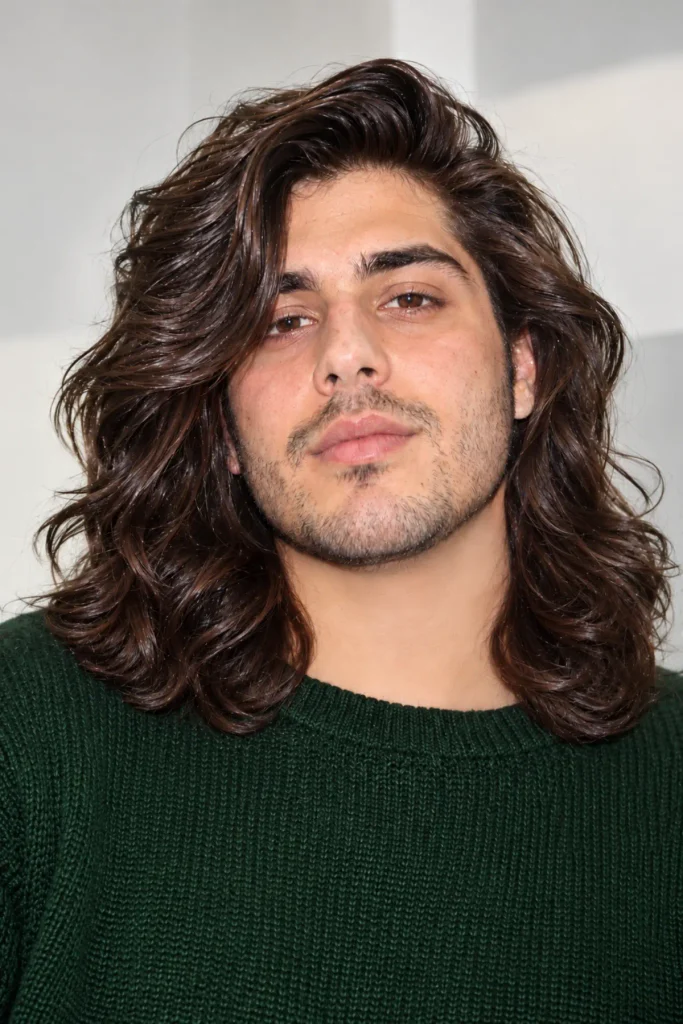
Long hair can work on a round face, but it is the hardest length to get right. Without layers it hangs straight down at cheek level and adds width exactly where it is not wanted. With long layers and a deep side part, it frames the face from the cheekbones down and draws vertical lines. The long layered hair for men page covers the style in more depth.
Wavy or curly hair at medium to high density carries it best, with trims every 6 to 8 weeks and easy to moderate styling: air dry or diffuse, with a texture spray for definition. The ask is “Length past the shoulders with long layers, nothing cut short around the face, and a deep side part.” Thin, limp hair hangs flat, and curtains of hair at cheek level add bulk.
23. Man Bun or Top Knot with an Undercut
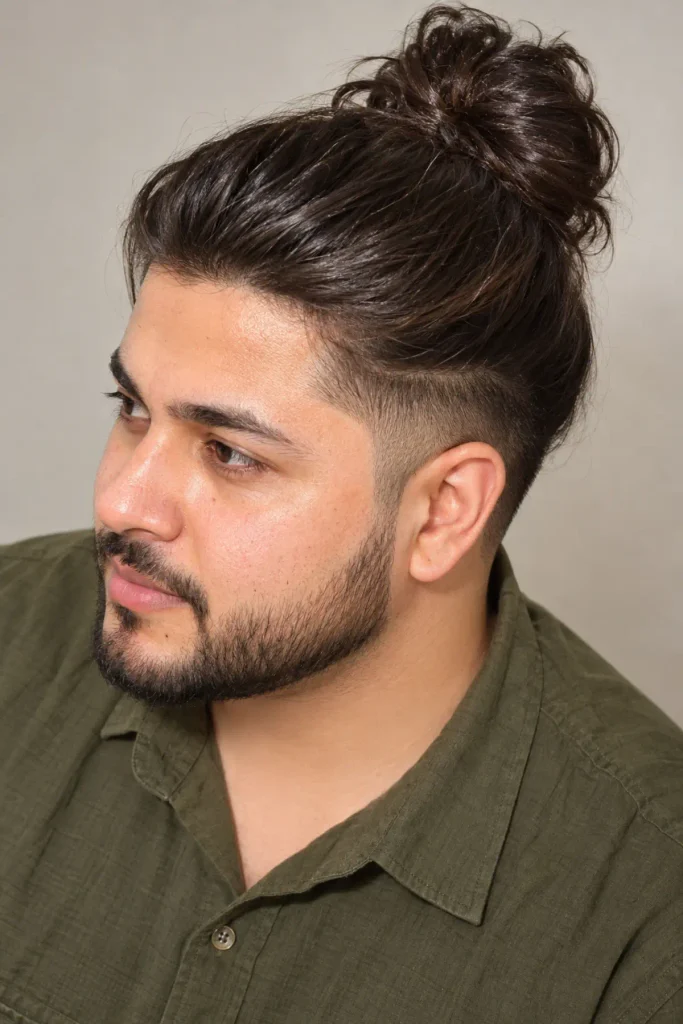
Pulling long hair up creates vertical length, and an undercut removes the side volume that can widen the face. The bun sits high on the crown rather than low at the nape. The man bun hairstyles guide has more ways to wear it. Straight or wavy hair long enough to tie, at medium to high density, is needed, and the undercut asks for a barber visit every 2 to 3 weeks.
The bun itself is easy: gather at the crown, twist, and secure with a soft tie. The order is “Undercut on the sides, with enough length on top to tie into a high bun, and a tidy neckline.” One health note: the American Academy of Dermatology warns that tightly pulled styles, including buns, can cause traction alopecia, so the tie should stay loose.
24. Short Crop for Thinning Hair

Height is the usual advice, but it takes hair on top to build it. When the hair is thinning, going shorter works better than fighting for volume. A neat short back and sides with the top kept short still looks deliberate, and a faded buzz works too. The short haircuts for men with fine hair guide has more ideas for low density hair. Fine or thinning hair at low density, including a receding hairline, is exactly who this cut is for.
Upkeep runs low to moderate, a barber visit every 2 to 4 weeks, and styling is very easy, with optional light texture powder at the roots. The ask is “Short back and sides with the top kept short and neat, no attempt at height, and the sides cut close all the way round.” A haircut cannot fix the cause of hair loss, so a board-certified dermatologist is the right first call for rapid or patchy thinning.
25. Silver Crop for Gray Hair

Gray and silver hair looks sharp when kept short and clean, and at this length it needs little more than a regular wash. Leaving enough length on top to sweep to one side gives the cut its asymmetry, and the close sides keep the width down. A short, neat gray beard completes the shape, and a barber visit every 3 to 4 weeks is plenty.
Gray or silver hair at any density works, and the cut is especially popular with men over 50. Styling is a little light paste or just a comb. The order is “A number 1 on the sides tapered to the neck, about an inch and a half left on top, and the front combed over to one side.” At this length every uneven line shows, so the fade should stay blended and the line-up squared at the corners.
Cuts That Only Work Sometimes
Barbers do not agree on everything, and a few popular cuts get mixed reviews on round faces. These come with conditions.
| Cut | Works when | Skip when |
|---|---|---|
| Middle part | The part sits slightly off center, the hair is layered, and the sides stay slim | The part is dead center and the hair falls flat to the cheeks |
| Mullet | The sides are faded short and the top has some lift, as in the burst fade mullet | The sides are fluffy and the top is flat |
| Wolf cut or shag | The layers stack upward at the crown and the sides are tapered, as in the wolf cut for men and shaggy haircuts for men | The layers sit at cheek level and add bulk |
| Caesar cut | The fringe is point cut, short, and uneven | The fringe is a blunt, straight line |
| Low fade | The top has real height, as in a quiff or pompadour | The top is flat and the sides keep fullness at the widest point |
Round Face Haircuts by Hair Type
| Hair type | What it does | Best bets |
|---|---|---|
| Straight | Holds parts and fade lines sharply but lies flat without help | Side part, Ivy League, crew cut, textured crop, quiff with root lift |
| Wavy | Lifts naturally, but waves spread outward as they dry | Wavy top with a temple fade, textured quiff, comb over |
| Curly | Builds volume at the crown on its own | Curly quiff, curly fringe, high fade with a curly top |
| Coily | Grows up and out, so shape matters most | Short afro with a shape-up, twists with faded sides |
| Fine or thin | Struggles to hold height, so light products and shorter cuts win | Crew cut, short textured crop, buzz with a high fade |
| Thick or coarse | Holds height easily but adds bulk at the sides | Pompadour, faux hawk, brush up with a high fade, with weight removed from the sides |
Hair Density Guide
Density means how much hair grows per square inch, and it decides whether a cut holds its shape or falls apart by lunch. A simple test: if the scalp shows easily through dry hair at the crown, the density is low.
- Low density: short crops, crew cuts, and faded buzz cuts. Height is difficult to build, so the cut should not depend on it.
- Medium density: almost every idea in this guide works, from the textured crop to the quiff.
- High density: pompadours, faux hawks, and slick backs hold beautifully. The barber should remove weight around the temples so the shape stays narrow.
Round Face Haircuts by Age and Lifestyle
- For the 20s: bolder looks like the faux hawk, spiky texture, and curly quiff are easy to try, and the fade can be sharp.
- For the 30s and 40s: the side part with a fade, the modern crew cut, and the textured crop keep the look polished at work without a long routine.
- For 50 and over: a silver crop, a short cut for thinning hair, or a clean fade with a short beard looks sharp and needs very little time.
- For the office: side parts, Ivy League, and tapered crops stay conservative while still adding height and an angle.
- For an active routine: a short textured crop or a faded buzz survives the gym without much fuss.
- For a no-fuss morning: the crew cut, the short back and sides, and the layered medium flow ask for the least styling time.
Beards and Facial Hair with a Round Face
A beard does the same job as a haircut, only lower on the face. Short sides and a longer chin draw the face downward and add the jaw definition a round face lacks. Most beard guides agree on the basic rule: keep the cheeks short and let the chin carry the length.
| Beard | Effect on a round face | Verdict |
|---|---|---|
| Goatee or extended goatee | Puts a point at the chin to add length | Great |
| Anchor | Narrows to a pointed chin for sharper angles | Great |
| Ducktail | Longer, pointed chin with shorter sides | Great |
| Van Dyke | Mustache and chin beard that stretch the face downward | Great |
| Short boxed beard | Short sides with a little extra length at the chin | Great |
| Heavy stubble with a crisp cheek line | Sharpens the lower face without bulk | Good |
| Full beard with thick sides | Adds width at the cheeks | Skip |
| Muttonchops or thick sideburns | Widen the face | Skip |
| Chin strap with no length at the chin | Only outlines the roundness | Skip |
The neckline matters just as much. A common barber tip is to trim everything below a point about two fingers above the Adam’s apple and keep that edge sharp. Anyone growing a full beard should ask the barber to take the cheek line up and keep the length at the chin.
What to Tell the Barber
Barbers work from pictures and numbers, so a photo plus four details gets the closest result.
- The top: how many inches, and whether it should be textured, smooth, or swept to one side.
- The fade: where it starts (low, mid, or high), whether it goes to skin, and which guard to blend into.
- The angle: a part, a hard part, a diagonal fringe, or a squared line-up.
- The beard: boxed, pointed, or short, with the cheeks kept tight.
A good opening line is: “I have a round face, so I want height on top and tight sides that make my face look longer.” Before the appointment, it helps to know the hair type, how many minutes there are to style each morning, and what the workplace allows. If the barber disagrees with the plan, a polite question about why usually leads to a better compromise, such as a mid fade instead of a skin fade for a more conservative office.
How to Style Hair for Height
The routine is the same for most of the cuts above, and it takes about five to ten minutes once it becomes a habit.
- Start damp. Towel dry the hair so it is damp, not dripping.
- Add a pre-styler. A light mist of sea salt or volumizing spray at the roots builds a base, especially for fine hair.
- Blow dry up and back. Use a round or vent brush, work in sections, and lift at the roots.
- Let it cool. Hair sets in the shape it cools in, so the brush stays in place for a few seconds.
- Finish with product. Matte clay gives texture, pomade gives shine and hold, and texture powder adds lift without weight. Fine hair does best with a lighter clay or fiber pomade.
- Press the sides flat. Keep product off the faded sides so the silhouette stays narrow.
Upkeep, Cost, and Grow-Out
| Cut type | Typical barber visit | How it grows out |
|---|---|---|
| Skin fade, hard part | Every 1 to 2 weeks | Shows regrowth fastest |
| Mid or high fade | Every 2 to 4 weeks | Loses the slimming effect once the sides fill in |
| Taper, crew cut, Ivy League | Every 3 to 4 weeks | Grows out most naturally |
| Layered medium or long hair | Every 6 to 8 weeks | Layers hide growth, but the sides need watching |
Cuts with more length on top stretch further between visits, because a little extra growth shows less than it does on a skin fade. On cost, published price guides put the average U.S. men’s haircut anywhere from the high $20s to the low $40s, and local prices swing a lot by city and shop. Fades and beard work can cost more, so asking the shop for its price before sitting down is the safest move. A grown-out fade is the signal to switch cuts or book the next visit, since the lengthening effect depends on tight sides.
Mistakes to Avoid
- Leaving bulk at the temples and ears. This is where a round face is widest, so extra hair here undoes the whole cut.
- Pairing a low fade with a flat top. A low fade leaves fullness at the sides, so the top has to carry real height.
- Cutting a blunt, straight fringe. It adds a horizontal bar and makes the face look shorter and wider.
- Styling flat. A quiff or crew cut brushed down loses the lift that makes the whole cut work.
- Overloading on product. Too much heavy gel or pomade weighs fine hair down and removes the height.
- Wearing a round, bushy beard. It extends the circle instead of breaking it up.
- Skipping touch-ups. A round face looks less sharp as soon as the fade grows out.
- Choosing a cut that ignores hair type. A pompadour on thin hair falls flat, no matter how good the photo looked.
FAQs
What is the best haircut for a round face man?
The best haircut for a round face man adds height on top, keeps the sides short, and includes one sharp angle. A textured crop with a mid fade, a quiff, a pompadour, or a side part with a fade all follow that formula. The right pick depends on hair type, density, and styling time.
What hairstyle makes a round face look thinner?
Styles that lift the hair at the front and tighten the sides make a round face look longer and narrower. Quiffs, pompadours, brush ups, and faux hawks do this best, and a diagonal fringe or hard part adds an angle. A short boxed beard can add jaw definition too.
Is a buzz cut good for a round face?
A buzz cut can work, mainly with contrast. A buzz with a high skin fade keeps a visible step on top, and a short boxed beard adds jaw definition. A plain, one-length buzz follows the curve of the skull and can make a round head look rounder.
Do fades work for round faces, and which fade height is best?
Yes, fades work well because they remove width at the sides. Most barber guides favor a mid or high fade for the strongest slimming effect. A low fade can still work when the top has real height, as with a quiff or pompadour. Skin fades need a trim every 1 to 2 weeks.
Should men with round faces have long or short hair?
Both can work. Short hair needs height on top and tight sides. Longer hair needs layers, a part that sits off center, and nothing bulky at cheek level. Long hair without layers hangs straight down and tends to add width, so it is the harder choice.
Can men with round faces wear a fringe?
Yes, if the fringe is textured and angled. A diagonal, point-cut, or side-swept fringe adds an angle and keeps the top taller than the sides. A heavy, blunt fringe cut straight across adds a horizontal bar, which makes the face look wider and shorter.
Does a beard help a round face?
Yes, when the shape is right. Short sides with a longer chin, such as a goatee, anchor, ducktail, or short boxed beard, add length and jaw definition. Full beards with thick sides, muttonchops, and chin straps without chin length add width or only outline the roundness.
What is the best haircut for a round face and thinning hair?
Going shorter usually works best. A crew cut, a short back and sides with a neat top, or a buzz cut with a high fade keeps the proportions balanced without needing much hair. A pompadour or tall quiff tends to fall flat when the hair is thin.
What works for a round face with curly or coily hair?
Curly and coily hair already grows upward, so the sides should stay tight. A high fade or taper with a curly quiff, curly fringe, short afro, or twists on top builds height. Barbers often cut curls dry so the real shape is visible.
How can men tell if they have a round face?
Pull the hair back and compare four measurements: forehead, cheekbones, jawline, and face length. A round face has cheekbone width and face length that are very close, both larger than the forehead and jaw, with a soft, curved jaw and no strong corners.
Can a haircut change face shape?
Not literally. A haircut changes how long, wide, and angular the face looks, but it cannot change bone structure or cheek fullness. The goal is balance, and the right height, fade, and angle change the proportions the eye sees.
Final Thoughts
A round face does not need to hide. It needs balance, and the formula stays the same across every cut in this guide: height on top, tight sides, and one clean angle. From there, the best pick comes down to hair type, density, and how much time goes into styling each morning. Showing a barber a photo, naming the fade height, and asking for texture on top gets most men the result they want on the first visit.
One thought on “Round Face Shape Haircuts For Men: 25 Ideas”