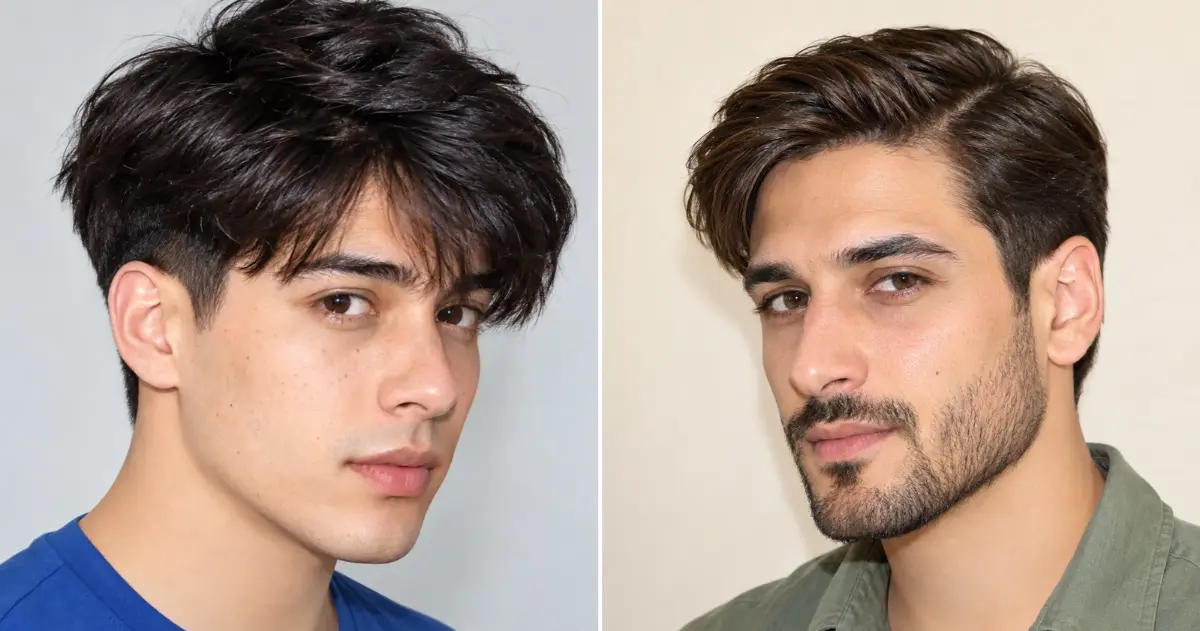
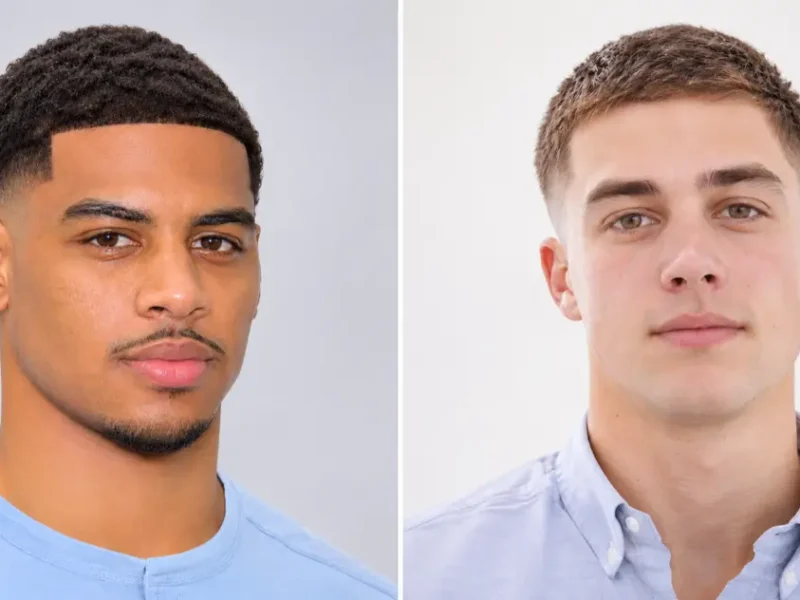
The best haircuts for men with an oblong face add width at the sides and keep height on top modest. Textured crops, French crops, side parts, curtain fringes, layered medium cuts and flowing waves all work well, while tall pompadours, high skin fades and flat, sleek, long styles tend to stretch the face even more.
| Goal | What to choose | What to skip |
|---|---|---|
| Shorten the look of the face | Fringe, forward texture, French crop, curtain fringe | Tall quiffs, sharp vertical height |
| Add width | Side volume, waves, layers over the ears, low tapers | Skin fades that strip the sides, flat slicked sides |
| Soften a long jaw or chin | Medium length with movement, a lightly fuller beard | Long, pointed beards, very tight sides |
| Keep it easy | Textured crop, Ivy League, messy medium cut | High maintenance sharp lines |
A simple rule of thumb: keep the top to about a finger or two of height, leave some weight around the temples and ears, and choose a low taper over a high fade.
Men with a long face often notice that a tall pompadour or a skin fade, which looks great on a friend, only stretches their face further. The right oblong face hairstyles for men fix this with small changes: modest height on top, more width at the sides and a fringe or forward texture.
This guide covers 20 flattering haircuts, from short crops to loose waves, with plain notes on who each one suits, how to style it and what to tell the barber. It also explains the fade choices that help and the mistakes that make a long face look longer.
Table of Contents
What Is an Oblong Face Shape?
An oblong face is longer than it is wide, with a forehead, cheekbones and jawline that are all about the same width. The sides of the face run fairly straight, the chin can be slightly rounded or squared off, and the forehead often looks tall. It is sometimes called a long or rectangular face, and it is easy to confuse with an oval face, which is also longer than wide but has gentler, more curved edges.
A quick self-check takes a minute. With the hair pulled back and a mirror in front, three things are worth checking:
- Length: Is the face clearly longer than it is wide, measured from the hairline to the chin and then across the cheekbones?
- Width: Are the forehead, cheekbones and jaw close to the same width, with no one area standing out?
- Sides: Do the cheeks run fairly straight down instead of curving in, as they would on a heart or diamond shape?
If most answers are yes, the face is probably oblong. Face shape is a guide, not a rule, and hair type, hairline and personal taste matter just as much. Men with a different shape can also compare options in guides such as men’s hairstyles for a heart face shape or triangle face shape hairstyles for men.
Styling Rules for an Oblong Face
The goal with an oblong face is balance. Every rule below is about making the face read as a little shorter and a little wider, without making the haircut look forced.
- Keep height on top modest. A tall quiff or pompadour adds length. Aim for a finger or two of height at most, and let the top fall forward or sideways instead of straight up.
- Add width at the sides. Leave some weight around the temples and ears. Waves, layers and a softly blended taper all help the head look wider.
- Use a fringe or forward texture. Hair that falls over part of the forehead shortens the visible length of the face.
- Choose a low taper over a high fade. A high skin fade removes the width at the sides, which exaggerates length. A low taper or a classic scissor cut keeps more shape.
- Avoid long, flat and straight styles. Long hair that hangs flat and sleek pulls the face downward. Add layers, texture or natural wave.
- Let the beard support the shape. A fuller beard with some width on the cheeks balances a long face better than a long, pointed beard that adds extra length at the chin.
These rules sometimes seem to clash in other guides. One article praises a quiff while another warns against it. The difference usually comes down to degree: a low, textured quiff with fuller sides can work, while a tall, narrow one with skin faded sides will not.
20 Best Oblong Face Hairstyles for Men
The ideas below run from short to long, so there is a fit for almost every hair type and routine. Barber visit times are typical ranges, since hair growth and personal standards vary from man to man.
1. Textured Crop With a Low Taper
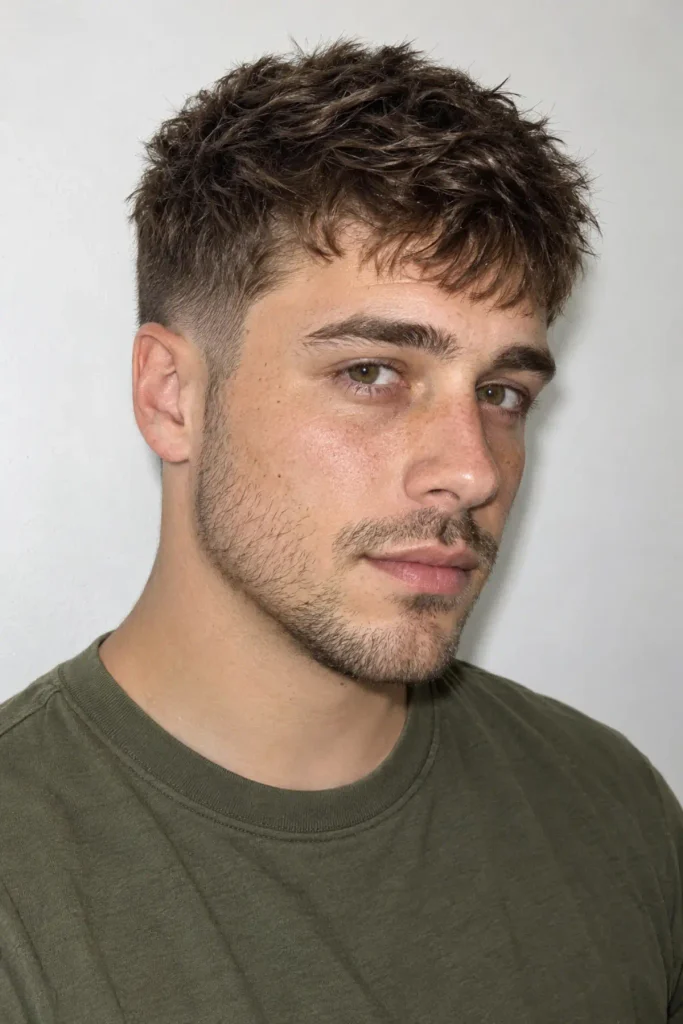
If one cut had to be named as the safest bet for an oblong face, most barbers would point to the textured crop. The top is cut short and choppy, then pushed forward into a loose fringe that sits just above the brows, which shortens the forehead without any fuss. The low taper around the ears keeps enough weight at the sides, so the head never looks squeezed. Straight and wavy hair both work, and men with finer strands can find extra ideas in these short haircuts for men with fine hair.
Daily styling is almost an afterthought: a pinch of matte clay worked through towel dried hair and pushed forward with the fingers. A trim every 3 to 5 weeks keeps the shape, though the cut forgives a late appointment better than most, since it simply grows into a messy medium style. The main complaint comes from men with strong front cowlicks, who sometimes need the fringe cut a little longer so it lies flat.
2. French Crop

The French crop owes its popularity to one detail, the blunt fringe cut straight across the forehead. On an oblong face that line works like a visual shortcut, covering the upper forehead so the face reads as shorter and a touch wider. It also hides a receding or high hairline better than almost any other short cut, which explains why barbers recommend it so often.
Styling takes about two minutes with a comb, a little paste and a quick brush forward. Sides in a low or mid taper look best, while a very tight fade tends to undo the benefit. A visit every 3 to 4 weeks keeps the fringe crisp. Very curly or very fine hair can struggle to hold such a straight edge, so those hair types usually do better with the softer textured crop above.
3. Caesar Cut

The Caesar cut is the French crop’s calmer relative, with an even length on top and a short, horizontal fringe that stays still all day. Because the front is combed forward in a flat line, it brings the same horizontal balance to a long face, only with less texture and less effort. Straight to slightly wavy hair with medium thickness suits it best.
A little light wax is usually enough to keep the fringe in place. Some barbers soften the line with a bit of point cutting so it does not look like a bowl, and that small detail makes the difference between a clean cut and a rigid one. It needs a trim about every 3 to 4 weeks. Men with a pronounced widow’s peak or a stubborn crown sometimes find the fringe fights back, and a slightly longer front usually solves it.
4. Ivy League

The Ivy League is the neat, grown up version of the crew cut, with a top long enough to comb to the side and a tapered back. Since the hair at the front is longer than at the sides, there is plenty of length to sweep across the forehead without building any height. It reads as tidy and professional, which makes it a regular pick for the kind of look seen in these office hairstyles for men.
A light cream or pomade on damp hair, then a comb to one side or slightly forward, completes the style. A top of about two to three inches works well, with a low taper at the back and sides. Trims every 3 to 5 weeks keep it sharp. The grow-out is painless, because the cut slowly turns into a classic short side part, so there is rarely an awkward stage.
5. Longer Crew Cut
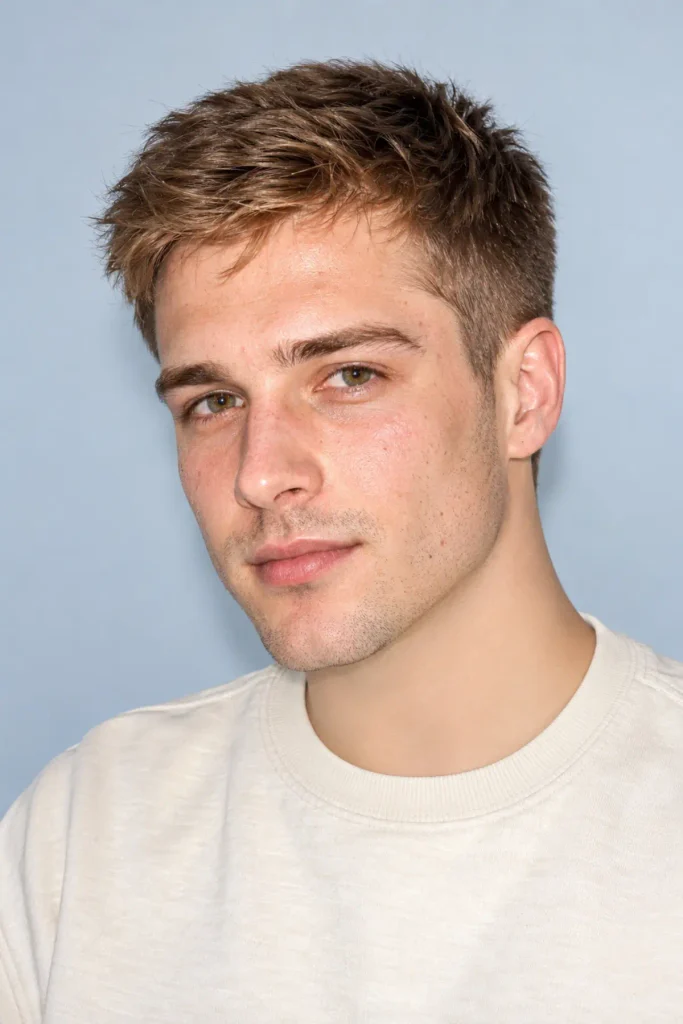
A standard crew cut can look a bit severe on an oblong face, since the short top gives the face nowhere to hide. The longer version solves that by leaving the top at around an inch and a half to two inches, so it falls forward instead of standing up. The sides stay tapered, not faded to the skin, which keeps a little width around the ears.
It suits men who want a cut that needs almost no thought, as long as the hair is straight or wavy and reasonably thick. A dab of paste or a few sprays of sea salt spray adds light texture, and trims every 3 to 4 weeks keep the neckline tidy. Fine hair can go flat with this cut, so men with thinner strands usually need a bit of volumizing product to keep it from looking plain.
6. Buzz Cut With the Right Conditions
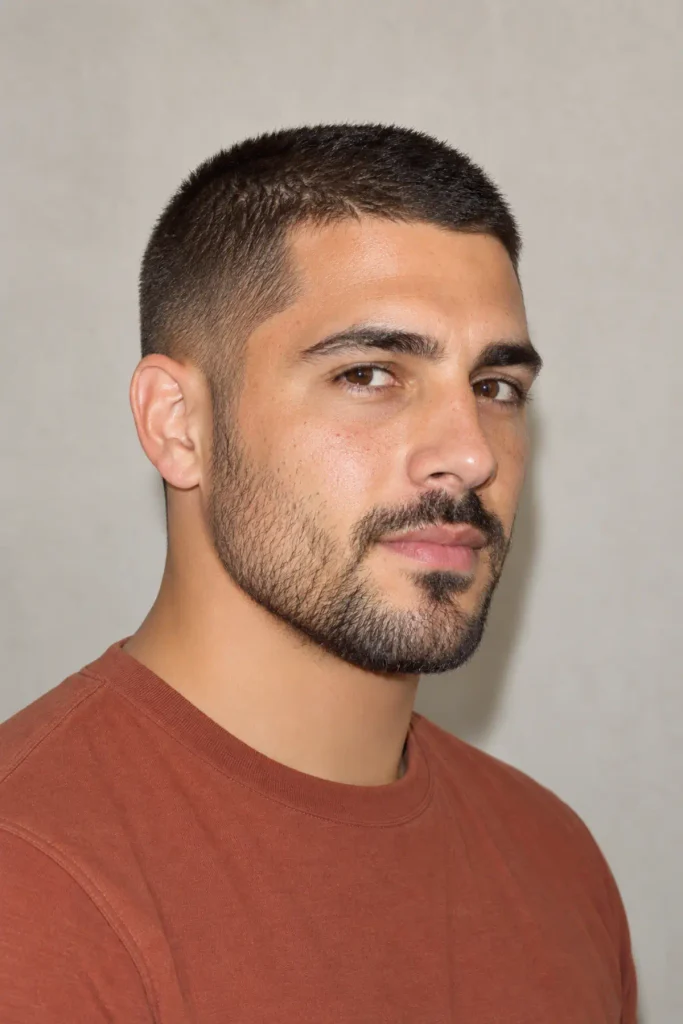
A buzz cut does not automatically spell trouble for an oblong face, but it only works under a few conditions. A longer guard, such as a number 3 or 4, keeps some softness and width, while a very tight buzz or a skin fade highlights both the length of the face and the shape of the skull. Dense hair and an even head shape help a lot, and men with a prominent forehead can pick up more guidance from this buzz cut for a big forehead guide.
This is by far the lowest maintenance haircut on the list, needing little more than a wash and some moisturizer. A short, well kept beard tends to balance the face nicely, and those who like the combination can see how it looks in this buzz cut fade with beard piece. The edges grow out quickly, so a clean up every 2 to 3 weeks keeps it looking intentional instead of unkempt.
7. Classic Side Part
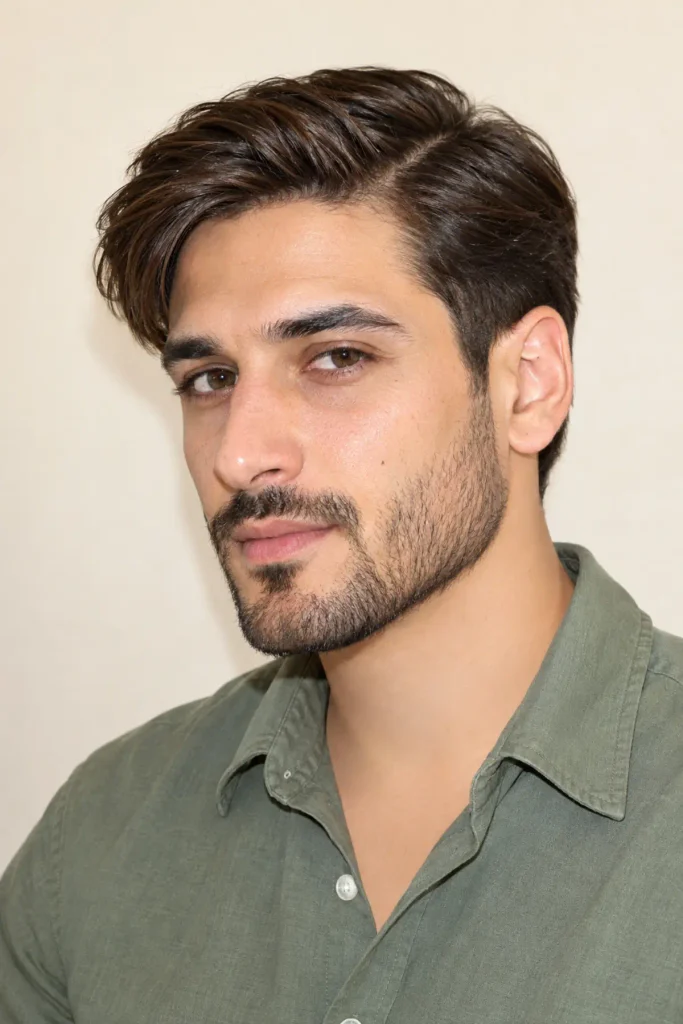
The side part has stayed in style for a hundred years, and for an oblong face it earns its place. A deep part sends the hair diagonally across the forehead, and that single line breaks up the length of the face. Because the sides are normally tapered rather than faded to the skin, the head keeps its width too. Straight and wavy hair both behave well, and medium density gives the best shape.
A light pomade on damp hair, a comb to set the part and a quick brush to soften it are all it takes. Barbers usually leave about two to three inches on top so there is enough to comb across, and trims every 3 to 4 weeks keep the part crisp. Men with very tight curls may find the classic version too neat for their texture, and a softer, more natural side sweep usually looks better on them.
8. Comb Over With a Low Taper
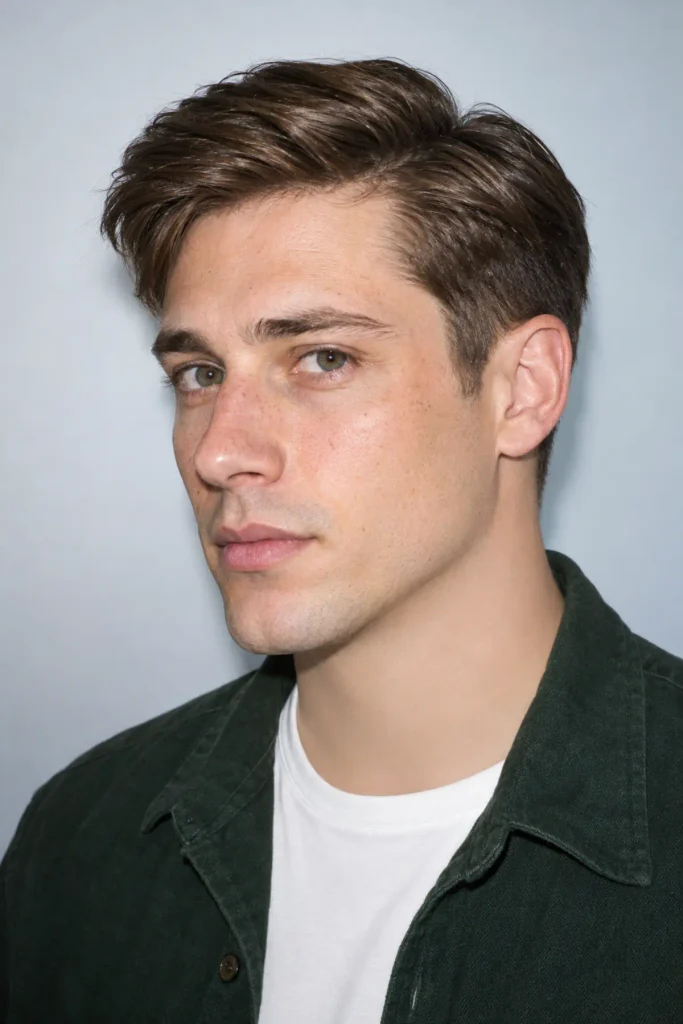
The modern comb over is a sharper cousin of the side part, with a clear parting line and the top swept across in one direction. What keeps it flattering is the taper: sides left with some weight instead of cut to the skin, so the head stays wide enough to balance the face. It works on straight and wavy hair, and it is a good fit for men who want a polished look without any tall front.
A matte pomade or light cream, a comb and a touch of lift at the front are enough, though too much lift pushes the style toward the height that the face does not need. A top of about two to three inches works well, with trims every 3 to 4 weeks. Men who like a bit of fade can keep it gentle, and the options in these mid fade haircuts for men show how far it can go before the sides start to look too thin.
9. Low Textured Quiff
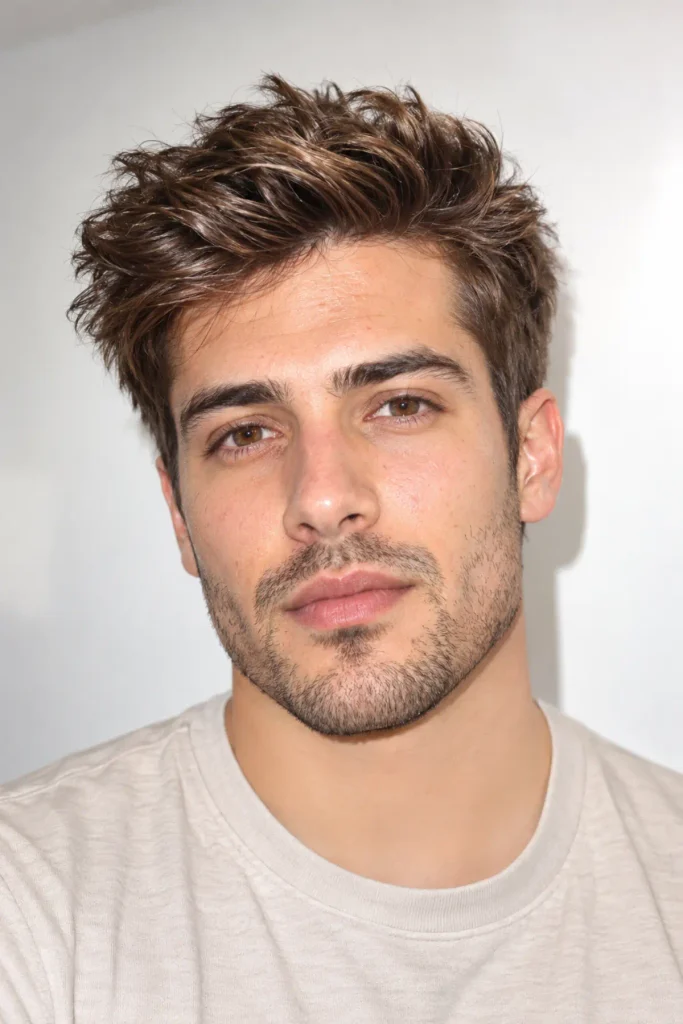
Quiffs get a bad name for oblong faces, but the problem is only ever the tall, narrow version. A low, textured quiff brushed slightly forward and left messy gives the top some interest without stretching the face upward, particularly when the sides stay fuller. Wavy hair and thick straight hair handle it best, and it suits men who like a relaxed, lived in finish.
Blow drying the front up and slightly forward, then breaking it up with a little clay, creates the shape. A short taper with weight left at the sides completes it, and trims every 3 to 4 weeks keep it looking deliberate. The warning sign is a quiff with very short sides and a tall front, because that combination is the one that makes a long face look even longer.
10. Curtain Fringe
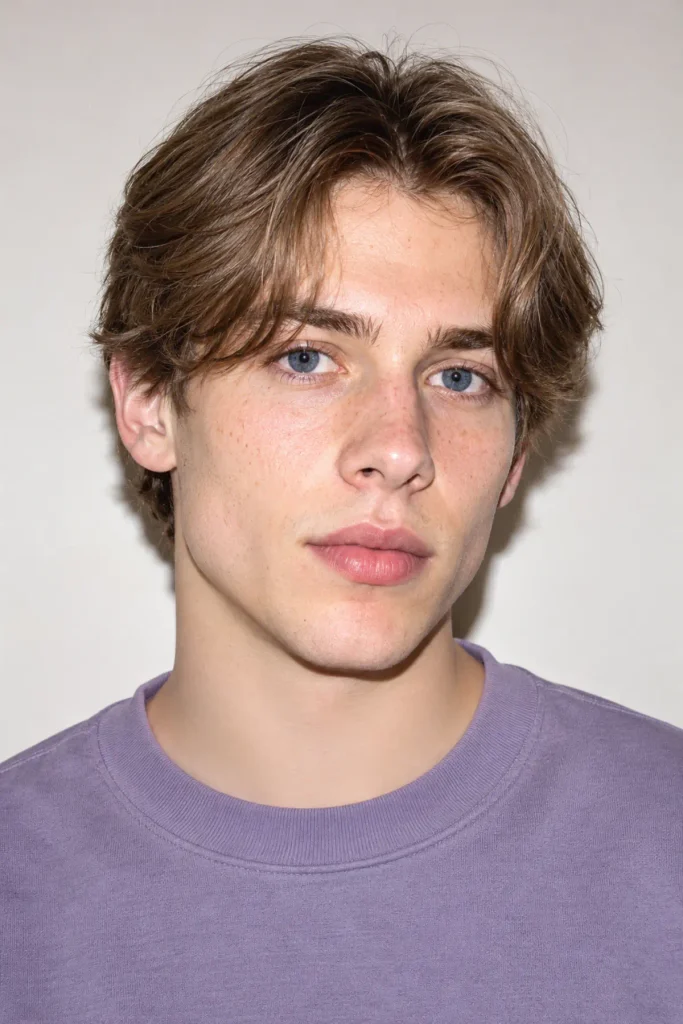
The curtain fringe parts in the middle or slightly off center and falls softly on each side of the forehead. Since it frames the cheekbones and covers the temples, it adds the width an oblong face is missing and takes length off the forehead at the same time. Straight and wavy hair with medium to thick density suits it best, and it is a favorite among men who like a relaxed, modern look.
Blow drying the fringe down and slightly outward, then adding a bit of sea salt spray or light cream, keeps the movement natural. A tapered back and sides with layers that frame the cheekbones complete the cut. A trim every 4 to 6 weeks is usually enough. Fine hair can look limp with this style, so a little root lift, or a slightly shorter fringe, helps it keep its shape.
11. Messy Textured Medium Cut
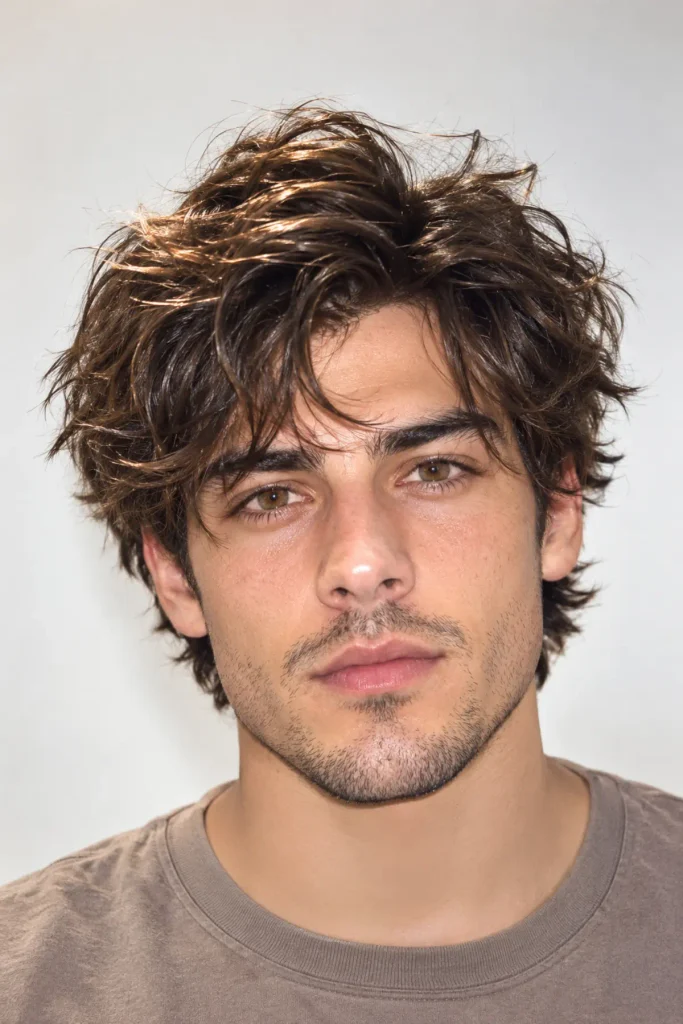
A messy textured medium cut leaves length on top and at the sides, with layers that create natural movement and a bit of volume around the temples. That sideways fullness is exactly what an oblong face is missing, which is why this is one of the more forgiving cuts for men who dislike frequent barber visits. Straight and wavy hair both work, and more shapes in this style are covered in this guide to medium length haircuts for men.
A small amount of paste or cream scrunched into damp hair, then left to air dry or diffused, gives enough shape for the day. Layers throughout, a light taper at the back and a fringe around the eyebrows keep the cut balanced. A visit every 5 to 8 weeks is typical. The only real catch is the in between phase while it grows out, which asks for a little patience and the occasional trim at the neckline.
12. Two-Block Cut
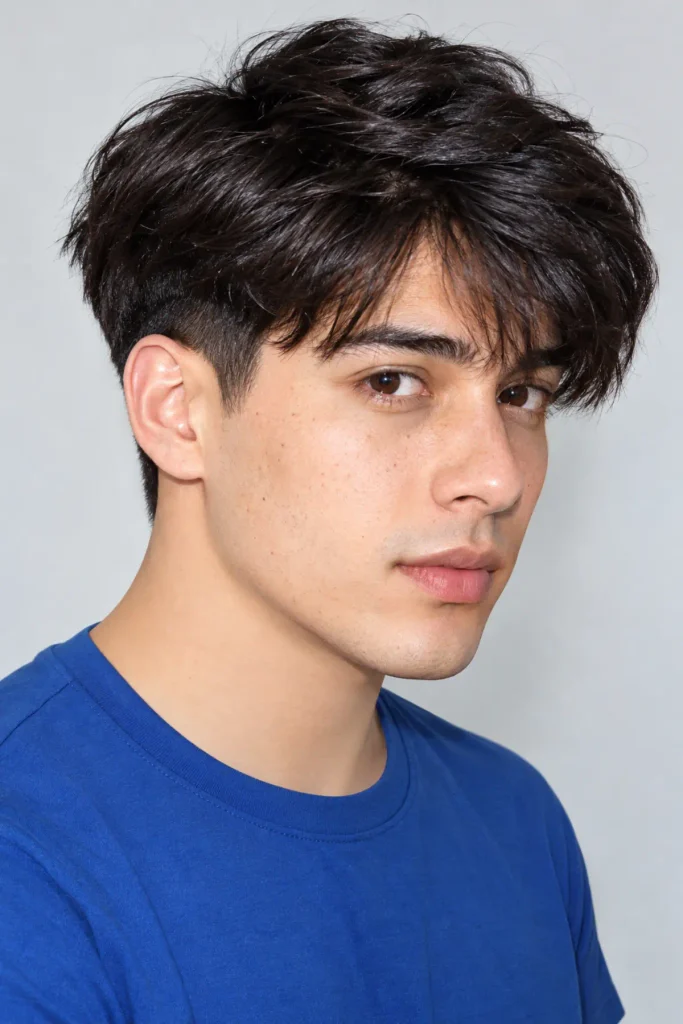
The two block cut pairs a longer top with shorter, undercut sides, which creates a strong contrast. On an oblong face the trick is to keep the sides fuller than a typical undercut and to let the top fall forward instead of standing up. It suits thick, straight hair best, and it is a good choice for men who like a more fashion forward style.
Blow drying the top forward and separating the ends with a light clay gives the usual finish. A top of around three to four inches works well, with soft, tapered sides. Trims every 4 to 5 weeks keep the contrast clean. Fine hair or tight curls can make the shape harder to hold, so those men often get better results with a gentler, more blended version.
13. Fluffy Fringe

The fluffy fringe combines tapered sides with a soft, airy top that falls forward over the forehead. The volume sits at the front, but because it falls across the forehead instead of standing up, it softens the length of an oblong face rather than adding to it. Straight and wavy hair of medium density works best, and the relaxed, slightly boyish look suits men who do not want to look too polished. More inspiration sits in this guide to fluffy fringe haircuts for men.
Blow drying the hair forward with a little sea salt spray or volumizing powder gives the airy texture. Light layers and a low taper at the sides complete the cut, and a trim every 4 to 5 weeks keeps it in shape. Very straight, heavy hair sometimes needs a little thinning to stay fluffy, because otherwise the fringe tends to fall flat in a single block.
14. Pageboy
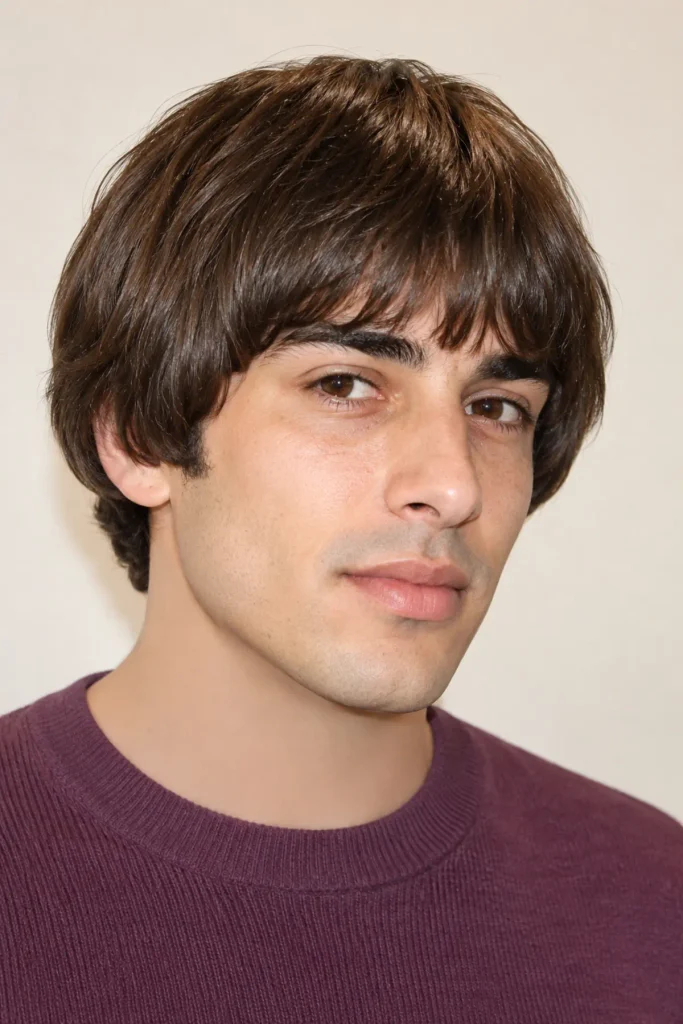
The pageboy is a smooth, rounded cut that falls to around the ears with a straight fringe across the forehead. The even weight around the head adds width, and the fringe takes length off the face, so the style balances an oblong shape from both directions. Straight and slightly wavy hair with medium to thick density suits it, and it works best for men who are comfortable with a fashion forward look. Full details are in this pageboy haircut for men guide.
Air drying or blow drying with a round brush, plus a little cream to control frizz, is the usual routine. A blunt fringe, ear length sides and soft edges define the cut, and a trim every 5 to 7 weeks keeps the shape. On very curly hair the cut can look heavy, so it is worth finding a barber who is comfortable working with texture before trying it.
15. Bro Flow
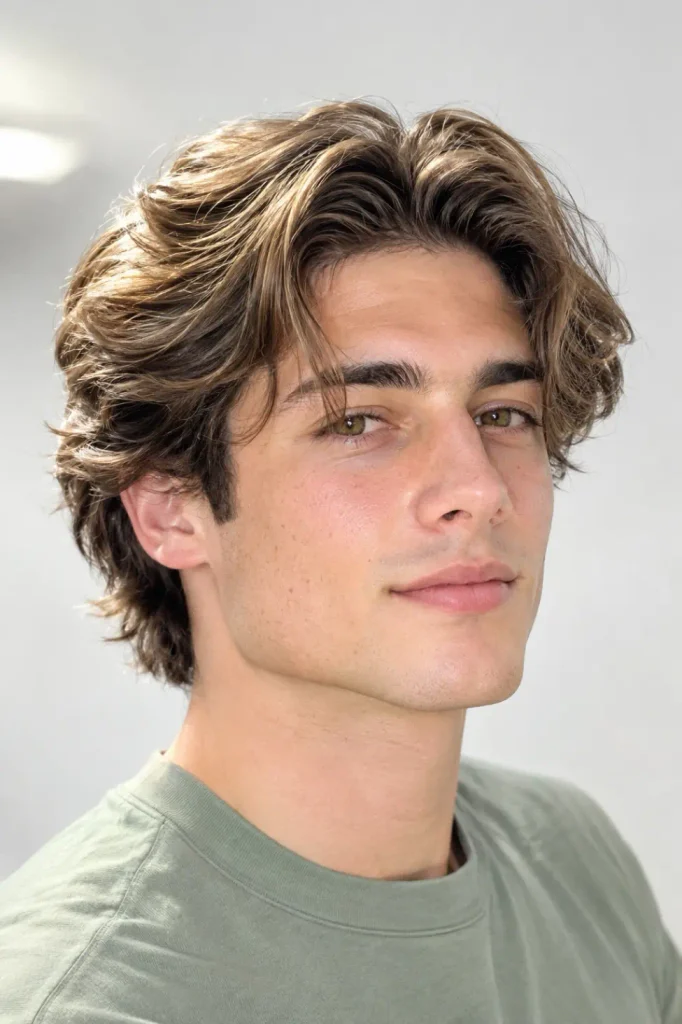
The bro flow is a medium length, swept back style that falls around the ears and the nape. For an oblong face the secret is keeping it relaxed and slightly tousled, since the length at the sides provides the width the face needs. Straight and wavy hair of medium to thick density works best, and it fits men with an active, casual lifestyle.
A light cream or a few sprays of sea salt spray, then a push back with the fingers or a sweep to the side, is the whole routine. Long layers, plenty of length at the sides and a clean neckline give the cut its shape, and a trim every 8 to 10 weeks keeps it tidy. The grow-out phase demands patience, but men who like low effort styling usually find it worth the wait.
16. Layered Waves

Layered waves rely on medium to long hair cut in soft layers, so natural movement builds around the sides of the head. That extra width at the cheeks and jaw is just what an oblong face needs, and the layers stop the style from falling flat. Wavy hair benefits most, though straight hair can manage it with a little help from texturizing spray. A deeper look at the technique is in this guide to long layered hair for men.
A leave in conditioner or curl cream on damp hair, then air drying or diffusing, brings out the waves. Long layers that start around the cheekbones, with no heavy blunt lines, keep the shape soft. A trim every 8 to 12 weeks is typical. Men with fine hair usually do better with lighter layers, since heavy layering can make the ends look thin.
17. Shag Cut
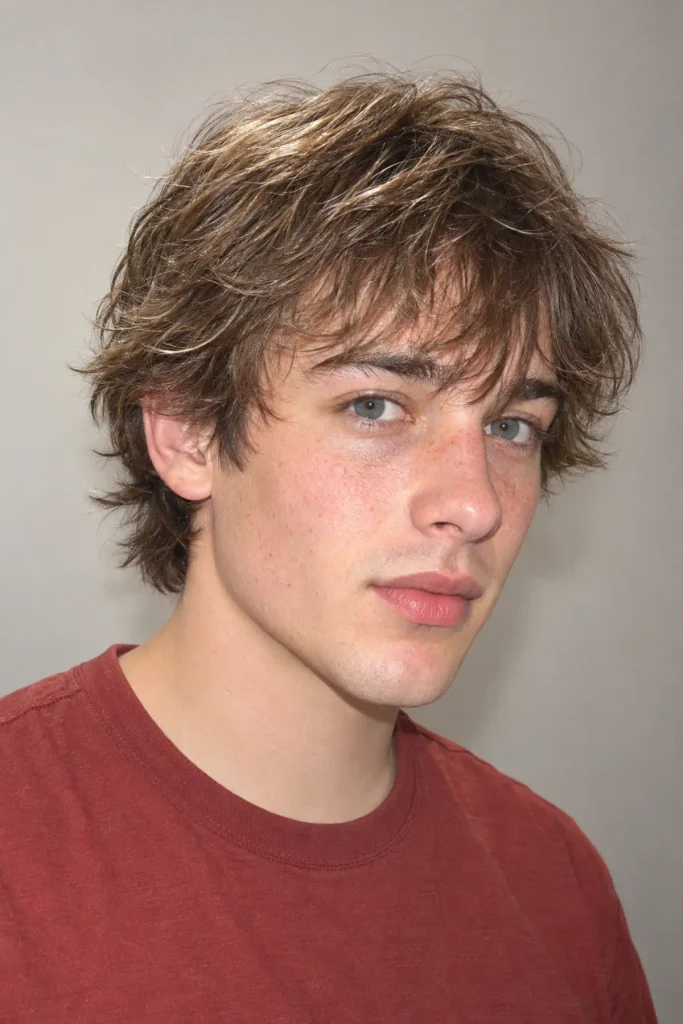
The shag is a layered, tousled cut with plenty of movement and a slightly rock and roll attitude. The layers build volume at the sides and the fringe often falls over the forehead, so it handles both jobs an oblong face needs done at once. Wavy and straight hair both work, thick density helps, and it suits men who are happy to stand out a little. A closer look at the shape sits in this guide to shaggy haircuts for men.
Styling takes a few minutes of texturizing spray or light paste scrunched into damp hair, then air drying. Choppy layers, a face framing fringe and a little weight at the sides define the cut, and a trim every 6 to 8 weeks keeps the layers in order. Very fine or thin hair can look sparse in a shag, so those men usually need softer layers and a bit of product for body.
18. Wolf Cut

The wolf cut blends a shag with a mullet, with short, wispy layers on top and more length at the back. Volume at the crown and sides adds width, while the fringe softens the forehead, so the whole shape looks more balanced. Wavy and thick hair gives the best result, and it is a strong pick for men who want a cut with real personality. More about the style is available in this wolf cut for men article.
Sea salt spray on damp hair, scrunching or diffusing for texture and a little paste for definition give the finished look. A soft fringe and well blended layers keep it wearable instead of costume like, and a trim every 6 to 8 weeks maintains the shape. Fine, straight hair may not hold the layers without product, which is the usual reason this cut disappoints on the wrong hair type.
19. Curly or Coily Top With a Low Taper
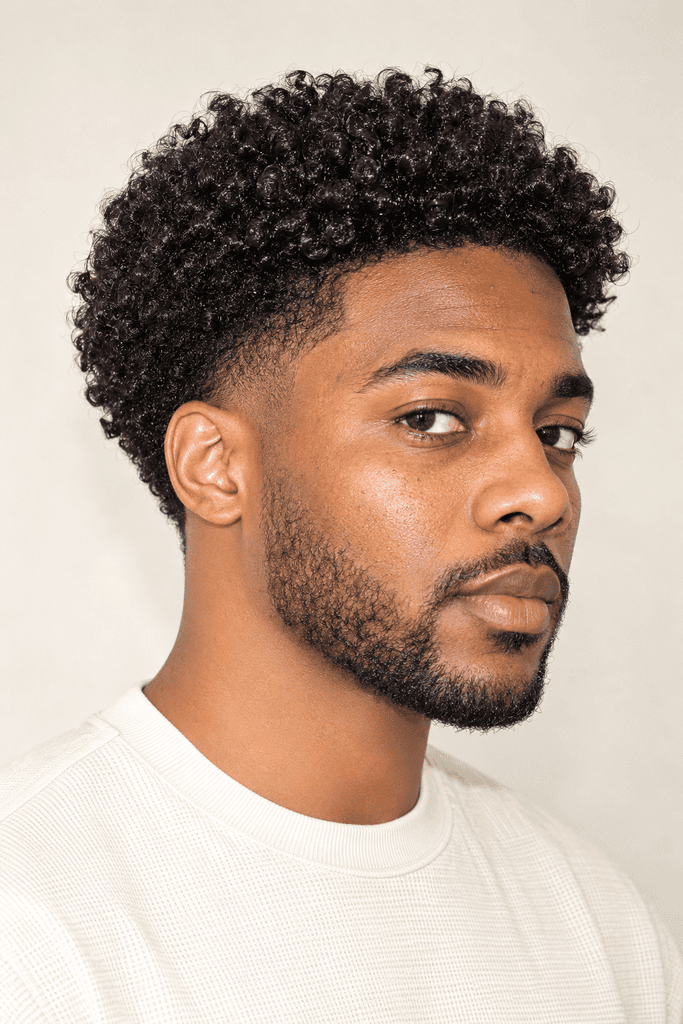
Curly and coily hair already adds width on its own, which makes a rounded top with a low taper a strong choice for an oblong face. The top can be shaped to stay close to the head, so the face never looks longer, and the curls give plenty of volume at the sides. Tight curls, coils and thick hair suit it best, and it works for men who want a clean, modern look.
A curl cream or leave in conditioner on damp hair, then shaping with the fingers or a soft brush, defines the curls. A lightly rounded top and a low taper keep the shape, and a trim every 3 to 5 weeks maintains it. A high fade on the sides is the one thing to skip, since it can make the curls on top look taller than intended and pull the face longer again.
20. Low Man Bun
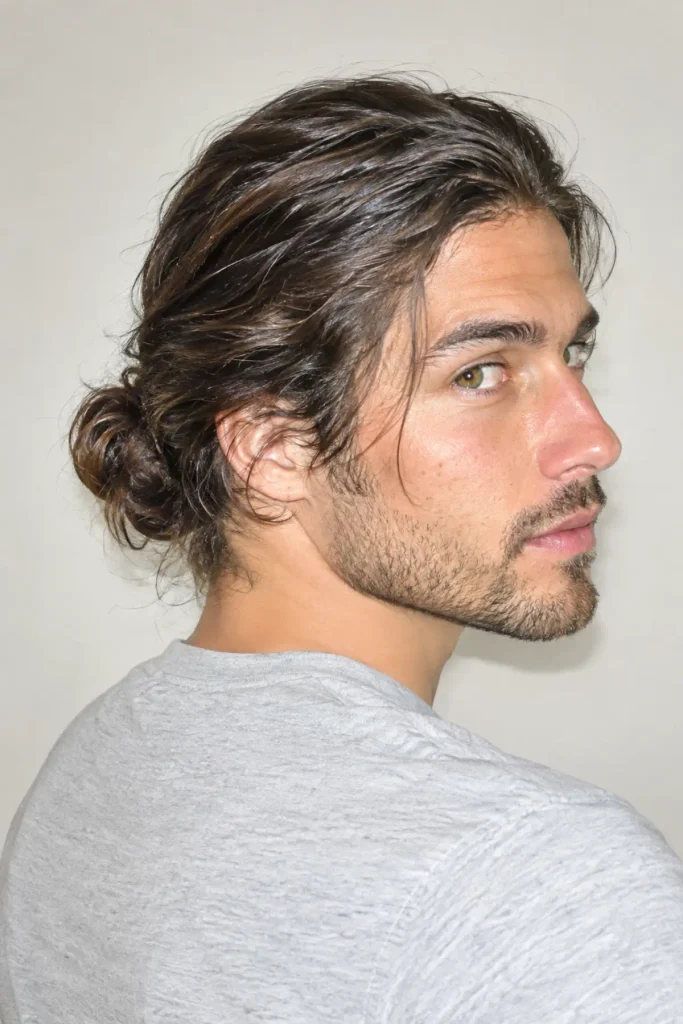
A low man bun keeps medium to long hair tied at the nape, which clears the face while adding a relaxed, balanced shape. For an oblong face the bun needs to sit low and the sides should stay loose enough to give some width around the temples. Straight, wavy and curly hair all work, particularly with thicker density, and it makes a good choice for men growing out a cut. Plenty of variations sit in this guide to man bun hairstyles.
Brushing the hair back, tying it at the nape with a soft elastic and pulling a few strands loose near the temples gives a natural finish. Even layers and a light taper at the neckline help the tie sit neatly, and a trim every 8 to 12 weeks is usually enough. A high, tight bun is the version to avoid, because it pulls the face upward and adds exactly the length an oblong face does not need.
Fades and Tapers for an Oblong Face
The side treatment matters as much as the top. A taper follows the natural hairline and leaves visible hair, while a fade moves down to very short hair or skin. For an oblong face, softer is usually better.
| Side style | Effect on an oblong face | Verdict |
|---|---|---|
| Scissor cut sides | Keeps the most width and a natural look | Best for medium and long styles |
| Low taper | Light shaping at the ears and neckline, with most weight kept | Best all round choice |
| Low fade | Short but not skin short, with only a slight loss of width | Good with a fuller top |
| Mid fade | Reduces width at the temples | Works if the top has texture and fringe |
| High fade | Removes much of the side width and adds apparent height | Usually best avoided |
| Skin or bald fade | Sharpest contrast, which makes the head look taller | Avoid unless the top is wide and forward |
Men who like fades can look at these mid fade haircuts for men and keep the fade low and the top forward.
Choosing by Hair Type, Density, Hairline and Age
Straight hair. Straight hair holds blunt fringes well, so the French crop, Caesar cut, Ivy League and side part are natural fits. It can fall flat at the sides, so a light texturizing spray helps add width.
Wavy hair. Wavy hair is the easiest to work with on an oblong face, because the natural movement adds width. Textured crops, curtain fringes, bro flow, shag and wolf cuts all take advantage of it.
Curly and coily hair. Curls add natural width, so the main job is to keep the top from growing too tall. A rounded top with a low taper, or a medium length cut with defined curls, works well.
Fine and thin hair. Fine hair looks fuller in shorter, textured cuts such as the crop or French crop. Very long, flat styles can look stringy, so light layers and volumizing products are the safer route. These short haircuts for men with fine hair are worth a look.
Thick hair. Thick hair can handle almost every style here, but it benefits from thinning at the sides so it does not become too bulky. Shag, wolf cut, two block and pageboy styles suit it best.
High or receding hairline. A fringe is the easiest fix. French crop, Caesar, curtain fringe and fluffy fringe styles cover the upper forehead and make the face look shorter.
Age. Younger men often lean toward the shag, wolf cut and fluffy fringe, while men in their 30s and beyond tend to choose the Ivy League, side part and textured crop for a polished, easy routine. Nothing is age locked, though, and any of these can work at any age if the hair density and lifestyle suit it.
How to Ask a Barber, Style at Home and Keep the Cut Fresh
A clear request saves time in the chair. Bringing a photo helps most, and a few plain phrases do the rest. Barbers usually respond well to details such as “leave weight at the sides,” “keep the fringe over the forehead,” “low taper, not a skin fade” and “keep the top short enough to avoid height.” Mentioning hair type, cowlicks and a daily routine helps too.
A simple styling routine works for most cuts on this list, and it goes like this:
- Washing and towel drying the hair until it is damp, not dripping.
- Applying a pea sized amount of product: matte clay or paste for texture, cream for softness, pomade for a neat side part.
- Blow drying the top forward or sideways, instead of straight up, to keep height low.
- Finishing with fingers or a comb, and adding a touch of sea salt spray for extra width if the sides look flat.
Maintenance depends on the cut. Short cuts and tapers usually need a trim every 3 to 5 weeks, medium styles every 5 to 8 weeks, and long hair every 8 to 12 weeks. These are typical ranges, not strict rules. For growing out a cut, hair grows about half an inch per month, or around six inches a year, according to the American Academy of Dermatology as quoted by USA TODAY, so a style that adds an inch of length usually needs about two months.
Mistakes to Avoid With an Oblong Face
- Going too tall on top. Tall pompadours, tall quiffs and spiky styles add length the face does not need.
- Choosing a high or skin fade. Cutting the sides too short removes width and makes the head look narrower and longer.
- Slicking long hair flat. Long, straight hair pulled down and back drags the face downward.
- Skipping the fringe. A fringe is one of the simplest ways to shorten the look of the forehead.
- Wearing a long, pointed beard. It adds extra length at the chin, so a shorter, fuller beard is a better balance.
- Copying a photo without checking hair type. A style that looks great on thick, wavy hair may fall flat on fine, straight strands, so it pays to ask the barber what will work.
- Using too much product. Heavy gel or wax can flatten the sides and highlight the length of the face. A small amount of matte product usually looks more natural.
Frequently Asked Questions
What is the best haircut for an oblong face male?
The best haircut for an oblong face is usually a textured crop, French crop or side part with a low taper. These styles keep height modest, add forward texture and leave enough weight at the sides to balance the length of the face.
What hairstyle makes an oblong face look shorter?
A hairstyle with a fringe makes an oblong face look shorter. French crops, Caesar cuts, curtain fringes and fluffy fringes all cover part of the forehead and reduce the visible length of the face.
Should men with an oblong face avoid fades?
Men with an oblong face do not need to avoid fades completely, but high and skin fades are usually best skipped. A low taper or low fade keeps more width at the sides, which helps the face look more balanced.
Can men with an oblong face wear a pompadour or quiff?
Men with an oblong face can wear a quiff if it is low, textured and paired with fuller sides. A tall, narrow pompadour with very short sides tends to add length and is usually not the best choice.
Is a buzz cut good for an oblong face?
A buzz cut can work on an oblong face if a longer guard is used, such as a number 3 or 4. Very short buzz cuts and skin fades can emphasize length and the shape of the head.
What beard suits an oblong face?
A short to medium, fuller beard with some width at the cheeks suits an oblong face. A long, pointed beard adds more length at the chin and is usually best avoided.
Is long hair good for an oblong face?
Long hair can look great on an oblong face when it has layers, waves or natural texture. Long, flat, straight hair tends to pull the face downward, so volume at the sides is important.
What is the difference between an oblong and an oval face?
An oblong face is longer and has straighter sides, with a forehead, cheeks and jaw of similar width. An oval face is also longer than it is wide, but its edges are softer and more curved.
What should I ask my barber for if I have an oblong face?
The most useful request is a style with a fringe or forward texture, a low taper instead of a skin fade and some weight left at the sides. A reference photo and a quick note about hair type help the barber adjust the cut.
How fast does hair grow when growing out a haircut?
Hair grows about half an inch per month, or around six inches a year, according to the American Academy of Dermatology as reported by USA TODAY. Growth speed varies with age, genetics and health.
Conclusion
An oblong face does not need a complicated fix. The best oblong face shape hairstyles for men keep the top modest, add width at the sides and use a fringe or forward texture to shorten the look of the face. Whether the pick is a textured crop, a side part, a curtain fringe or a loose wolf cut, the same balance applies.
Before the next barber visit, it helps to choose two or three favorites from the list, save a photo and mention hair type and daily routine. For more inspiration, readers can also browse medium length haircuts for men and office hairstyles for men.
2 thoughts on “Oblong Face Hairstyles for men: 20 Best Haircuts for a Balanced Look”