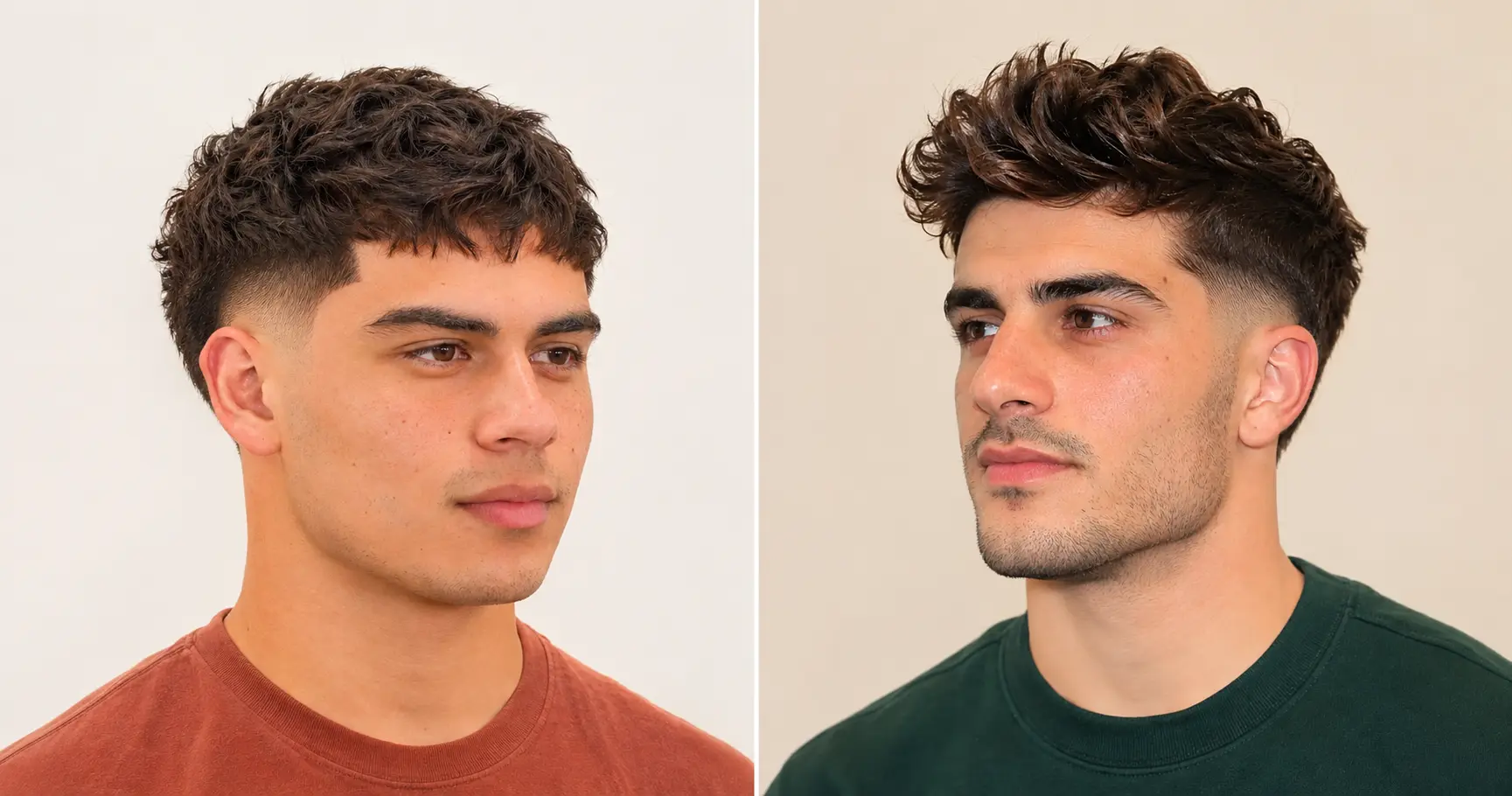
Picture a man in the barber chair, phone in hand, showing a photo and asking for a mid burst fade. The barber nods, the clippers start up, and twenty minutes later the result is either exactly what he pictured or close but not quite. The gap almost always comes down to a few small details that never got said out loud. The cut itself is worth the trouble: it curves around the ear in a rounded arc, sits about halfway up the side of the head, and leaves length on top for whatever style a man likes, from a tidy crop to a full set of curls.
That gap is what this guide is here to close. It explains what the cut really is, who it suits, and what to say in the chair, then walks through 20 ideas with their real tradeoffs. Prices, guard lengths, and regrowth rates come from named sources. Styling times and rebooking windows are practical estimates based on how this cut usually behaves, so they work as starting points, not rules. Where barbers disagree, the guide says so.
A mid burst fade haircut is a fade that curves in a half circle around the ear and reaches roughly halfway up the side of the head. The hair around the ear is the shortest, the top keeps its length, and the nape is usually left longer. Most men rebook every two to four weeks to keep the curve crisp.
Mid Burst Fade at a Glance
| Question | Short answer |
|---|---|
| What it is | A rounded fade that hugs the ear at mid height, paired with any top style |
| Where “mid” sits | About halfway up the side, near the temple line (barbers vary, so a photo helps) |
| How it differs from a regular fade | It curves around the ear instead of running level across the side |
| The nape | Usually left longer, but it can be tapered or shaped on request |
| Best hair types | Straight, wavy, curly, and coily, with extra care for fine hair |
| Styling difficulty | Easy to moderate, since only the top needs work |
| Rebooking | Roughly every 2 to 4 weeks |
| Typical price | Often $30 to $40 for a fade (StyleSeat), up to $65 in some shops (Booksy) |
| Skip it if | A man hopes contrast will hide a receding hairline, or prefers very few barber visits |
Mid Burst Fade vs Similar Fades
| Cut | Fade line | Nape | Contrast | Best for |
|---|---|---|---|---|
| Mid burst fade | Half circle around the ear, mid height | Usually longer | Medium | Textured tops, mullets, curls |
| Low burst fade | Same arc, lower on the head | Usually longer | Soft | Office settings, first timers |
| High burst fade | Same arc, higher on the head | Usually longer | Strong | Mohawks and bold looks |
| Regular mid fade | Level band across the sides and back | Faded | Medium | Clean, classic tops |
| Mid drop fade | Dips behind the ear toward the nape | Faded | Medium | Men who want the back faded too |
| Burst taper | Small soft arc that never reaches skin | Often longer | Gentle | Fine hair, conservative looks |
Table of Contents
What Is a Mid Burst Fade?
Strip away the jargon and a mid burst fade is simple. Instead of running level across the side of the head like a regular fade, the shortest hair curves around the ear in a half circle, a bit like a small sunburst, then grows longer as it moves up and away. Several barbering guides describe the same shape, and one working barbershop notes that a standard burst drops behind the ear and ends at the side of the neck instead of continuing along the nape.
The word mid is all about height. A mid burst reaches roughly halfway up the side of the head, which makes it bolder than a low burst and softer than a high one. Here’s where it gets slippery: barbers don’t all agree on where mid starts. Some place it near the temple line, others just above the ear, which is why a reference photo beats any single word. The mid fade haircuts for men guide shows how the height reads in real life.
Five choices make up every mid burst fade:
- Height: mid, meaning about halfway up the side.
- Arc size: how tightly the curve hugs the ear and how far it travels toward the back.
- Finish: bare skin, a shadow, or a guard length.
- Nape: left long, softly tapered, or shaped into a V or a square.
- Top: length, texture, and styling direction.
Height and shape usually get named. The finish, the nape, and the top often don’t, which leaves the barber guessing, and guesses are where most disappointing haircuts begin.
Who Suits a Mid Burst Fade?
Hair Texture
Straight hair shows the cleanest arc, though it needs some texture on top or the whole cut can look flat. Wavy hair is the easy middle: the sides stay tidy and the waves keep their movement. Curly and coily hair often gets the biggest payoff, since tight sides remove bulk and let the curl pattern stand out. One quirk worth knowing is that curls spring up as they dry, so an arc set on wet hair can end up sitting higher than planned.
Hair Density
Thick hair handles bolder contrast, skin finishes included, because there’s plenty of bulk to remove. Fine or low density hair usually looks better with a shadow or taper finish and a little more weight above the arc, since bare sides can make a thin top look thinner. Strand thickness and density are different things, which is why a man can have fine strands and still have a very full head of hair.
Face and Head Shape
Face shape matters less than hair behavior, but a few rules of thumb are handy. MenHairInspo’s guides for round faces and oblong faces show how top height and fringe length change the balance for wider and longer faces.
Heart shaped and triangle shaped faces have their own tricks, laid out in the heart face shape hairstyles for men and triangle face shape hairstyles for men guides. Then there are the small anatomy details that rarely show up in photos. Ears that stick out, a cowlick near the ear, or a flat spot at the back of the head all change how the arc sits, and a good barber checks for them before the first pass.
Age and Thinning Hair
Teens and men in their 50s wear this cut equally well, because the top can be dialed up or down. With thinning hair, a burst taper and a textured top is the gentlest route, but no fade hides a receding hairline, and an honest barber will say so up front.
20 Mid Burst Fade Haircut Ideas
Each idea below covers who it suits, the styling effort, how often the cut needs attention, and the catch worth knowing about. Time and rebooking figures are practical estimates, so a barber’s advice on a specific head always wins.
1. Textured Crop
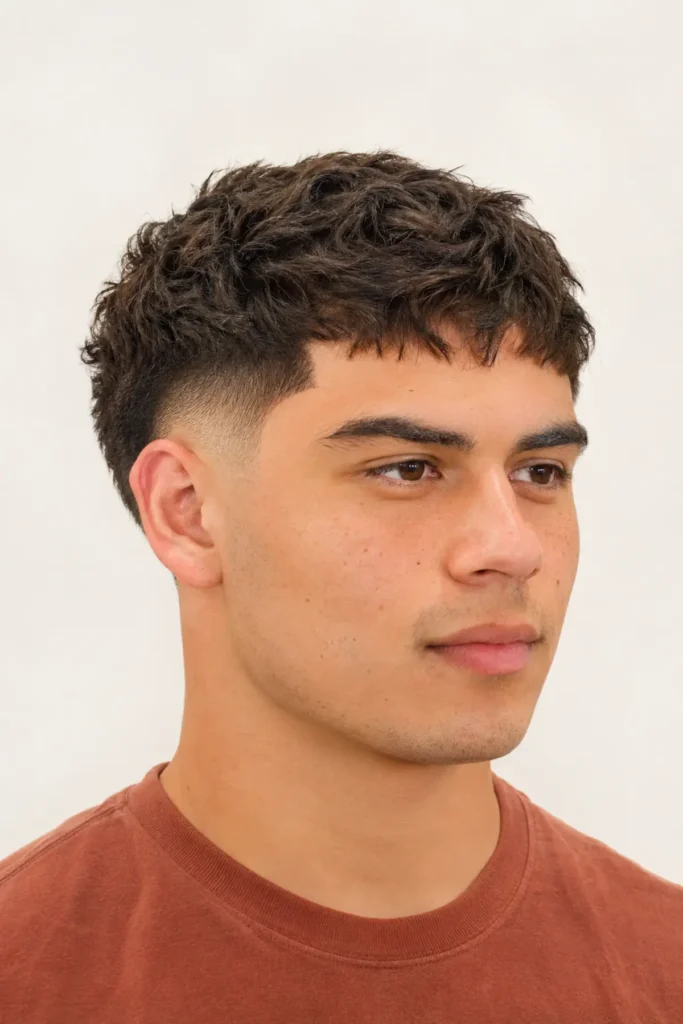
This is the cut that makes a mid burst look easy. The top stays short and choppy, pushed a little forward, and the tight arc around the ears keeps everything looking intentional even on a lazy morning. It works best on straight or wavy hair with medium to thick density. A pea sized dab of matte clay or texture powder, worked through dry hair with the fingertips, takes about two minutes, so the difficulty stays low.
Most barbers point cut the top for that broken up look, so a clear order is a textured crop, mid burst, shadow finish. Expect to be back in the chair somewhere around the three week mark, give or take. Very fine hair can turn stiff and flat here, and an extra half inch at the front usually fixes it. The grow out is forgiving too, softening into a loose fringe without an awkward middle stage.
2. Buzz Cut
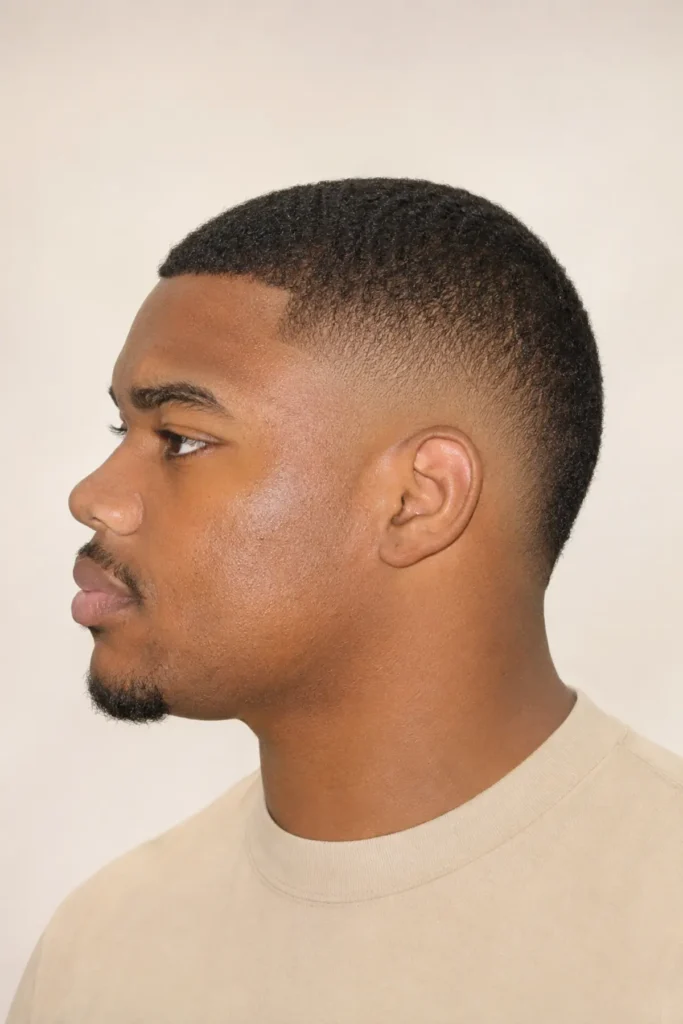
A buzz cut can look like no decision at all, and the burst is what turns it into one. With the arc curling around each ear, even a single length top looks shaped and deliberate. A number 2 guard leaves a quarter inch and a number 3 leaves three eighths, and both suit almost every hair type, which makes this one of the easiest ways into the cut. Men with a high hairline can see how guard length shifts the balance in the buzz cut for a big forehead guide.
The trade is upkeep. On a short top regrowth shows quickly, so the curve looks sharpest for about two weeks and starts to blur after that. A single length also gives uneven patches nowhere to hide, so men with scarring or patchy density often do better with a slightly longer guard. A little scalp moisturizer keeps the exposed skin comfortable.
3. Crew Cut
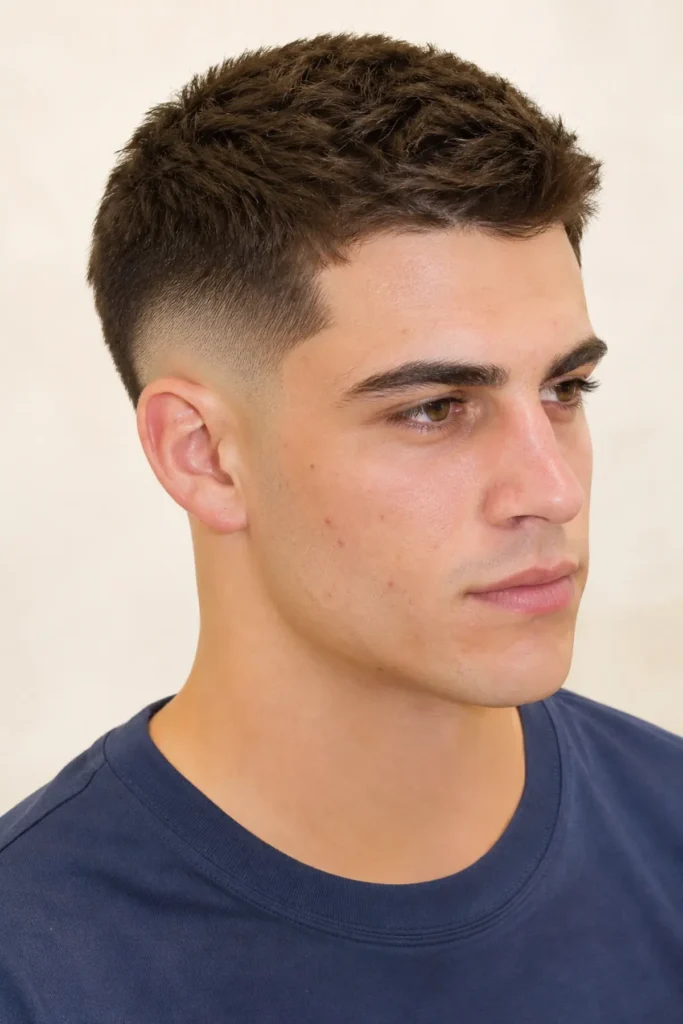
The crew cut is the old reliable of men’s hair: short on top, a touch longer at the front, and nothing to fuss with. Adding a mid burst gives it a sharper edge without losing the neat, slightly athletic feel. It suits straight and wavy hair and gets along with most workplaces, because the contrast stays moderate. A comb and a light cream take about a minute.
Barbers usually taper the top into the arc so the transition looks seamless, and the cut tends to look best for roughly three weeks. The honest drawback is that a crew cut hides very little, so uneven density or a thinning crown shows plainly. Anyone growing it out gets a short textured top after a couple of months.
4. French Crop
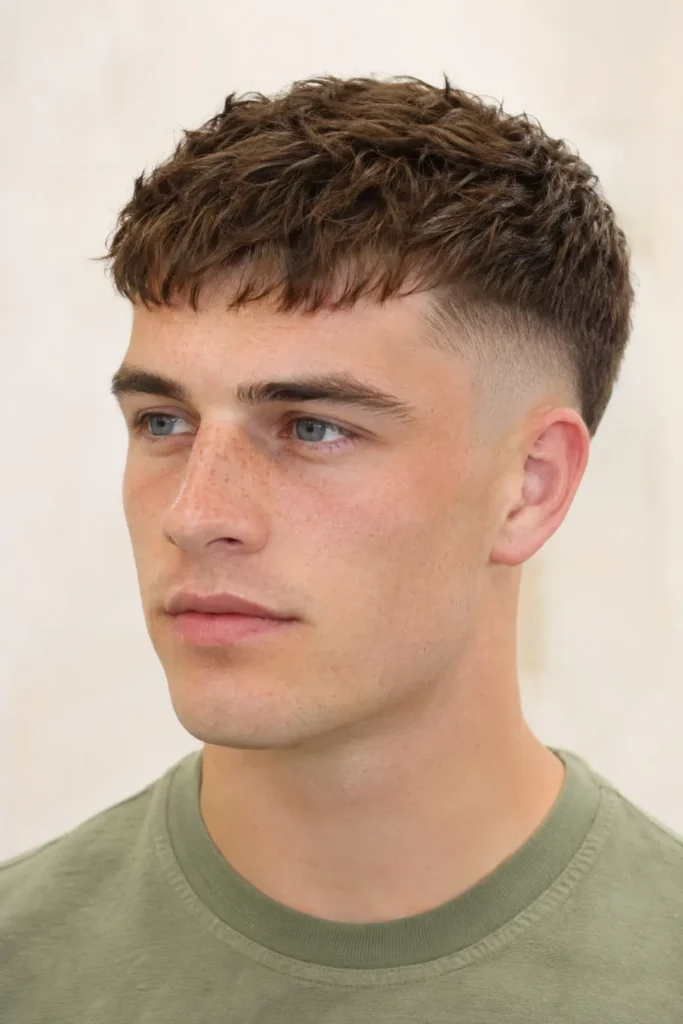
The French crop pairs a short, blunt fringe cut straight across the forehead with the curve of the burst, and that contrast between a straight line up front and a rounded arc at the sides is what makes it work. It suits straight and wavy hair with medium to thick density, and men with rounder faces often like how it keeps the top compact, as the round face shape haircuts for men guide explains. A tiny amount of paste sets the fringe in under a minute.
Precision matters here, and scissors usually give a softer fringe line than clippers. A trim around the three week mark stops the fringe from drooping toward the eyebrows. Very curly or coily hair tends to fight a blunt fringe, and a receding front hairline can make the line look uneven. Grown out, it becomes a textured fringe that works just as well.
5. Textured Fringe
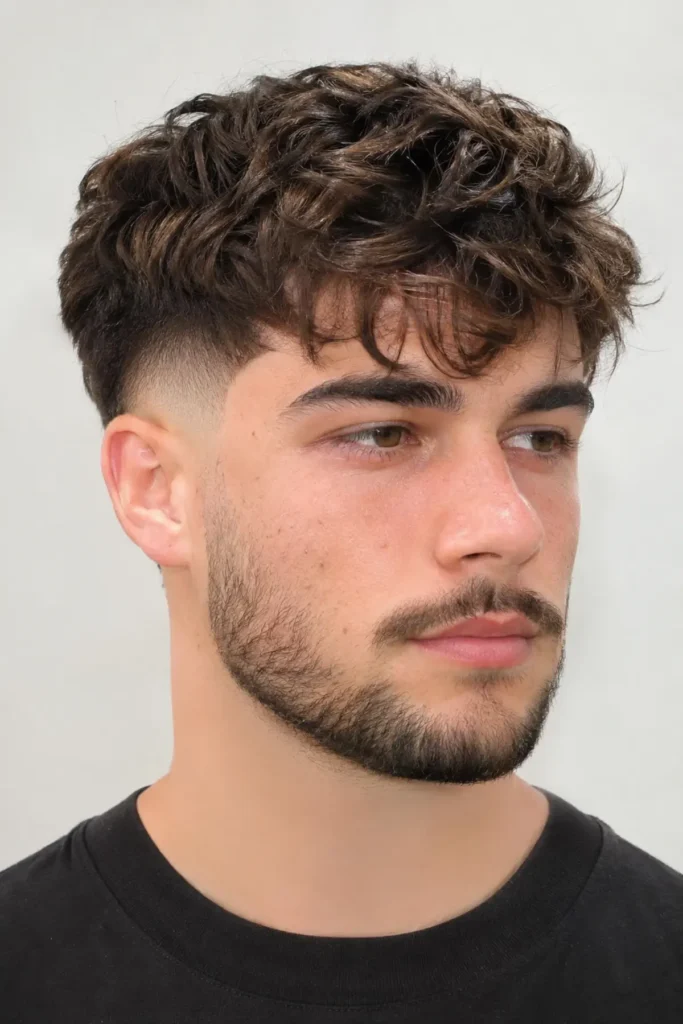
Longer pieces fall forward over the forehead with point cut ends, giving a lived in, slightly undone look against the clean sides. It suits wavy and slightly coarse hair, and men with longer faces often like how a fringe shortens the look of the forehead, which the oblong face hairstyles for men page covers in more depth. A short routine does the job: sea salt spray on damp hair, a quick blow dry with the fingers, then a pinch of matte clay, about three minutes in all.
The detail worth settling before the cut is fringe length, meaning whether it sits above the eyebrows or just brushes them. The fade tends to need a refresh sooner than the fringe does. Fine, straight hair can collapse into a flat curtain, and heavy products make that worse, so lighter is better. Left alone, it grows into a curtain style.
6. Fluffy Fringe
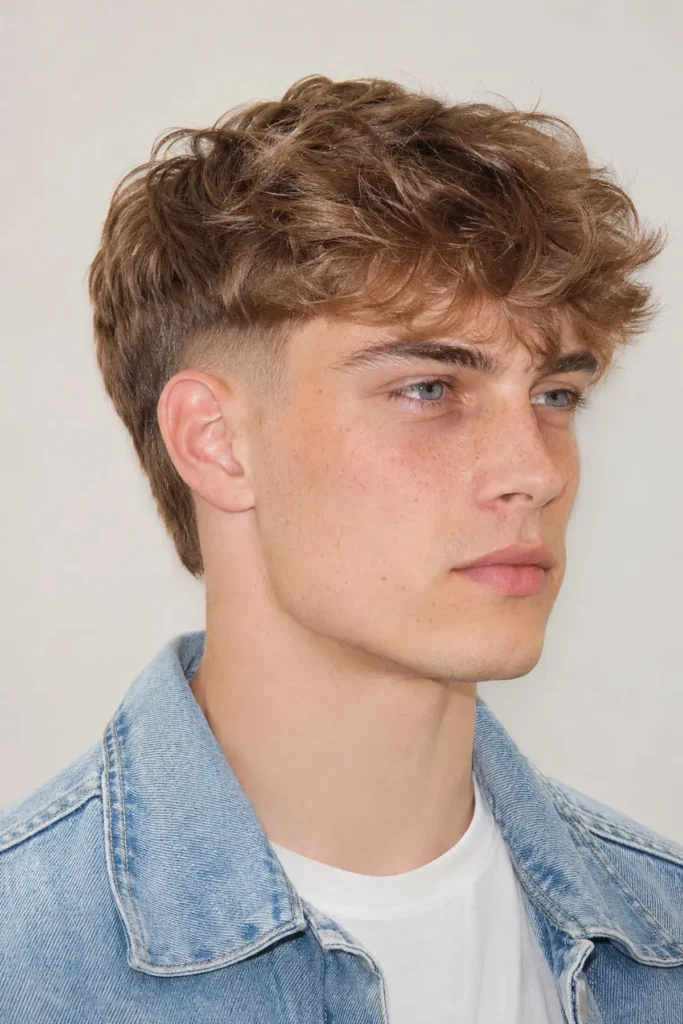
Soft volume at the front, light layers, and tight sides give this one a youthful, airy shape that looks effortless but isn’t entirely. It suits fine to medium hair that holds lift with a blow dryer and a little light mousse, and it flatters wavy textures too. The fluffy fringe haircuts for men collection shows plenty of lengths and finishes. Styling is moderate because the dryer does most of the work.
The volume comes from layering, so a barber who is comfortable with scissors gives a better result than clippers alone. The top can usually wait a bit longer between trims than the arc can. Heavy gel or wax crushes the effect in minutes, and very thick hair may need thinning shears so the shape doesn’t puff outward.
7. Quiff
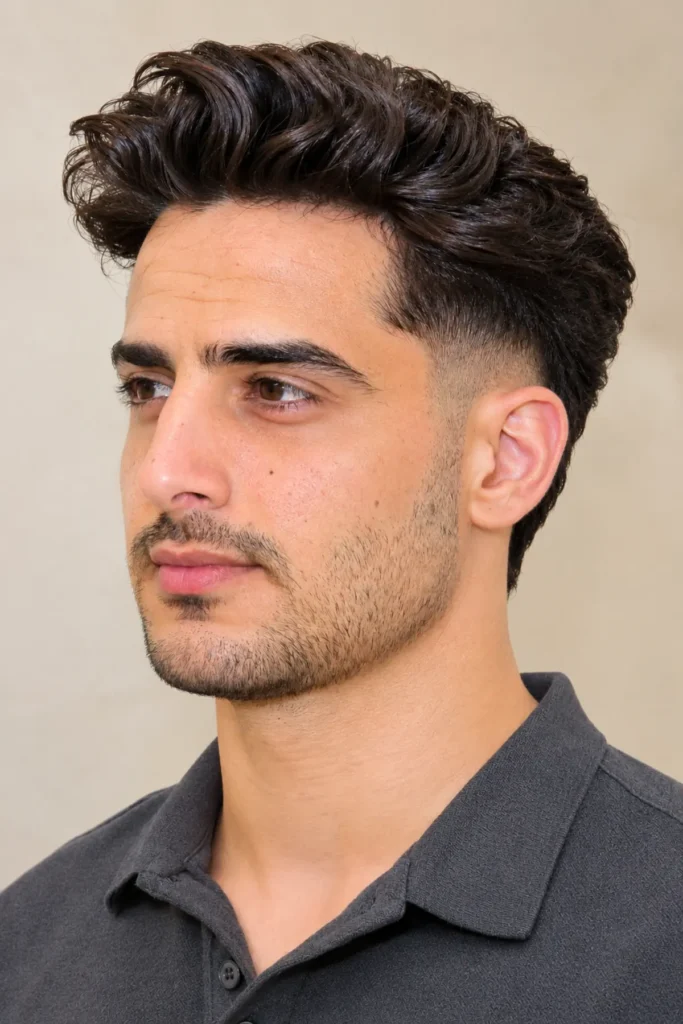
A quiff lifts at the front and sweeps up and slightly back, and the mid burst tightens the sides so the height looks deliberate instead of top heavy. It suits straight and wavy hair with medium density, and men with a heart shaped face often like the balance it creates, as shown in the heart face shape hairstyles for men guide. About five minutes with a blow dryer and a flexible hold clay or pomade gets it done, so the difficulty is moderate.
Most quiffs need around three inches at the front, tapering shorter toward the crown, so that number is worth mentioning in the chair. Thin, silky hair struggles to hold height, and humidity can flatten even a good quiff by the afternoon. Grown out, it settles into a longer swept style.
8. Pompadour
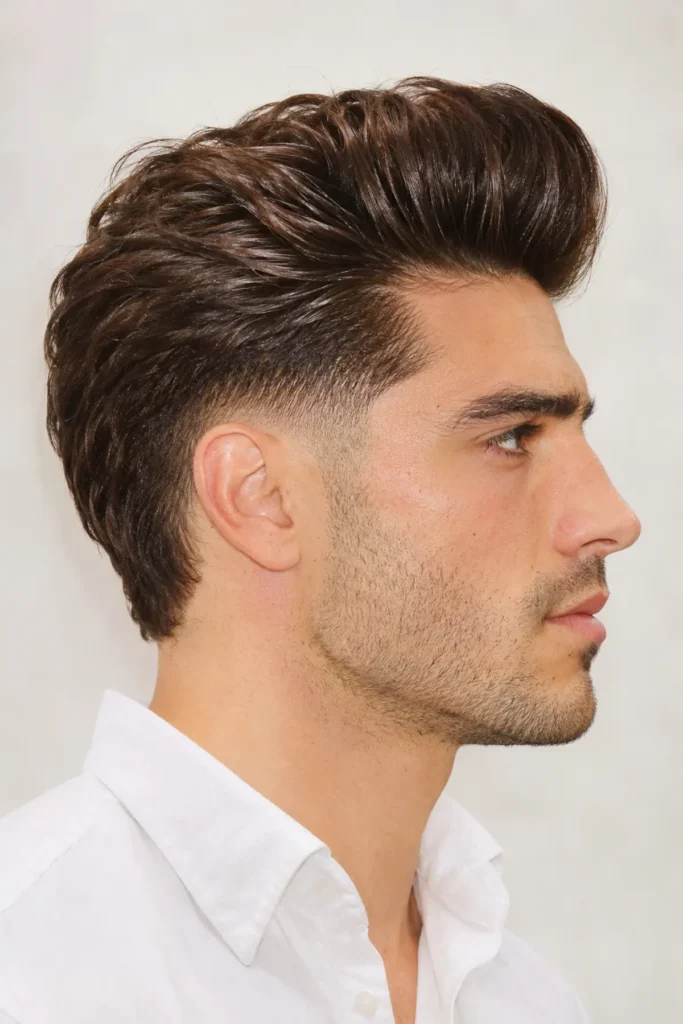
The pompadour is the quiff’s more dramatic cousin: more height, more polish, and a clear nod to classic barbershop style. The mid burst gives it a clean base so the volume stays the star. It suits thick to medium straight hair that can handle height, and men with a triangle shaped face often like the extra lift on top, as the triangle face shape hairstyles for men page explains. Expect five to eight minutes with a blow dryer, a brush, and a firm hold pomade, so the difficulty is high.
At least three to four inches on top is the usual starting point, with the sides blended into the length so the shape doesn’t look boxy. This cut rewards frequent visits, since the arc looks best when it’s fresh. Fine hair, a thinning crown, or a dislike of blow dryers are all good reasons to pick something else. The grow out is easy because the top is already long.
9. Side Part
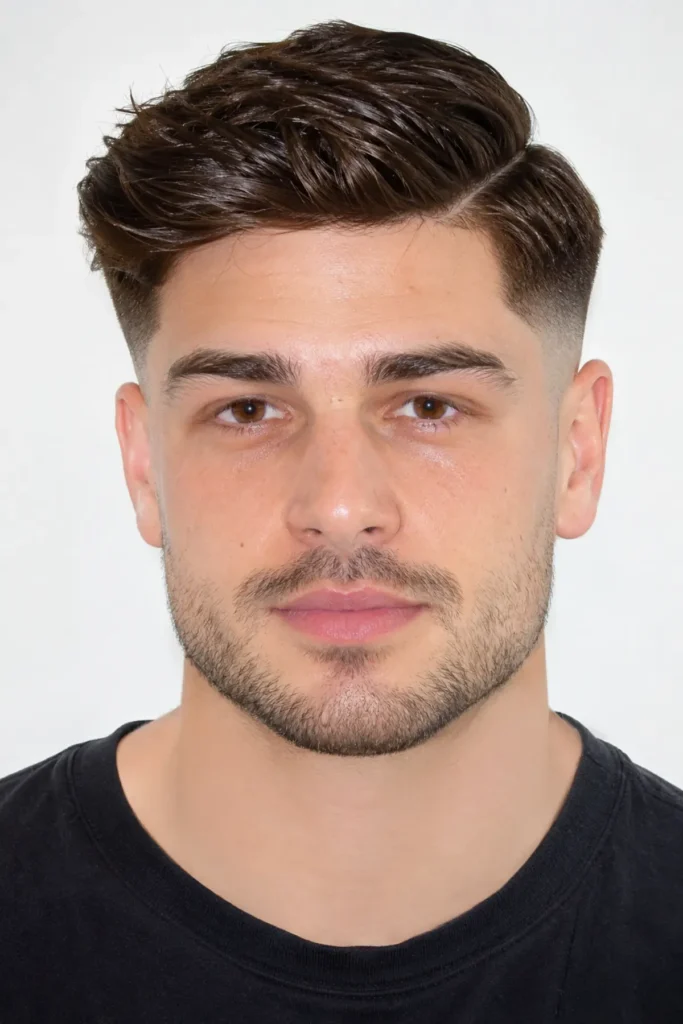
A side part over a mid burst is the version that quietly gets approved in meetings. The part gives the top a clean shape, and the burst keeps the sides sharp without shouting. It suits straight and wavy hair and shows up often in office hairstyles for men. A light cream or a medium shine pomade and a comb handle the styling in about a minute.
For conservative workplaces, asking for a shadow finish instead of bare skin softens the contrast. A cowlick near the part line can rebel, and very curly hair may not hold a crisp part at all. Left to grow, it becomes a classic longer side part, which most barbers are happy to reshape.
10. Comb Over With a Hard Part
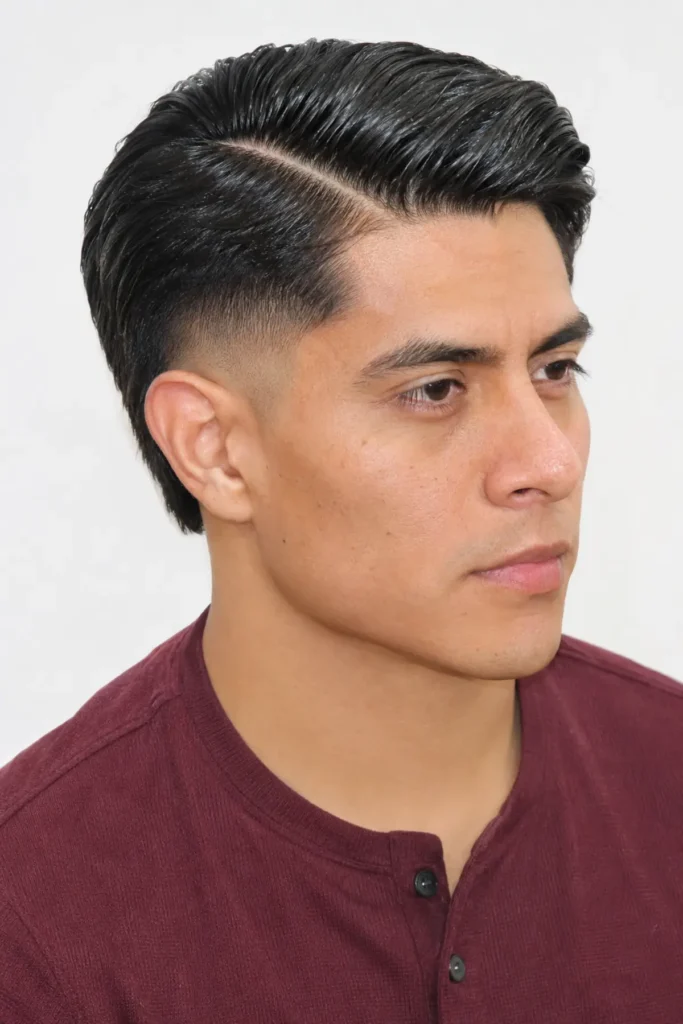
A razor shaved line marks the part and the top combs neatly over it, so a perfectly straight line meets the curve of the arc. It’s a sharp, retro leaning look for straight to slightly wavy hair with medium to thick density. A firm pomade and a fine tooth comb create the finish in three to four minutes, so the difficulty runs moderate to high.
Hard parts blur faster than the fade does, so the line usually needs a touch up every couple of weeks. The look is bold and can clash with strict dress codes. A receding hairline or sparse patches can make the line expose scalp, which is worth knowing before committing. Without upkeep, it settles into a plain side part.
11. Slick Back
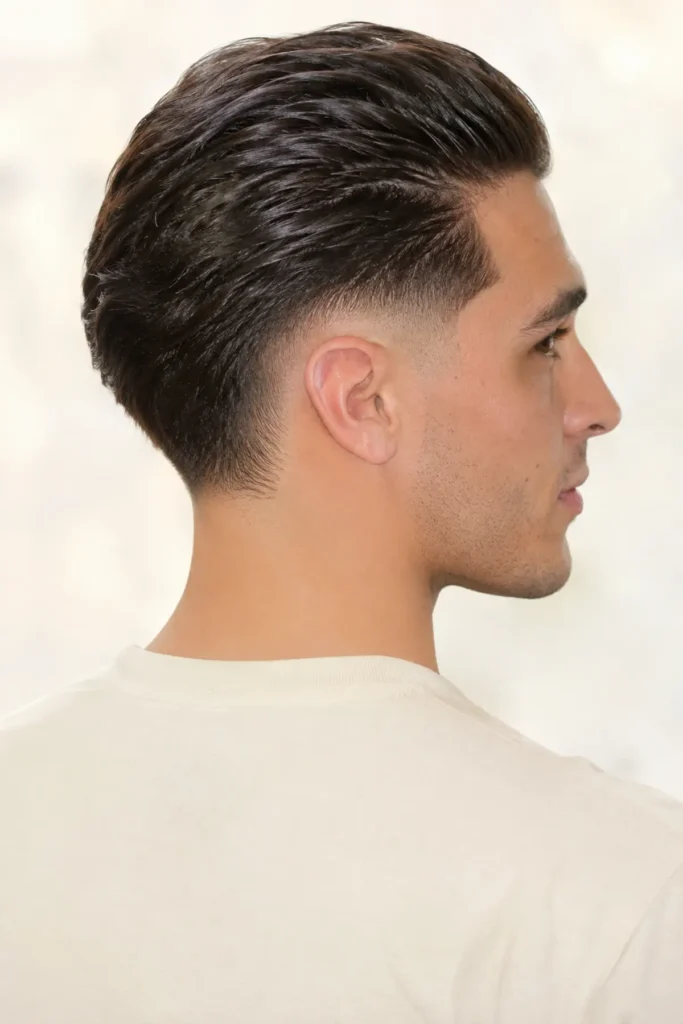
Hair combed straight back off the forehead looks sleek against tight mid burst sides, and the contrast gives the whole cut a confident, polished feel. It suits straight and wavy hair with at least three to four inches on top, and men with a strong hairline tend to carry it best. A water based pomade with medium shine and a comb take about four minutes, so the difficulty is moderate.
A good barber tapers the sides into the length so nothing sticks out around the ears. Very curly hair won’t lie flat without help, fine hair can look greasy under heavy product, and a receding hairline is more visible when everything is swept back. As it grows, it turns into a longer brushed back look.
12. Burst Fade Mohawk
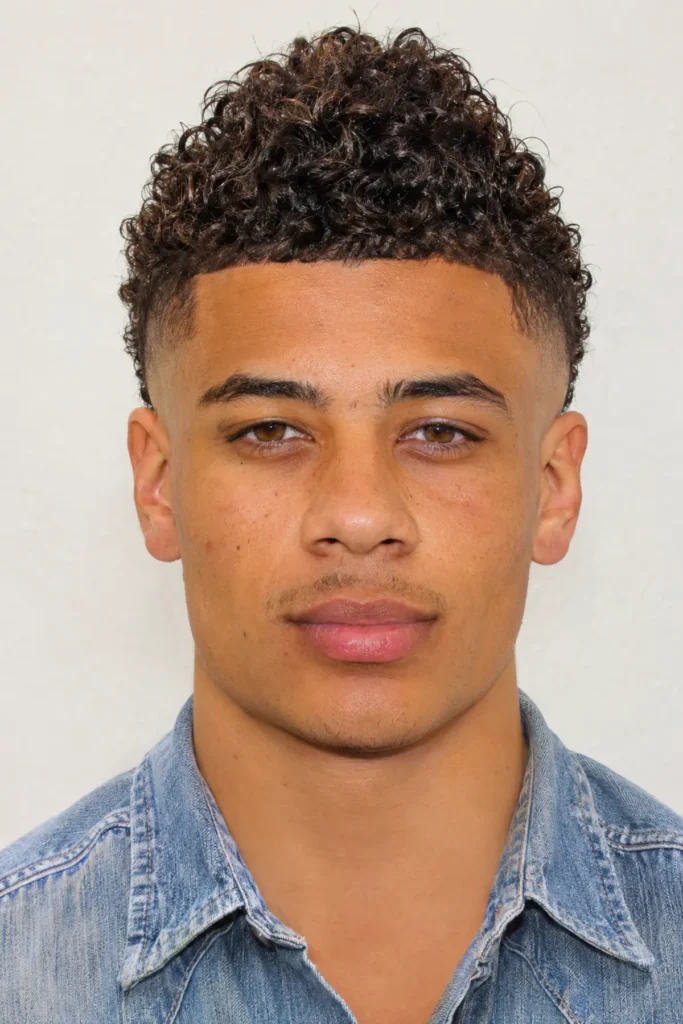
A strip of longer hair runs down the center while the mid burst frames both sides in a rounded arc, a combination some barbers call a South of France cut. It’s a bold look that suits thick straight, wavy, or curly hair that can stand up on its own. A strong hold clay or gel and a quick blow dry take about five minutes, so the difficulty is moderate.
The width and height of the strip are the key decisions, so the barber should hear both before the clippers come out. Symmetry shows fast, which means frequent visits keep it looking right. Fine hair tends to collapse, and strict grooming rules at some workplaces may rule it out. Grown out, it becomes a wide textured top that can be reshaped into a crop.
13. Faux Hawk
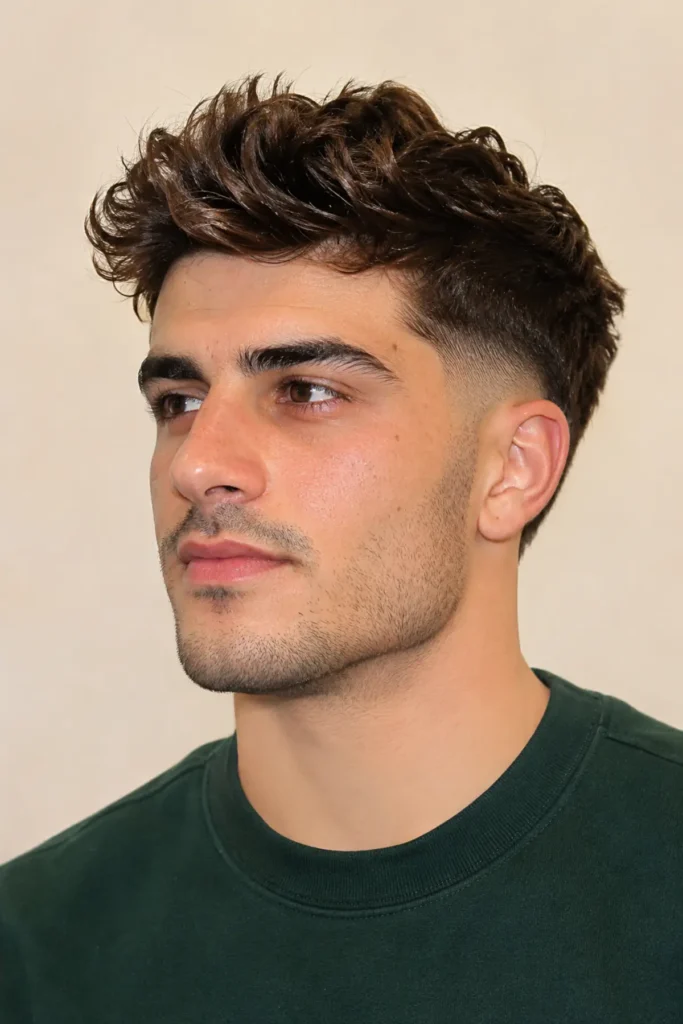
Think of the faux hawk as the mohawk’s easygoing sibling. The center lifts, but the sides aren’t removed as dramatically, so it’s easier to wear in conservative settings. It suits straight and wavy hair with medium density. A light paste lifts the center in about two minutes, so the difficulty is low to moderate.
Asking for a center that’s longer than the sides, with a smooth blend instead of a hard line, creates the softer result. Fine hair may need more product than it can comfortably hold, and very curly hair can read as a tall top rather than a hawk. It grows out easily, because the top simply gets fuller.
14. Mullet
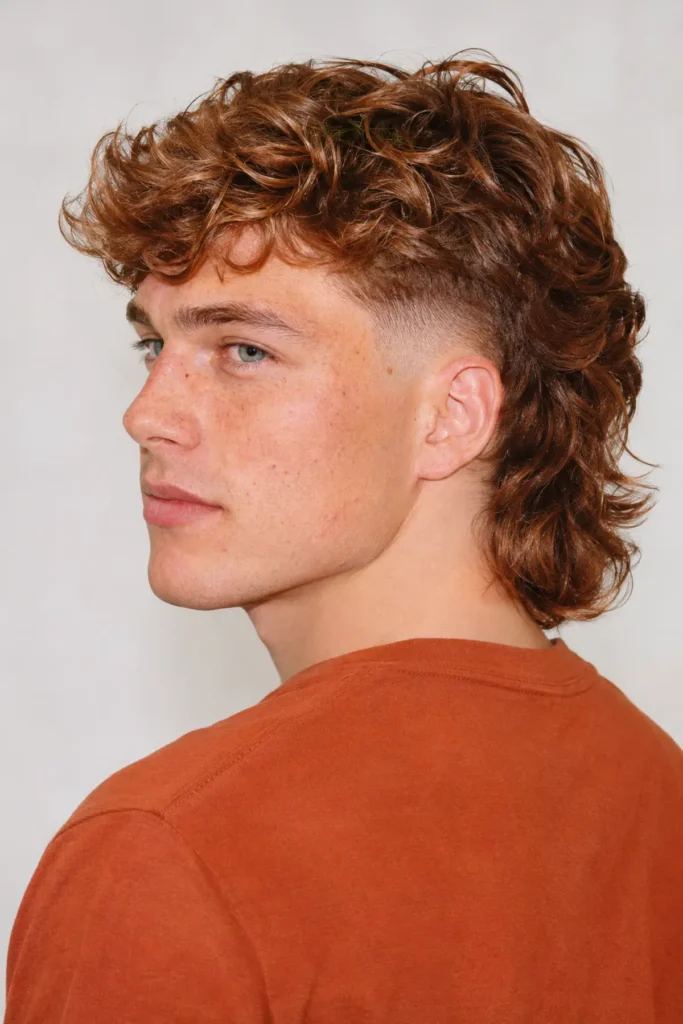
The mid burst is a natural partner for a mullet because the arc fades around the ear while leaving length at the back, exactly where a straight fade would cut it away. The burst fade mullet guide shows plenty of versions. It suits wavy, curly, and thick straight hair, and styling takes about three minutes with a light cream, plus a diffuser for curls. The difficulty is moderate.
Since the back stays long, the barber needs to know exactly how long, ideally with a photo taken from behind. The fade itself needs attention more often than the back does. Fine hair can look stringy, and strict dress codes may rule it out. At about half an inch of growth per month, according to the American Academy of Dermatology, adding three more inches at the back takes roughly six months.
15. Curly Top
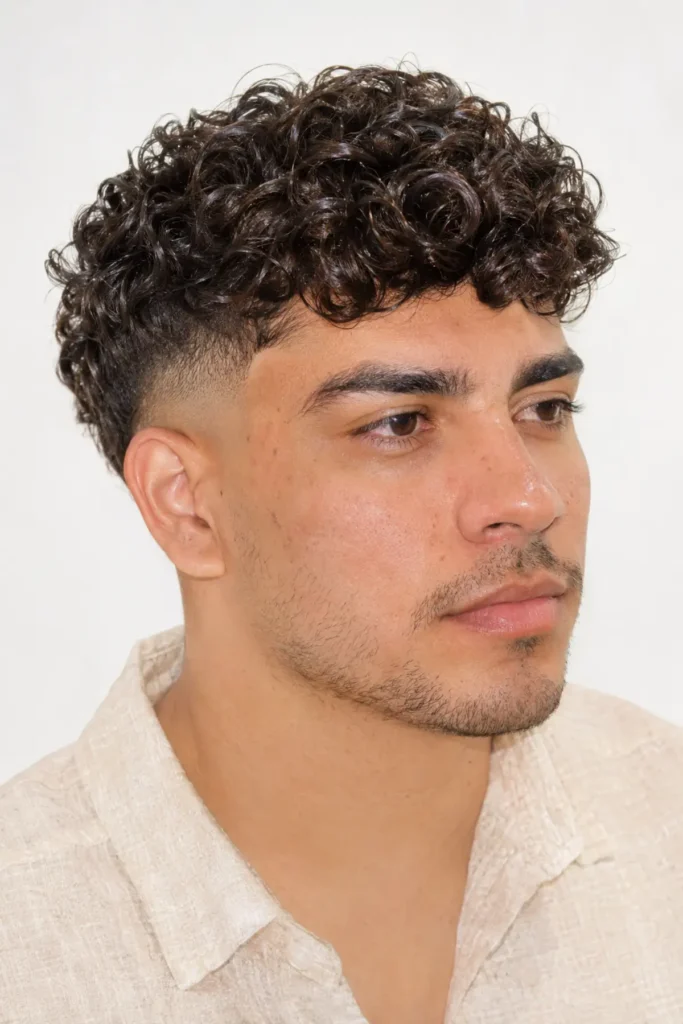
Here the curls get the spotlight. The mid burst keeps the sides tight and removes bulk, so the curl pattern on top reads clearly instead of looking like a cloud. It suits medium to thick density, and the burst fade haircuts for curly hair guide has plenty of variations to browse. A curl cream on damp hair, a scrunch, then air drying or a diffuser on low heat takes about five minutes. The difficulty is moderate.
Curls spring up as they dry, so setting the arc height on dry hair avoids a result that sits higher than planned. Three to four inches on top lets the pattern show, and cutting much shorter can flatten it. Men whose skin reacts to close trimming can ask for a shadow finish. It grows out as a fuller curly top.
16. Wavy Top
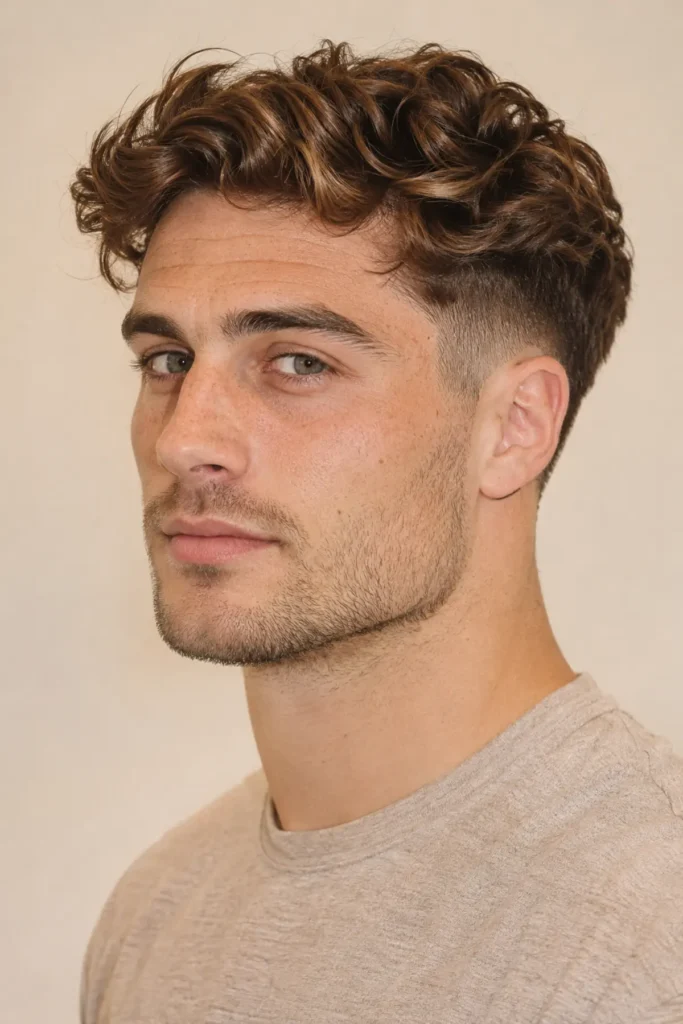
Natural waves move freely on top while the mid burst keeps the sides clean, which gives a relaxed but tidy shape that suits most settings. It works on wavy hair with medium to thick density. Sea salt spray on damp hair and an air dry take about three minutes, so the difficulty is low. Many men later let it grow into one of the medium length haircuts for men.
Leaving three to five inches helps the waves show. Very fine waves can fall flat, and humid weather adds frizz, so a light cream helps. Heavy wax tends to drag waves straight, which defeats the point. As it grows, the waves gain weight and shape.
17. Coily Top, Short Afro, or Twists
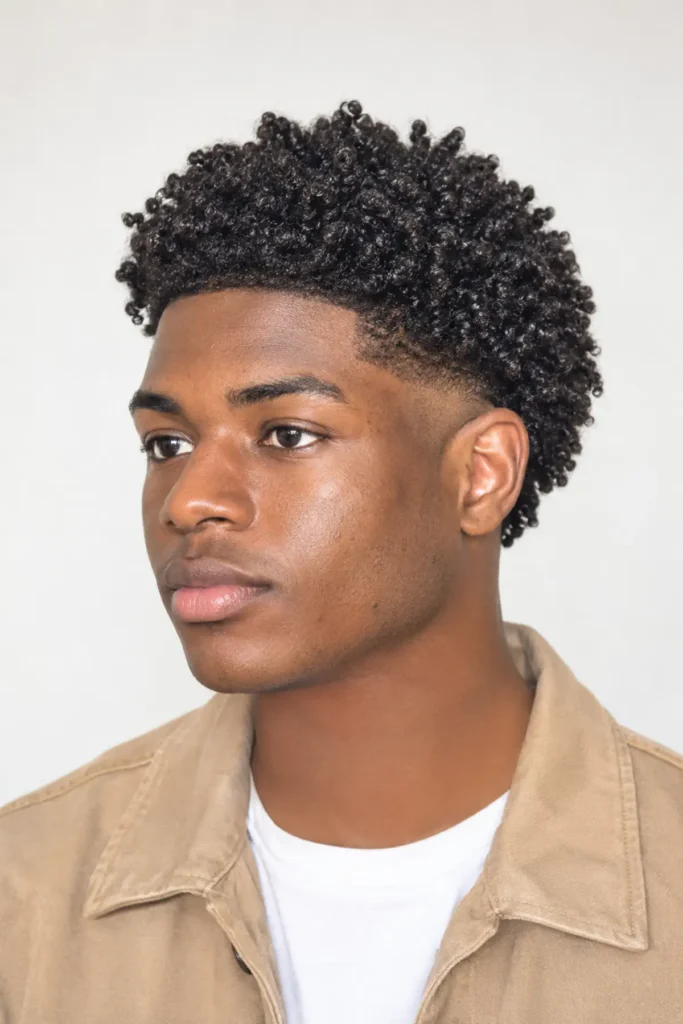
The arc frames the rounded shape of a short afro or twists while the shortest point behind the ear stays crisp, so the contrast between texture and edge does the styling. It suits coily hair of any density. A leave in conditioner and a light oil keep the top moisturized between visits, and the styling itself is quick, so the difficulty runs low to moderate.
Coily hair shrinks a lot, so the arc should be judged at natural resting length, not stretched. A shadow finish helps men who are prone to razor bumps, and a barber who cuts coily textures regularly makes a noticeable difference. Skin finishes soften soonest, so they need attention sooner. Growing it out builds a larger, rounder shape.
18. Long Top and Man Bun
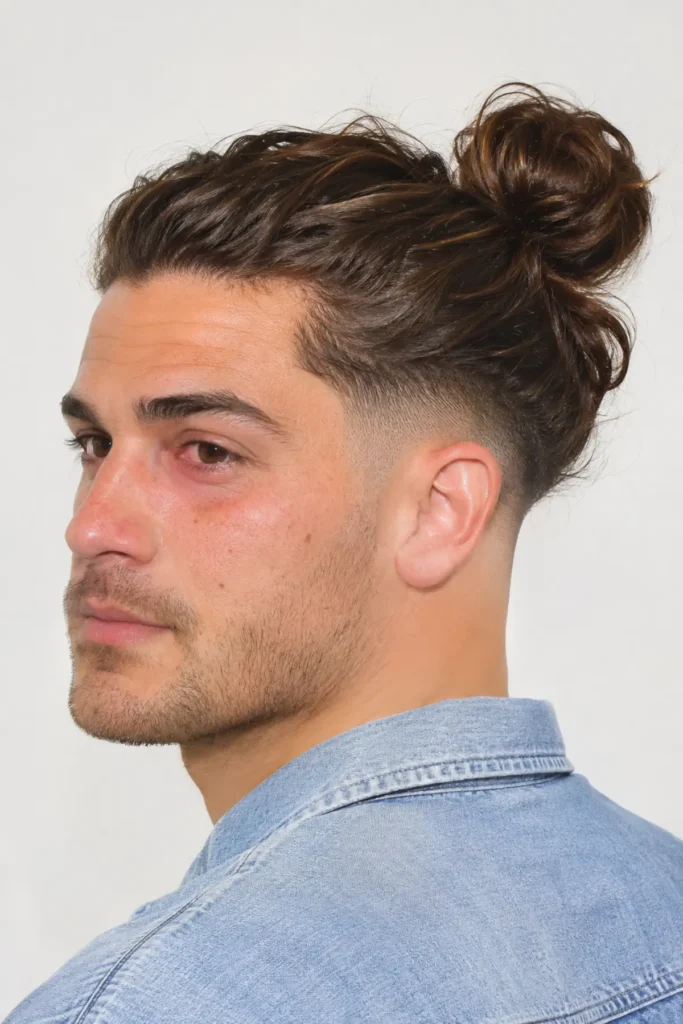
A longer top can be worn down, tied back, or twisted into a bun above a mid burst, and the shaved arc keeps hair off the ears, which makes ties and caps easier. It suits straight, wavy, and thick hair with at least five or six inches on top. The man bun hairstyles guide covers the options, and the wolf cut for men page shows similar texture. Styling is low to moderate in difficulty.
Because the top matters more than the arc here, visits can stretch out a little. The catch is the grow out: at half an inch per month, every extra inch takes about two months. Fine hair can look sparse when tied back, so layers tend to work better than one length.
19. Beard Blend
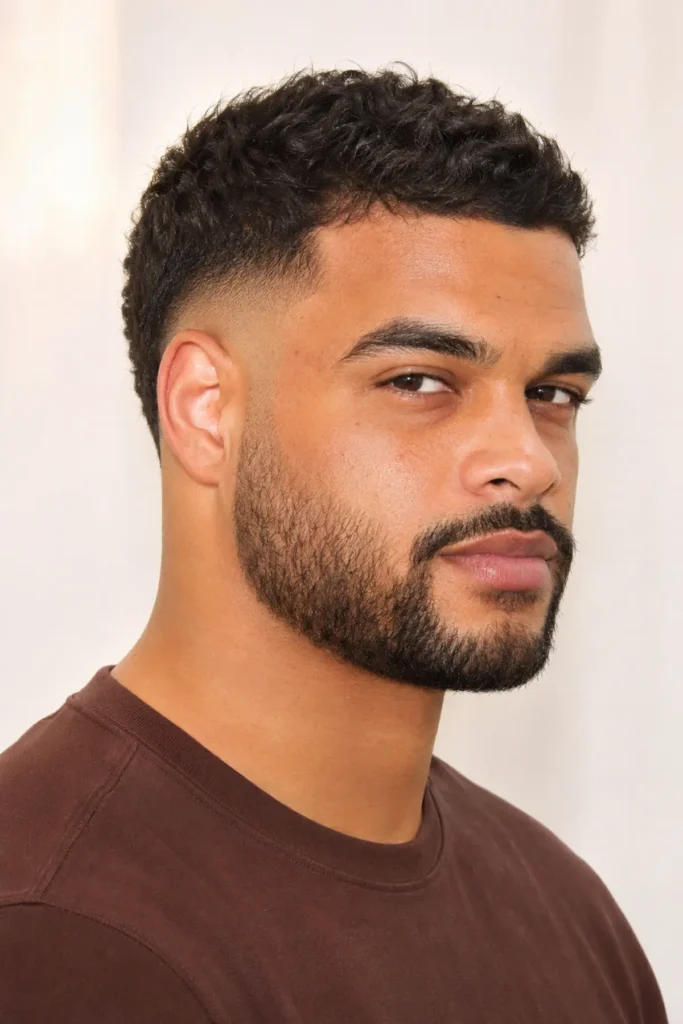
The mid burst melts into the sideburns and beard, which creates one continuous shape instead of two separate haircuts. It suits full beards, boxed beards, and heavy stubble, and the buzz cut fade with a beard page has more pairings to look at. A little beard oil and a brush finish the styling, so the difficulty is low.
The detail that matters most is the sideburn blend, so the barber should hear the words fade straight into the beard to avoid a visible gap. Patchy beards show the contrast more, and a shadow finish blends better. Beard lines need attention more often than the arc does. It grows out neatly because the beard and the sides follow the same rhythm.
20. Soft Taper Finish
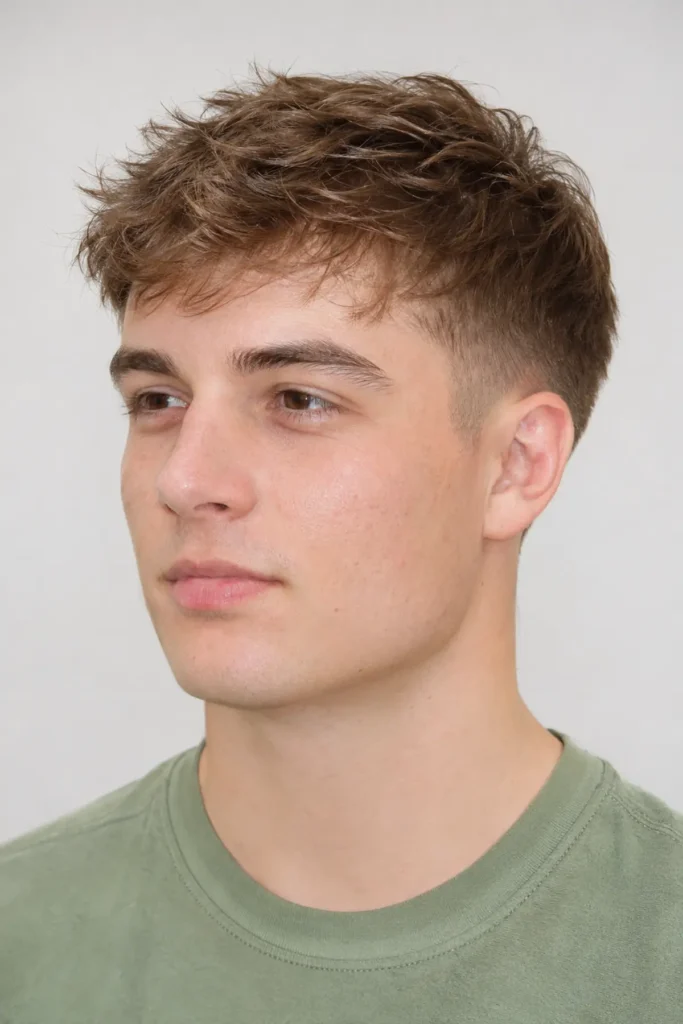
The arc stays gentle here, with a shadow or short taper at the shortest point instead of bare skin, so the contrast stays low. It suits fine, thinning, or graying hair and men who want a conservative look. The short haircuts for men with fine hair guide pairs well with it. A pinch of texture powder at the roots handles the styling, so the difficulty is low.
Barbers call this a burst taper when the shortest point stops at a guard instead of going to skin. With no bare skin to show regrowth, rebooking can stretch toward three or four weeks. It won’t hide a receding hairline or a thin crown, so a slightly longer, textured top works better than a tight crop. Growing it out is the easiest of all twenty.
What to Tell the Barber
Ordering by name alone is where most mix ups begin, because mid burst fade only settles the height and the shape. A clear request adds the rest of the five choices: how tight the arc sits, the finish at the shortest point, the nape, and the top. In the chair, it can sound like this:
Mid burst fade, curved tight around both ears, shadow finish at the shortest point, three inches left on top, nape kept long, and sideburns blended into the beard. Side and back photos attached.
Photos do more talking than adjectives. A front facing photo says almost nothing about the arc, so a side shot and a back shot of hair with a similar texture and density are worth saving ahead of time. A picture of the client’s own hair on an ordinary day helps too, since it shows growth direction and any stubborn cowlicks.
Guard numbers deserve a quick note. They set length only, not where the fade starts or how it curves. Wahl’s standard guide combs leave these lengths:
| Guard | Length left | Typical role in a burst |
|---|---|---|
| Number 1/2 | 1/16 inch (1.5 mm) | Closest guarded finish near the ear |
| Number 1 | 1/8 inch (3 mm) | Short shadow at the shortest point |
| Number 1.5 | 3/16 inch (4.5 mm) | Softer shadow or taper start |
| Number 2 | 1/4 inch (6 mm) | Taper finish or short buzz top |
| Number 3 | 3/8 inch (10 mm) | Longer buzz top or higher blend |
| Number 4 | 1/2 inch (13 mm) | Crew cut length or blend into the top |
Before paying, a quick check with a hand mirror catches most problems:
- Both ears match in height and curve, with no flat spots.
- The blend between the fade and the top looks smooth, with no harsh line.
- The nape looks the way it was requested.
- Sideburns, temples, and edges are even on both sides.
- The top has the requested length and texture.
- The skin looks calm, with no redness or nicks around the arc.
How to Style a Mid Burst Fade
The sides mostly take care of themselves, so styling comes down to the top. Product belongs on the top only, because product dragged into the arc makes the blend look patchy.
| Top length | Go to product | Time | Technique |
|---|---|---|---|
| Under 1 inch | Scalp moisturizer only | 0 minutes | Wash and go |
| 1 to 3 inches | Matte clay or texture powder | 2 minutes | Work through dry hair with the fingers |
| 3 to 5 inches | Cream, sea salt spray, or pomade | 3 to 5 minutes | Towel dry, then blow dry if needed |
| 5 inches or more | Light cream or leave in conditioner | 3 to 5 minutes | Air dry, then comb back or tie |
| Curly or coily | Curl cream or gel on damp hair | 5 minutes | Scrunch and diffuse on low heat |
Washing two to three times a week with a gentle shampoo keeps buildup out of the fade zone. On fine hair, heavy products flatten the very volume the contrast is meant to highlight.
Upkeep, Timeline, and Cost
How Long It Stays Sharp
Barbers and style guides most often put the sharp window between two and four weeks, and the math backs that up. Scalp hair grows about half an inch per month, according to the American Academy of Dermatology, so a skin level arc carries roughly a quarter inch of regrowth after two weeks and about half an inch after four. That works out to something close to a number 2 guard length at two weeks and a number 4 at four weeks, which is why skin finishes soften first while shadow and taper finishes hold longer. The week by week estimates below are that math in plain language.
| Week | What usually happens |
|---|---|
| Week 1 | The arc is crisp and the shortest area is smooth |
| Week 2 | Skin finishes show about a quarter inch of regrowth around the ear |
| Week 3 | The arc starts to blur and the line between fade and top softens |
| Week 4 | Regrowth reaches roughly half an inch, so it is time to rebook |
Between visits, a quick trimmer cleanup of the neckline every seven to ten days helps. The arc itself is better left to the barber, since a curve cut by hand is hard to match on both sides.
What a Mid Burst Fade Costs
StyleSeat’s men’s haircut price data puts the national average for a men’s haircut at about $29, with fades typically running $30 to $40, while Booksy lists $30 to $65 for a classic or fade cut. Where the chair is makes a big difference: StyleSeat reports a New York City average of $118 against $26 in Milwaukee. A tip of 15 to 20 percent is standard. The table below shows the yearly math for each rebooking rhythm, before tips.
| Rebooking rhythm | Visits per year | At $30 | At $40 | At $65 |
|---|---|---|---|---|
| Every 2 weeks | 26 | $780 | $1,040 | $1,690 |
| Every 3 weeks | 17 | $510 | $680 | $1,105 |
| Every 4 weeks | 13 | $390 | $520 | $845 |
A shadow or taper finish stretches the gap between visits, which is the simplest way to bring the yearly total down.
Skin and Scalp Care
Razor bumps, known medically as pseudofolliculitis barbae, happen when closely cut hairs curl back into the skin. Mayo Clinic’s folliculitis guidance says they mainly affect people with curly hair who shave too close and show up most on the face and neck, and it suggests avoiding the closest shave by using an electric razor or a guarded blade. Mayo also advises seeing a health care provider if symptoms last beyond a week or two of self care. For men who get bumps easily, a shadow finish at the nape and arc is a sensible way to lower the odds, and sunscreen on skin exposed by a short finish is an easy summer habit.
Mistakes to Avoid
- Ordering by name only. Height and shape leave the finish, nape, and top undecided.
- Skipping the back photo. The nape treatment is invisible in a front facing picture.
- Choosing skin on sensitive skin. A shadow finish is gentler for razor bump prone skin.
- Ignoring density. Fine hair usually needs a softer finish and more weight above the arc.
- Waiting past four weeks. The curve loses its shape and the cut starts to look unplanned.
- Dragging product into the arc. Wax and clay in the fade zone make the blend look patchy.
- Forgetting the sideburns and beard. Without a clear instruction, a visible gap can appear.
Growing a Mid Burst Fade Out
At about half an inch per month, six inches of growth takes a year, and one extra inch takes roughly two months. The easiest path is to stop refreshing the arc and let the sides soften into a taper while the top keeps its shape with regular trims. The in between phase is where most men give up, so asking the barber for a soft taper at each visit beats leaving it untouched. Curly and coily hair look shorter than they are because of shrinkage, so measuring beats judging by eye.
Mid Burst Fade FAQs
What is a mid burst fade?
A mid burst fade is a haircut where the sides fade in a half circle around the ear, starting about halfway up the side of the head. The hair around the ear is shortest, the top keeps its length, and the nape is usually left longer. It pairs with almost any top style.
How should a man ask a barber for a mid burst fade?
A client should name the cut, then fill in the details: mid height, how short the shortest point goes (skin, shadow, or a guard), how much length stays on top, what happens at the nape, and how the sideburns or beard blend. A side photo and a back photo remove most of the guesswork.
What is the difference between a mid burst fade and a mid drop fade?
Both can start at the same height, but the shape differs. A burst fade curves around the ear and usually leaves the nape longer. A drop fade dips down behind the ear toward the neckline and keeps fading around the back. Barbers use the terms loosely, so a photo settles it.
Is a mid burst fade the same as a mullet or a mohawk?
No. Burst describes the sides, while mullet and mohawk describe the top and back. They are often combined because the arc leaves length where a mullet or mohawk needs it, but a mid burst fade also works with crops, curls, buzz cuts, and slick backs.
How often does a mid burst fade need a touch up?
Most barbers suggest every two to four weeks. Skin finishes soften soonest, often around two weeks, while softer taper finishes stretch toward four. Hair grows about half an inch per month, so a skin level arc reaches roughly a quarter inch of regrowth after two weeks.
Does a mid burst fade work on curly or coily hair?
Yes. The tight arc removes bulk from the sides so curls on top stand out. Curls shrink when dry, so the arc height is best judged on dry hair. Coily hair benefits from a barber who cuts that texture often, and a shadow finish can help men prone to razor bumps.
Can a mid burst fade work with thinning or receding hair?
It can work, but it will not disguise thinning. A soft taper finish and a low to mid arc keep contrast gentle, and a slightly longer, textured top avoids exposing scalp. A barber can advise whether a burst taper or a classic taper suits the pattern.
Is a mid burst fade professional enough for an office?
Often, yes, when the finish stays restrained. A shadow or taper finish, a mid arc, and a tidy top such as a side part or crew cut look polished. Skin finishes, hard parts, and designs read bolder, so a written dress code is worth checking.
How much does a mid burst fade cost, and how much should be tipped?
StyleSeat reports a national average of about $29 for a men’s haircut and $30 to $40 for a fade, while Booksy lists $30 to $65 for a classic or fade cut. Tips of 15 to 20 percent are standard. Prices vary by city and barber experience.
How long does it take to grow out a mid burst fade?
Hair grows about half an inch per month according to the American Academy of Dermatology, so every inch takes roughly two months. Because the top is cut independently, it can grow into a mullet or a longer style while the sides stay tidy or are simply grown out.
Can a man cut a mid burst fade at home?
It is harder than a straight fade because the arc is curved and must match on both ears. Beginners usually get the best result from a professional first, then use a trimmer for neckline cleanup between visits. Mistakes at the arc are difficult to hide.
Final Thoughts
A mid burst fade rewards a little preparation. Clear words, a side photo, a back photo, and a realistic plan for rebooking turn a good idea into a great haircut. After that, the top is the fun part: crop, curls, mullet, quiff, or a soft taper finish for a calmer look. For more fade heights and shapes to compare, the mid fade haircuts for men guide is a handy next stop.
2 thoughts on “20 Mid Burst Fade Haircut Ideas for Every Hair Type and What to Tell Your Barber”